By Alexander Merz · Published on · Details checked on 14 September 2026
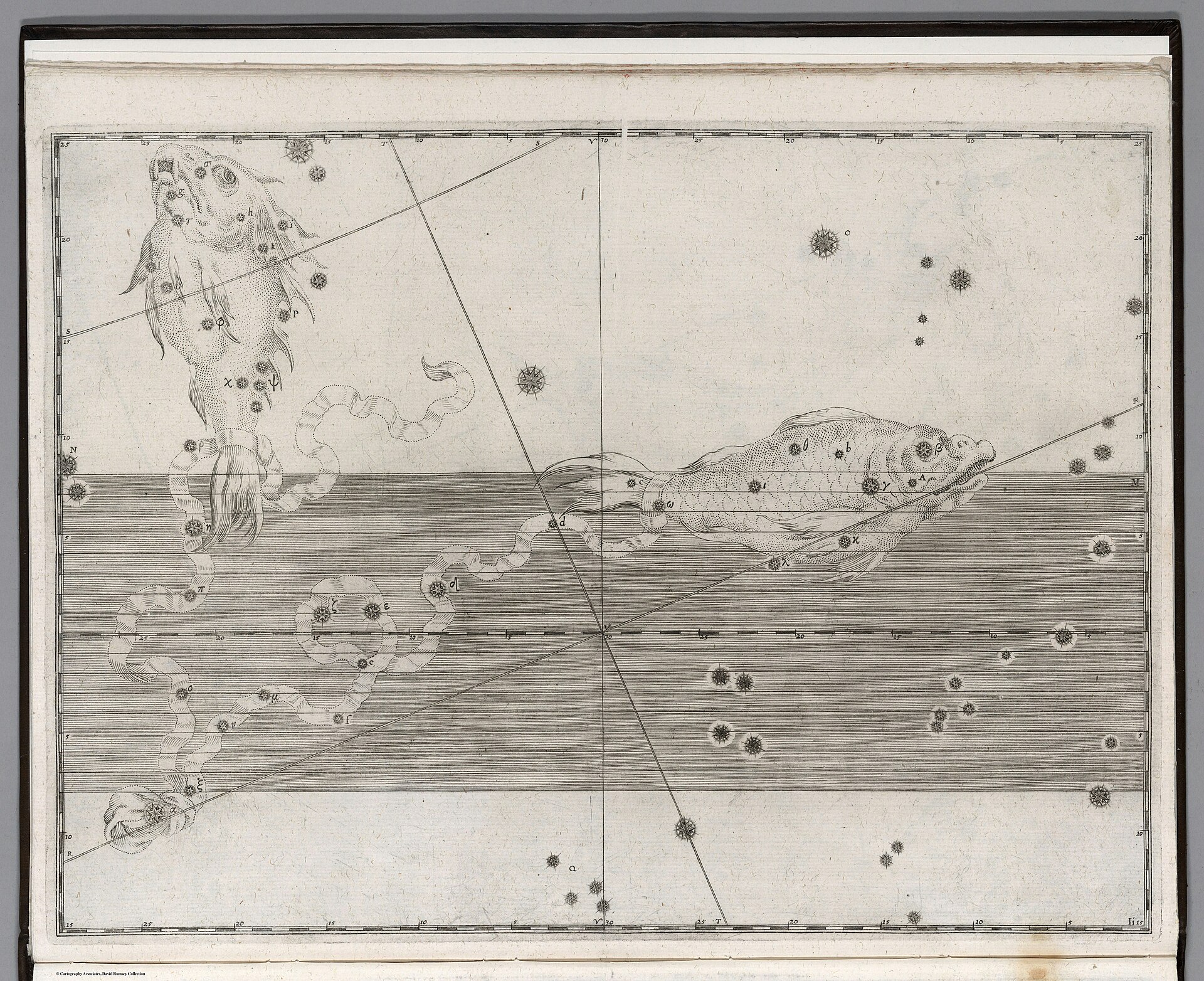
In Latin, the stars of the constellation Pisces are also called “Pisces.” Accounts from Greek mythology tell of the flight of the Olympian gods and their pursuit by Typhon, the monster born of Gaia. Two fish rescued Aphrodite and her son Eros and, in gratitude, were allowed to wander the sky as a sign for all eternity.
From the Myth of the Constellations to Science
The less people knew about their surroundings, the stronger grew the urge – of individuals as well as of groups thinking together – to explain things rationally. In the course of scientific progress, the influence of “our” signs on human life and endeavour suddenly seemed doubtful. Yet, like all constellations, the sign of Pisces has remained an ancient attempt – still successful today – to create order through fixed points of reference, especially when travelling.
Until the 17th century, astrology was regarded as a recognised natural science. Healing methods were calculated according to the position of the stars and the Moon, and the course of the year was foretold, in deep faith, from particular phenomena. The constellation Pisces was considered one of the most inspiring celestial figures and was frequently depicted in art.
Galileo, Copernicus and Kepler did indeed turn away from superstition. Yet at least Kepler still granted the astrology of his time the scientific value of prophecy. He cast horoscopes for payment. Astronomy finally established itself as an independent, purely rational science in Newton’s day, in part thanks to his inventions.
The Star of Bethlehem
Beneath the coordinates of the constellation Pisces on the ecliptic, the “Great Conjunction” (every 854 years) took place in 7 BC, during which the gas giants Jupiter and Saturn met three times in a single year. Historians see in the depiction of the “Star of Bethlehem” (alongside many other attempts at interpretation) that rare conjunction of fixed stars, in the course of which Venus and Mars could also be seen aligned in the constellation Pisces (back then without telescopes). The present-day arrangement of the constellation and its deep-sky objects has, however, changed compared with the ancient configuration owing to the motion of the stars.
As with most constellations, various ancient civilisations devised their own myths about the constellation Pisces as well. One thing is common to all the stories: the stellar configuration of the ecliptic stands for beneficial qualities such as rain or love. Among the Babylonians, the stars of the “Fish” are associated with their goddess of love “Ishtar,” while among the Greeks it is Aphrodite and her son Eros. The Romans regarded the two parts of the constellation as a pair of fish. Those stars, double stars and deep-sky objects of the constellation that lie close to the ecliptic are especially well visible through a telescope.
Where in the Sky Can the Constellation Pisces Be Found?
The stars linked to the sign of Pisces are fully visible at our Central European latitudes in autumn. The Sun passes through all of these stars between 12 March and 19 April each year. You will find this large zodiac sign more easily by observing the neighbouring constellations Aquarius, Triangulum, Andromeda and others. The widely distributed stars between the lines lie at right ascensions 22h 51m 17s to 2h 06m 40s and declinations −6° 18′ 27″ to +33° 40′ 55″.
The vernal equinox point (ecliptic), the origin of all right ascension and declination values in the sky, crosses the constellation Pisces at the celestial equator. From the changes in stellar positions, astronomers have calculated that around the year 2597 the ecliptic will leave the constellation and move into “Aquarius.”
The Ecliptic and the Constellation Pisces
The ecliptic is an imaginary astronomical line around the Earth that traces the Sun’s path over a calendar year as a circle against the background of the fixed stars. Constellations near this line are also known as “signs of the zodiac.” This name comes from the fact that, at certain times each month, the Sun, the Moon and the planets travel through each of the zodiac signs – for example through the constellation Pisces from 12 to 19 April each year. The deep-sky objects of the “Fish” are a popular observing target through the telescope. Its western neighbour on the ecliptic is the constellation Capricornus – at 413.9 square degrees, the smallest zodiac constellation of all.
Visible Stars in the Constellation Pisces
Although the region of the constellation “Pisces” contains only very few deep-sky objects, its stars themselves form a long row of bright single and double stars. Many of them are so clearly visible through a telescope because they are fairly close to Earth, in some cases less than 100 light-years away. The most famous variable star of this constellation of the ecliptic is probably “19 Piscium,” a red giant with 700 times the Sun’s diameter, ranking among the largest stars discovered so far.
Deep-Sky Objects – Spiral Galaxies and Supernovae
In the constellation Pisces, the few deep-sky objects that reside there are easy to locate. Anyone who owns at least a medium-sized telescope and good astrophotography equipment can observe face-on galaxies there, their tightly wound spiral arms, star-burst regions and dusty emission areas. In the spiral galaxy M74 of the constellation Pisces, 2 supernovae occurred within 6 months over the past 10 years.
Spiral Galaxy Messier 74
The spiral galaxy M74 is the brightest of 7 galaxies that interact more or less strongly with one another as a galaxy group in the constellation Pisces. The same group also includes the deep-sky object NGC 660, a polar-ring galaxy, as well as 5 irregular galaxies. The spiral arms of the group’s largest member, M74, appear especially beautiful in large telescopes. Earthbound observers look directly at this star system of around 100 billion stars from the front (“face-on”). Serving as objects of study are not only the supernovae of recent years but also observations of hot, blue star-forming regions and an ultra-luminous X-ray source, behind which an intermediate-mass black hole of an estimated 10,000 solar masses is thought to be the cause.
M74 is a true “hidden beauty” among the spiral galaxies of the constellation Pisces. Because of its low surface brightness, it is visible without a telescope only in areas free of light pollution and on truly clear, dark nights. Experienced deep-sky observers recommend letting the eye adjust to the darkness for a while before searching for its position, so that it can better distinguish the faint light from its surroundings. Through prism binoculars, however, it appears as no more than a hazy patch. M74 became well known in 2002, when a so-called hypernova (a rare Type Ic supernova) occurred there.
Hypernova SN 2002ap and Supernova 2003 dg
2 stellar explosions brought the spiral galaxy M74 increased research and media attention 10 years ago. SN 2002ap, the very rare type of a hypernova (a particularly energetic stellar explosion), was observed by a Japanese amateur astronomer. 6 months later, a large Australian telescope discovered the equally spectacular supernova SN 2003 dg. Both events took place in the constellation Pisces, in the southern spiral arm of the deep-sky object M74, and were bright enough for a while to be seen even in medium-sized telescopes.
Besides the especially bright spiral galaxy M74, the two other galaxies in the constellation Pisces are at most faint little patches. Yet they too keep deep-sky observers on tenterhooks, since they contain very active regions with supernovae, bright cores and star-forming areas. Through the telescope, both specimens reveal more or less identifiable spiral structures.
Spiral Galaxy NGC 488 and the Theory of Spiral-Arm Formation
The deep-sky object NGC 488 is one of the very tightly wound spiral galaxies that can be observed in the constellation Pisces. For William Herschel and his then still comparatively simple telescope, it was no more than a distant, faint nebula that did not move like a comet. Later technology revealed there a very tightly wound spiral structure with a bluish shimmer as well as a bright, yellow galactic core. In 1976, a supernova was observed in the south-western core region of this spiral galaxy.
Although the spiral galaxy NGC 488 is between 90 – 100 light-years from Earth, the latest telescopes reveal fascinating facts about this deep-sky object. Measurement of the stellar velocity showed that the stars “race” around the core at an impressive 360 kilometres per second (!). For comparison: the speed of the stars around the centre of our Milky Way is “only” 220 km/s. As researchers have repeatedly suspected, the spiral structure is not formed by the kinematic motions of the stars but is the result of star formation in molecular clouds. The bluish shimmer comes from massive, very hot stars that can “die” in a supernova after only a few million years of life.
The Galactic “Pin” NGC 524
With an angular extent of just 3 arcminutes, the deep-sky object NGC 524 appears only as a bright “little dot” when viewed through a medium-sized telescope. Despite the actually favourable face-on position of this lenticular galaxy in the constellation Pisces, the rings or arcs and the lens-shaped outline are only faintly discernible. Owing to its distance of 130 million light-years from Earth, however, spirals can be identified only indistinctly even with space telescopes, which is why a classification as a spiral galaxy has not yet been possible. Nevertheless, there was a distinctly flaring supernova in the galaxy in both the year 2000 and 2008.