By Alexander Merz · Published on · Details checked on 14 September 2026
Capricornus is the constellation almost no one knows – even though almost everyone knows its name. As a zodiac sign it is omnipresent; as a figure in the sky it is a pale, broad triangle low above the southern horizon, whose brightest star barely reaches 2.9 mag. Not a single star of the constellation Capricornus ranks among the hundred brightest in the sky. Anyone who wants to find it anyway needs no eagle eyes, but a sight line – and that line begins at one of the most conspicuous stars of summer.
And it is worth it: Capricornus is the smallest of the twelve zodiac constellations, it hosts a star that eclipses itself every 24.5 hours, two double stars that can be split without a telescope – and about 2,000 years ago it gave its name to the Tropic of Capricorn. The fact that it no longer stands there at all today is one of the finer stories in the sky.
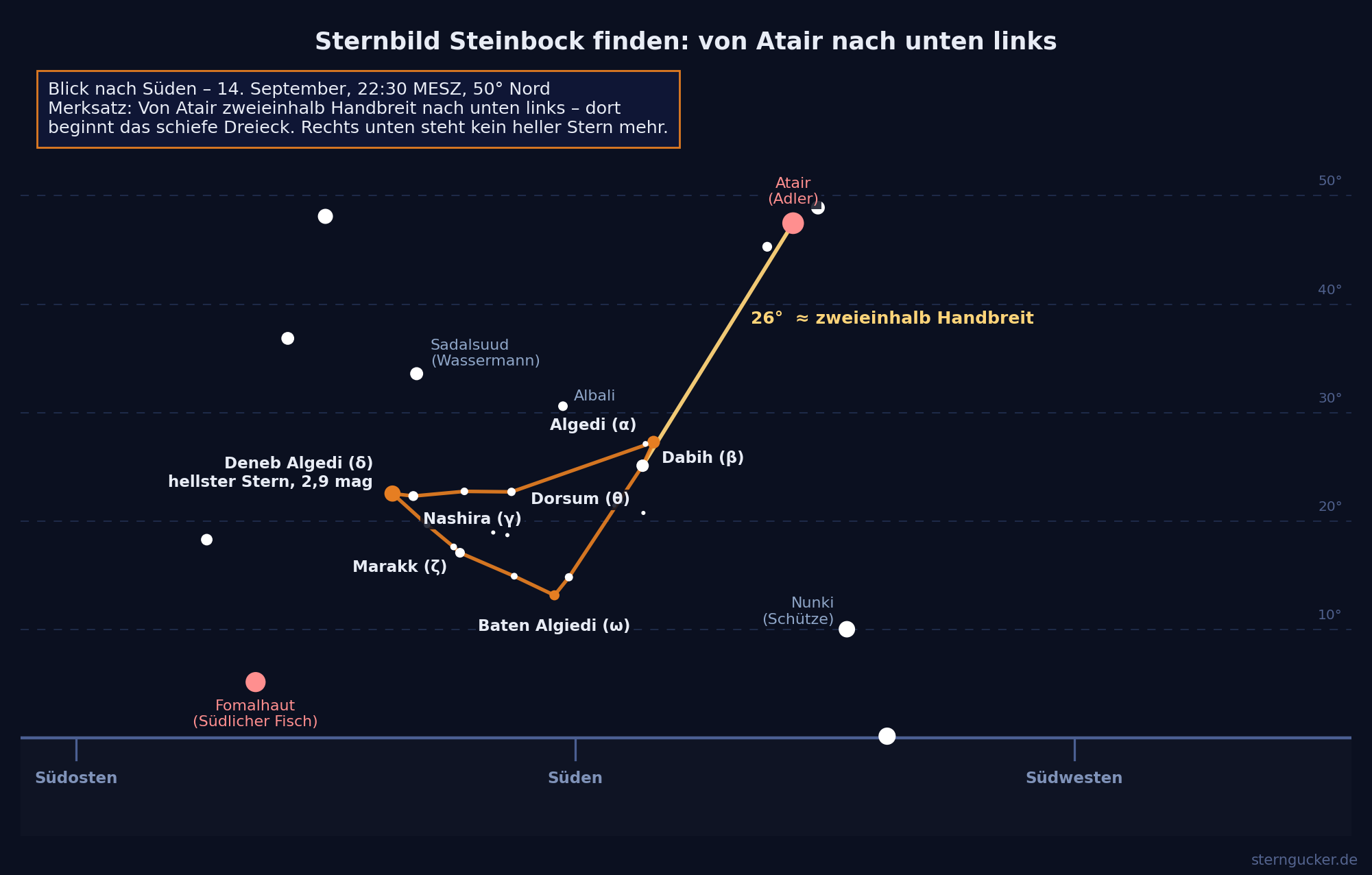
⚡ The quick answer: Capricornus (Latin Capricornus, “goat’s horn”) is a late-summer and autumn constellation. You find it by going from the bright star Altair in the Summer Triangle about 26 degrees – roughly two and a half hand-widths at arm’s length – southward. There stands a broad, flat triangle of 3rd- and 4th-magnitude stars.
Best time: August to mid-November. On 14 September the middle of the constellation stands due south at around 10:30 p.m. CEST. Even then the brightest star reaches only 20° (Hamburg) to 27° (Zurich) above the horizon – an unobstructed view to the south is a must.
What makes it special: at 413.9 square degrees, Capricornus is the smallest zodiac constellation. Its brightest star Deneb Algedi is an eclipsing variable, and the globular cluster M 30 is its only Messier object.
Finding the constellation Capricornus: the sight line from Altair to the south
The usual method – “look for the figure” – reliably fails with Capricornus. Its brightest stars lie at 2.9, 3.1 and 3.6 mag. For comparison: the faintest star in the Big Dipper has 3.3 mag. Capricornus is therefore not invisible, but it has no pattern that jumps out at you, and on top of that it stands low. In the city it is practically hopeless without aids. What works: measuring off a distance from a reliable, bright star.
The starting point in the sky: Altair in the Summer Triangle
In August and September the Summer Triangle stands high in the south in the evening. Its southernmost corner is Altair in the constellation Aquila, a white star of magnitude 0.8 – unmistakable, because it is flanked by two fainter stars that form a short straight line with it. These three stars are called Tarazed, Altair and Alshain, and they are the only starting point you need for Capricornus.
From Altair you go downward, i.e. toward the south to south-southeast. The distance is about 26 degrees. When you stretch out your arm, your clenched fist is about 10 degrees wide; 26 degrees therefore amount to a good two and a half fist-widths. At the end of this stretch you stand right in the middle of Capricornus – more precisely at its western tip, where the two stars Algedi and Dabih stand close together.
The check in the south: Fomalhaut as a counter-test
If you are unsure, a second anchor helps. Low in the south, well below and to the left of Capricornus, stands Fomalhaut – at 1.2 mag the only truly bright star in this region of the sky and therefore hard to mistake. In Central Europe it rises only a few degrees above the horizon and often flickers there in colours. If you mentally draw a line from Altair to Fomalhaut, then Capricornus lies roughly halfway, offset slightly to the right (west). Between Capricornus and Fomalhaut lies the similarly pale constellation Aquarius.
The hand-width method
At arm’s length, the following roughly correspond in the sky: little finger ≈ 1°, three fingers side by side ≈ 5°, clenched fist ≈ 10°, spread hand from thumb to little finger ≈ 20°. This works for almost everyone, because larger hands go with longer arms. For the stretch Altair → Capricornus you therefore need a good two and a half fist-widths, or a spread hand plus half a fist.
The figure of Capricornus: a flat triangle, not a goat
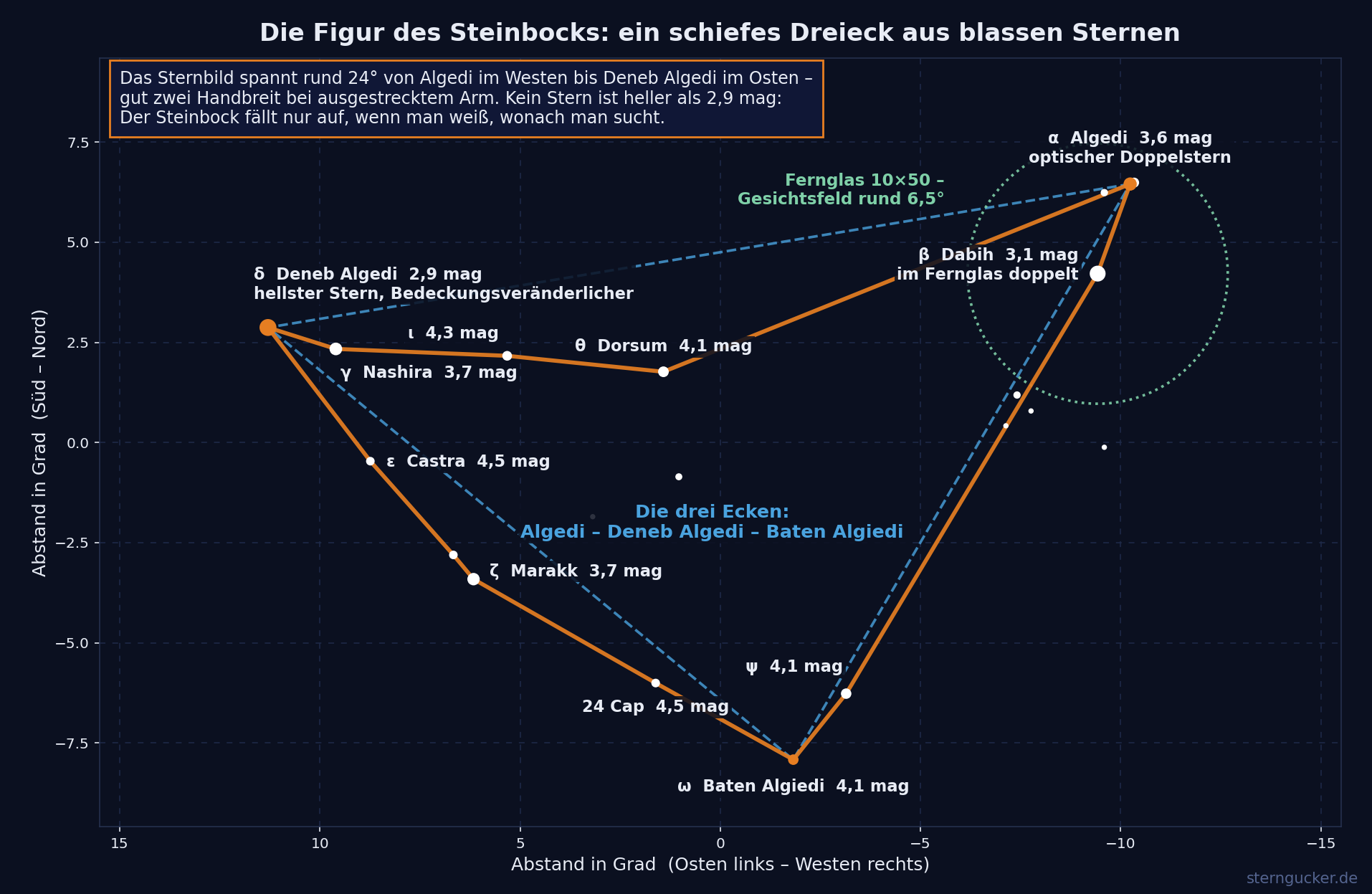
Once you have found the spot, you see no animal. What you see is a broad triangle sagging downward – some compare it to a boat, others to a spread-out smile or a bathtub. The western tip is formed by Algedi and Dabih, the eastern tip by Deneb Algedi and Nashira, and the southern tip sags downward with Baten Algiedi and Omega Capricorni. From one tip to another it is about 20 degrees – the constellation is thus wider than a spread hand.
Capricornus at a glance: the key facts of the constellation
| Feature | Value |
|---|---|
| Latin name | Capricornus (“goat’s horn”), genitive Capricorni |
| IAU abbreviation | Cap |
| Area | 413.9 square degrees – rank 40 of 88 and the smallest zodiac constellation |
| Brightest star | Deneb Algedi (δ Cap), 2.85 mag |
| Neighbours | Aquila and Aquarius to the north and east, Sagittarius to the west, Microscopium to the south |
| Best visibility | August to mid-November, culmination of the middle on 14 September at around 10:30 p.m. CEST |
| Maximum altitude (50° North) | about 24° for Algedi, about 21° for Deneb Algedi |
| Deep sky | globular cluster M 30 (7.2 mag), galaxy NGC 6907, Hickson group 87 |
| Meteor shower | Alpha Capricornids, maximum at the end of July, slow and often very bright fireballs |
The sea-goat in the sky: why Capricornus has a fish tail
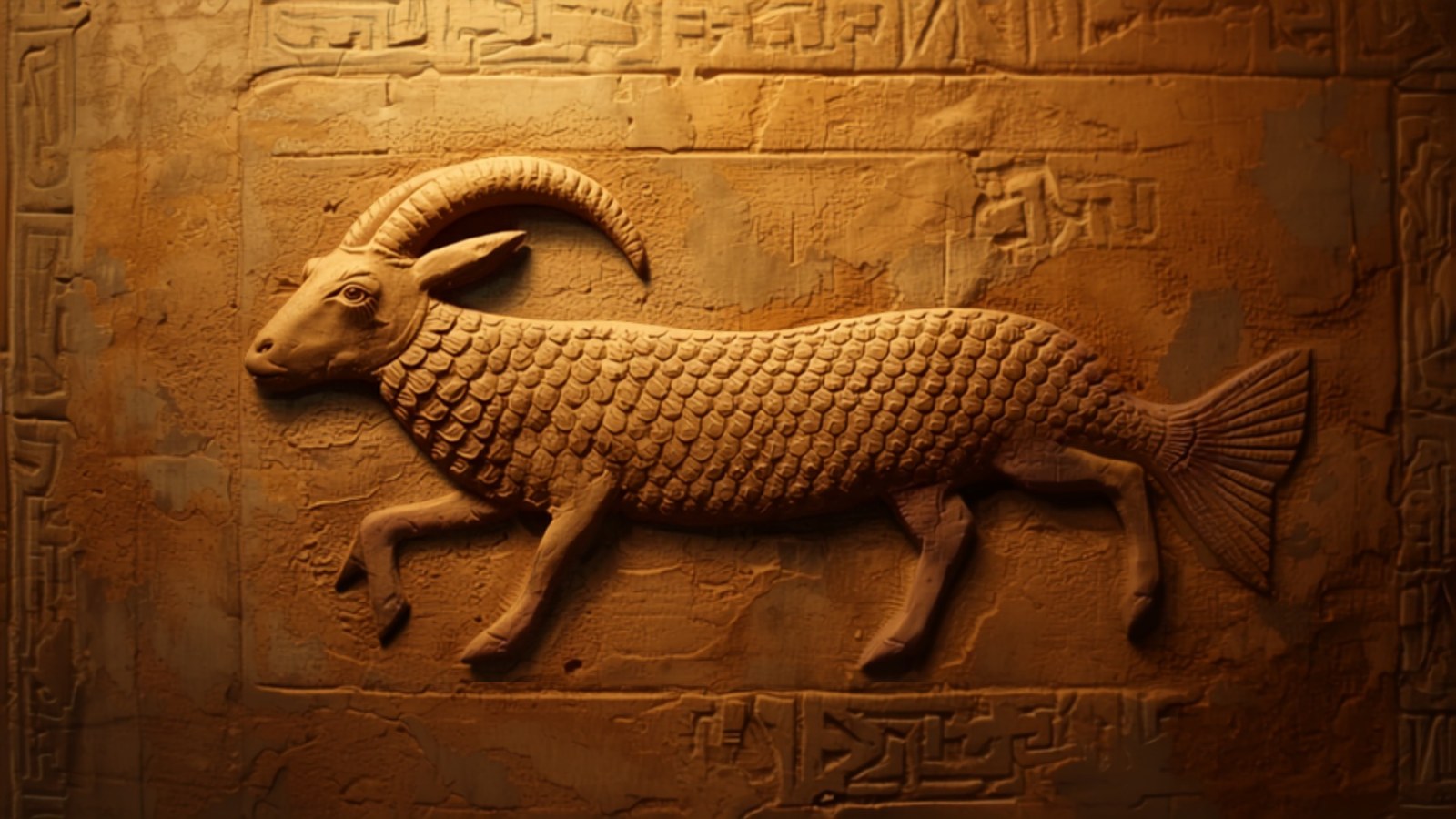
Anyone who opens old star charts is puzzled: there Capricornus is no goat. At the front it is a goat with horns and forelegs – and at the back a fish with scales and a tail fin. This creature is called the sea-goat, in English sea goat, and it is not an invention of romantic chart-makers, but the oldest known interpretation of this star field of all. The Greek Pan myth was only added roughly a thousand years later.
Is Capricornus a goat? What the Babylonian sources say
Half. In the Babylonian star lists – the best known being the catalogue MUL.APIN, whose core goes back to the second millennium BC – this field bears the name MUL SUḪUR.MÁŠ, literally “the goat-fish”. It belonged to the water god Ea (Sumerian Enki), the lord of fresh water, wisdom and craftsmanship. Ea was himself often depicted with streams of water, and his companion animal was precisely this hybrid creature: an animal that is at home both in the mountains and in the water.
The reason for the combination is probably calendrical. The whole section of sky between Capricornus, Aquarius and Pisces is called, in essence, “the sea” in Babylonian texts – the Sun passed through it during the rainy season. An animal that rises halfway out of the water suits this neighbourhood better than a pure mountain dweller. So if someone asks whether Capricornus is a goat, the honest answer is: at the front yes, at the back no.
Sea goat: why the fish tail has persisted to this day
The Greeks adopted the Babylonian figure fish tail and all, and called it Aigokerōs (“goat’s horn”). The Romans turned it into Capricornus – from caper (billy goat) and cornu (horn). The fish tail remained in the pictorial tradition, even though the name no longer mentions it. That is why the constellation is to this day still often called the sea goat in English, and that is why the question “why does Capricornus have a fish tail?” only seems strange at first glance: the answer is simply that the fish is older than the goat.
In the sky itself, incidentally, this is no help at all. The stars form neither a goat nor a fish, but a triangle. As with most zodiac constellations, the figure is an attribution, not a description.
Mythology of Capricornus: from Ea via Pan to Amalthea
Several tales have settled around the constellation, tales that do not exclude one another but lie on top of one another like layers. Anyone searching for the meaning of the constellation Capricornus therefore finds something different depending on the source – and all of them are right within their own time frame.
Babylon and Sumer: the sea-goat of the water god Ea
The oldest layer is the Babylonian one, and it is also the only one in which the figure fits the matter: Ea is a water god, his animal is half a water creature, and the section of sky is called “the sea”. The sea-goat appears on boundary stones (kudurrus) and seals over many centuries. This makes Capricornus one of the constellations with the best-documented prehistory of all – roughly 2,800 years older than the Greek myths that were later assigned to it.
Greece: Pan flees from the monster Typhon
The best-known Greek version: when the monster Typhon attacked the gods, they fled to Egypt and transformed themselves into animals. The shepherd god Pan – already half goat – leapt into the Nile. The part of his body that plunged into the water became a fish tail, the part that stayed above water remained a goat. Zeus placed the result in the sky in gratitude. The story is obviously a retrospective explanation for an image the Greeks already found ready-made – it explains precisely the feature that came from Babylon.
Amalthea: the goat that suckled the infant Zeus
A second Greek attribution sees in the constellation Amalthea, the goat that nourished the young Zeus in a Cretan cave while his father Cronus was searching for him. From one of her horns came the cornucopia. This version explains the goat part well and the fish tail not at all – a hint that two originally separate traditions were pushed together here.
An image from the calendar: why the myth does not explain the figure
All these tales share one problem: they explain a figure that cannot be seen in the sky. The reverse path is more likely. In antiquity Capricornus marked the lowest position of the Sun in the year – the winter solstice. From here the Sun climbed again. An animal that rises out of the water and climbs mountains is a fitting image for that. The figure therefore follows the calendar, not the shape of the stars.
The stars in Capricornus: Deneb Algedi, Dabih and Algedi
No star of Capricornus is conspicuously bright, but three of them are interesting for observers: one eclipses itself, one can be split with binoculars, one even with the naked eye. For its size, the constellation thus has an astonishing density of rewarding targets.
Deneb Algedi: the brightest star and an eclipsing variable
Deneb Algedi (δ Capricorni) is at 2.85 mag the brightest star of the constellation and stands at the eastern corner of the triangle. Its name comes from Arabic and means “tail of the goat” – the same root as in the much better-known Deneb in Cygnus. At only 39 light-years distance, it is one of the nearest bright stars to us of all.
What is exciting is what you cannot see about it: Deneb Algedi is an eclipsing variable of the Beta Lyrae type. Two stars orbit one another so closely that they mutually obscure each other while being deformed by tidal forces. The period is only about 24.5 hours, and the brightness varies by about 0.2 magnitudes in the process. That is borderline with the naked eye, but in direct comparison with its 3.7-mag neighbour Nashira it can certainly be tracked over several nights – a fine beginner’s project for anyone who wants to practise estimating brightnesses.
Dabih: the double star for binoculars
Dabih (β Capricorni) is at 3.05 mag the second-brightest star and stands at the western tip. In binoculars it becomes a pair: an orange-yellow primary star of 3.1 mag and a bluish companion of 6.1 mag stand about three and a half arcminutes apart. That is already enough for a pair of 10×50 binoculars, and the colour contrast is one of the finest in this region of the sky. The system lies about 340 light-years away; the two visible components are themselves in turn multiple systems.
Algedi: the double star for the naked eye
Right next to it stands Algedi – and it is double. α² Capricorni (3.57 mag, 109 light-years) and α¹ Capricorni (4.24 mag, 690 light-years) stand only about 6.3 arcminutes apart. That is far enough for a normally sighted eye, under a dark sky, to split the two without any aid – one of the few occasions in the sky where this succeeds.
Physically, however, the two have nothing to do with one another: they stand more than 500 light-years one behind the other and appear in the same direction only by chance. Such a thing is called an optical double star. Dabih, by contrast, is a real, gravitationally bound system. Anyone who looks at both in a single night has understood the difference between “apparent” and “real” in five minutes.
Nashira, Dorsum and the fainter stars of the figure
Nashira (γ Cap, 3.69 mag, 139 light-years) stands close beside Deneb Algedi and serves as a comparison star for its brightness variations. Dorsum (θ Cap, 4.08 mag) and Marakk (ζ Cap, 3.74 mag) lie inside the figure, Baten Algiedi (ω Cap, 4.11 mag) marks the southern tip – and precisely for that reason it is the critical star: it stands so low that in northern Germany it barely rises above 10 degrees. If you can see Baten Algiedi, your southern horizon is good.
| Star | Brightness | Distance | Notable feature |
|---|---|---|---|
| δ Cap – Deneb Algedi | 2.85 mag | 39 ly | Brightest star, eclipsing variable with a 24.5 h period |
| β Cap – Dabih | 3.05 mag | 340 ly | Double star with 6.1-mag companion, splittable in binoculars |
| α² Cap – Algedi | 3.57 mag | 109 ly | Optical double star with α¹, splittable with the naked eye |
| γ Cap – Nashira | 3.69 mag | 139 ly | Comparison star for Deneb Algedi |
| ζ Cap – Marakk | 3.74 mag | 400 ly | Bright giant inside the figure |
| θ Cap – Dorsum | 4.08 mag | 160 ly | Northern edge of the triangle |
| ω Cap – Baten Algiedi | 4.11 mag | 630 ly | Southern tip, barely visible in northern Germany |
| α¹ Cap | 4.24 mag | 690 ly | The more distant of the two Algedi stars |
When can the constellation Capricornus be seen?
Capricornus is a constellation for the second half of the year. Between December and June it stands in the sky during the day and is therefore invisible. From mid-July it appears in the second half of the night, in September it stands in the south in the evening, and in November it takes its leave toward the southwest.
The observation window: from August to mid-November
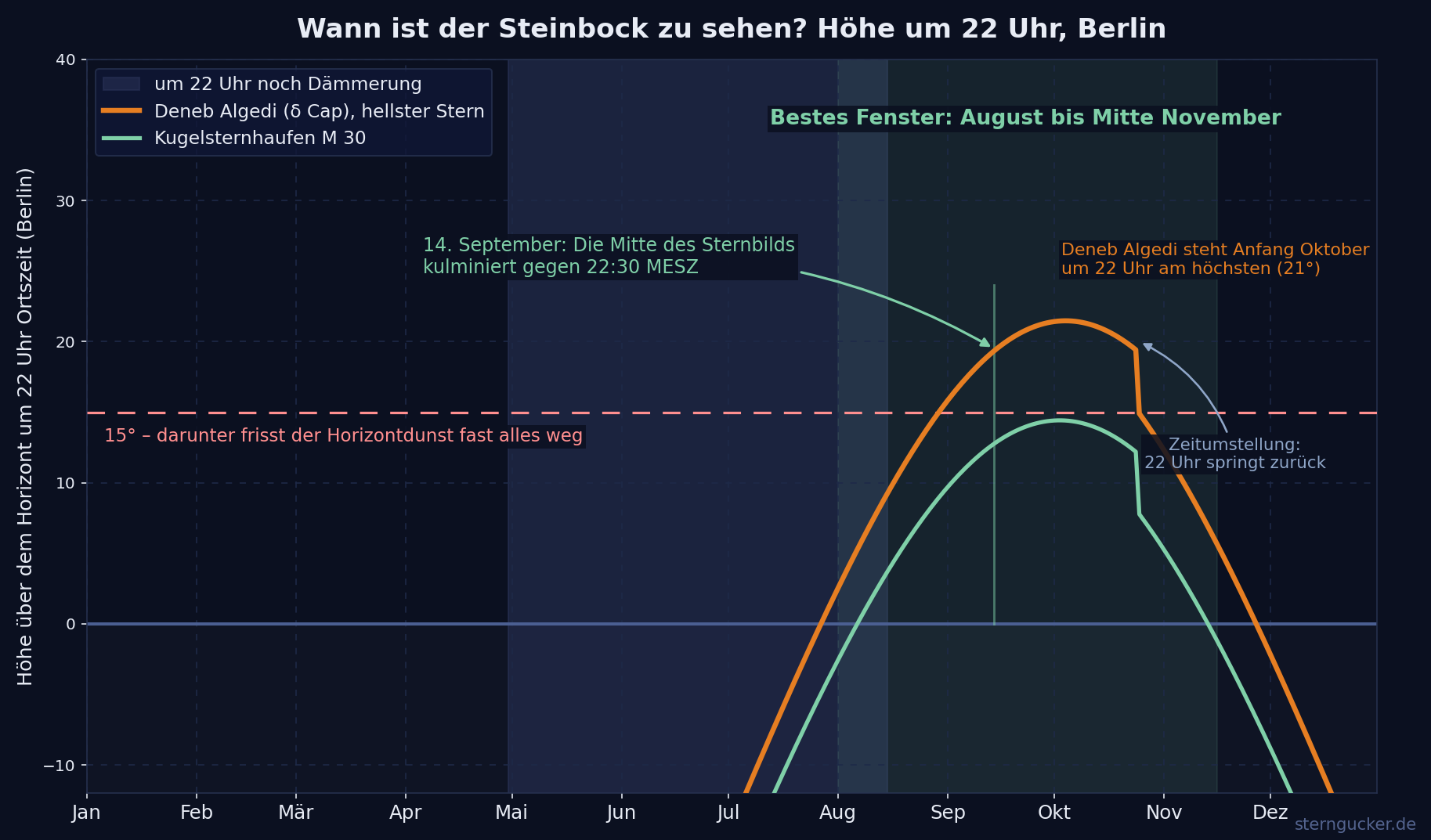
The practically usable window runs from the beginning of August to mid-November. In August you have to wait until after 11 p.m., because twilight ends late and the constellation only then stands high enough. In September and October it stands in the south at the best time. In November it sinks early toward the southwest. What else is happening in the sky during these months is set out in our overview of the night sky in September and the night sky in October.
The best evening: the culmination on 14 September
A constellation stands highest when it is exactly due south – this is called culmination. For the middle of the constellation Capricornus this happens on 14 September at around 10:30 p.m. CEST. Anyone who has only one evening in the year takes this one: twilight is then over, and the figure stands complete and centred above the southern horizon.
Culmination date ≠ highest position at 10 p.m.
Two figures that are often confused. On 14 September the middle of the constellation culminates at around 10:30 p.m. CEST. The star Deneb Algedi stands further east and reaches its highest position at a fixed time of 10 p.m. only at the beginning of October, at about 21 degrees. Both are correct – they are simply two different questions. In practice this means: between mid-September and mid-October it is equally good in the evening anyway.
The figures for Berlin, each at 10:30 p.m. CEST, make the course clear: on 1 August Deneb Algedi stands only 6° high, on 15 August 12°, on 1 September 18°, on 15 September 21°, on 1 October 21° – and on 1 November only 15°. The globular cluster M 30 lies about six degrees lower in each case, which for it makes the difference between visible and invisible.
Culmination altitude: how high Capricornus rises in your city
Because Capricornus lies south of the celestial equator, its altitude depends strongly on latitude. The difference between Hamburg and Zurich is a good six degrees – and in this altitude range six degrees really do decide between success and failure, because the air just above the horizon swallows an enormous amount of light.
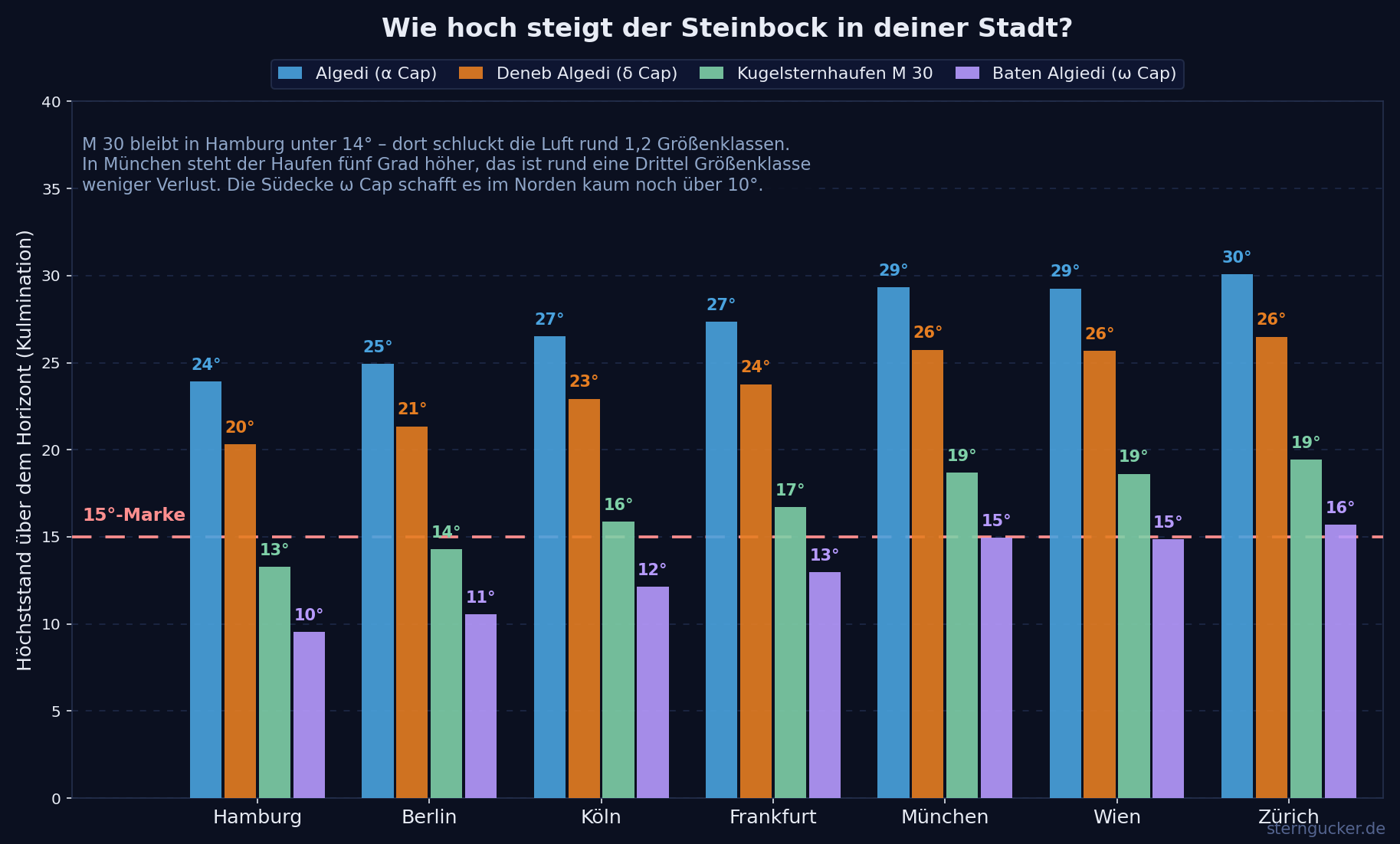
| City | Algedi | Deneb Algedi | M 30 | Light loss for M 30 |
|---|---|---|---|---|
| Hamburg | 23.9° | 20.3° | 13.3° | 1.21 mag |
| Berlin | 24.9° | 21.3° | 14.3° | 1.13 mag |
| Cologne | 26.5° | 22.9° | 15.9° | 1.02 mag |
| Frankfurt | 27.3° | 23.8° | 16.7° | 0.97 mag |
| Munich | 29.3° | 25.7° | 18.7° | 0.87 mag |
| Vienna | 29.3° | 25.7° | 18.6° | 0.88 mag |
| Zurich | 30.1° | 26.5° | 19.4° | 0.84 mag |
The last column is the really interesting one. It states how much brightness the atmosphere takes away from the globular cluster M 30 at its highest position. In Hamburg that is 1.2 magnitudes: 7.2 mag effectively becomes 8.4 mag, and with that the cluster slips out of the reach of small binoculars. In Zurich only 0.84 mag of it remains. This is the reason why the same globular cluster comes off much better in travel reports from southern Germany than in observation logs from the North Sea. On the role of the sky background we have a dedicated page on light pollution.
How long is a night in Capricornus worth it?
On 1 September, from Berlin, Deneb Algedi stands during the astronomical night about four and a half hours above 15 degrees. The globular cluster M 30 manages about four hours above 10 degrees. That sounds like a lot, but it is the theoretical upper limit – haze, trees and local lighting on the southern horizon easily devour half of it in practice. So plan realistically for a time window of two to three hours around midnight.
Deep sky in Capricornus: M 30 and what else is possible
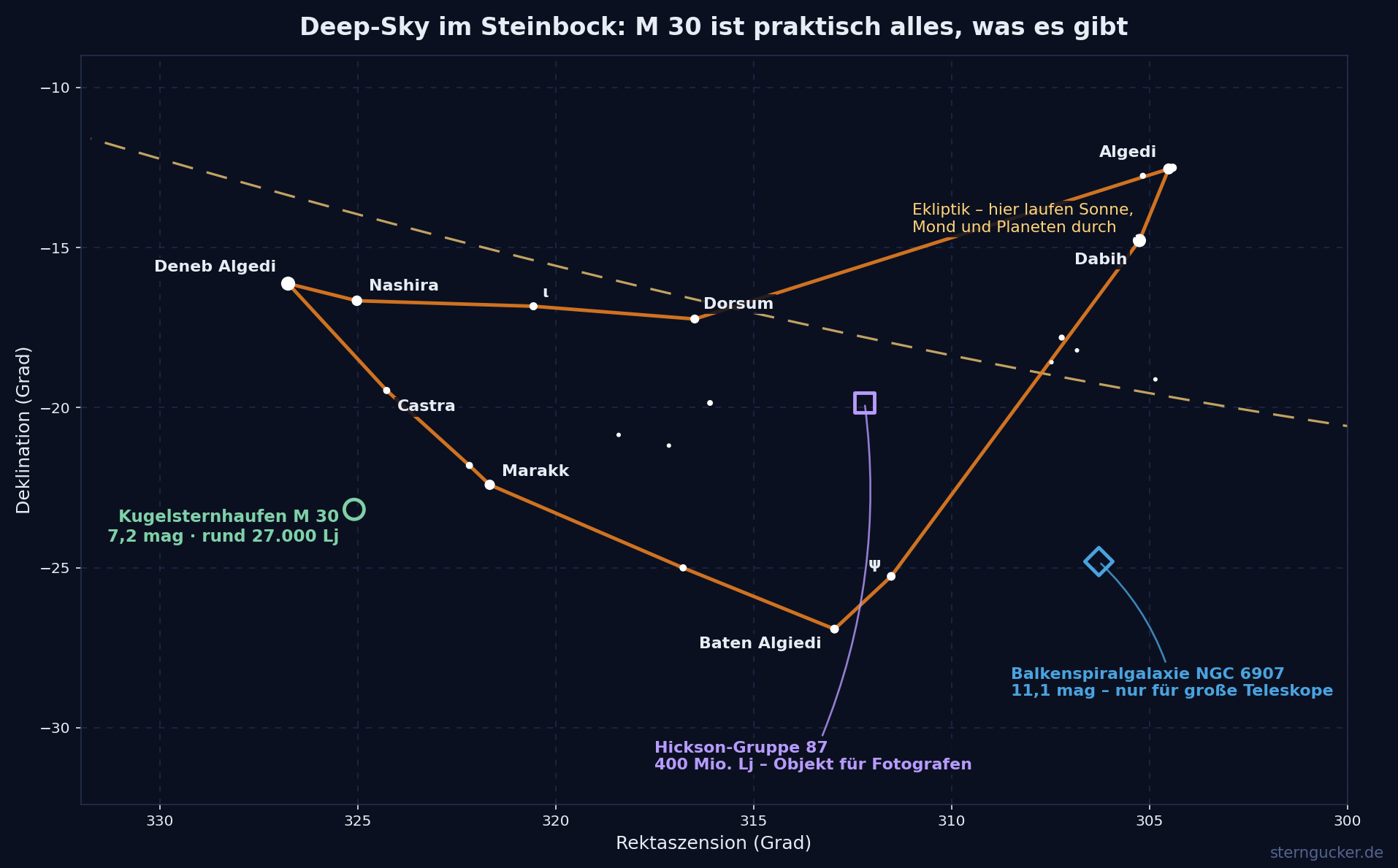
Capricornus is no deep-sky paradise. It lies away from the Milky Way, and because it also stands low, the yield is modest: a single Messier object, plus a few galaxies for large apertures. But anyone who happens to be in this region should not skip M 30 – the cluster is considerably better than its reputation.
The globular cluster M 30: the only Messier object in Capricornus
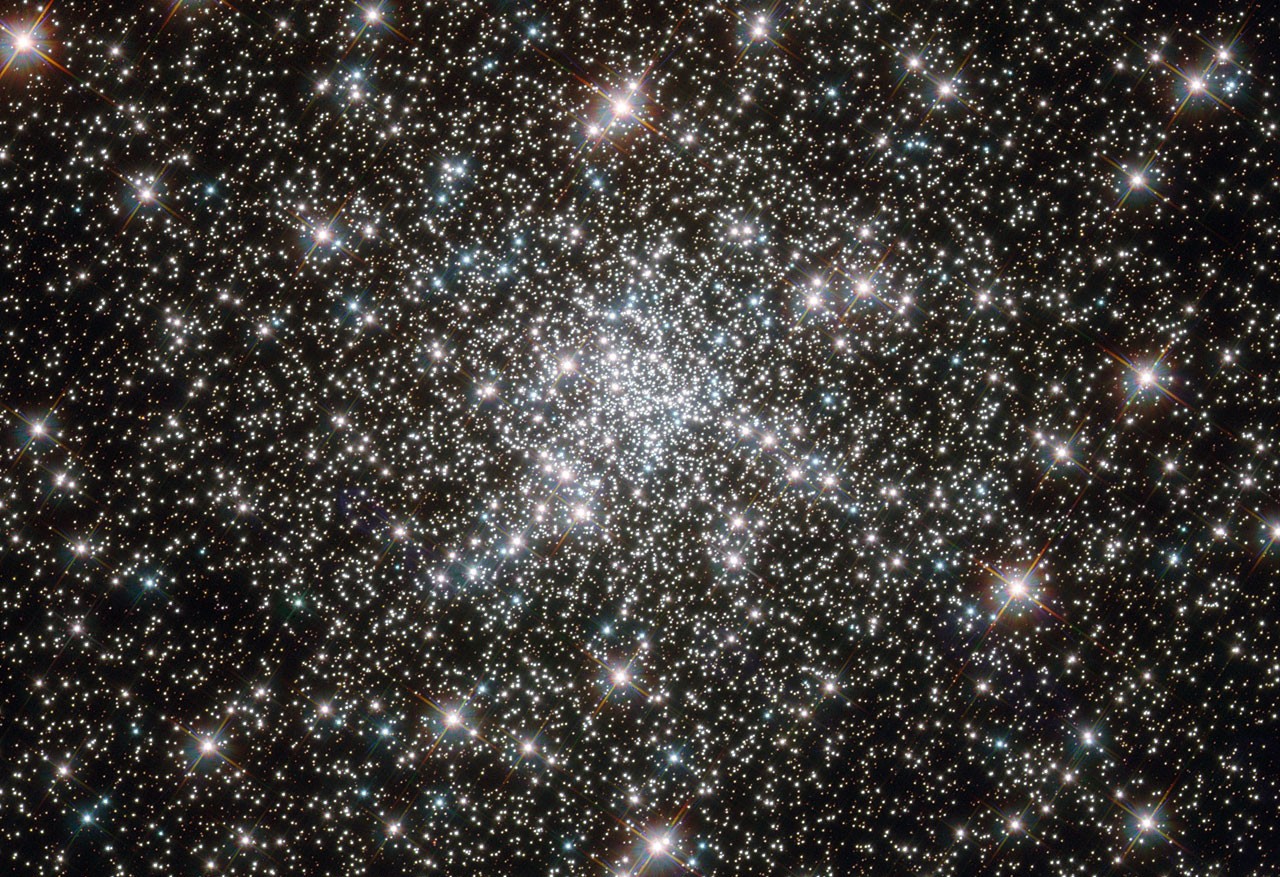
M 30 (NGC 7099) is a globular cluster of about 7.2 mag at roughly 27,000 light-years distance. Charles Messier entered it into his catalogue in 1764 and took it for a nebula – he could not make out stars with his instrument. This is to this day the decisive experience with this object: what you look at M 30 with determines what you see.
Locating it is easy: M 30 stands a good three degrees east of Zeta Capricorni in the lower part of the figure. In 10×50 binoculars it appears under a dark sky as a tiny, round nebulous patch – no more, and from northern Germany often not at all. From about 15 centimetres of aperture the edge begins to become grainy. From about 20 centimetres the outer regions resolve into individual stars, and then the two striking star chains that run off from the core toward the north also show up.
Astrophysically, M 30 is a core-collapsed globular cluster: its centre has collapsed in on itself over time and is today extremely densely packed. Only about one fifth of all known globular clusters have reached this stage. At about 13 billion years, it is among the oldest objects that can be seen from Central Europe at all.
NGC 6907 and HCG 87: targets for large apertures
NGC 6907 is a barred spiral galaxy of about 11.1 mag in the western part of the constellation. Visually it is a pale oval patch and needs at least 25 centimetres of aperture as well as a really dark sky – at an altitude below 25 degrees, that is a demanding task in Central Europe. In photographs it shows two unusually far-reaching spiral arms.
HCG 87 is a Hickson galaxy group of four interacting galaxies at about 400 million light-years distance. Visually it is practically unreachable for amateur telescopes, but for astrophotography with a long exposure time it is an appealing target. You will find further rewarding objects in our overview of deep-sky objects.
The smallest zodiac constellation: 413.9 square degrees
Of the twelve zodiac constellations, Capricornus is the smallest. At 413.947 square degrees it occupies overall rank 40 of 88 constellations – for comparison: Virgo, the largest zodiac constellation, is at 1,294 square degrees more than three times as large. This also explains why the Sun stands in Capricornus for only a relatively short time.
| Zodiac constellation | Area (square degrees) | Rank of 88 |
|---|---|---|
| Virgo | 1,294.4 | 2 |
| Aquarius | 979.9 | 10 |
| Leo | 946.9 | 12 |
| Pisces | 889.4 | 14 |
| Sagittarius | 867.4 | 15 |
| Taurus | 797.2 | 17 |
| Gemini | 513.8 | 30 |
| Cancer | 505.9 | 31 |
| Scorpius | 496.8 | 33 |
| Libra | 538.1 | 29 |
| Aries | 441.4 | 39 |
| Capricornus | 413.9 | 40 |
The ranks come from the official constellation boundaries laid down by the International Astronomical Union in 1930. These boundaries are straight lines along right ascension and declination – since their introduction, every point in the sky belongs unambiguously to exactly one constellation.
The Tropic of Capricorn: a name from antiquity
The Tropic of Capricorn is the parallel at 23.4 degrees southern latitude, over which the Sun stands vertically at the winter solstice. It runs through Australia, South Africa, Chile and Brazil. Its name comes from the fact that on that day the Sun stood in the constellation Capricornus at the time the term was coined.
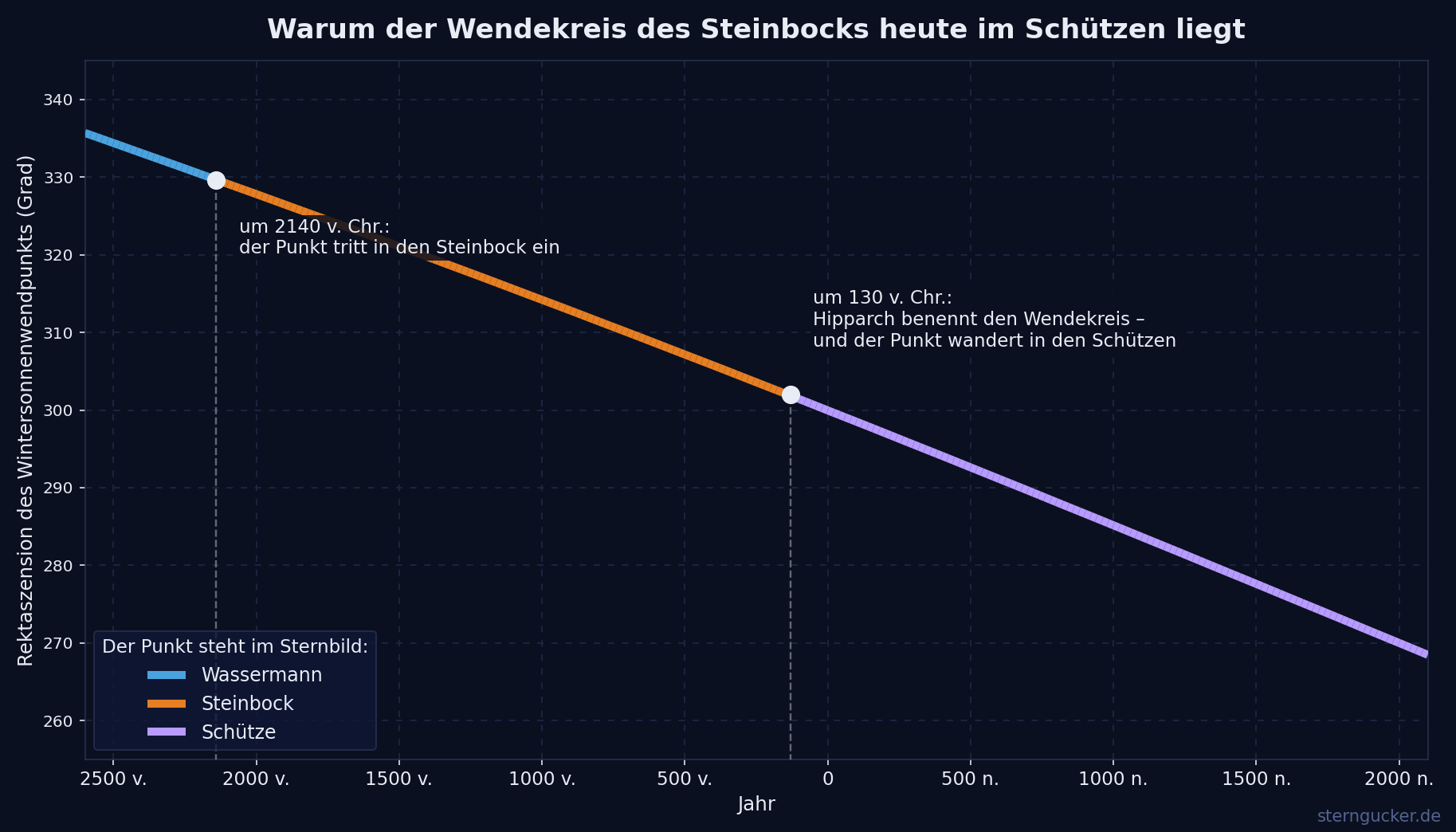
This is no longer true today. The Earth’s axis wobbles like a spinning top, with a period of revolution of about 25,800 years. This precession slowly shifts all seasonal points against the constellations. According to our calculation, the winter solstice point stood in Capricornus from about 2140 BC until about 130 BC – and today lies in the neighbouring constellation Sagittarius.
The moment of naming: why Hipparchus was right
The remarkable thing about this period: precisely in its final phase, in the 2nd century BC, Hipparchus of Nicaea was at work, the first to describe precession. In his time the name “Tropic of Capricorn” was therefore still correct – just barely. A few generations later it no longer was. The name stayed nonetheless, and for the same reason the vernal equinox point is to this day called the “First Point of Aries”, even though it has long lain in Pisces.
Anyone who wants to know why the Earth’s axis wobbles at all and what other consequences that has will find the basics in our article on how long the Earth takes to orbit the Sun.
Star sign Capricorn and the constellation Capricornus: two different things
Anyone born under the star sign Capricorn has their birthday between 22 December and 20 January. Except: during that time the Sun is not in the constellation Capricornus at all. The reason is the same precession as with the tropic – the astrological signs were fixed about 2,000 years ago and have not been adjusted to the sky since.
When is the Sun really in the constellation Capricornus?
According to today’s IAU boundaries, the Sun passes through the constellation Capricornus from 21 January to 16 February – that is about 27 days, and thus a good four weeks later than the sign of the same name. Because Capricornus is the smallest zodiac constellation, this is also one of the shorter passages. For comparison: in Virgo the Sun stands for more than 44 days.
In practice this means: anyone born under the star sign Capricorn had the Sun standing in Sagittarius on their birthday. And even more practically: in the weeks around one’s own birthday the corresponding constellation is fundamentally invisible, because it stands with the Sun in the daytime sky. We have written up the whole system in a dedicated article on the difference between star signs and constellations.
Capricorn traits: what astronomy can say about them
Honest answer: nothing. Attributed traits such as endurance, discipline or ambition are part of astrology, not astronomy. There is no physical mechanism by which a constellation 39 to 690 light-years away could influence a human being – and the stars of Capricornus do not even form a coherent system, but merely happen to stand in the same line of sight. What remains is a culturally extraordinarily long-lived image: the sea-goat has accompanied us for over 3,000 years.
Was Neptune discovered in Capricornus? A persistent error
In many texts about Capricornus it says that the planet Neptune was discovered here in 1846. That is wrong, and it can be checked by calculation. On the night of 23 to 24 September 1846, Johann Gottfried Galle found the planet at the Berlin observatory at a right ascension of about 22 hours 01 minute and a declination of −12 degrees 40 minutes. This position lies in the constellation Aquarius – about twelve degrees east of the Capricornus boundary.
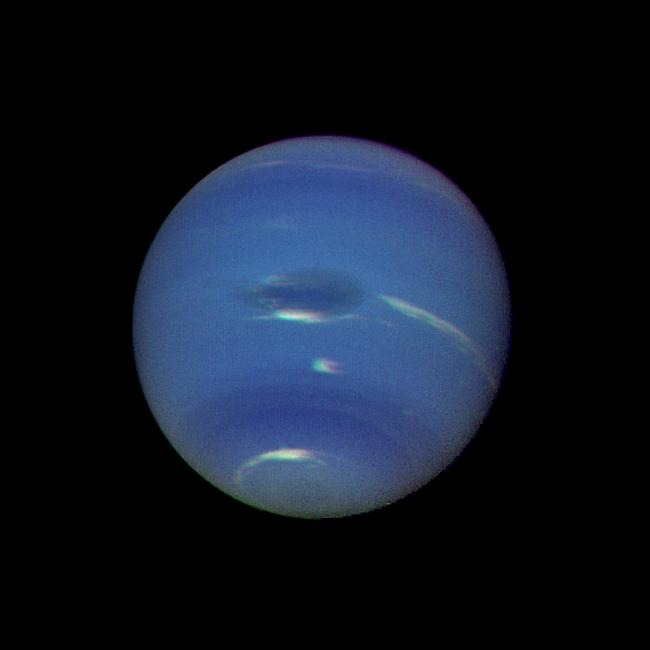
How does the error come about? Probably in two ways. First, Neptune moves slowly but steadily: in the decades before 1846 it did indeed stand in Capricornus, and the orbital calculations of Le Verrier and Adams relied on older observation points. Second, the predicted position is occasionally confused with the one that was found. Anyone who wants to be correct says: Neptune was found in Aquarius, after it had left Capricornus shortly before.
Binoculars or telescope: what you need for Capricornus
With Capricornus the answer is unusually clear – clearer than with most other constellations. This is because its two finest objects fall into different classes: the double star Dabih belongs to the binoculars, the globular cluster M 30 belongs to the telescope.
What binoculars achieve with Capricornus
A pair of 10×50 binoculars is here more than a stopgap. It shows the complete figure in two to three fields of view, it splits Dabih effortlessly into its orange-blue pairing, it shows Algedi as a wide double-star pair, and it makes visible the fainter stars of the figure that you never see with the naked eye from the city. For locating and placing the constellation, binoculars are even better suited than a telescope, because the large field of view preserves the overview.
When the telescope is nonetheless worth it
As soon as it comes to M 30, the binoculars reach their limit. In the 10×50 the globular cluster remains a tiny nebulous patch – if it emerges from the horizon haze in northern Germany at all. The real experience, namely that a diffuse patch resolves into thousands of individual stars, only begins at about 15 centimetres of aperture and becomes really good from 20 centimetres. The same applies to NGC 6907 and all the other galaxies in the vicinity. We have described the difference in detail in our comparison telescope or binoculars.
Anyone who can only buy one instrument and really wants to explore the sky should reach for the telescope; the binoculars are the supplement, not the replacement. For low-standing objects like M 30 a second argument comes into play: aperture compensates for part of what the atmosphere takes away near the horizon.
For M 30 and the galaxies in Capricornus: Skywatcher Dobson Telescope N 200/1200 Skyliner Classic
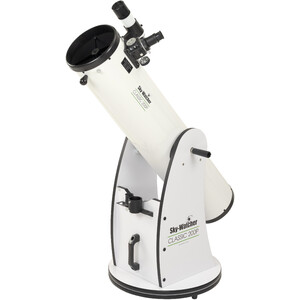
200 mm of aperture — the most sky for your money. Set it on the ground, point by hand: nebulae, clusters and galaxies for years to come.
Price: € 479
The 20-centimetre Dobsonian is the classic recommendation when deep sky is the priority: lots of aperture per euro, simple operation, no electronics that can fail at night. It shows M 30 resolved and also gets further with NGC 6907 than any smaller instrument.
A compact entry with a large field of view: Skywatcher Dobson Telescope N 130/650 Heritage FlexTube
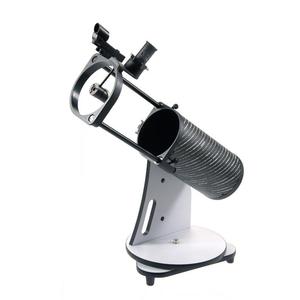
A compact tabletop Dobson with a true parabolic mirror. Folds down, fits in a bag: the Moon, planets and the bright deep-sky classics.
Price: € 265
When space, budget or transport speak against the large Dobsonian, the 130-millimetre FlexTube is the sensible alternative. It shows M 30 as a grainy ball with hinted-at edge stars – not resolved, but clearly more than any binoculars. We have compiled further options in this price range in the comparison of telescopes under 300 euros and in the big telescope test.
The most important factor costs nothing
With Capricornus an unobstructed southern horizon beats any instrument. A 15-centimetre telescope in an open field shows M 30 better than a 25-centimetre instrument behind a row of trees. Before observing, look for a spot from which you have a clear view to the south down to about 10 degrees – ideally already in daylight.
Frequently asked questions about the constellation Capricornus
What does the constellation Capricornus look like?
In the sky you see no animal, but a broad, flat triangle that sags downward – often compared to a boat or a smile. It is about 20 degrees wide. On old star charts it becomes a sea-goat: goat at the front with horns, fish at the back with a tail fin.
Where exactly is Capricornus in the sky?
Low in the south, between Sagittarius to the west and Aquarius to the east. In practice you find it by going from Altair in the Summer Triangle about 26 degrees south – a good two and a half fist-widths at arm’s length.
When can you see the constellation Capricornus?
From August to mid-November. It is most favourably placed from mid-September to mid-October, in the hours around 10 to 11 p.m. Between December and June it is invisible, because it crosses the daytime sky together with the Sun.
Can I observe Capricornus tonight?
Between August and November: yes, provided the sky is clear and you have a clear view to the south. Between December and July: no. Check the Moon as well – at full moon nothing can be seen of M 30. What else is currently in the sky can be found in our astro events.
What is Capricornus called in Latin?
Capricornus, from caper (billy goat) and cornu (horn) – so literally “goat’s horn”. The official IAU abbreviation is Cap, the genitive Capricorni. In Greek it was called Aigokerōs, in English it is often called sea goat.
Why is Capricornus called the sea-goat?
Because the Babylonian original form of the constellation was a hybrid creature: MUL SUḪUR.MÁŠ, the companion animal of the water god Ea, goat at the front and fish at the back. The Greeks adopted the image and explained the fish tail retrospectively with the flight of the god Pan from Typhon.
How many stars does the constellation Capricornus have?
Under a good country sky, about 30 to 40 stars can be made out with the naked eye, of which only five are brighter than 4 mag. The brightest is Deneb Algedi at 2.85 mag. In total the constellation covers 413.9 square degrees and is thus rank 40 of 88.
Is Capricornus a zodiac constellation?
Yes – and indeed the smallest of the twelve. The ecliptic, that is the apparent path of the Sun, runs through its northern part. That is why the Moon and planets regularly pass through there too; in autumn 2026 Saturn is moving through this region of the sky.
What is the finest object in the constellation Capricornus?
For the naked eye and binoculars: Dabih, the colourful double star at the western tip. For the telescope: the globular cluster M 30, which resolves into individual stars from about 20 centimetres of aperture and is among the oldest objects that can be seen from Central Europe.
Further reading on Sterngucker
- Constellation Aquarius – the eastern neighbour with the Helix Nebula
- Constellation Sagittarius – the western neighbour with the teapot
- Summer Triangle – here stands Altair, the starting point of the sight line
- Star signs and constellations – why your sign has “slipped”
- Deep-sky objects – globular clusters, nebulae and galaxies at a glance
- Neptune – the planet that was precisely not discovered in Capricornus
- Night sky in September – the best month for Capricornus
- Telescope or binoculars – what is worth it for which object
- All constellations at a glance – the entry point into our catalogue