By Alexander Merz · Published on · Details checked on 14 September 2026
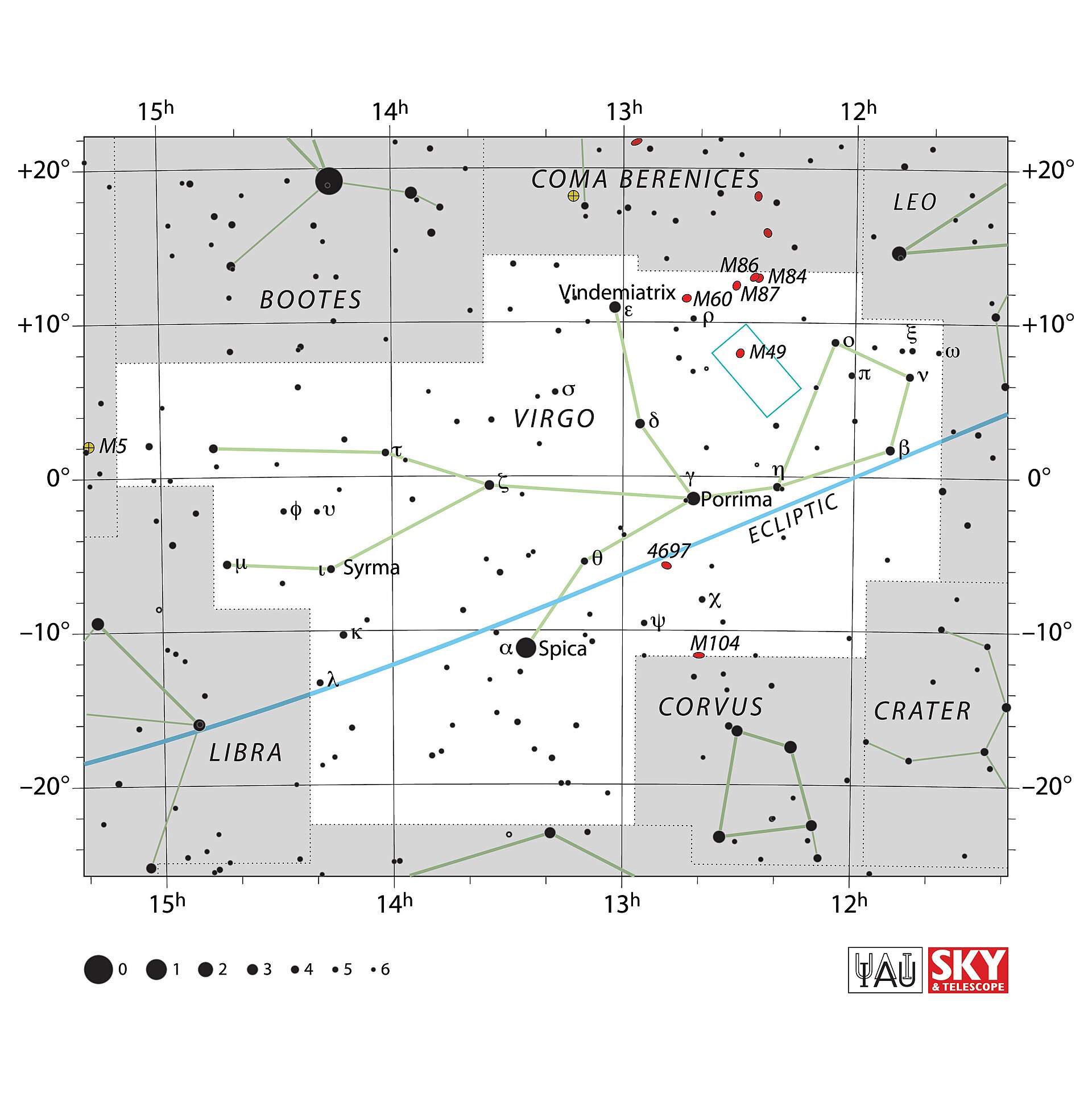
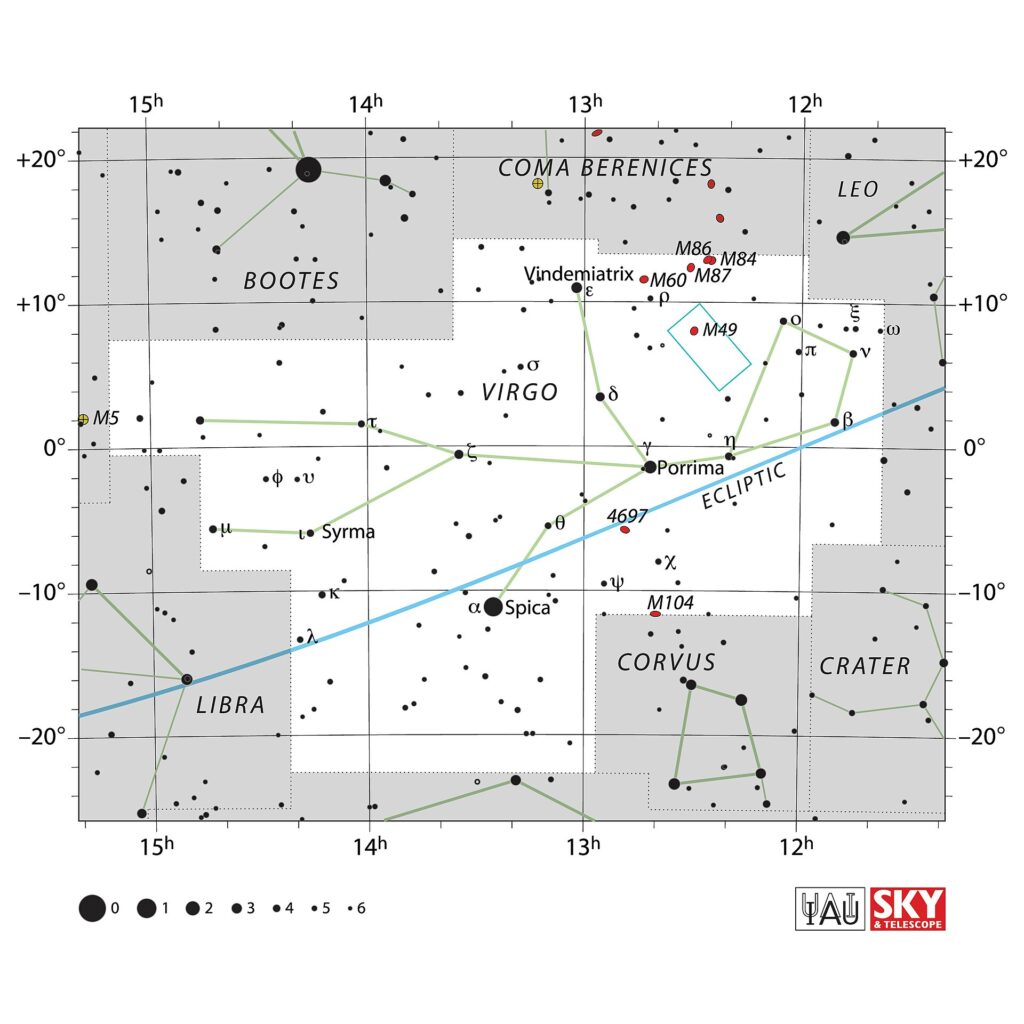
The constellation Virgo is the second-largest constellation in the sky and one of the constellations of the ecliptic (the astronomical imaginary line of the Sun’s path). It is regarded as an ancient symbol of fertility and justice. Its proximity to the constellation Libra is no coincidence according to the mythological arrangement. To the west lies the constellation Leo, which culminates in spring before Virgo. In spring, deep-sky observers scan, among the stars of the constellation, for an immense concentration of galaxies: the Virgo Cluster, with an estimated 2,000 galaxies.
Orientation and observation in the constellation Virgo
Besides their ancient importance for navigation, all the classical constellations, which also include the constellation Virgo, often carry different symbolic meanings. Thus “Mul Ab. Sin” (the furrow) or Šala (“the god or goddess of the ear of grain”, today the name of the star Spica) was first mentioned in Mesopotamian records in connection with the agricultural “celestial year” around 2700 BC. Furthermore, according to these writings, the “heliacal rising” on the ecliptic shifted back by a week between 2700 and 1900 BC. Among the deep-sky objects worth the effort are galaxies, a whole series of double stars, variable stars and multiple star systems.
The brightest star in the constellation Virgo is Spica (Mesopotamian: the goddess Šala, the ear of grain), an eclipsing binary star that originally gave its name to the entire constellation. To find this bright main star of Virgo for deep-sky observations, follow the extension of the handle of the “Big Dipper” past “Arcturus” (the main star in Boötes) toward the ecliptic. Many of the Virgo galaxies are already visible to the naked eye as nebulous patches among the stars of the constellation.
Mythological interpretations of Virgo
The earliest surviving legend about the constellation Virgo comes from Mesopotamia and tells how Inanna (a Sumerian goddess) sent the celestial bull to Earth as a punishing force. There it also served as a bringer of rain and as a plough ox. Later the Greeks told their own myth about this constellation of the ecliptic. One of their interpretations thus depicts the constellation as Persephone, the future bride of Hades. The classical proper names of several stars of “Virgo” recall many fragments of these and other tales.
The nebulous deep-sky objects, known for about 350 years, were not yet known to the astronomers of antiquity. Messier realised that the many galaxies discovered at the time in the constellation Virgo might be connected with one another while compiling his well-known “Messier Catalogue”.