By Alexander Merz · Updated on · Details checked on 14 September 2026
December 2026 gives you the longest nights of the year – and fills them generously: the Geminids, the richest meteor shower there is, reach their maximum under good moon conditions, the magnificent winter sky with Orion takes over the stage, and Jupiter, Mars and Venus gather in the morning sky. Your month at a glance – including last-minute tips for telescope presents.
The key facts in brief
- 13/14 December: Geminids maximum – up to 150 meteors per hour, and largely free of moonlight! All the details: Geminids guide
- 21 December, 21:50: winter solstice – the longest night of the year; after that the days start getting longer again
- 24 December: full moon – a “Christmas full moon” over the presents
- The winter sky in full glory: Orion with the Orion Nebula, the Pleiades, Sirius – the finest objects of the whole year
- Morning sky: Venus as the morning star (with the crescent moon on 5 December), Jupiter and Mars becoming more striking from week to week
- Saturn in the early evening: on 24 December at 18:00 it stands around 39° high in the south – the first target for a freshly unwrapped telescope
- Mercury: the first week of December is its last window of the year, after that it is gone
- A telescope as a present? December is the gift month – what is actually worth it is collected under astronomy gifts
The December 2026 sky calendar
All times are Central European Time (CET), calculated for the middle of Germany (51.2° N / 10.5° E). The dates hold anywhere in Central Europe; further south the objects simply stand a little higher.
| Date | Event | What you get out of it |
|---|---|---|
| 1 December, 07:08 | Last quarter | From here on the evenings are free of moonlight – the start of two dark weeks |
| 1 to 7 December | Mercury’s last window of the year | On 1 December Mercury still stands 7° high in the south-east at the start of dawn and shines at −0.5 mag; after that it drops lower every day |
| 5 December, around 06:30 | Thin crescent moon beside Venus | About 7° apart, both more than 14° above the south-eastern horizon – the photograph of the month |
| 9 December, 01:51 | New moon | The darkest nights of the month – perfect timing four days before the Geminids |
| Night of 13/14 December | Geminids maximum | Up to 150 meteors per hour under ideal conditions, and the thin crescent no longer gets in the way |
| 17 December, 06:42 | First quarter | Half moon in the evening sky – the best time for craters in the telescope |
| 17 December, evening | Moon beside Saturn | Around 21:00 about 8° apart, both a good 34° high in the south |
| 21 December, around 21:50 | Winter solstice | The longest night of the year – roughly 16 hours between sunset and sunrise |
| 21 December, evening | Moon beside Uranus | About 6° apart, high in the south – but the nearly full moon turns Uranus into a binocular exercise |
| 22/23 December | Ursids maximum | The overlooked shower out of Ursa Minor, around 10 meteors per hour – worth it anyway in such a long night |
| 24 December, 02:28 | Full moon, the “Cold Moon” | The brightest full moon of the year falls on Christmas Eve – deep sky has no chance that evening, the moon itself is magnificent |
| 27 December, morning | Moon beside Jupiter | Around 06:30 about 7° apart, both more than 35° high |
| 28 December, morning | Moon beside Mars | About 7° apart, high in the south-west – Mars has become noticeably brighter by then |
| 30 December, 19:59 | Last quarter | Dark evenings for the turn of the year |
When does it actually get dark in December?
December is the month with the longest astronomically dark nights of the year. In mid-December the sun sets around 16:10 in central Germany, and it is completely dark from about 18:15 – end of astronomical twilight, sun 18° below the horizon.
That darkness holds until around 06:15 in the morning: twelve hours in one stretch. For comparison: in June, at these latitudes, there is none at all.
In practice that means you do not have to stay up until midnight. Anyone who takes the telescope onto the balcony at 18:30 already has the full night sky – which makes December the most family-friendly observing month of the year.
The Geminids on 13/14 December: the best shooting-star night of the year
The Geminids are the richest meteor shower of the year – richer than the Perseids in August. In 2026 the maximum falls in the night of 13 to 14 December, with up to 150 meteors per hour as the theoretical ideal figure (ZHR). Under a genuinely dark country sky you really see 60 to 100.
The moon conditions are good: new moon was on 9 December, and on the night of the maximum only a thin waxing crescent is in the sky, setting early in the evening. The radiant near Castor and Pollux is high enough from about 20:00 – unlike in summer, you do not have to wait for midnight.
One detail makes the Geminids special: their parent body is not a comet but the asteroid Phaethon. Their meteors are correspondingly slow and bright – single ones can be caught while it is still twilight.
What you need for this: no telescope.
For shooting stars any instrument is a handicap – it narrows the field of view exactly when you want to see as much sky at once as possible. What really helps: a deck chair or a sleeping mat, warm clothing for several hours below freezing, and a spot away from street lights. To work out where it is dark enough: light pollution and the Bortle scale.
All the dates of the year are in the meteor shower calendar.
The Ursids around 22 December
The second December shower is the less well known one: the Ursids are active from 17 to 26 December, with their maximum around 22/23 December at roughly 10 meteors per hour. Their radiant in Ursa Minor is circumpolar from Central Europe, so it stays above the horizon all night.
In 2026 the almost full moon just before Christmas interferes considerably. Anyone who goes out anyway looks for a spot where a house or a tree hides the moon.
The winter solstice on 21 December
On 21 December 2026 at around 21:50 CET the sun reaches its lowest point – that is the astronomical start of winter and the longest night of the year. In central Germany roughly 16 hours pass between sunset and sunrise.
After that the trend reverses, but not symmetrically: the evenings start getting lighter again from mid-December, while the latest sunrises only come in early January. The reason is the equation of time – the Earth runs faster around the sun in winter.
The moon phases in December 2026
| Date | Moon phase | What that means for you |
|---|---|---|
| 1 December | Last quarter | Evenings become free of moonlight |
| 9 December | New moon | Darkest nights – perfect timing just before the Geminids |
| 17 December | First quarter | Half moon in the evening – good moon watching with a new telescope |
| 24 December | Full moon | The “Cold Moon” shines over Christmas Eve – as the brightest supermoon of the year! |
All the dates: Full moon calendar · Moon calendar 2026
The planets in December 2026
The evening sky belongs to Saturn and Uranus. Saturn stands high in the south as darkness falls and sets earlier and earlier as the month goes on. At 0.8 mag and around 18 arcseconds of apparent diameter it is the most rewarding telescope target of the month.
Uranus stays above the horizon all night after its November opposition and culminates before midnight in Taurus. At 5.6 mag it can just barely be guessed at with the naked eye under a dark sky, and is unmistakable in binoculars. Neptune stands west of Saturn and sets around midnight.
The morning sky belongs to the bright planets. Venus gleams at −4.4 mag as the morning star and reaches about 24° altitude at the start of dawn around 10 December – its best morning showing of the year. On 5 December the thin crescent moon stands next to it.
Jupiter changes its role over the month: on 1 December it only rises around 22:20, on 31 December already at 20:20. It brightens to −2.3 mag and grows to almost 43 arcseconds – the countdown to its opposition on 11 February 2027 is running.
Mars is catching up: it climbs from 0.5 to −0.1 mag and grows in the telescope from 8.0 to 10.3 arcseconds. Its opposition follows on 19 February 2027, eight days after Jupiter’s – February 2027 will be the best planetary month in years.
Mercury can only be caught in the first week of December. On 1 December it still stands 7° high at the start of dawn and is bright enough at −0.5 mag; by 10 December it has sunk below 3° and disappears for the rest of the month.
The constellations in December: Winter Hexagon and Orion
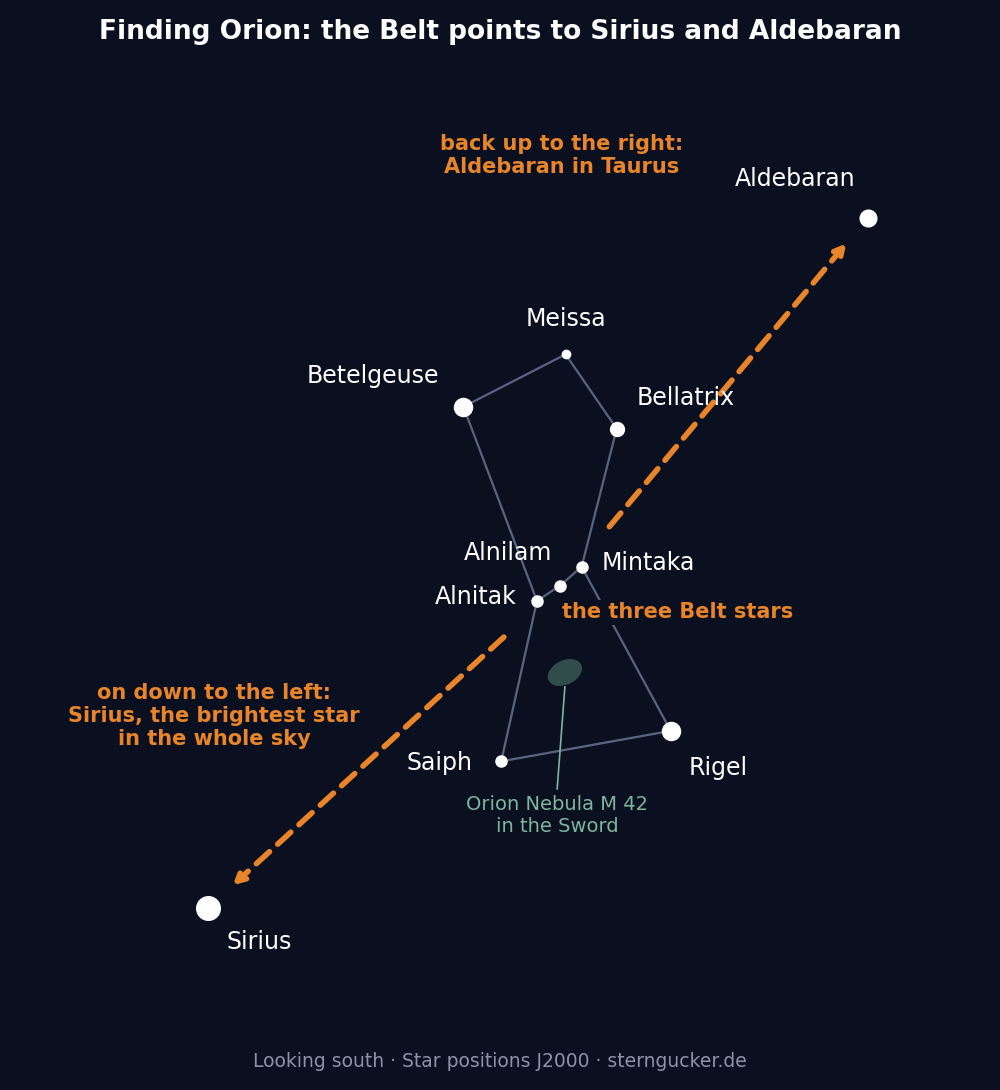
In mid-December Orion rises around 17:35 and stands highest shortly before midnight – for the first time in the year at an hour when you can see it without setting an alarm. Sirius, the brightest star in the night sky, follows it over the horizon around 20:55.
Together with Rigel, Aldebaran, Capella, Pollux and Procyon, Sirius spans the Winter Hexagon – the finest stretch of sky in the year. Six first-magnitude stars in one view happens at no other time.
Anyone watching Sirius at low altitude sees it flicker violently in every colour. That is not a property of the star but air turbulence: close above the horizon its light crosses far more atmosphere. Higher up in the sky the effect almost stops.
The dates that are actually worth it are often months apart – and easily forgotten. So you do not miss one:
One short email, in good time – with the times and an honest take on whether it is worth getting up for.
You will get a confirmation email in a moment. Your address stays with us – no sharing, no third-party ads.
Deep sky in December: the winter sky has arrived
- Orion Nebula (M42): the showpiece of winter – visible even in binoculars as a glowing patch of nebulosity below the three belt stars of Orion.
- Pleiades (M45): the Seven Sisters stand high in the evening – in binoculars a sparkle of dozens of stars.
- Sirius: the brightest star in the night sky follows Orion over the horizon – its flickering in every colour is not an optical illusion in your eye but turbulence in the air.
- Winter Hexagon: Sirius, Rigel, Aldebaran, Capella, Pollux and Procyon frame the finest stretch of sky in the year.
Important for planning: in the week around Christmas the full moon is in the sky and wipes out every faint object. The deep-sky nights of the month are 5 to 15 December. An overview of the targets worth the trip: deep sky.
Best choice for beginners: Omegon Telescope AC 70/700 AZ-2
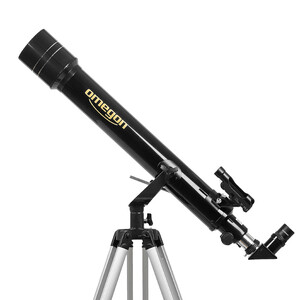
The no-pitfall starter refractor: Moon, Saturn's rings and Jupiter's moons from the very first night. No collimation.
Price: € 119
For more experienced observers: Skywatcher Dobson Telescope N 200/1200 Skyliner Classic
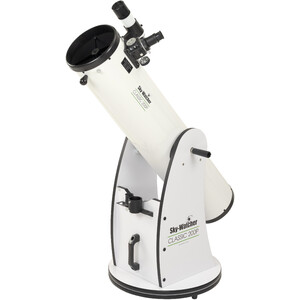
200 mm of aperture — the most sky for your money. Set it on the ground, point by hand: nebulae, clusters and galaxies for years to come.
Price: € 479
A telescope under the Christmas tree: what is actually worth it
December is the month in which most telescopes are given away – and the month in which most bad buys happen. The three most common ones: a device with a huge magnification figure on the box, a wobbly tripod that turns every touch into an earthquake, and a purchase date of 22 December.
The honest order is the other way round: aperture and mount decide, magnification comes second – it depends on the eyepiece and can be changed at any time. And anyone who only orders shortly before Christmas often finds the popular beginner instruments no longer in stock; the delivery time is shown in the shop for every model.
One point that most gift lists keep quiet about: on a telescope with 60 mm of aperture everything is over at around 120 times magnification. Beyond that the image gets bigger but blurrier – the three-digit number on the packaging promises nothing you can actually see.
If you would rather compare than commit here: the beginner telescope guide works through the designs, the selection for children names the age limits honestly, and under astronomy gifts you will find the ideas beyond telescopes – from books to the home planetarium.
And if it is going to be a telescope but the price question is still open: what does a telescope cost? sorts out all the price brackets – including the line below which binoculars are the better buy.
Not sure what is already in the cupboard? A gift voucher makes less of an impression under the tree, but it saves you the second eyepiece in duplicate.
Christening the new telescope: the first targets at Christmas
One detail most gift lists leave out: on the evening of 24 December 2026 the brightest full moon of the year is in the sky. For nebulae and galaxies that is the worst possible night – for a freshly unwrapped telescope it is almost ideal, because the three best beginner targets are all bright.
| When | Target | What you see |
|---|---|---|
| from 18:00 | Saturn, around 39° high in the south | The rings are unmistakably there from 60 mm of aperture upwards – the moment at which most people say “oh” for the first time |
| from 19:00 | The full moon in the east | At full moon the craters have no shadows – instead the ray systems around Tycho and Copernicus light up. On 17 and 30 December the half moon shows the craters in relief |
| from 20:00 | The Pleiades, around 55° high | Too big for the telescope, perfect for the finder scope that came with it or a pair of binoculars – dozens of stars at once |
| from 21:00 | Orion above the south-eastern horizon | The Orion Nebula shows as a milky patch even under a full moon – it gets properly good in the moonless nights of early January |
One piece of advice worth more than any accessory: put the telescope outside half an hour before the first observation. With ten degrees of temperature difference the air inside the tube shimmers so badly that even a good instrument looks out of focus – and that is exactly why some people give up after the first evening.
What comes next is in our overview of telescope accessories – and the answer is usually: a second eyepiece, not a second telescope.
* Affiliate link: if you buy through this link we may earn a small commission from Astroshop or High Point Scientific, at no extra cost to you.
Frequently asked questions about the December sky
When are the Geminids in 2026?
The maximum falls in the night of 13/14 December 2026 – with up to 150 meteors per hour under a largely moon-free sky. All the showers of the year: meteor shower calendar.
When is the winter solstice in 2026?
On 21 December 2026 at 21:50 Central European Time (CET) – the longest night of the year, with more than 16 hours of darkness in Germany.
Which planets can you see at Christmas 2026?
In the early evening Saturn in the south-west, later Uranus in Taurus – and in the morning sky Venus, Jupiter and Mars. On top of that the full moon of 24 December.
When is the full moon in December 2026?
On 24 December 2026 at 02:28 CET. It carries the name “Cold Moon” and is at the same time the brightest full moon of the whole year – on the evening of the 24th it still looks perfectly round to the eye.
Which telescope should I give as a Christmas present?
For most beginners a reflecting telescope with around 130 mm of aperture is the best choice – big enough for Saturn’s rings and the Orion Nebula, compact enough to actually be carried outside. Aperture and a stable mount matter more than the magnification figure on the box. The full picture is in the beginner guide.
Which constellations can you see in December?
The winter sky takes over: Orion with its belt, Taurus with Aldebaran and the Pleiades, Auriga with Capella, Gemini with Castor and Pollux, and Canis Major with Sirius. In the early evening the autumn constellations Pegasus and Andromeda are still in the west.
When does it get dark enough to observe in December?
In mid-December the sun sets around 16:10, and it is completely dark from about 18:15. The darkness holds until around 06:15 – roughly twelve hours in one stretch, and therefore the longest observing nights of the year.
➡️ What comes next: The night sky in January 2027 – with the Quadrantids and the build-up of Jupiter and Mars.
⬅️ The month before: The night sky in November 2026 – with the Uranus opposition, the meeting of Mars and Jupiter, and the Leonids.