By Alexander Merz · Updated on · Details checked on 5 October 2026
⏳ 2026 shower over – countdown to Perseid night 2027
The peak on the night of 12–13 August 2026 is over and the shower petered out around 24 August. The countdown points to the next peak: the night of 12–13 August 2027. Before that, the first shower worth staying up for is the Orionids on 21–22 October 2026.
What comes next ↓On the night of 12–13 August 2026 the Perseids reached their peak – on a New Moon, with not a trace of moonlight, and earlier that same evening a deep partial solar eclipse swept across the UK and much of Europe.
More in our overview: Shooting Stars.
The shower is over: the 2026 Perseids petered out around 24 August. This page tells you how peak night went, how to watch and photograph a meteor shower properly – which showers come next and when the Perseids peak again.
⚡ The quick answer: The 2026 Perseids are over: the peak was on the night of 12–13 August 2026 and the shower petered out around 24 August. The next shower worth an evening is the Orionids on 21–22 October 2026 (about 20 meteors an hour), then the Geminids on 13–14 December, the richest of the year. Next Perseid peak: the night of 12–13 August 2027. No telescope needed: just your eyes, a reclining chair and a warm blanket.
When exactly? Peak, best nights and times
The Perseids are active from roughly 17 July to 24 August, but the real show plays out in the week around the peak. The key thing to know: the rate climbs through every night towards dawn, because your side of Earth then turns "head-on" into the stream of particles and the radiant in Perseus rises higher. So the best time is not the early evening but the hours between midnight and dawn.
| Night | Conditions | Verdict |
|---|---|---|
| 8–9 to 10–11 August | building | Already worthwhile — rates grow noticeably from night to night |
| 11–12 August | very good | Dress rehearsal, with high rates already in the second half of the night |
| 12–13 August | Peak + New Moon | The night of nights — best hours between 2 am and dawn |
| 13–14 August | very good | Almost as strong as peak night — a perfect second chance if clouds roll in |
| from 15–16 August | fading | Rates roughly halve from one night to the next |
To put the numbers in context: the often-quoted figure of up to 100 meteors per hour is the theoretical ideal (radiant at the zenith, perfectly dark sky). Realistically, under a dark countryside sky in 2026 — thanks to the New Moon — you can count on around 50–60 visible shooting stars an hour in the best pre-dawn hours; from the edge of town more like 20–30. That is still, on average, one meteor a minute. For everything else the summer sky has on offer, see our overview of the August night sky.
What are the Perseids?
Every August the Earth crosses the dusty trail of comet 109P/Swift–Tuttle, discovered independently in 1862 by Lewis Swift and Horace Tuttle, which takes about 133 years to orbit the Sun (its next return is due in 2126). Its millimetre-sized fragments slam into the atmosphere at roughly 60 km/s — over 200,000 km/h — and burn up as bright, fast streaks of light. By perspective, all their paths seem to radiate from the constellation Perseus (the "radiant"), which is how the shower got its name.
Perseids are typically short, bright streaks, some of which leave a glowing train hanging in the sky for a second or two. Exceptionally bright members — fireballs, or bolides — are far from rare in this shower. In folklore the Perseids are known as the "Tears of St Lawrence", after the saint's feast day on 10 August. A quick note on terminology: while it glows in the sky it is a meteor; only a piece that actually reaches the ground becomes a meteorite — with the dust-grain-sized Perseids, that essentially never happens.
The Perseids are over: what comes next
Earth kept crossing the dust trail of Swift-Tuttle until around 24 August: after the peak the rate fell from 20–30 meteors an hour to a handful, and the shower is now closed. Here are the next dates, in order:
| Date | Meteors per hour (realistic) | What that means |
|---|---|---|
| 1 September 2026 | approx. 6 | Alpha Aurigids. Weak: the Moon is 85 % lit and stays up for most of the night. |
| 9 September 2026 | approx. 5 | September Perseids. Few meteors, but an almost moon-free sky. |
| 21–22 October 2026 | approx. 20 | Orionids. The first shower worth losing sleep over again: dark window between 3 and 5.30 am. |
| 13–14 December 2026 | up to 150 | Geminids. The richest shower of the year, with a largely moon-free peak. |
| 12–13 August 2027 | up to 100 | Perseids 2027. The Moon is 83 % lit and sets around 1.30 am – the second half of the night is what counts. |
The best window is much the same from one shower to the next: from about 11 pm, properly good after midnight. The radiant only climbs high enough as the night goes on – the higher it stands, the more meteors end up in your field of view at all.
The Kappa Cygnids, which ran alongside the Perseids, closed on 25 August as well. Every shower with date, rate and Moon phase is in our meteor shower calendar.
And if a night of shooting stars left you wanting to look deeper: for meteors a telescope is useless and always will be – but the rest of the sky is another matter, and October and December are the right months to start. Our guide to the best beginner telescopes starts from the right question – what do you want to see – rather than from the price; if you want the overview first, it is all in buying a telescope.
Perseids 2027: the next date
The next peak falls on the night of 12–13 August 2027. Conditions will be worse than in 2026: the Moon is 83 % lit and only sets around 1.30 am. The hours before that are washed out; the window between moonset and dawn is all the more valuable – anyone planning for Perseids in 2027 should plan the second half of the night from the start.
Every shower with date, rate and Moon phase is in our meteor shower calendar. The next big sky event is not a meteor shower, though: it is Saturn at opposition on 4 October 2026 – visible all night, its rings opened to 9.2° again, no filter needed. The partial lunar eclipse of 28 August 2026 can be read up on in recap.
12 August 2026: an hour-by-hour plan for the double bill
That double evening has been and gone – the plan stays online as a look back.
Having a solar eclipse and the Perseid peak land on the same calendar day is a gift. Here is how to make the most of both:
| Time (BST) | Programme |
|---|---|
| Afternoon | Location check: a clear view to the west (eclipse) and a dark spot for the night. Compare weather forecasts, settle on a plan B. |
| Early evening | Partial solar eclipse low in the evening sky — only ever view it through certified eclipse glasses! (Total across parts of Iceland and Spain.) |
| After nightfall | First Perseids — still few, but this is when the "earthgrazers" fly: rare, but unusually long trails that skim low across the sky. |
| From about 11 pm | Set up your reclining chair, let your eyes adapt to the dark for 20–30 minutes, put the phone away. |
| Midnight–2 am | Rates climb sharply as the radiant rises in the north-east. |
| 2 am to dawn | Prime time: the highest rates of the night. Holding out pays off — a flask of tea helps. |
How to watch properly
- Find a dark site: the less light pollution, the more meteors — the gap between town and countryside is a factor of three to five.
- After midnight is prime time: that is when the radiant in Perseus stands high and the Earth turns "head-on" into the particle stream.
- No telescope needed: shooting stars are wide-angle events. The naked eye, lying back comfortably, gaze halfway up to straight overhead — directly above you is where you catch the most.
- Protect your dark adaptation: 20–30 minutes without bright light, phone in your pocket (or night mode with a red filter). Every glance at the screen costs you minutes of sensitivity.
- Wrap up warm: even in August it turns surprisingly cold when you are lying still — blanket, sleeping mat, warm jacket, a flask.
- Be patient: meteors come in bursts. Plan for an hour and don't give up after ten minutes.
The best places to watch
The basic rule: get away from the town, keep a clear view to the north-east and overhead, and no direct light in your field of view — a field, a hilltop, a lake shore. The UK's darkest skies are found in its certified Dark Sky Reserves and parks, such as Northumberland, Exmoor, the Brecon Beacons (Bannau Brycheiniog), Galloway Forest or the Isle of Skye. Many local observatories and astronomy societies also run public viewing nights during the Perseids — ideal if you are after company or beginner tips. And if you are stuck in the city, a dark park or courtyard will still show the brightest members under a New Moon.
A word on the weather: whether the night turns clear is only decided at short notice — on 11 and 12 August compare several forecasts and keep a second site 30–60 minutes' drive away in reserve. In high summer it often pays to head towards the coast or the hills, where local cloud tends to clear more quickly. And if 12 August clouds over completely: the following night is almost as good.
Photographing the Perseids
Camera on a tripod, wide-angle lens, ISO 1600–3200, aperture wide open, 15–25-second exposures in a continuous series — sooner or later a shooting star will fly through the frame. Don't aim straight at the radiant but 30–60° to one side: that is where the trails appear longest. Our astrophotography guide explains how to tame camera and night sky; you can also do a surprising amount with a phone — see smartphone astrophotography. Smart telescopes, by the way, are not suited to meteors (their field of view is too small) — but they will happily shoot deep-sky objects on the same night.
Do you need any equipment?
For the meteors themselves, no — quite the opposite: any optic narrows your field of view and you miss shooting stars. The naked eye is the perfect instrument. Where a pair of binoculars really earns its place is in the quiet spells between bursts: sweep the summer Milky Way arching overhead, drop in on the Double Cluster in Perseus right beside the radiant, or the Andromeda Galaxy climbing in the east. A comfortable 10x50 is the classic all-rounder for exactly this kind of relaxed, hand-held sky-gazing.
Best all-rounder: Omegon Brightsky 10x50 Binoculars

Bright, high-contrast binoculars: perfect for the Moon, star clusters and Milky Way fields, handheld.
Price: € 289
Two things that help on meteor nights, even though the Perseids themselves need neither: a planisphere shows you at any moment which constellations stand above you — handy while you wait for the next bright one. And if watching meteors leaves you wanting to look deeper, a small tabletop Dobsonian is the classic first instrument.
For finding your way: Oculum Swivelling Sky Map 29 cm

Set date and time, hold it up, find the constellations: the swivelling star chart shows exactly the sky above you at that moment. No battery, no signal, no screen glare.
Price: € 19.90
The first telescope: Skywatcher Dobson Telescope N 130/650 Heritage FlexTube
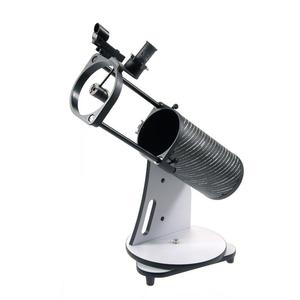
A compact tabletop Dobson with a true parabolic mirror. Folds down, fits in a bag: the Moon, planets and the bright deep-sky classics.
Price: € 265
* Affiliate link: if you buy through this link we may earn a small commission from Astroshop or High Point Scientific, at no extra cost to you.
Perseids with kids: shooting stars for the whole family
The Perseids are the most family-friendly sky event of the year: they fall in the summer holidays, the nights are mild and no equipment is needed. Two things make the evening work for children. First, manage expectations — far fewer meteors fall in the early evening than after midnight, but a child who holds out for half an hour from around 10:30 pm under a dark sky will still catch a few bright ones, and those are exactly the ones they remember. Second, comfort: a sleeping mat, a sleeping bag, hot chocolate, plus a little game ("who counts ten first?"). The night of 12–13 August 2026 is a Wednesday night — no problem for school-age children on their holidays. If you want to point out a few constellations along the way, Perseus and the striking "celestial W" of Cassiopeia above it are quick to find.
Shooting stars need no equipment at all. The rest of the sky does.
Six short questions, an honest answer by e-mail – including “better not”.
Frequently asked questions about the Perseids 2026
When exactly will I see the most shooting stars?
The peak was on the night of 12–13 August 2026, ideally between 2 am BST and dawn. The Perseids were not a one-night event: until 24 August the pre-dawn hours stayed best, with rates dropping night by night. The shower is now closed.
How many shooting stars will I really see?
The famous "up to 100 an hour" is an ideal value. Realistically: under a dark countryside sky in 2026 around 50–60 an hour in the best pre-dawn hours, 20–30 on the edge of town, and only the brightest from the middle of a city. Thanks to the New Moon, the odds in 2026 are as good as they rarely get.
Where should I look?
Nowhere in particular — meteors appear all over the sky. The radiant lies in the north-east (Perseus, below Cassiopeia), but you see the longest trails when you look a little to the side of it, or straight overhead.
Do I need binoculars or a telescope?
No — on the contrary: any optic shrinks your field of view and you miss meteors. The naked eye is the perfect instrument. Binoculars only pay off on the side, for the Milky Way and star clusters, and a telescope for a look at Saturn on the same night.
What is the difference between a meteor, a meteorite and a shooting star?
Shooting star and meteor mean the same thing: the streak of light from a particle burning up. A meteorite is the rare case of a chunk actually reaching the ground — with the dust-fine Perseids that essentially never happens. So "meteorite shower" is, strictly speaking, wrong.
Can I already see the Perseids in July?
Yes, the odd one from around 17 July, when the Earth crosses the outer edges of the dust trail. The rates stay low, though; things only really get going in the August nights from 8–9 August, with a steep climb towards the peak.
The bottom line
The Perseids 2026 were the best shooting-star opportunity in years: the peak on the night of 12–13 August, a New Moon, the summer holidays – and a partial solar eclipse earlier that same evening as the warm-up act. Stragglers were still around until 24 August; the next genuinely rich shower is the Geminids on 13–14 December 2026, moon-free and up to 150 meteors an hour.
🪐 The next sky show is already booked: on 4 October 2026 Saturn stands at opposition and is visible all night – a steady yellow point to the naked eye, its rings showing in even a small telescope. Everything is in the Saturn guide; the lunar eclipse of 28 August 2026 can be read up on in recap. And so dates like these never catch you out again:
The best observing dates, explained in plain language, plus honest buying advice without the marketing noise. Free, unsubscribe any time.
You will get a confirmation email in a moment. Your address stays with us – no sharing, no third-party ads.
📚 Read next:
- The August night sky: everything to see this month
- Best beginner telescopes: our buyer's guide
- Light pollution: how to find a truly dark sky
Also available in other languages: Deutsch · Français · Italiano