By Alexander Merz · Published on · Details checked on 14 September 2026
Perseus – A few prominent stellar configurations stretch right along the band of our Milky Way in the northern sky, among them the constellation Perseus. As with its famous neighbours, many stories, some of them contradictory, surround this hero of Greek mythology. Central European observers get their best view of the stars of Perseus in the autumn and winter sky. The greatest attention goes to the constellation during the activity maxima of two meteor showers which, from its radiant, “pour out” their shower of shooting stars across the sky in July as well as in September.
The most important facts at a glance
- Perseus is one of the 88 officially recognised constellations and lies north of the equator.
- It was named after the Greek myth of Perseus, a hero who beheaded the Gorgon Medusa and whose head, according to legend, came into the sky: the star Algol in Perseus is regarded as the eye of Medusa.
- Perseus is known for its many interesting celestial objects, including open star clusters, globular clusters, emission nebulae and galaxies.
- Some of the best-known celestial objects in Perseus are the Perseus Double Cluster, two open star clusters that lie close together and are visible to the naked eye, as well as the California Nebula, an emission nebula that shows a characteristic shape in visible light.
- Right next to Perseus, in Cassiopeia, lies the supernova remnant Cassiopeia A, which consists of the material released during the explosion of a massive star.
- An interesting fact about Perseus is that it is the radiant (the point of origin) of the annual Perseid meteor shower, one of the most famous and spectacular meteor showers of the year, visible in August.
- In astrology, Perseus is associated with qualities such as bravery, determination and independence.
- The constellation Perseus was first described by the Greek astronomer Ptolemy in the 2nd century AD.
Perseus, the legendary hero of Greek mythology
The son of the father of the gods Zeus and the mortal Danaë won his place in the northern sky through numerous battles and fateful encounters. Famous to this day, the constellation is known for the cunning with which he struck off the death-bringing head of Medusa (symbolised by the star “Algol”). On the band of the Milky Way his constellation accompanies the neighbouring constellation “Andromeda“, whom he rescued from a sea monster and received as his wife out of gratitude. Of his two meteor showers, the Perseids are the best known.
Because the Perseus myth itself is very extensive, many of its stars likewise have their own stories. “Algol”, for instance, is the older Arabic term for “head of the demon”, which the people of antiquity recognised in Medusa. Anyone who attentively observes the region around the constellation Perseus in the northern sky can understand why its position on the Milky Way, in connection with the myth, was feared in ancient times as a “star of doom”. Its meteor showers were therefore regarded as a fatal omen.
Where in the sky do I find Perseus?
In late autumn and winter the constellation Perseus is best visible, since at this time it stands high in the sky. It is located between the striking constellations of Auriga, with its pentagon of stars, and Cassiopeia. Perseus’s beloved, Andromeda, also points in his direction.
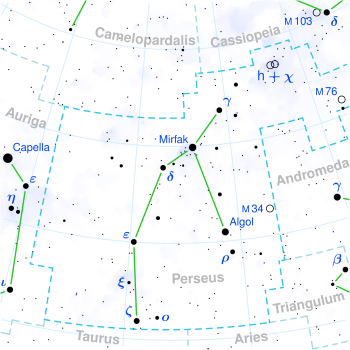
To find the constellation, you can follow the line of stars of Andromeda, which can be seen from the Great Square of Pegasus. On autumn evenings the constellation hangs in the sky as a chain of stars beneath Cassiopeia, and between the two constellations lies a pair of star clusters that can be viewed with binoculars.
The two clusters, named h and chi Persei, contain many stars that are about 7400 light-years away from us. With the naked eye, however, only diffuse patches can be made out.
What is there to observe in the constellation Perseus?
The constellation Perseus offers a wealth of celestial objects that can be observed with the naked eye or with telescopes. That way, before you set out to buy a telescope, you know what there is to observe. Here are some of the most interesting objects you can see in the constellation:
- The Perseus Double Cluster: these are two open star clusters lying close together, visible to the naked eye as a blurred patch in the sky. With a telescope, however, numerous stars can be discerned in both clusters.
- The California Nebula: an emission nebula that shows a characteristic shape in visible light and lies at the boundary with the neighbouring constellation Taurus. The nebula can be viewed with a telescope.
- NGC 869 and NGC 884: two further open star clusters, also known as the “Western” and “Eastern” Perseus Double Cluster. They can be observed with a telescope.
- Cassiopeia A (in the neighbouring constellation Cassiopeia): a remnant of a supernova, consisting of the material released during the explosion of a massive star. The remnant can be viewed with a telescope.
- The Perseid meteors: every year in August the Perseid meteors can be observed, which appear to come from the constellation.
- Other galaxies and star clusters: the constellation contains numerous galaxies and star clusters that can be observed with a telescope, including NGC 1023, NGC 1260 and IC 348.
Scientific features in the constellation
One advantage when observing the constellation is a collection of dark clouds that dims the light of background stars in this region of the Milky Way. Some of the brighter stars of this configuration in the northern sky are imposing multiple star systems. Their behaviour (e.g. variations in brightness) was described by the Arabs as “devil’s work”, which is how, for example, “Algol” came by its further nickname as the “Demon Star”. The two meteor showers (Perseids / September Perseids), with around 2,000 years of recorded history, are slightly younger than the descriptions of the hero Perseus himself.