By Alexander Merz · Updated on · Details checked on 13 October 2026
Its rusty glow and uncanny resemblance to our own world make the planet Mars one of the most captivating sights in the night sky. Our immediate neighbour is the outermost of the rocky inner worlds and, after Mercury, the second-smallest of the eight planets in the solar system. Here is everything you need to know to understand and observe it.
More in our overview: Planets of Our Solar System.
⚡ The quick answer: Mars is our outer neighbour, the “Red Planet” with half the diameter of Earth, giant volcanoes and icy polar caps. Right now (summer 2026) Mars rises in the pre-dawn sky and is edging closer to Earth: on 19 February 2027 it reaches opposition and will remain the most striking red object in the night sky for months.
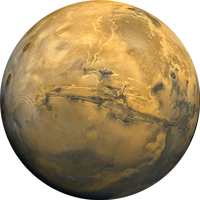
Mars fact sheet
- Rocky planet, the “Red Planet”
- 2 moons – Phobos and Deimos
- Diameter: 6,792 km
- Orbital period: 687 days
- Length of day: 24 h 37 min
- Distance from the Sun: 207 to 249 million km
- Temperature: −133 °C to +27 °C
- Atmosphere: 95 % CO₂
Planet Mars at a glance
Before we dive in, here are the key figures that sum up our red neighbour.
| Property | Value |
|---|---|
| Type | Terrestrial (rocky) planet |
| Orbital period | approx. 687 days (≈ 1.9 Earth years) |
| Day length (sol) | 24 h 40 min |
| Distance from the Sun | 207 to 249 million km |
| Surface temperature | -133 °C to 27 °C |
| Diameter | 6,792 km |
| Moons | Phobos and Deimos |
Where does the name Mars come from?
The planet owes its name to its orange, blood-red appearance in the sky. The Romans named it after Mars, their god of war, a symbol of conflict and strife. Its two small moons carry equally martial names: “Phobos” (Fear) and “Deimos” (Dread), the god’s sons. The entire surface and even the thin atmosphere are laced with iron(III) oxide — rust — which is why it is universally known as the “Red Planet.”
The key features of the planet Mars
Mars is only half the size of Earth and orbits 1.5 times farther from the Sun than our planet. A Martian year lasts about 1.9 Earth years, while a Martian day (a “sol”) runs to 24 hours and 40 minutes. Its orbit is far more elongated than those of the other planets: its eccentricity today is around 0.0935, compared with just 0.002 some 1.35 million years ago. Calculations show that the paths of Mars and Earth have drawn closer over the past 35,000 years and will keep narrowing for the next 25,000.
The habitable zone: could life exist on Mars?
A planet is deemed “habitable” when it lies neither too close to its star — where water would boil away — nor too far — where it would freeze solid. This long-standing concept assumes that life, if it exists at all, can only develop in forms resembling our own biology. By that definition Mars orbits just outside the “zone of life,” making life as we know it unlikely.
Space missions have disappointed astronomers and dreamers time and again. Structures that looked artificial from afar — even resembling a human face — turned out to be nothing more than tricks of erosion. Yet every new rover that touches down on Martian soil sharpens our understanding of the planet and may one day overturn our ideas about the worlds of the solar system.
Exploring Mars, then and now
No other planet is as close or as similar to Earth as Mars. Brightly lit by the Sun, it was already known to ancient civilisations. By the late 16th century astronomers had measured its position, determined its rotation (a little more than one Earth day, or 24.5 hours) and discovered its polar caps. The first maps of Mars date from 1820, and the famous “canali” reported by Giovanni Schiaparelli fuelled the myth of a once-inhabited world for decades.
Science spared no expense: more than thirty missions to Mars ended in failure, undone by unpredictable conditions or technical faults. But the successful flybys and landings dispelled the mystery of the “red desert.” Enigmatic structures proved to be volcanic vents, the surface grooves mere signs of erosion, and the supposedly habitable world a place hostile to life. Even so, these missions confirmed one bold intuition: Mars once held liquid water and an atmosphere. To this day it still harbours water ice and salt deposits left behind by ancient groundwater.
Also worth reading: How long does it take to travel to Mars?
Phobos and Deimos, the two moons of Mars
The discovery of two satellites orbiting our rocky neighbour was a genuine sensation. Phobos, the larger and closer of the two, behaves in a remarkable way: it rises in the west and sets in the east, twice every Martian day. Its very low density makes it look like a loosely bound rubble pile, most likely an asteroid captured long ago. Orbiting inside the “Roche limit,” Phobos spirals closer to Mars by 1.8 metres per century. Within 50 million years at the latest, tidal forces will tear it apart, either sending it crashing onto the surface or spreading it into a dusty ring around the Red Planet.
Deimos, smaller and much darker, behaves more conventionally: it rises in the east and sets in the west, but only once every 2.5 Martian days. From the surface of Mars an observer would see it as no more than a dim point of light. Like Phobos, it does not share the planet’s formation history and was probably captured as well. Several missions targeting both moons are now in preparation to unlock their secrets.
How to observe the planet Mars through a telescope
Mars only puts on a good show roughly every 26 months, when Earth overtakes it on the inside track: this is opposition. The next one falls on 19 February 2027, in the constellation Leo. From autumn 2026 the Martian disc grows noticeably in the eyepiece; from December onward, high magnification reveals dark surface markings and the bright polar cap.
For a first look, an affordable beginner refractor is enough to reveal the small red disc of Mars, the Moon and the brighter planets. To catch more detail around opposition, aperture is king: a Dobsonian telescope of 150 to 200 mm is the ideal instrument. If you are still weighing up instruments, our guide to observing Mars with a telescope compares the apertures in detail.
Best for beginners: Omegon Telescope AC 70/700 AZ-2
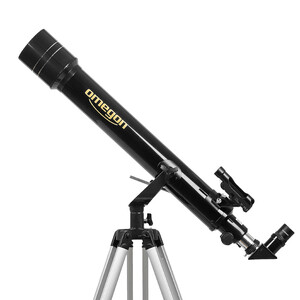
The no-pitfall starter refractor: Moon, Saturn's rings and Jupiter's moons from the very first night. No collimation.
Price: € 129
Best value: Skywatcher Dobson Telescope N 200/1200 Skyliner Classic
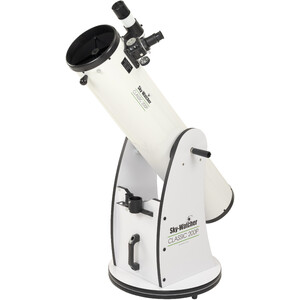
200 mm of aperture — the most sky for your money. Set it on the ground, point by hand: nebulae, clusters and galaxies for years to come.
Price: € 479
* Affiliate link: if you buy through this link we may earn a small commission from Astroshop or High Point Scientific, at no extra cost to you.
Where Mars is right now
Since its conjunction with the Sun on 9 January 2026, Mars has slowly worked its way out of the solar glare. Through the summer and autumn of 2026 it sits in the morning sky as an inconspicuous, slightly reddish star of about 1.5 mag – in the telescope barely more than a point.
That changes from winter onwards: every week brings Earth closer, the disc grows, and the real observing season begins around December 2026. You can check where it stands tonight in our overview Which planets are visible tonight?
The opposition on 19 February 2027 – the best date
Roughly every 26 months Earth overtakes Mars on the inside track. The planet then stands exactly opposite the Sun: it rises at sunset, is visible all night and reaches its greatest brightness. The next date is 19 February 2027, with Mars in Leo – a favourable position for Europe, because Leo culminates high in the February sky.
One caveat belongs with it: this is an aphelic opposition. Mars is then near the point of its orbit farthest from the Sun, and Earth closes to only 101.4 million kilometres (0.678 AU). The disc therefore stays clearly smaller than at the spectacular perihelic oppositions: 13.8 arcseconds, against 24.5 in September 2035 – almost double.
At −1.2 mag Mars is still brighter than any star except Sirius, and an unmistakable orange-red light in the winter sky. Around opposition it appears to reverse direction: the retrograde phase runs from 10 January to 1 April 2027. Over those weeks Mars traces a loop among the stars of Leo – an effect that occupied ancient astronomers for centuries and that you can follow with the naked eye.
What you see at which aperture
Mars demands magnification and steady air. As a rule of thumb: useful magnification up to about twice the aperture in millimetres, and better to wait half an hour until the telescope has cooled down.
| Instrument | What is visible around opposition |
|---|---|
| Naked eye | An orange-red “star”, very bright at opposition |
| 10×50 binoculars | Only a bright orange point – but the colour is unmistakable |
| 70–80 mm refractor | A tiny disc, occasionally a hint of the bright polar cap |
| 130 mm reflector | Polar cap clearly, plus the largest dark marking – Syrtis Major |
| 127 mm Maksutov | High-contrast image, several dark albedo regions in steady air |
| 200 mm Dobsonian and up | Fine surface detail, cloud veils at the limb, and their disappearance during dust storms |
A tip from practice: an orange or red filter lifts the dark albedo regions noticeably, while a blue filter brings out clouds and haze instead. Both cost little and are the cheapest gain in detail there is for Mars observing.
Phobos and Deimos through a telescope
The two Martian moons are a genuine challenge. Phobos reaches about 11.3 mag and Deimos about 12.4 mag – bright enough for a 150 mm telescope in principle, but they vanish in the glare of a planet a thousand times brighter.
Anyone who wants to try needs at least 250 mm of aperture, high magnification and a trick: hide Mars behind an occulting bar in the eyepiece or just outside the field, so that only the surrounding sky remains in view. At greatest elongation the moons stand only a few arcseconds from the planet.
Mars shows surface detail only around opposition and only in a telescope with enough aperture.
Six short questions, an honest answer by email – even when binoculars are the better choice.
Frequently asked questions about the planet Mars
When is the next Mars opposition?
On 19 February 2027. Because it happens near aphelion (Mars at its farthest from the Sun), the Martian disc stays fairly small at just under 14 arcseconds, but the planet still shines bright and unmistakable.
Why is Mars red?
Its surface dust contains iron oxide — plain rust. The reddish tint is clearly visible even to the naked eye.
Can you see Mars with a beginner telescope?
Yes, as a small reddish disc. Around opposition, telescopes from about 130 mm of aperture reveal dark surface markings and the white polar cap in steady air.
How long is a day on Mars?
A Martian day, called a “sol,” lasts 24 hours and 40 minutes, only slightly longer than a day on Earth.
How many moons does Mars have?
Two: Phobos and Deimos, two small, dark and irregular bodies that were most likely asteroids captured by the planet’s gravity.
📚 Read next: