By Alexander Merz · Updated on · Details checked on 6 October 2026
Mercury is the smallest of the eight planets in our solar system and the one closest to the Sun: a rocky planet 4,879 km across, with no moon, that circles the Sun in just 88 days.

Mercury fact sheet
- Rocky planet, closest to the Sun
- No moons
- Diameter: 4,879 km
- Orbital period: 88 days
- Length of day: 176 days
- Distance from the Sun: 57.9 million km
- Temperature: −173 °C to +427 °C
- Atmosphere: almost none
Mercury fact sheet: all the data at a glance
Mercury is a planet of extremes: the smallest planet, the shortest year and the widest temperature range in the solar system – and despite its closeness to the Sun, there is water ice in the permanently shadowed craters at its poles.
| Property | Value |
|---|---|
| Position in the solar system | 1st planet, the smallest in the solar system |
| Type | rocky planet – with the largest iron core relative to its size |
| Diameter | 4,879 km – smaller than Jupiter’s moon Ganymede and Saturn’s moon Titan |
| Mass | 3.301 · 1023 kg = 0.055 Earth masses |
| Mean density | 5.43 g/cm³ – the second-highest value after Earth |
| Surface gravity | 3.70 m/s² – about 38 % of Earth’s gravity |
| Mean distance from the Sun | 57.9 million km = 0.387 AU |
| Closest / farthest point from the Sun | 46.0 / 69.8 million km – the most eccentric planetary orbit |
| Distance from Earth | 77.3 to 221.9 million km |
| Orbital period | 88 Earth days – the shortest year in the solar system |
| Rotation period | 58.6 Earth days – in a 3:2 resonance with its orbital period |
| Solar day | 176 Earth days – one Mercury day lasts two Mercury years |
| Axial tilt | 0.03° – practically no seasons |
| Temperature | −173 °C at night to +427 °C at noon – the widest range in the solar system |
| Atmosphere | practically none – just a thin exosphere of oxygen, sodium and hydrogen |
| Moons | 0 |
| Magnetic field | yes, but weak – about 1 % of Earth’s field strength |
| Age | about 4.5 billion years – as old as the solar system |
| Apparent magnitude | −2.5 to +7.2 mag |
| Spacecraft | Mariner 10 (1974/75), MESSENGER (2011–2015), BepiColombo (in orbit from 21 Nov 2026) |
Observing Mercury: how to find it
In the sky, Mercury never strays more than about 28 degrees from the Sun. That is why you only see it low above the horizon in twilight – and only around its greatest elongations, the days when it stands farthest from the Sun. For one to two weeks it is then either low in the east in the morning or low in the west in the evening, roughly 60 to 40 minutes before sunrise or after sunset.
A clear horizon is a must – a row of houses or the edge of a forest is enough to close the window. Which window is currently open is listed in our monthly sky preview: The night sky in October 2026.
Hunting for Mercury works best with binoculars: they let you find the bright little dot in the brightening twilight much faster than with the naked eye. Important: never point the binoculars towards the Sun once it has risen!
Mercury visibility in 2026 and 2027: the dates
Not every greatest elongation is also a good apparition as seen from Central Europe. What matters is how steeply the ecliptic – the path of the Sun and planets across the sky – meets the horizon: in the evening in winter and spring, and in the morning in autumn, Mercury stands highest. We calculated the table for central Germany (50.5° N), so it applies to Central Europe; the altitude refers to the end or start of civil twilight (Sun 6° below the horizon).
| Well placed (altitude ≥ 5°) | When and where | Greatest elongation | Max. altitude | Rating |
|---|---|---|---|---|
| – (Oct 2026) | evening, southwest | 12 Oct 2026 (25.2°) | below 0° | not visible from Central Europe |
| 11 Nov – 5 Dec 2026 | morning, southeast | 21 Nov 2026 (19.6°) | 11° | good – best chance of 2026 |
| 25 Jan – 12 Feb 2027 | evening, southwest | 3 Feb 2027 (18.3°) | 9° | good |
| – (Mar 2027) | morning, east | 17 Mar 2027 (27.6°) | 2–3° | practically not visible |
| 10 May – 6 Jun 2027 | evening, west-northwest | 28 May 2027 (22.9°) | 10° | good – best evening apparition of 2027 |
| 17 Jul – 27 Jul 2027 | morning, east-northeast | 15 Jul 2027 (20.7°) | 6° | difficult, binoculars only |
| – (Sep 2027) | evening, southwest | 25 Sep 2027 (26.3°) | below 0° | not visible from Central Europe |
| 26 Oct – 18 Nov 2027 | morning, east-southeast | 4 Nov 2027 (18.8°) | 11° | good |
The best Mercury opportunity of the coming months is in late November 2026: around 7 a.m. CET (calculated for central Germany) it stands about 11° high in the southeast and, at around −0.5 mag, is brighter than most stars. On the very day of its greatest elongation, 21 November, the BepiColombo spacecraft is also due to enter orbit around Mercury. What else is in the sky right now is shown on our page Planets visible tonight.
🔭 Our pick for hunting Mercury
Celestron Nature DX ED 10x50 BinocularsOmegon Brightsky 10x50 Binoculars (currently $269.95€ 289) – bright and easy to handle: ideal for tracking down Mercury in twilight, and a dream for the Milky Way on the side.
View at Astroshop* →
Want to see more than a dot? Mercury itself stays a tiny crescent even in a telescope – for that you explicitly don’t need a big instrument. If, on the other hand, you want to see Saturn’s rings, Jupiter’s cloud bands and the phases of Venus, you’ll find the right telescope designs, with honest expectations, in our guide Which telescope for planets? – for a broad start, have a look at Telescopes for beginners.
*Affiliate link: if you buy through it, we receive a small commission – the price stays the same for you.
You’ll see Mercury best with binoculars – Saturn’s rings and Jupiter’s bands need more.
Six short questions, an honest answer by e-mail. Even when binoculars are all you need.
What is Mercury?
Mercury is the innermost of the four terrestrial planets, the rocky planets like Venus, Earth and Mars. Just as its motion through space is restless and eccentric, its surface is just as inhospitable: hot days of up to +427 °C and icy nights of −173 °C make it about as hostile to life as a world can be.
There are practically no seasons like ours, because its axis is barely tilted. Even so, the sunlight it receives varies greatly, because its orbit is so eccentric. This orbit also slowly turns around the Sun (perihelion precession, producing a so-called rosette orbit).
By the way, Mercury is not just the planet closest to the Sun: on average it is even closer to Earth than Venus is. We work out why in our article Which planet is closest to the Sun?
What’s more, Mercury’s year, at 88 days, is the shortest of all the planets in the solar system. Its rotation period of 58.6 days is exactly ⅔ of its orbital period around the Sun – three rotations for every two orbits.
It used to be assumed that Mercury always turns the same side towards the Sun, just as the Moon does towards Earth. Radar measurements disproved this in 1965.
What makes Mercury special: 6 facts that set it apart
- Shortest year: 88 days – in one Earth year, Mercury circles the Sun a little more than four times.
- Longest day: 176 Earth days pass from one sunrise to the next – one Mercury day lasts two Mercury years.
- Widest temperature range: about 600 degrees between the day side and the night side.
- Huge iron core: it extends over about 85 % of the planet’s radius.
- Ice in the searing heat: water ice lies in permanently shadowed craters at the poles.
- Einstein’s test case: the shift of its orbit by 43 arcseconds per century more than expected was only explained by the general theory of relativity.
How big is Mercury? Diameter and size comparison
Mercury has a diameter of 4,879 km – just 38 % of Earth’s. Its circumference at the equator is about 15,300 km.
It is even smaller than two moons: Jupiter’s moon Ganymede (5,268 km) and Saturn’s moon Titan (5,150 km) are larger. Our own Moon, at 3,475 km, is considerably smaller.
At 0.055 Earth masses, Mercury is nevertheless surprisingly heavy for its size. Its density of 5.43 g/cm³ is almost at Earth’s level – thanks to its large iron core. How it measures up against the other planets is shown in our overview of the planets by size.
Mercury’s temperature: between scorching heat and deep frost
On its day side, Mercury heats up to +427 °C; on its night side, it cools down to −173 °C. No other planetary surface swings so wildly. Lead would melt at noon.
The culprit is the missing atmosphere: without a layer of gas, Mercury cannot store or distribute heat. On top of that comes the extremely long solar day – every point on the surface bakes in the Sun for about 88 Earth days and then cools down for just as long.
| Location | Temperature |
|---|---|
| Day side (noon, near perihelion) | up to +427 °C |
| Average surface temperature | about +167 °C |
| Night side | down to −173 °C |
| Permanently shadowed polar craters | always below −170 °C – water ice survives here |
| For comparison: Venus | about +464 °C, day and night |
Even so, the hottest planet is not Mercury but Venus. Its dense carbon dioxide atmosphere traps the heat like a greenhouse – even at night.
What is planet Mercury made of?
Mercury is a rocky planet with no moon. Its iron core is huge in proportion: it extends over about 85 % of the planet’s radius, with only a shell of mantle and crust about 400 km thick on top. That is why little Mercury has almost the same density as the much larger Earth.
| Layer | Composition |
|---|---|
| Crust and mantle | silicate rock, together only about 400 km thick |
| Core | mainly iron, about 85 % of the radius, partly liquid |
Despite its slow rotation, Mercury has a global magnetic field – a sign of a partly liquid core. However, it is only about 1 % as strong as Earth’s.
Surface and appearance: what does Mercury look like?
Seen with the naked eye, Mercury would look grey-brown and, with its countless craters, strongly resembles our Moon. Its low reflectivity reveals dark rock on the surface.
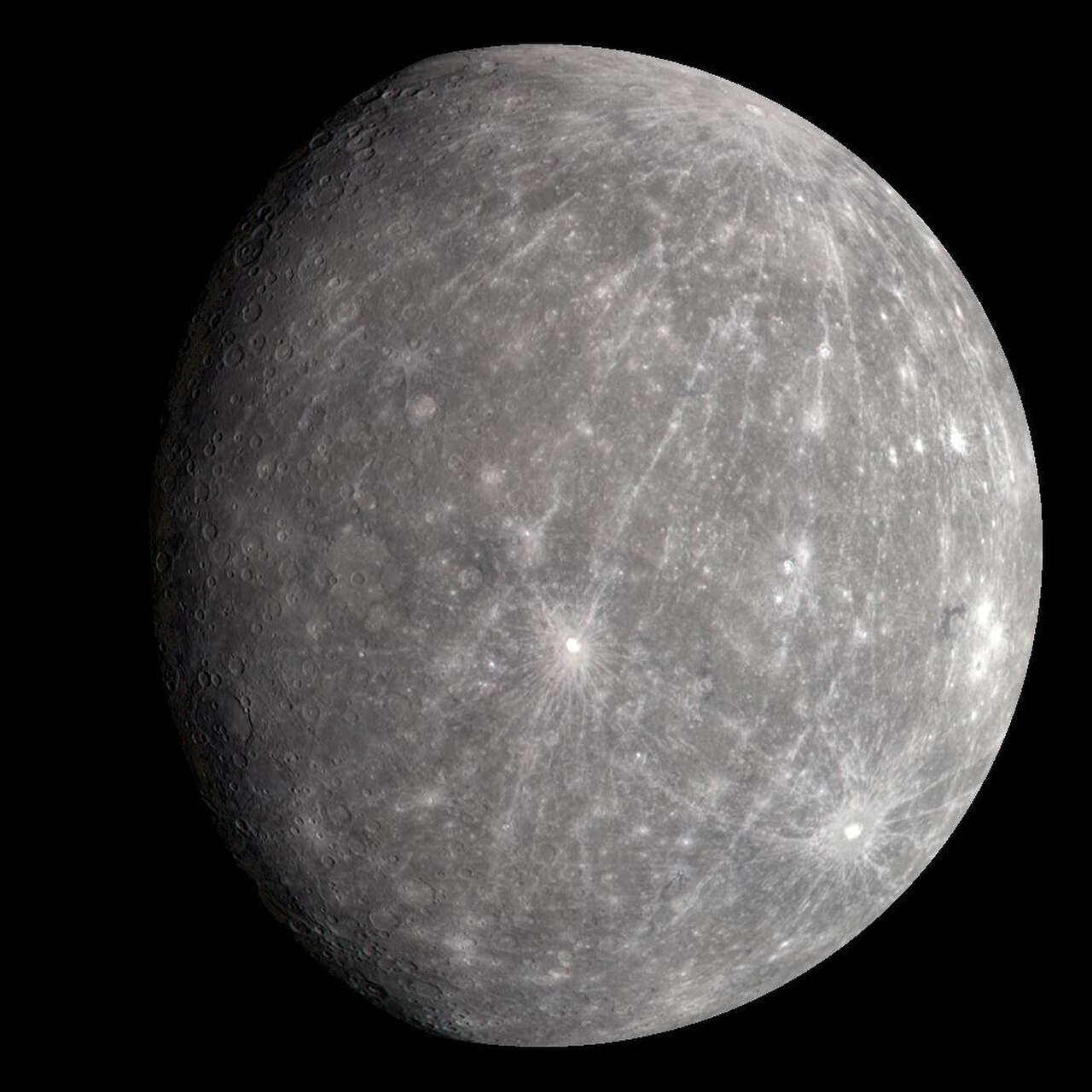
Because Mercury has hardly any atmosphere, meteorites strike it unchecked. Its surface is therefore riddled with craters, grooves and furrows. The largest scar is the Caloris Basin, about 1,550 km across – almost a third of the planet.
Mercury is shrinking: as its core cooled, it has lost kilometres of radius since it formed. Evidence of this are cliffs kilometres high that run for hundreds of kilometres across the landscape.
Does Mercury have an atmosphere?
The Sun constantly sweeps these particles away, while the solar wind and impacts knock new ones out of the ground. The exosphere offers no protection from radiation or cold.
How many moons does Mercury have? None – and there are reasons
Mercury has not a single moon. Together with Venus, it is the only planet in the solar system without a companion.
| Planet | Moons |
|---|---|
| Mercury | 0 |
| Venus | 0 |
| Earth | 1 |
| Mars | 2 |
The main reason is the nearby Sun: its gravity is so dominant that a moon could only orbit little Mercury stably within a narrow zone. A moon farther out would sooner or later be pulled away by the Sun.
Astronomers once actually believed they had found a moon of Mercury: in 1974, Mariner 10 picked up a UV signal that turned out to be a background star. Since then, neither MESSENGER nor BepiColombo has discovered a moon.
When was the planet discovered?
Mercury has no discoverer – it has been known since antiquity, because it can be seen with the naked eye. The oldest surviving records come from Mesopotamia: the cuneiform compendium MUL.APIN lists it, and the observations probably go back to Assyrian astronomers in the 14th century BC.
| Year | Milestone |
|---|---|
| c. 14th century BC | first recorded observations in Mesopotamia |
| 2nd century AD | Ptolemy describes Mercury – and greatly overestimates its size |
| 1631 | Pierre Gassendi is the first to see a transit of Mercury across the Sun |
| 1639 | Giovanni Zupi discovers Mercury’s phases through a telescope |
| 1965 | radar measurements reveal the 3:2 rotation |
| 1974 | Mariner 10 returns the first close-up images |
The Greek scholar Ptolemy described Mercury in the 2nd century, but his idea of its size was far from reality. In 1631, Pierre Gassendi was able to conclude from a transit of Mercury that Mercury did not measure 1/15 of the Sun’s diameter, as Ptolemy had estimated, but was many times smaller.
Name and meaning: messenger of the gods and quicksilver
Mercury takes its name from the Roman messenger of the gods, Mercurius, the god of merchants, travellers and thieves – fitting for its swift path across the sky. The Greeks called it Hermes, and in ancient Egypt it was associated with the god Set.
In alchemy, Mercury stood for quicksilver, the liquid, “nimble” metal. That is why this metal is still called “mercury” in English today; its chemical symbol is Hg.
What is a “mini solar eclipse” (transit of Mercury)?
A “mini solar eclipse”, as it is popularly known, means the passage of a planet in front of the Sun’s disc. Only Mercury and Venus can do this.
There are about 13 transits of Mercury per century, during which the planet, as seen from Earth, glides across the Sun as a tiny black dot. The next transit of Mercury, on 13 November 2032, can also be followed from Europe, and the one after that on 7 November 2039.
The exploration of Mercury
In 1639, Mercury research took a huge leap forward. Telescopes now allowed more precise views of the planets of the solar system. The Italian astronomer Giovanni Zupi discovered the phases of Mercury (similar to the phases of the Moon), proving that it orbits the Sun.
Around 1800, the German astronomer Johann Hieronymus Schröter drew rather sketchy maps of the planet. At the end of the 19th century and in 1934 and 1972, more accurate planetary maps were produced by Schiaparelli, Lowell, Antoniadi and Dollfus. What they all had in common: Mercury was given a prime meridian as well as lines of longitude and latitude, just as we know them from Earth.
Spacecraft to Mercury: Mariner 10, MESSENGER and BepiColombo
Mercury is not very “hospitable” to spacecraft. They have to withstand the high temperatures, the intense solar radiation and the particles of the solar wind. In addition, a spacecraft heading towards the Sun has to brake enormously, which is why it can only get there on long transfer orbits with several swing-by manoeuvres at other planets.
| Mission | Period | Result |
|---|---|---|
| Mariner 10 (NASA) | 1974/75 | three flybys, discovery of the magnetic field |
| MESSENGER (NASA) | in orbit 2011–2015 | first map of the whole planet, ice at the poles |
| BepiColombo (ESA/JAXA) | launched 2018, in orbit from 21 Nov 2026 | two orbiters, science operations from April 2027 |
The first successful close-up look was achieved by NASA’s Mariner 10 via a swing-by at Venus. A cleverly chosen trajectory, based on an idea by the Italian Giuseppe Colombo, gave it three encounters with Mercury instead of just one, in 1974 and 1975.
Mariner 10 returned images in visible, infrared and ultraviolet light. In the process, the spacecraft discovered the magnetic field – a first hint of a partly liquid planetary core, which is unusual for such a small body.
Some 30 years later, in 2004, the second NASA spacecraft, MESSENGER, was launched. After several flybys from 2008, in March 2011 it became the first spacecraft to enter orbit around Mercury. The mission ended on 30 April 2015, when it ran out of fuel and the spacecraft crashed onto Mercury’s surface as planned.
BepiColombo: arrival at Mercury in November 2026
The European-Japanese twin spacecraft BepiColombo has been on its way since 2018 and has already photographed Mercury during six flybys. On 3 September 2026 it separated its transfer module, and on 21 November 2026 it is due to enter orbit.
After that, the two orbiters will separate: the European MPO and the Japanese Mio, planned for 9/10 December 2026. The actual research is due to begin in April 2027 – including studies of the magnetic field, the core, the polar ice and Einstein’s theory of relativity.
Mercury explained for kids: the key facts
- Mercury is the planet that orbits closest to the Sun.
- It is the smallest planet – only a little bigger than our Moon.
- A year there lasts only 88 days. So you would have your birthday four times as often!
- In the daytime it is hotter than any oven, at night colder than the South Pole.
- Mercury has no moon and almost no air.
- You can sometimes see it shortly before sunrise or after sunset as a bright dot low in the sky.
Frequently asked questions about Mercury
When can you see Mercury?
Several times a year, each time around a greatest elongation – Mercury then stands for one to two weeks either low in the east in the morning or low in the west in the evening, always in twilight. The next good apparition as seen from Central Europe is from 11 November to 5 December 2026 in the morning sky. Which window comes next is listed in our monthly sky preview: The night sky in October 2026.
Why is Mercury so hard to observe?
In the sky, it never gets more than about 28 degrees away from the Sun. That is why it almost always rises and sets with the Sun – it is only visible briefly in twilight, low on the horizon.
Does Mercury have moons?
No. Mercury and Venus are the only planets in the solar system without moons.
Is Mercury a star?
No, Mercury is a planet – it does not shine by itself but reflects the light of the Sun. In the sky, however, it looks like a bright star, and the ancient Greeks at first even took it for two different stars: Apollo in the morning, Hermes in the evening.
How far is Mercury from Earth?
That varies between 77.3 and 221.9 million kilometres, depending on whether Mercury is on our side of the Sun or behind it. On average, this makes it even closer to us than any other planet.
How old is Mercury?
About 4.5 billion years – it formed together with the Sun and the other planets.
Which spacecraft is currently exploring Mercury?
The European-Japanese mission BepiColombo is due to enter orbit around Mercury on 21 November 2026 – the first European spacecraft at the innermost planet.
How to remember the order of the planets for good – from Mercury to Neptune – is shown on our page Planet mnemonic. You’ll find more about our solar system as a whole under Solar system.