By Alexander Merz · Updated on · Details checked on 6 October 2026
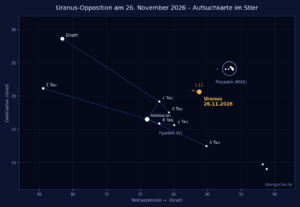
The ice giant is up all night, between the Pleiades and the Hyades. Findable with binoculars and a finder chart.
The right gear: Sky-Watcher Heritage 130 Tabletop Dobsonian – $269.00*
* Affiliate link: if you buy through this link we may earn a small commission – at no extra cost to you.
The Sun (the daytime star) is the central star of our solar system. All the planets, asteroids and comets of the solar system orbit the Sun. It holds more than 99% of the mass of the solar system and has a diameter 110 times larger than that of the Earth.
Despite this unimaginable size, the Sun is a rather medium-sized (dwarf) star and will continue to supply the solar system with warmth and other radiation for about another five billion years, before it dies out spectacularly.

What is the Sun?
The Sun is the star closest to Earth and forms the central body of our solar system. The Sun is a huge, extremely hot ball of gas. Every second it fuses 657 million tons of hydrogen into 653 million tons of helium.
The mass difference of 4 million tons is released as energy in the form of radiation. This radiation is emitted across the entire electromagnetic spectrum: radio waves, infrared radiation (heat), visible light, and X-ray and gamma radiation.
Our daytime star is a star of medium size. It is around 100 times larger than very small dwarf stars, but is itself 1,000 times smaller than the largest known star, VY Canis Majoris.
How old is the Sun? 4.6 billion years – about halfway
The Sun is about 4.6 billion years old, so it is roughly halfway through its life as a stable star. It will keep shining as steadily as today for about another 5 billion years, then swell into a red giant.
Its age is not measured on the Sun itself but on the oldest solid grains in the solar system: calcium-aluminium-rich inclusions (CAIs) in meteorites such as Allende. Their lead-lead age is 4.567 billion years, and the Sun is only slightly older than these first crumbs of its dust disc.
Helioseismology provides an independent cross-check: the oscillations of the solar surface reveal how much of the hydrogen in the core has already fused into helium. The result, about 4.57 billion years give or take 0.1 billion, matches the meteorites.
| Stage | When | What happens |
|---|---|---|
| Formation | 4.6 billion years ago, lasting a few tens of millions of years | A gas cloud collapses and nuclear fusion ignites in the core. |
| Main sequence (today) | for 4.6 billion years, about 5 billion to go | Hydrogen fuses into helium. The Sun slowly gets brighter – at the start it had only about 70 % of today’s luminosity. |
| Red giant | in about 5 to 7.5 billion years | The hydrogen in the core is used up and the Sun swells to roughly the size of Earth’s present orbit. |
| Planetary nebula | afterwards, a few tens of thousands of years | The outer layers are shed and glow as a nebula. |
| White dwarf | afterwards, trillions of years | What remains is an Earth-sized, extremely dense core that slowly cools down. |
For life on Earth the clock runs faster than for the Sun. Because it gets almost 10 % brighter every billion years, it will probably be too hot for liquid oceans in about a billion years – long before the red giant stage.
How is the Sun structured?
Our star has a shell-like structure. These three shells are separated from one another by thin transition zones.
Core of the Sun
The star’s core is the site of stellar fusion, where hydrogen is fused into helium. Only in the core are the pressure (200 billion bar) and temperature (15 million degrees) high enough for hydrogen to exist as an ionized gas (plasma). This allows the merging of four hydrogen nuclei into helium as part of hydrogen burning.
Inner atmosphere
Radiation zone
The radiation zone adjoins the core and passes the energy produced in the core on to the next zone as radiation. It can take many hundreds of thousands of years for a photon created in the core to travel through the radiation zone, before it reaches the surface of our central star and journeys to Earth in 8 minutes. The reason for this lies in collision and absorption effects.
Convection zone
In the convection zone, energy is transferred to circulating mass, which is heated in the process and rises to the Sun’s surface. Near the surface, energy is released, for example in the form of heat. The mass cools down and slowly sinks back towards the radiation zone, where it is heated again.
Photosphere
The photosphere is the visible part of the Sun. It forms the boundary surface between the stable matter and space, and radiates the Sun’s energy away, among other things in the form of light.

Chromosphere
The chromosphere is a thin gaseous envelope around the Sun that absorbs part of the radiated energy. It is visible for a brief moment during a total solar eclipse.
Outer atmosphere
Corona
The corona directly adjoins the chromosphere and merges into interplanetary space without a sharp boundary. Its size and appearance vary depending on the Sun’s level of activity. The corona is visible during a total solar eclipse.
When and how did the Sun form?
When our star formed about 4.6 billion years ago, the universe was already more than 9 billion years old. The first generation of stars, which formed early after the Big Bang, had already died. In these first-generation stars, the first heavier elements (helium, oxygen, carbon, silicon and iron) had already been produced from the abundant hydrogen.
After the first-generation stars perished in enormous explosions, they left behind the newly fused heavier elements as dust clouds in interstellar space. The birthplace of our daytime star was such a gas cloud, which already contained faint traces of these heavy elements.
The initially evenly distributed mass can collapse under its own gravity or be thrown out of equilibrium by a shockwave from a supernova. Both lead to a concentration of matter, which increasingly proceeds as a chain reaction and accumulates further matter ever more quickly.
As the mass increases, the pressure and temperature within the protostar rise. Its immediate surroundings are already clear of mass.
As soon as the core temperature exceeds a critical range, stellar fusion begins and a new star is born. From the remaining mass in the star’s gravitational field, planets, asteroids and comets can form.
How does our star work?
Why does our central star shine? Why, at a distance of 150 million km, do we still feel its warmth on our skin?
To understand this, we need to know what the energy source of our star is.
Like all stars, our star consists predominantly of hydrogen. Hydrogen is the most common element in the universe and is abundantly available, gathered in gas clouds, during star formation. After a gas cloud collapses, more and more matter accumulates in a protostar.
The star grows and the pressure and temperature in its core keep rising. Above a critical temperature and pressure, stellar fusion – so-called “hydrogen burning” – begins in the core of the newly born star. During stellar fusion, 4 hydrogen nuclei are fused into helium.
This creates a mass defect of about 0.7%. This “missing” mass has been converted into energy. The star, and therefore the Sun too, releases this energy among other things in the form of light and heat.
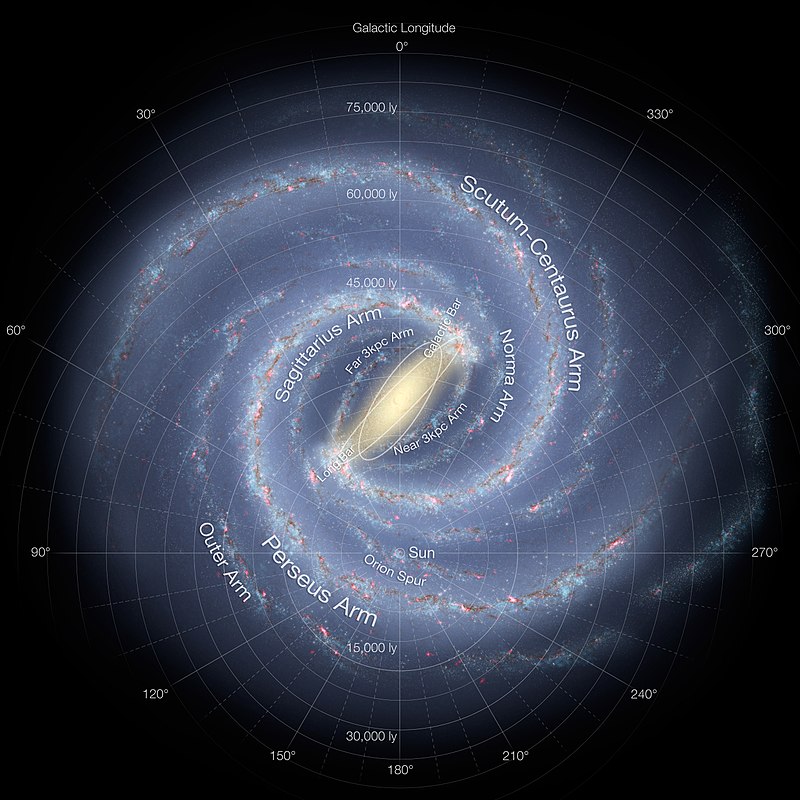
Where is the Sun located in the Milky Way?
Our solar system is located in the Orion Arm of our galaxy. The Orion Arm lies at half the radius of the galactic plane.
It is 28,000 light-years to the center of the Milky Way and 30,000 light-years to the outermost edge. The Sun takes 210 million years to orbit the galactic center.
Does the Sun influence the seasons?
The main cause of the seasons is Earth’s rotational axis, which is tilted relative to the orbital plane. The tilt means that the northern hemisphere is closer to the Sun in summer than in winter.
The reverse applies to the southern hemisphere. The tilt of Earth’s rotational axis has the least effect at the equator, which is why the climate there is described as a diurnal climate. The seasons are most noticeable at the poles.
Exciting and impressive facts about the Sun
- Diameter: The Sun has a diameter of about 1.4 million kilometers, making it 109 times larger than the Earth.
- Mass: The Sun makes up about 99.86% of the total mass of our solar system and weighs around 1.989 × 10^30 kilograms.
- Nuclear fusion: Inside the Sun, nuclear fusion reactions take place in which hydrogen is fused into helium. This releases enormous amounts of energy in the form of light and heat.
- Sunspots: Dark areas, known as sunspots, can be seen on the Sun’s surface. They are created by strong magnetic fields that affect heat transfer and thus lead to cooler spots.
- Solar wind: The Sun continuously emits charged particles, known as the solar wind. This affects the entire solar system and contributes to the formation of auroras on Earth.
- Solar cycle: The Sun goes through an activity cycle of about 11 years, ranging from calmer phases with few sunspots to more active phases with many sunspots and solar flares.
- Solar flares: Occasionally, powerful eruptions occur on the Sun, hurling large amounts of charged particles and radiation into space. Under certain circumstances, such events can disrupt satellites and communication systems on Earth.
- Lifespan: The Sun is about 4.6 billion years old and is expected to exist for another 5 billion years. It will then swell into a red giant and finally end as a white dwarf.
- Speed of light: The Sun’s light takes about 8 minutes and 20 seconds to reach the Earth.
- Gravity: The Sun’s gravity keeps the planets of our solar system in their orbits and thus makes life on Earth possible.
- Lagrange points: Balance points between the Sun, Earth and Moon.
Observing the Sun yourself
The Sun is the only star whose surface you can watch change with your own eyes – spots drifting across it over days, prominences arching off the limb. It is also the only object in the sky that can blind you in seconds: a look through an unfiltered telescope destroys the retina permanently, and painlessly.
Which filters are safe, why eyepiece filters are a trap, what separates white light from H-alpha, and how the projection method works without any filter at all – it is all in the guide Observing the Sun safely. If you want to start with the big event: a solar eclipse crosses Europe on 12 August 2026.
Frequently asked questions
✅ What are sunspots?
Sunspots are dark, cool areas on the photosphere. Their number and size depend on solar activity.
Solar activity, and with it the sunspots, goes through a cycle of about 11 years. The cause of sunspots is thought to be strong magnetic fields, which impede heat transport through the convection zone and are partly responsible for strong solar flares.
✅ How can I observe the Sun?
There are numerous live images of the Sun on the internet. This lets you observe the Sun conveniently and safely on your monitor.
Anyone wishing to buy a telescope in order to observe the Sun ABSOLUTELY needs a solar filter, which must be mounted in front of the telescope aperture.
This filter reduces the solar radiation to 0.001–0.0001% and thus prevents strong radiation from entering the telescope, which unfiltered would lead to blindness.
In general, all improvised filters, such as blackened glass or the like, are strongly discouraged.
✅ Is the Sun a star?
Yes, the Sun is a star. It is one of the medium-sized dwarf stars and is in the middle of its life cycle.
In about 5 billion years, the Sun will use up its fuel and, as a white dwarf the size of the Earth, will continue to exist for a long time before it dies out completely (a black dwarf).
✅ How long does light take to travel from the Sun to the Earth?
A photon leaving the Sun’s surface takes an average of 8 minutes and 20 seconds to reach the Earth.
The same photon, however, takes up to 170,000 years to travel from where it was created in the Sun’s core to the Sun’s surface.
✅ How hot is the Sun?
The surface temperature of our star averages 5,500°C. In the core of our Sun, temperatures of up to 15.5 million°C prevail.
✅ How far is the Earth from the Sun?
The Earth is on average 149.6 million km from the Sun. This distance is also referred to as one astronomical unit (AU).
✅ How many times does the Earth fit into the Sun?
We answer this frequently asked question in various ways in How many times does the Earth fit into the Sun?