By Alexander Merz · Published on · Details checked on 14 September 2026
No other constellation has so much to offer – and shows us so little of it. Behind the constellation Sagittarius lies the center of our Milky Way, fifteen Messier objects crowd together here in the smallest of spaces, and right in the middle sits a black hole of four and a half million solar masses. The catch: from Germany, the figure never crawls higher than a hand’s width above the southern horizon. To find Sagittarius you therefore need no large telescope, but above all the right night, the right direction and a clear view to the south.
⚡ The quick answer: Sagittarius (Latin Sagittarius) sits low in the south, below and to the left of the red Antares in Scorpius. Eight of its stars form the “Teapot” – an asterism with lid, handle and spout.
Best time: July to early September, around 11 p.m. On July 1 there remain roughly 3.6 hours of genuine observing window; in August the constellation stands highest in the evening – but even then Nunki reaches only 13.7° at 50° north.
What makes it special: behind the spout of the Teapot lies the center of the Milky Way with Sagittarius A*. No constellation contains more Messier objects – among them the Lagoon Nebula M 8 and the globular cluster M 22.
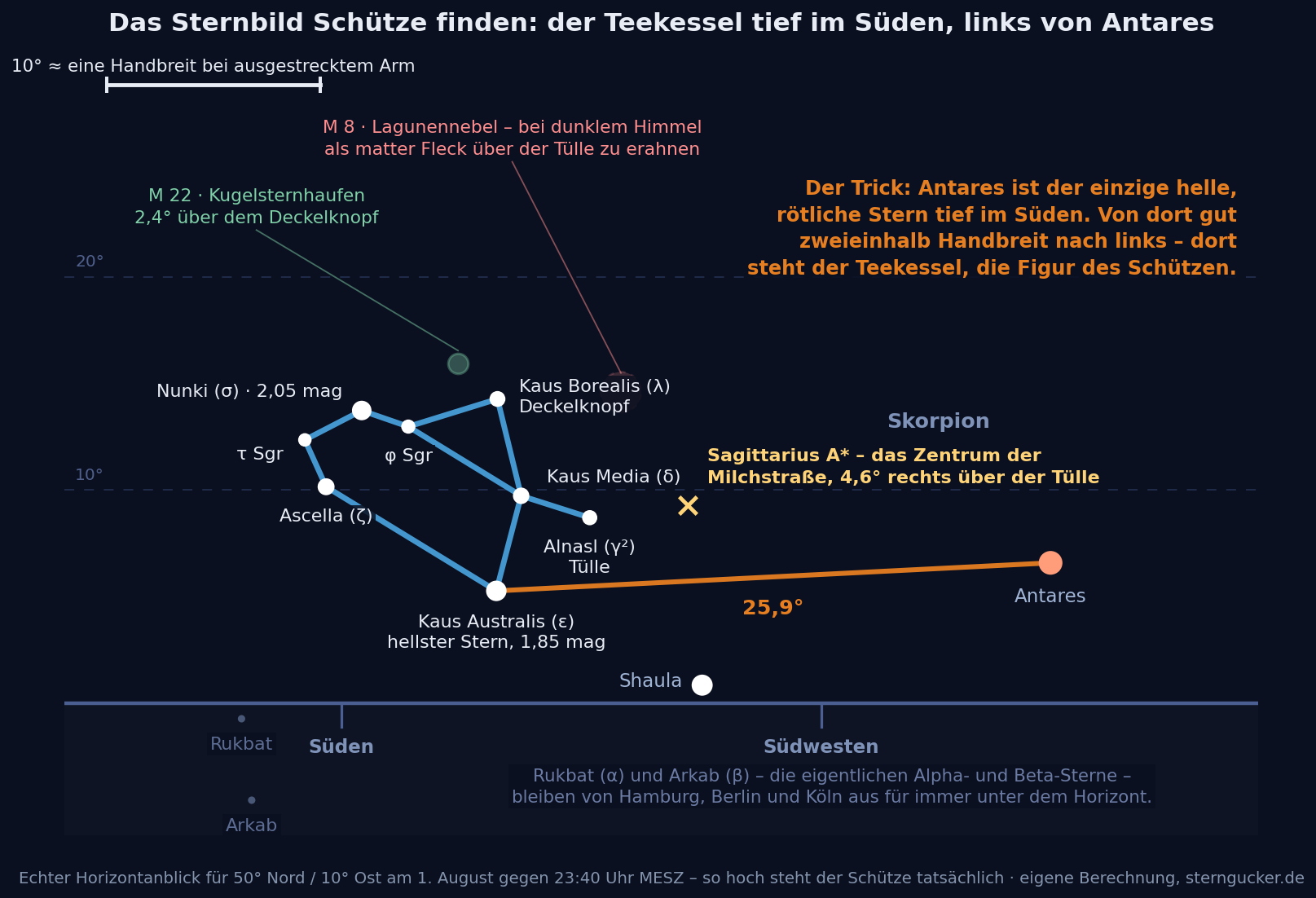
Finding the constellation Sagittarius: the Teapot above the southern horizon
The good news first: Sagittarius is one of the few cases where you don’t have to search for a constellation, only a direction. In high summer it stands exactly in the south when it is highest – and because it stays so low, the horizon itself is the best guide. Everything between the southern horizon and an outstretched fist comes into question.
The rest is a single line of sight. About 26 degrees to the west – that is, to the right – of Sagittarius shines the red supergiant Antares, the heart of Scorpius and the most conspicuous star in this part of the sky. Whoever has found Antares practically has Sagittarius already.
The line of sight from Antares: 26 degrees to the left to the Teapot
From Antares you go to the left (east). The outstretched fist at the end of an outstretched arm measures about 10 degrees, a spread hand about 20 degrees. Two to three fist widths to the left of Antares the Teapot begins:
| Line of sight | Angular distance | outstretched arm |
|---|---|---|
| Antares → Alnasl (spout) | 21.5° | a good two fist widths to the left |
| Antares → Kaus Australis | 25.9° | about one spread hand plus half a fist |
| Shaula (Scorpion’s sting) → Alnasl | 9.5° | barely one fist width |
The second route runs via the Scorpion’s sting: the two stars Shaula and Lesath stand as a close pair at the end of Scorpius, less than a fist width to the right of Alnasl, the tip of the Teapot’s spout. Whoever sees the sting also sees Sagittarius – and whoever does not see the sting simply has no clear southern horizon. Then only a different site helps, not a larger instrument.
🧭 The question of location decides everything
For Sagittarius, a clear horizon counts more than any instrument. A hill, a row of trees or a house to the south wipes out half the constellation. Ideal are lakeshores, field tracks with a view to the south, coasts or hilltops.
Added to this is light pollution: the horizon haze over a city sits exactly where Sagittarius stands. Even 30 kilometers south of a large city the light dome can completely outshine the constellation.
The Teapot in detail: eight stars, 35 degrees of perimeter
The Teapot (“Teapot”) is not an official constellation, but an asterism – a figure that observers read into the brightest stars. It is far easier to recognize than the ancient archer, whom almost no one finds again in the sky without a template. And once seen, you never lose it again:
| Part of the pot | Star | Brightness |
|---|---|---|
| Spout (tip) | γ² Sgr – Alnasl | 2.96 mag |
| Spout (bottom) | δ Sgr – Kaus Media | 2.70 mag |
| Base (right) | ε Sgr – Kaus Australis | 1.85 mag |
| Lid | λ Sgr – Kaus Borealis | 2.81 mag |
| Base (left) | ζ Sgr – Ascella | 2.59 mag |
| Handle (top) | σ Sgr – Nunki | 2.05 mag |
| Handle (middle) | φ Sgr | 3.17 mag |
| Handle (bottom) | τ Sgr | 3.32 mag |
Measured out, the pot is surprisingly compact: the distance from the spout (Alnasl) to the handle (Nunki) measures 11.6 degrees, from the base (Kaus Australis) to the lid (Kaus Borealis) it is 9.0 degrees. The total perimeter of the figure amounts to 34.7 degrees – that is less than three outstretched fists. It thus fits easily into a binocular field of view, if you pan the binoculars along three times.
A pretty detail for mild summer nights: the band of the Milky Way rises exactly out of the spout. Anyone under a truly dark sky sees the “steam” rising vertically from the pot – in reality these are the star clouds of the inner galaxy.
Sagittarius at a glance: area, boundaries and neighbors
| Feature | Value |
|---|---|
| Latin name | Sagittarius (genitive: Sagittarii) |
| Abbreviation (IAU) | Sgr |
| Area | 867.4 square degrees – rank 15 of 88 |
| Right ascension | 17h 44m to 20h 28m |
| Declination | −45.2° to −11.7° |
| Brightest star | ε Sgr (Kaus Australis), 1.85 mag |
| Stars brighter than 3 mag | 7 |
| Messier objects | 15 – more than in any other constellation |
| Best visibility | July to early September |
| Sun in the constellation | December 18 to January 18 |
| Neighbors | Aquila, Capricornus, Corona Australis, Microscopium, Ophiuchus, Scorpius, Scutum, Serpens, Telescopium |
Two figures in this table call for explanation. The area of 867.4 square degrees makes Sagittarius the fifteenth-largest constellation of all – so it is not small at all, we simply see only its upper edge. And the 15 Messier objects are an absolute record: Charles Messier worked from Paris, a good four degrees of latitude farther south than Berlin, and even there Sagittarius stood at the lower limit of the possible. Even so, he found more objects here than in any other constellation – simply because toward the galactic center there is so unimaginably much.
The declination of −11.7° to −45.2° is the source of all the difficulties. At 50° north the southernmost still-visible point lies at about −40° – the lower third of the constellation simply never rises above the horizon from Central Europe.
The stars in the constellation Sagittarius: from Kaus Australis to Rukbat
Sagittarius has no truly bright star – no Vega, no Antares, no Deneb. Its brightest, Kaus Australis, reaches 1.85 mag and thus ranks 36th on the list of stars. In return, no fewer than seven stars are brighter than 3 mag, which holds the figure together surprisingly well under a clear sky. The Arabic names of the three “Kaus” stars, by the way, simply mean bow: Kaus Australis is the southern, Kaus Media the middle, Kaus Borealis the northern part of the bow.
| Bayer | Name | mag | Light-years | Notable feature |
|---|---|---|---|---|
| ε Sgr | Kaus Australis | 1.85 | 143 | fastest known rotator in the Milky Way |
| σ Sgr | Nunki | 2.05 | 225 | next expected core-collapse supernova |
| ζ Sgr | Ascella | 2.59 | 88 | triple system, closest companion in a 21-year orbit |
| δ Sgr | Kaus Media | 2.70 | 348 | orange giant, lower part of the spout |
| λ Sgr | Kaus Borealis | 2.81 | 78 | only 2.1° from the ecliptic – occultations possible |
| γ² Sgr | Alnasl | 2.96 | 106 | “arrowhead” – points almost exactly at the galactic center |
| η Sgr | η Sagittarii | 3.10 | 146 | never rises from Hamburg |
| φ Sgr | φ Sagittarii | 3.17 | 231 | upper attachment of the handle |
| τ Sgr | τ Sagittarii | 3.32 | 122 | lower attachment of the handle |
| π Sgr | Albaldah | 2.88 | 510 | triple system north of the pot |
| α Sgr | Rukbat | 3.97 | 170 | bears the “alpha”, yet is only the eleventh-brightest star |
| β¹ Sgr | Arkab Prior | 3.96 | 378 | rises nowhere in Central Europe |
Kaus Australis (ε Sgr): the fastest spinning top in the Milky Way
The brightest star of Sagittarius is a blue-white giant 143 light-years away, about 375 times as luminous as our Sun. Its real record, however, is another one: Kaus Australis rotates at 236 kilometers per second at its equator. That is about 95 percent of the speed at which a star of its mass and size would be torn apart by centrifugal force – the highest rotation rate ever measured on a star in the Milky Way.
For comparison: our Sun rotates at its equator at just under 2 kilometers per second and needs 25 days for one turn. Kaus Australis manages one rotation in a few hours. Such a star is markedly flattened – its equatorial diameter noticeably exceeds its polar diameter, and the poles are hotter than the equator. In binoculars you notice none of this, of course; you see a white point low above the horizon. But it is one of those cases where knowledge changes the view.
Nunki in the constellation Sagittarius: the next supernova candidate
Nunki marks the upper handle of the Teapot and is the star by which the visibility of the whole constellation is measured – all height figures in this article refer to it. The name is one of the oldest of all: it comes from Babylonian and is thus about 4,000 years old, its meaning unclear to this day.
Astronomically, Nunki is a blue main-sequence star of type B2.5, 225 light-years away, about seven times as massive as the Sun and 3,300 times as luminous. With this mass its end is preordained: Nunki will explode in a few tens of millions of years as a core-collapse supernova – and is thus, by current knowledge, the closest star to Earth for which such a supernova is expected. It won’t be dangerous: a supernova would become critical for Earth’s biosphere only from about 50 light-years’ distance, and Nunki stands four times as far away. In the sky, however, it would shine brighter than the full Moon for weeks.
Kaus Borealis (λ Sgr): the star right on the ecliptic
Kaus Borealis forms the lid of the Teapot and, at 78 light-years, is the closest bright star of the constellation to Earth. Its special feature is its position: it stands only 2.1 degrees south of the ecliptic, that is, almost exactly on the path that the Sun, Moon and planets follow. That is why the Moon can occult it, and occasionally planets do so too. On November 19, 1984, Venus passed in front of Kaus Borealis – an event that, for any given star, occurs on average only once every few centuries.
The nearness to the ecliptic also explains why planets are so often guests in Sagittarius. Jupiter, Saturn and Mars regularly wander through the pot – and a bright planet in the Teapot is by far the easiest opportunity to find the constellation at all. The astro-events calendar shows when that will next be the case.
Rukbat and Arkab in Sagittarius: stars that never rise for us
For Sagittarius, Johann Bayer evidently did not sort by brightness in 1603. α Sagittarii (Rukbat), at 3.97 mag, is only the eleventh-brightest star of the constellation, β Sagittarii (Arkab), at 3.96 mag, the tenth. Both mark the forelegs of the centaur – Bayer probably named them here by position rather than by brilliance.
For us this is academic anyway, because both stars lie so far south that in large parts of Central Europe they never rise above the horizon. The declination below which a star remains theoretically invisible depends solely on the geographic latitude:
| Location | Circumpolar-invisible below | Consequence for Sagittarius |
|---|---|---|
| Hamburg (53.6° N) | −36.4° | Rukbat, Arkab and η Sgr remain invisible |
| Berlin (52.5° N) | −37.5° | Rukbat and Arkab remain invisible |
| Cologne (50.9° N) | −39.1° | Rukbat and Arkab remain invisible |
| Frankfurt (50.1° N) | −39.9° | Rukbat and Arkab remain invisible |
| Munich (48.1° N) | −41.9° | Rukbat becomes visible (max. 1.3°), Arkab does not |
| Bern (46.9° N) | −43.1° | Rukbat visible, Arkab still not |
Arkab (−44.5°) stays below the horizon throughout Central Europe – you cannot see it from here in principle. Whoever wants to see the complete figure of the archer must move to the Mediterranean region: from Crete or Cyprus onward, the whole constellation stands clear in the sky.
When Sagittarius is visible: altitude and observing window
For Sagittarius this question has two answers that must be kept apart. One is: July to early September – that is the time when the constellation is above the horizon in the evening at all. The other is: depending on the night, one to three and a half hours – that is the time when it is simultaneously high enough and the sky dark enough. The difference is greater for Sagittarius than for any other constellation.
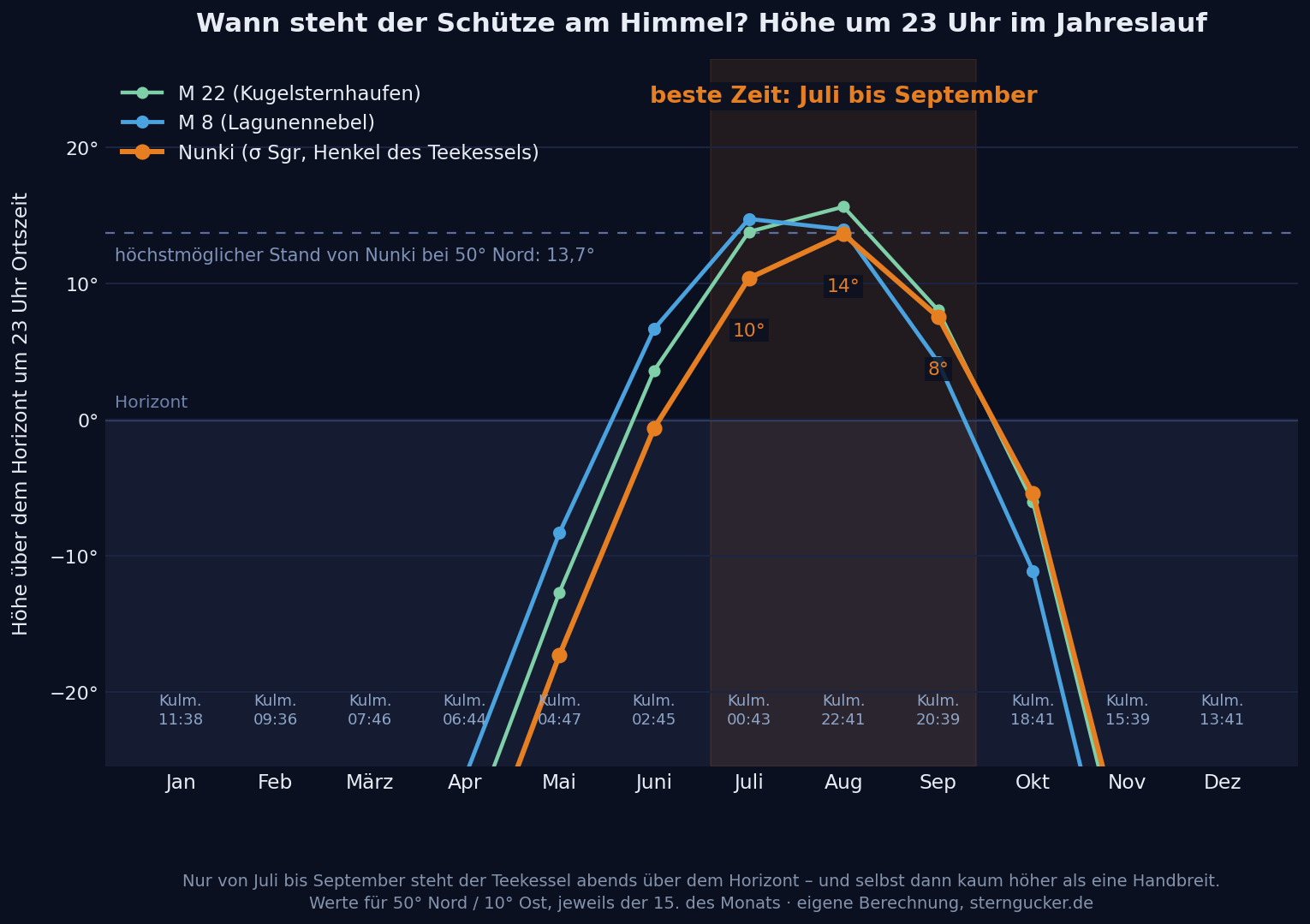
The curve shows the altitude at 11 p.m. local time over the year, calculated for 50 degrees north. From January to May Nunki is deep below the horizon at this hour – in January even 65 degrees below it, that is, on the other side of the Earth. Only in July does it emerge, in August it reaches almost exactly its theoretical maximum with 13.6 degrees, and in October the show is over.
| Month | Altitude of Nunki at 11 p.m. | Culmination | In practice |
|---|---|---|---|
| January | below the horizon | 11:38 | – |
| March | below the horizon | 07:46 | – |
| May | below the horizon | 04:47 | from mid-May in the dawn twilight |
| June | just at the horizon | 02:45 | hardly visible in the bright night |
| July | 10.4° | 00:43 | best window of the year |
| August | 13.6° | 22:41 | highest in the evening, but brief |
| September | 7.5° | 20:39 | only the upper half left |
| October | below the horizon | 18:41 | already culminates during twilight |
The third column explains the paradox: in August Sagittarius culminates at 22:41, when it is highest – but twilight is not quite over then, and by midnight it is already sinking again. In July it culminates only at 00:43, in the middle of the darkest part of the night. That is why July is the better choice for deep-sky, even though the constellation stands higher in August on paper.
The real observing window: when dark and high coincide
If you count only the time when Nunki stands higher than 10 degrees and the Sun is more than 12 degrees below the horizon (nautical twilight over), astonishingly little remains. Calculated for 50 degrees north in 2027:
| Date | usable window | Note |
|---|---|---|
| May 15 | 1.1 h | only in the dawn twilight |
| June 1 | 1.7 h | shortly before sunrise |
| June 15 | 2.4 h | the shortest nights of the year slow it down |
| July 1 | 3.6 h | 23:50 to 3:26 – the optimum |
| July 15 | 3.4 h | practically equivalent |
| August 1 | 2.8 h | very good, the pot culminates at 22:41 |
| August 15 | 2.4 h | the figure is already sinking noticeably |
| September 1 | 2.0 h | only early in the evening now |
| October 1 | 1.2 h | the rest of the season |
July 1 is thus the best night of the year for Sagittarius: 3 hours 36 minutes between 23:50 and 3:26, during which the constellation is high enough and the sky dark enough. Anyone with only a single evening to spare for this constellation should put it in the first week of July – and check the Moon calendar beforehand, because a Moon over 50 percent ruins everything near the horizon.
Culmination altitude by city: from Hamburg to Bern
For Sagittarius, just a few hundred kilometers decide between success and frustration. Every degree of latitude farther south raises the constellation by exactly one degree. The following table shows the maximum altitude above the horizon that the most important objects in Sagittarius reach at eleven locations – calculated for the moment of culmination:
| City | Kaus Borealis | Nunki | Kaus Australis | M 8 | M 22 | M 17 |
|---|---|---|---|---|---|---|
| Hamburg | 11.0° | 10.2° | 2.1° | 12.1° | 12.5° | 20.3° |
| Berlin | 12.1° | 11.2° | 3.1° | 13.1° | 13.6° | 21.3° |
| Dresden | 13.5° | 12.7° | 4.6° | 14.6° | 15.0° | 22.8° |
| Cologne | 13.6° | 12.8° | 4.7° | 14.7° | 15.2° | 22.9° |
| Frankfurt | 14.5° | 13.6° | 5.5° | 15.5° | 16.0° | 23.7° |
| Stuttgart | 15.8° | 14.9° | 6.8° | 16.8° | 17.3° | 25.0° |
| Vienna | 16.4° | 15.5° | 7.4° | 17.4° | 17.9° | 25.6° |
| Munich | 16.4° | 15.6° | 7.5° | 17.5° | 18.0° | 25.7° |
| Zurich | 17.2° | 16.3° | 8.2° | 18.2° | 18.7° | 26.4° |
| Graz | 17.5° | 16.6° | 8.5° | 18.5° | 19.0° | 26.8° |
| Bern | 17.6° | 16.8° | 8.7° | 18.7° | 19.1° | 26.9° |
Two things stand out. First: Kaus Australis, the brightest star of the constellation, stands in Hamburg even at the best moment only 2.1 degrees above the horizon – that is less than a thumb’s width and practically never visible, because at this altitude the ordinary haze already swallows everything. In Bern it is 8.7 degrees, and that is observable.
Second: M 17, the Omega Nebula, stands everywhere markedly higher than the rest. It lies at the northern edge of the constellation and reaches over 20 degrees even in Hamburg. Whoever lives far north and still wants to see something of Sagittarius starts with M 17 – not with M 8.
Why Sagittarius looks so pale: the air swallows its light
Altitude figures alone do not yet explain why Sagittarius looks so much more disappointing in binoculars than in photos. The real reason is atmospheric extinction: the shallower the view, the more air stands in the way. Straight up, the light passes through one air mass, at 30 degrees altitude already two, at 10 degrees altitude nearly six.
| Altitude above horizon | Air masses | Light loss | Fraction swallowed |
|---|---|---|---|
| 90° (zenith) | 1.00 | 0.28 mag | 23 % |
| 45° | 1.41 | 0.40 mag | 30 % |
| 30° | 1.99 | 0.56 mag | 40 % |
| 20° | 2.90 | 0.81 mag | 53 % |
| 13.7° (Nunki at 50° N) | 4.16 | 1.16 mag | 66 % |
| 10° | 5.59 | 1.56 mag | 76 % |
| 5° | 10.31 | 2.89 mag | 93 % |
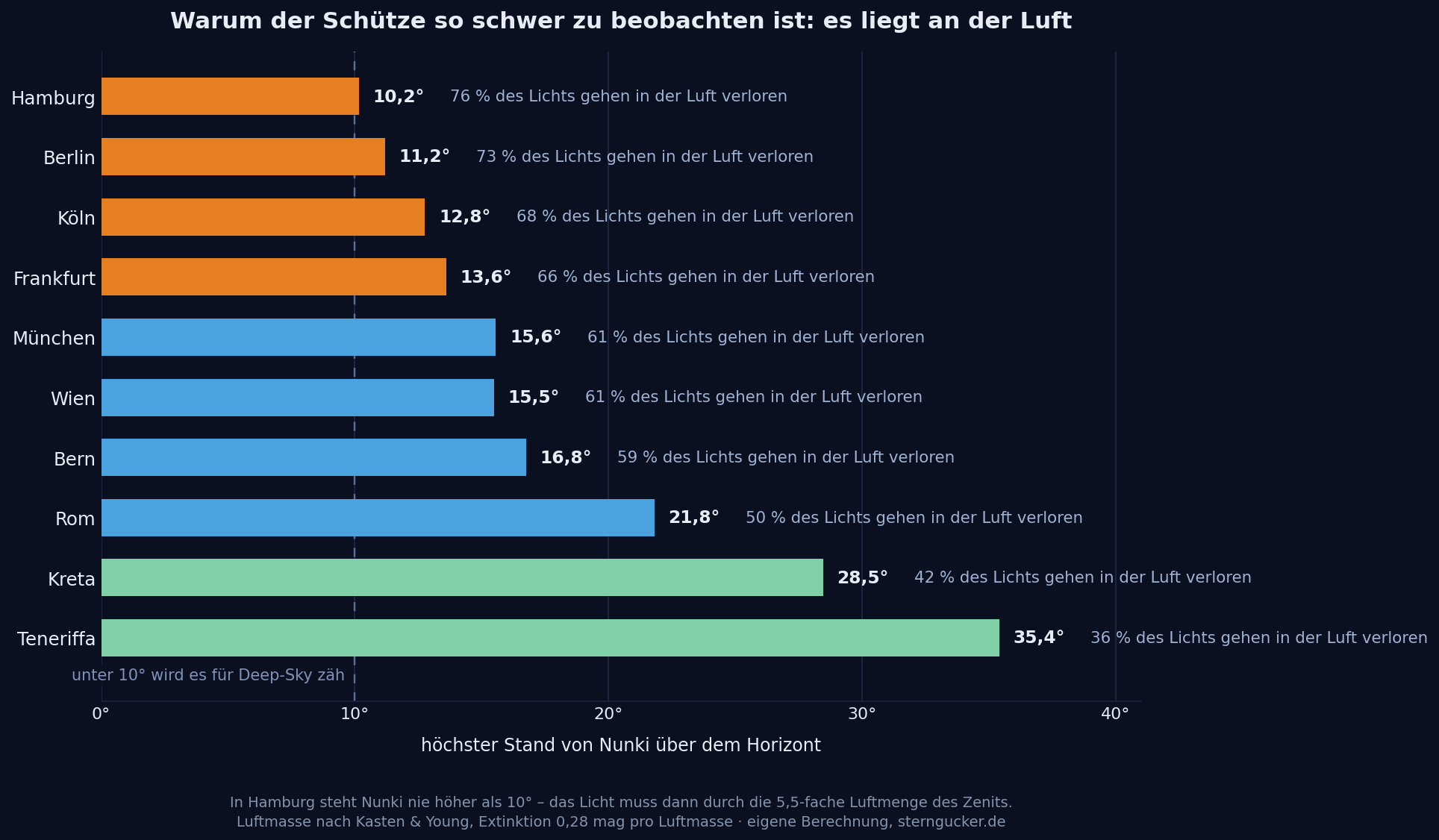
At the peak of its arc, Nunki therefore loses two thirds of its light in the atmosphere here – a 2.05-mag star optically becomes a star of 3.2 mag. For deep-sky objects this is more dramatic still, because they are extended: the Lagoon Nebula loses not only brightness, it also loses contrast against the brightened horizon sky.
The calculation also explains why the same objects suddenly work on holiday. In Rome Nunki culminates at 21.8 degrees (50 percent loss), on Crete at 28.5 degrees (42 percent), on Tenerife at 35.4 degrees (36 percent). It is the same nebula with the same binoculars – only with half as much air in front. Anyone who has once seen M 8 from the Mediterranean understands why it is so celebrated in old observing reports.
💡 What helps against extinction
Gain altitude: every meter of elevation counts for less than every degree of latitude – but a mountain summit still helps, because you get above the near-ground haze.
Hit the moment: observe an object only in the 40 minutes around culmination. An hour earlier or later it stands 2 to 3 degrees lower – that costs noticeably.
Drive south: Lake Constance instead of Hamburg already doubles the altitude of Kaus Australis. For a holiday on the Mediterranean, packing the binoculars is worth more than for any other part of the sky.
Deep-sky in Sagittarius: the densest region of the whole sky
Now for the reward. Sagittarius lies in the direction of the center of our Milky Way, and that means: between us and the galactic core the spiral arms, star clouds, gas nebulae and globular clusters of the inner galaxy are stacked on top of one another. Nowhere else in the sky is there so much on so little area. Fifteen Messier objects, plus dozens of NGC objects – you can sweep binoculars here aimlessly and still hit something every few degrees.
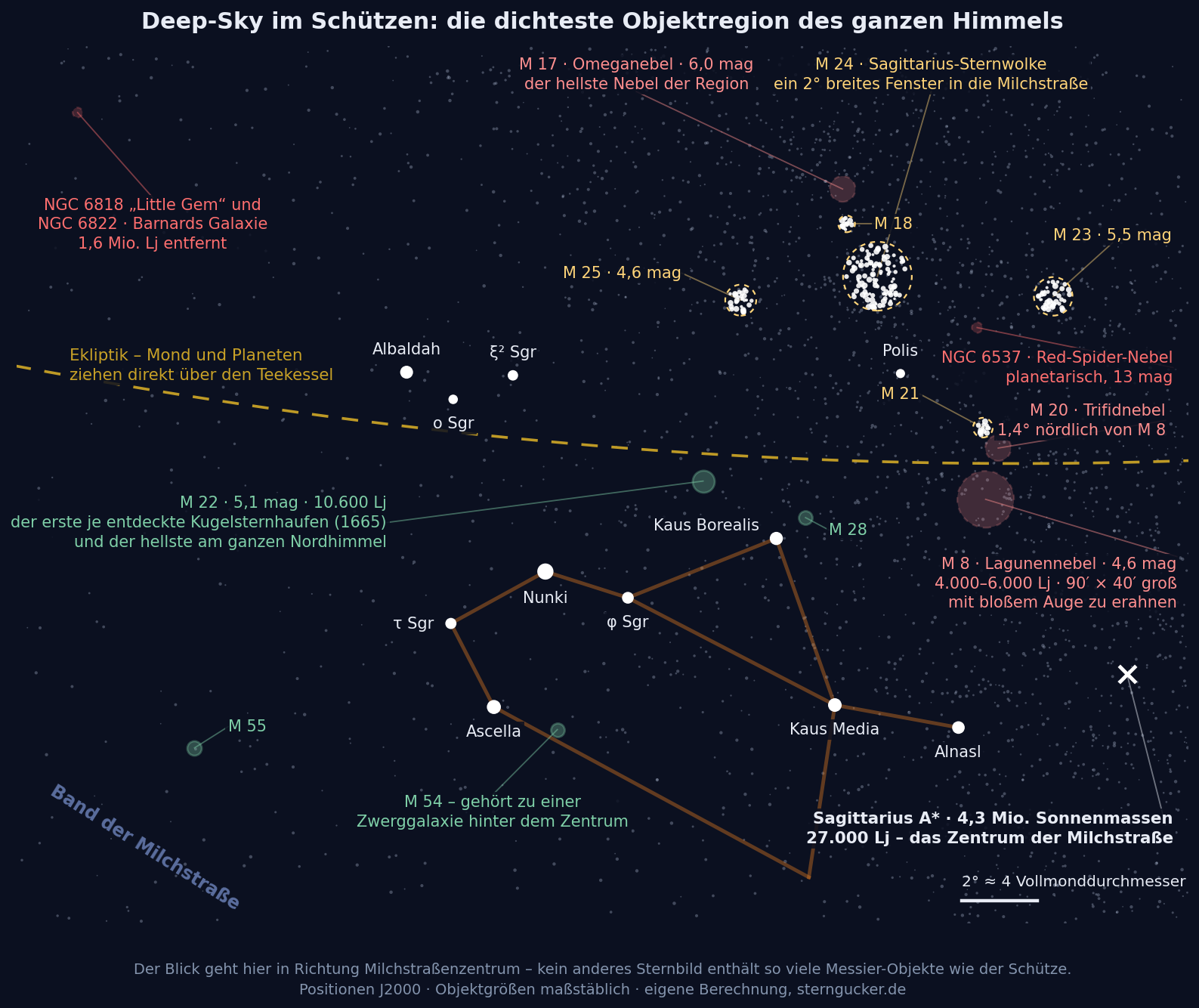
The chart shows the Teapot with the most important targets. The lid star Kaus Borealis serves as orientation: from it there are 5.6 degrees to the upper right to the Lagoon Nebula M 8 and only 2.4 degrees to the left to M 22. Whoever knows these two lines of sight finds almost everything else by sweeping onward. How finding works in general is explained in our guide to the star chart.
The Lagoon Nebula M 8: the brightest nebula of the summer sky
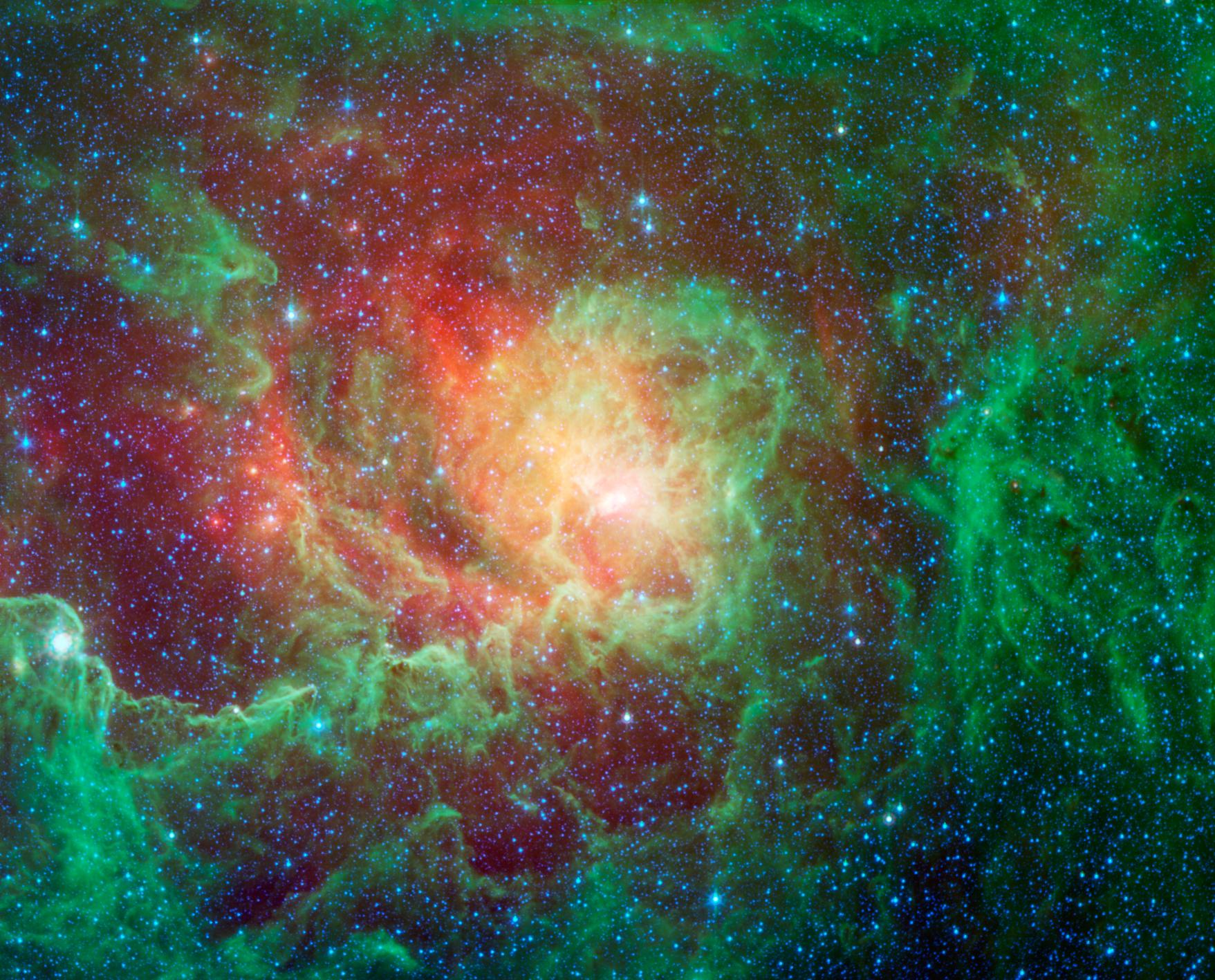
M 8 is the flagship of the constellation and one of only two star-forming nebulae of the northern hemisphere visible to the naked eye – the other is the Orion Nebula. Under a dark sky it appears as an elongated, dull patch just above the Teapot, a good 5.6 degrees to the upper right of Kaus Borealis.
The nebula lies 4,000 to 6,000 light-years away and measures 90 by 40 arcminutes in the sky – three times as wide as the full Moon. It was discovered in 1654 by the Sicilian astronomer Giovanni Battista Hodierna, more than a hundred years before Messier’s catalog. The name comes from a broad dark dust lane that runs through the nebula like a lagoon.
In binoculars M 8 shows itself as a distinct nebulous patch with embedded stars – that is the open cluster NGC 6530, around a hundred young stars that formed out of the nebula’s material and now excite it to glow. In a telescope with larger aperture the lagoon becomes visible as a dark dividing line, and in the brightest part, with good seeing, you can make out the Hourglass Nebula: a compact, brilliantly glowing zone in which massive stars are forming right now.
The Trifid Nebula M 20: a nebula with three faces
Only 1.4 degrees north of M 8 – in the same binocular field – stands the Trifid Nebula M 20. The name comes from trifidus, “split in three”: the dark cloud Barnard 85 divides the bright part of the nebula into three segments. In binoculars you see none of this; there M 20 is only a small round shimmer beside the far larger Lagoon. Only from about 15 centimeters of aperture and under a dark sky do the dividing lines become perceptible.
Photographically M 20 is one of the most colorful nebulae of all: the lower part glows red as an emission nebula, the upper part blue as a reflection nebula, with the dark dust lanes lying in between. This threefold division by nebula type was documented in detail in 2009 by ESO images. The dark cloud Barnard 85, incidentally, will eventually collapse itself and then become the birthplace of new stars – just not on human timescales.
The Omega Nebula M 17: the highest target in Sagittarius
M 17 has more names than any other deep-sky object: Omega Nebula, Swan Nebula, Horseshoe Nebula, Checkmark Nebula, Lobster Nebula. All describe the same shape – a bright arc with an attached stroke, depending on your imagination a Greek Ω, a swimming swan or a check mark.
For observers in Germany M 17 is, for a very practical reason, the most important object of the constellation: it stands at the northern edge of Sagittarius and thus reaches over 20 degrees altitude even in Hamburg – almost twice as high as the Teapot. Whoever lives in the north has here the most realistic chance of a truly good view.
The nebula is an H II region about 40 light-years across in the Sagittarius Arm of the Milky Way. Inside it, new stars are constantly forming; 35 of them have already gathered into an open cluster, the rest are still buried deep in dust. Even binoculars show a distinct, elongated nebulous patch, a telescope from 10 centimeters the characteristic hook shape.
Globular cluster M 22: the first of its kind ever discovered
If a single object justifies the effort, it is this one. M 22 stands only 2.4 degrees to the upper left of Kaus Borealis, is 5.5 mag bright and measures 32 arcminutes – larger than the full Moon. It contains around 70,000 stars and lies 10,600 light-years away. From mid-northern latitudes it is the brightest globular cluster of all, brighter than the famous M 13 in Hercules.
Added to this is a historic title: M 22 was discovered in 1665 by Abraham Ihle and is thus the first globular cluster ever found – more than a hundred years before anyone knew what such an object actually is. Messier entered it in 1764 as number 22 in his catalog.
And that it nevertheless stands in the shadow of M 13 for us has exactly one reason: the altitude. In Hamburg M 22 culminates at 12.5 degrees, M 13 by contrast at over 80 degrees. So whoever catches M 22 on a clear July night in the south sees an object that actually belongs among the three finest of the whole sky – only through four air masses. More on M 22 and its neighbor M 28 is on the object page M 22 and M 28.
Star clouds M 24, M 23 and M 25: the domain for binoculars
North of the Teapot lies a zone where binoculars are superior to any telescope. M 24, the Sagittarius Star Cloud, is not a star cluster at all, but a window: a gap in the interstellar dust through which you look onto a far-distant stretch of the Sagittarius Arm. It measures 2 by 1 degree in the sky – four full-Moon diameters wide – and consists of thousands of individual stars. No telescope can show it entirely; in 10×50 binoculars, by contrast, it is one of the most impressive fields of the whole sky. Details on the object page M 24 and NGC 6522.
Right next to it stand the open clusters M 23 (around 150 stars, 27 arcminutes) and M 25 (about 30 brighter stars, 32 arcminutes), both comfortably resolved in binoculars. Whoever slowly sweeps the region between M 24 and M 17 crosses four Messier objects in two and a half degrees of travel – individual portraits are given for M 23 and M 25 as well as for M 18 and M 21.
Further globular clusters: M 28, M 54, M 55, M 69 and M 70
Sagittarius alone contains seven globular clusters from the Messier catalog – no coincidence, since these objects form a halo around the center of the Milky Way, and it is in that direction that we look here.
| Object | Brightness | Distance | Note |
|---|---|---|---|
| M 28 | 6.8 mag | 18,000 ly | 1.0° northwest of Kaus Borealis, good in binoculars |
| M 54 | 7.6 mag | 87,000 ly | belongs to the Sagittarius Dwarf Galaxy, not to the Milky Way |
| M 55 | 6.3 mag | 17,600 ly | large and loose, but very far south |
| M 69 | 7.6 mag | 29,700 ly | compact, close to the base of the pot |
| M 70 | 7.9 mag | 29,400 ly | discovery site of Comet Hale-Bopp in 1995 |
| M 75 | 8.5 mag | 67,500 ly | at the eastern edge, very compact |
Two entries deserve a second look. M 54 was long regarded as a normal globular cluster of the Milky Way – until in 1994 it became clear that it belongs to the Sagittarius Dwarf Galaxy, a small galaxy that is being torn apart and absorbed by our Milky Way right now. M 54 was thus the first globular cluster demonstrably belonging to another galaxy.
And M 70 was, on July 23, 1995, the target object when Alan Hale and Thomas Bopp independently noticed an unknown nebulous patch beside it. It was Comet Hale-Bopp, which in 1997 became the brightest comet in decades. These clusters are covered in more detail on the pages about M 54 and M 55 and about M 69 and M 70.
Red Spider Nebula NGC 6537: hottest star and spider shape
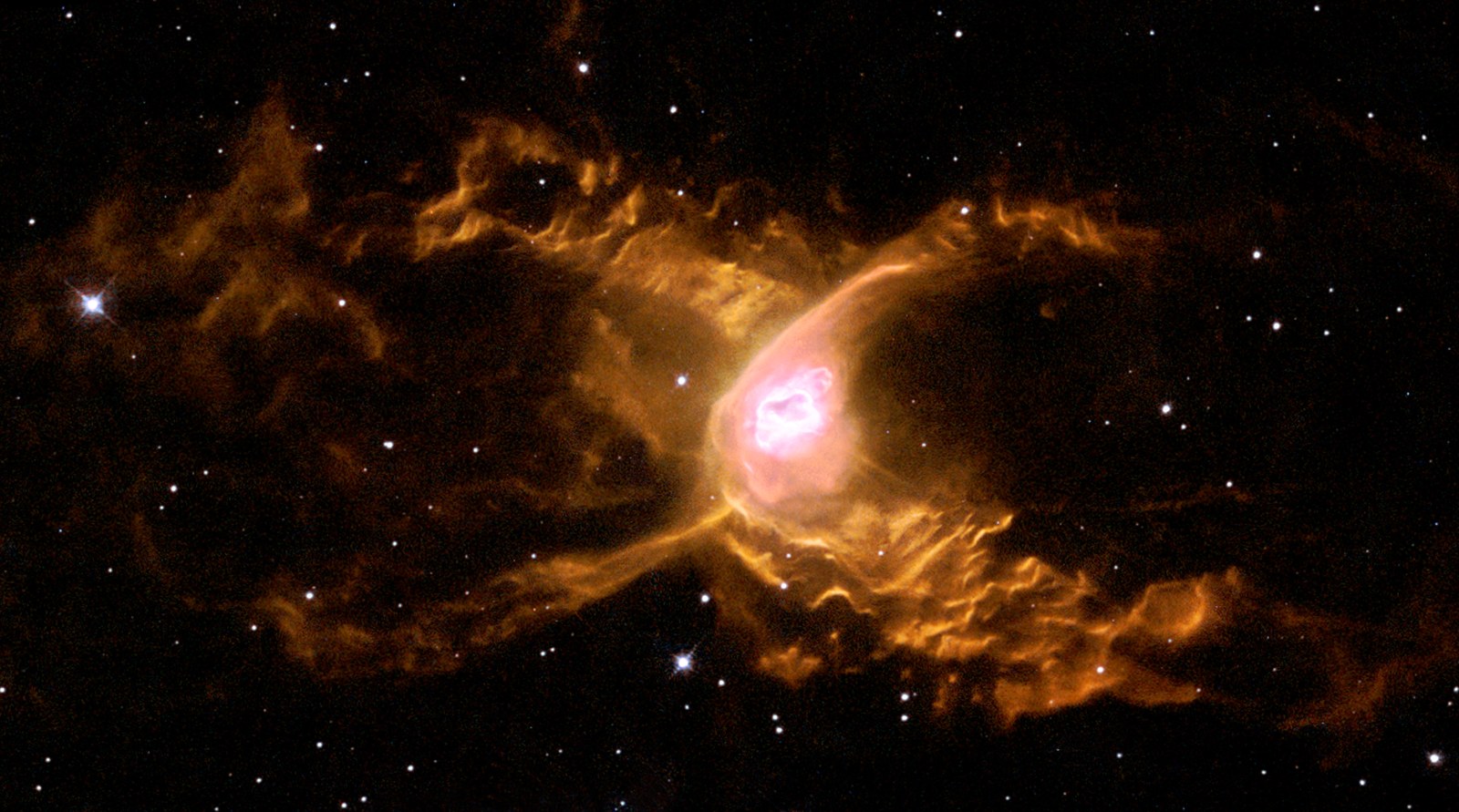
The Red Spider Nebula is not a birthplace but a death chamber. A star here shed its outer shells at the end of its life; what remained is a white dwarf that excites the gas to glow with its radiation – a planetary nebula. Its two symmetrical gas lobes recall spider legs or spread wings.
The central star, at around 150,000 to 200,000 kelvin, ranks among the hottest known stars of all – the Sun’s surface reaches 5,800 kelvin. Its stellar winds lash through the surrounding gas at over 300 kilometers per second and generate waves there about 100 billion kilometers high. Whether the double-lobe shape comes from a hidden companion star or from magnetic fields remains open to this day.
Observationally NGC 6537 is a demanding target: 11.6 mag, discovered in 1882, and very small. You need a telescope from about 15 centimeters aperture, high magnification and patience – in binoculars it is unreachable.
Little Gem Nebula NGC 6818: the vase-shaped bubble
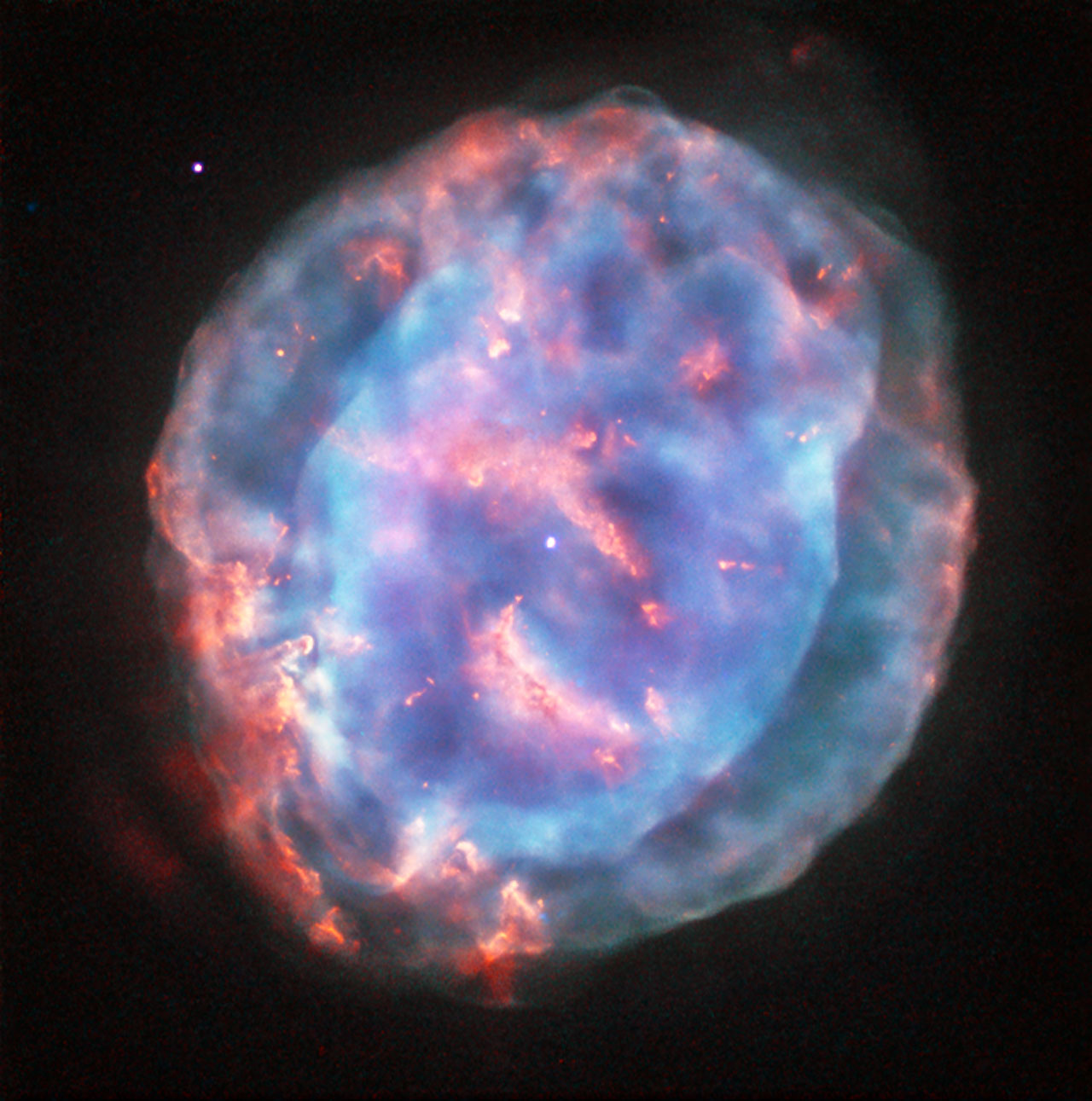
NGC 6818 is the second worthwhile planetary nebula in Sagittarius and, at 9.3 mag, markedly easier than the Red Spider Nebula. Wilhelm Herschel discovered it in 1787. The nickname “Little Gem” describes the view in the telescope quite well: a compact, distinctly greenish-blue shimmering patch that shows a slightly elongated shape at high magnification.
Images reveal a double structure: an outer, rounded shell and an inner, vase- or bubble-shaped structure. Astronomers explain this with fast stellar winds from the central star that blow into the older ejected material and tear it open from within. For observers NGC 6818 is a good practice object: small enough to learn the finding technique, bright enough to be rewarded.
Barnard’s Galaxy NGC 6822: neighboring galaxy of the Local Group
Only 0.7 degree south of NGC 6818 – in the same eyepiece field at low magnification – stands an object of a completely different order of magnitude. NGC 6822, Barnard’s Galaxy, is an irregular dwarf galaxy 1.6 million light-years away and belongs, like the Milky Way and the Andromeda Nebula, to the Local Group.
Edward Emerson Barnard discovered it in 1884. It ranks among the 50 brightest galaxies in the sky, but is very faint in surface brightness at 8.7 mag – the light is spread over 15 by 14 arcminutes. That makes it one of the most difficult objects on this list: you need a dark sky, low magnification and a telescope from 15 to 20 centimeters. Its deformed structure points to a past encounter with a larger neighboring galaxy. The historical value is great: it was on NGC 6822 that Edwin Hubble showed in 1925 that there are star systems outside the Milky Way. A separate page is devoted to Barnard’s Galaxy NGC 6822.
Sagittarius A* in Sagittarius: the black hole of the Milky Way
If you extend the line through the spout of the Teapot – from Kaus Media out past Alnasl – you meet, after a good 4.6 degrees, a point where there is absolutely nothing to see, neither with the naked eye nor in the telescope. There stands Sagittarius A*, the black hole at the center of our galaxy.
| Sagittarius A* | Value |
|---|---|
| Mass | 4.297 million solar masses |
| Distance | about 27,000 light-years |
| Shadow diameter | about 51 microarcseconds |
| Discovered | February 13 to 15, 1974 by Bruce Balick and Robert Brown |
| First image | May 12, 2022 (Event Horizon Telescope) |
| Nobel Prize | 2020 to Reinhard Genzel, Andrea Ghez and Roger Penrose |
Optically there is nothing to gain at this spot: between us and the center lie about 27,000 light-years full of dust, which dims the visible light by about 30 magnitudes – a factor of a trillion. That is why the radio source was discovered in 1974 in the radio range, and all findings come from radio, infrared and X-ray observations.
The mass emerged from decades of patient work: two teams around Reinhard Genzel and Andrea Ghez tracked the orbits of individual stars around the galactic center from the 1990s onward. The star S2 circles Sagittarius A* in just 16 years and races through its periapsis at up to 7,700 kilometers per second. From such orbits it could be calculated that 4.297 million solar masses sit there in a space smaller than our solar system. For this proof the Nobel Prize in Physics was awarded in 2020.
On May 12, 2022, the Event Horizon Telescope collaboration finally published the first image: the orange glowing ring of material that flares up one last time just before the event horizon. It was taken with a network of radio telescopes around the globe that together work like an Earth-sized telescope.
🔭 What you can really see at this spot
Nothing – and that is the point. But pointing binoculars at the region between Alnasl and the horizon has something to it all the same: here you look through the densest star clouds of the Milky Way, straight toward its center. Every one of these stars stands thousands of light-years farther in toward the interior of the galaxy than our Sun.
The Wow! signal of 1977: 72 seconds from Sagittarius
On August 15, 1977, the “Big Ear” radio telescope of Ohio State University recorded a narrowband signal that lay clearly above the background noise for 72 seconds. The astronomer Jerry Ehman circled the string of digits on the printout and wrote “Wow!” in the margin – hence the name.
The signal came from the direction of the constellation Sagittarius, its frequency lay near the 1420-megahertz line of neutral hydrogen, that is, exactly where, by common reasoning, one would search for extraterrestrial signals. The 72 seconds correspond exactly to the time a fixed point in the sky needs to drift through the telescope’s field of view – so the signal behaved just as a cosmic source would, not as a terrestrial interference.
Despite dozens of later searches at the same spot, it was never received again. Comets, reflections off space debris and a rare hydrogen cloud have been proposed as explanations; none is regarded as certain. Scientifically it therefore remains a unique, non-reproducible event – interesting, but without evidential value. Since then, research on Sagittarius has focused on what can be measured repeatedly: the galactic center and the star formation in its nebulae.
Zodiac sign and constellation Sagittarius: why the dates differ
Whoever is born under the sign of Sagittarius has their birthday between November 23 and December 21. During this time, however, the Sun is not in the constellation Sagittarius at all, but in Scorpius and in Ophiuchus. In fact it crosses Sagittarius only from December 18 to January 18.
| What | Period | Basis |
|---|---|---|
| Zodiac sign Sagittarius | November 23 – December 21 | 30° of the ecliptic, astrological division |
| Constellation Sagittarius | December 18 – January 18 | real area of sky with IAU boundaries |
The shift of about four weeks has a physical cause: precession. The Earth’s axis wobbles like a spinning top and takes 25,800 years for one revolution. The astrological division was fixed more than 2,000 years ago and has not been adjusted since – the sky beneath it has kept turning. This is explained in detail in our article on zodiac signs and constellations.
The winter solstice point: in Sagittarius since 130 BC
For Sagittarius, precession has a side effect that surprises many. The winter solstice point – the spot where the Sun reaches its southernmost position on December 21 – lies today in the constellation Sagittarius. It migrated in there about 2,150 years ago, that is, around 130 BC, when it crossed the boundary from Capricornus.
That is why the parallel at 23.5 degrees south is called the Tropic of Capricorn, even though the Sun has long since ceased to stand in Capricornus there – just as the northern tropic is named after Cancer. The names come from antiquity, the Sun has moved on. In a few centuries the solstice point will migrate farther into Scorpius and then into Ophiuchus.
Precession has consequences for Nunki too, though on entirely different timescales: in about 8,000 years the star will stand at a declination of about +9 degrees – the handle of the Teapot will then shine in the northern sky, high above the horizon, and Sagittarius would be a comfortable summer constellation from Central Europe.
Mythology of Sagittarius: from the archer Krotos to Pabilsang
The figure of an archer at this spot in the sky is ancient. The Babylonians saw here Pabilsang, a winged hybrid god with a lion’s head, scorpion’s tail and drawn bow – a depiction preserved on boundary stones of the second millennium BC. From there the motif traveled by way of Greece into our present-day constellation catalog.
The Greeks interpreted the figure in various ways. One tradition sees in it the satyr Krotos, the inventor of archery and companion of the Muses, whom Zeus set in the sky at their request. Another makes it the centaur Chiron – which is problematic, however, since Chiron traditionally belongs to the constellation Centaurus. The more likely reading remains Krotos, an archer with a horse’s body, but not a centaur in the strict sense.
Remarkable is the direction of aim: the arrow of Sagittarius – marked by the star Alnasl, Arabic for “arrowhead” – points almost exactly at the heart of Scorpius, the red giant Antares. Whether the ancient observers composed it deliberately this way, no one knows. But it yields a scene in the sky that you never forget after seeing it once: the archer taking aim at the Scorpion.
Diffuse region in the constellation: the crossword answers
One of the most-searched questions around Sagittarius does not come from astronomy at all, but from crosswords. Usually a “diffuse region in the constellation” is asked for – meaning a nebula:
| Clue (letters) | Solution |
|---|---|
| Diffuse region in the constellation (5) | CLOUD |
| Diffuse region in the constellation (6) | NEBULA |
| Latin name of Sagittarius (11) | SAGITTARIUS |
| Star in the constellation Sagittarius (5) | NUNKI |
| Star in the constellation Sagittarius (6) | RUKBAT or ALNASL |
| Star in the constellation Sagittarius (7) | ASCELLA |
| Nebula in the constellation Sagittarius (6) | LAGOON |
| Asterism in Sagittarius (6) | TEAPOT |
Astronomically, “diffuse region” is indeed a technical term: diffuse nebulae are extended, fuzzily bounded clouds of gas and dust – in contrast to the sharply delimited planetary nebulae. The Lagoon Nebula M 8 in Sagittarius is a prime example of a diffuse nebula; NGC 6537 and NGC 6818 are planetary ones.
Which instrument for Sagittarius: binoculars or telescope
Sagittarius is one of the few cases where the answer is not clear-cut – the objects are too different. Roughly divided: everything large and extended belongs in binoculars. Everything small and point-like belongs in the telescope.
For star clouds and nebula fields: binoculars
For the star cloud M 24, the open clusters M 23 and M 25 and the Lagoon Nebula M 8, bright binoculars are in fact the better tool. M 24 is two degrees wide – a telescope only ever shows a section of it and breaks up exactly the impression that matters. Added to this is the practical side: binoculars are ready to use in seconds, and because Sagittarius stands so low, you search mostly along the horizon anyway.
A 10×50 with about six degrees of field is the classic choice here – large enough for M 24 in one piece, bright enough for M 8, and still steady to hold without a tripod.
For M 24 and the nebula fields: Celestron Cometron 7x50 Binoculars
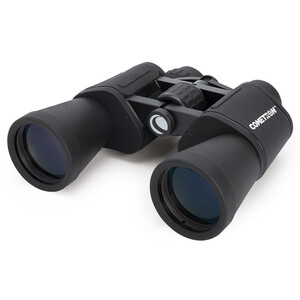
The astronomy classic among affordable binoculars: 7×50 with a large exit pupil for bright handheld views of the Moon and Milky Way – the ideal first step before a telescope.
Price: € 65
When the telescope is worth it after all
As soon as it comes to M 22, M 17, the globular clusters M 28 to M 75 or even the planetary nebulae NGC 6537 and NGC 6818, binoculars are at their limit. M 22 remains a round nebulous patch in them; only from about 15 centimeters of aperture does it break up into thousands of individual stars – and that is exactly the moment for which you seek out this cluster. Barnard’s Galaxy and NGC 6537 are not reachable in binoculars at all.
Added to this is the extinction problem from above: if two thirds of the light already stays in the air, the aperture has to make up for it. A 200-millimeter mirror gathers about four times as much light as a 100-millimeter objective – for an object that stands at the edge of visibility anyway, that is often the difference between “nothing to see” and “distinct”.
Whoever can buy only one instrument and really wants to explore the sky reaches for the telescope; binoculars are the supplement, not the substitute. For Sagittarius this means, concretely: a Dobsonian telescope with the largest possible aperture and the shortest possible setup time, because the observing window lasts only two to three hours anyway.
For M 8, M 22 and Sagittarius A*: Skywatcher Dobson Telescope N 200/1200 Skyliner Classic
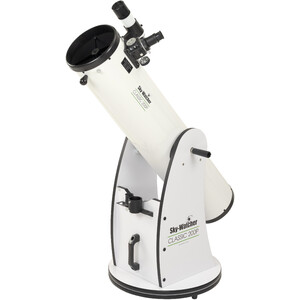
200 mm of aperture — the most sky for your money. Set it on the ground, point by hand: nebulae, clusters and galaxies for years to come.
Price: € 479
Whoever wants to start smaller will find in the Sky-Watcher Heritage 130 Tabletop DobsonianSkywatcher Heritage 130/650 FlexTube, for around $305.00€ 265, a compact alternative – 13 centimeters of aperture already show M 22 grainy and M 17 with structure. An overview of the options in this price class is given by our comparison Telescopes under 300 euros; whoever is unsure on principle will find the detailed weighing-up in Telescope or binoculars.
Frequently asked questions about the constellation Sagittarius
What does the constellation Sagittarius look like?
The eight brightest stars form a Teapot with the spout at the lower left, the lid on top and the handle to the right – this shape is recognized at once. The ancient figure of the archer with a horse’s body and drawn bow, by contrast, is almost impossible to read out without a template, especially since its lower parts do not rise above the horizon from Central Europe at all.
Where in the sky is the constellation Sagittarius?
Low in the south, below and to the left of Scorpius. The most reliable line of sight runs from red Antares about 26 degrees to the left – that is two and a half fist widths on an outstretched arm. The Teapot then rests, with its base, practically on the horizon.
When is the constellation Sagittarius visible?
From July to early September, best around 11 p.m. In July the constellation culminates at 00:43 in the middle of the darkest part of the night, in August already at 22:41. The usable window is longest on July 1, at around 3.6 hours.
Why is Sagittarius so hard to see in Germany?
Because of its southern position. At 50 degrees north Nunki reaches a maximum altitude of 13.7 degrees, Kaus Australis in Hamburg only 2.1 degrees. At this altitude there is so much air in the way that two thirds of the light is swallowed – added to which is usually the horizon haze over the nearest city.
How many stars does the constellation Sagittarius have?
The Teapot figure consists of eight stars; for the complete archer figure, usually twelve to fifteen are drawn. Within the official boundaries there are, under a very good sky, around 190 stars visible to the naked eye – seven of them brighter than 3 mag.
What is the constellation Sagittarius called in Latin?
Sagittarius, from the Latin sagitta for “arrow”. The genitive, which astronomers use for star designations, is Sagittarii – hence names like σ Sagittarii for Nunki. The official IAU abbreviation is Sgr.
Which planets are in the constellation Sagittarius?
Because Sagittarius lies on the ecliptic, the Moon and all planets pass through it regularly. Jupiter needs about a year for the passage, Saturn nearly two and a half. A bright planet in the Teapot is the easiest opportunity to find the constellation – then there is suddenly an object there you cannot miss.
What is special about the constellation Sagittarius?
Behind it lies the center of the Milky Way. That is why Sagittarius, with 15 Messier objects, contains more than any other constellation, among them the Lagoon Nebula M 8 and the globular cluster M 22 – and that is why the black hole Sagittarius A*, with 4.3 million solar masses, also lies in its direction.
Read on at Sterngucker
- Constellation Scorpius – the western neighbor with Antares as the guide star
- Constellation Capricornus – the eastern neighbor in the zodiac
- Antares – the red supergiant the search runs through
- Milky Way – what lies behind the spout of the Teapot
- Black holes – more on objects like Sagittarius A*
- Summer Triangle – the orientation figure high above Sagittarius
- Deep-sky objects – nebulae, clusters and galaxies at a glance
- The night sky in September – what else there is to see in the sky right now
- Astronomy binoculars – why M 24 looks better here than in a telescope
- All constellations at a glance – the entry into our catalog