By Alexander Merz · Updated on
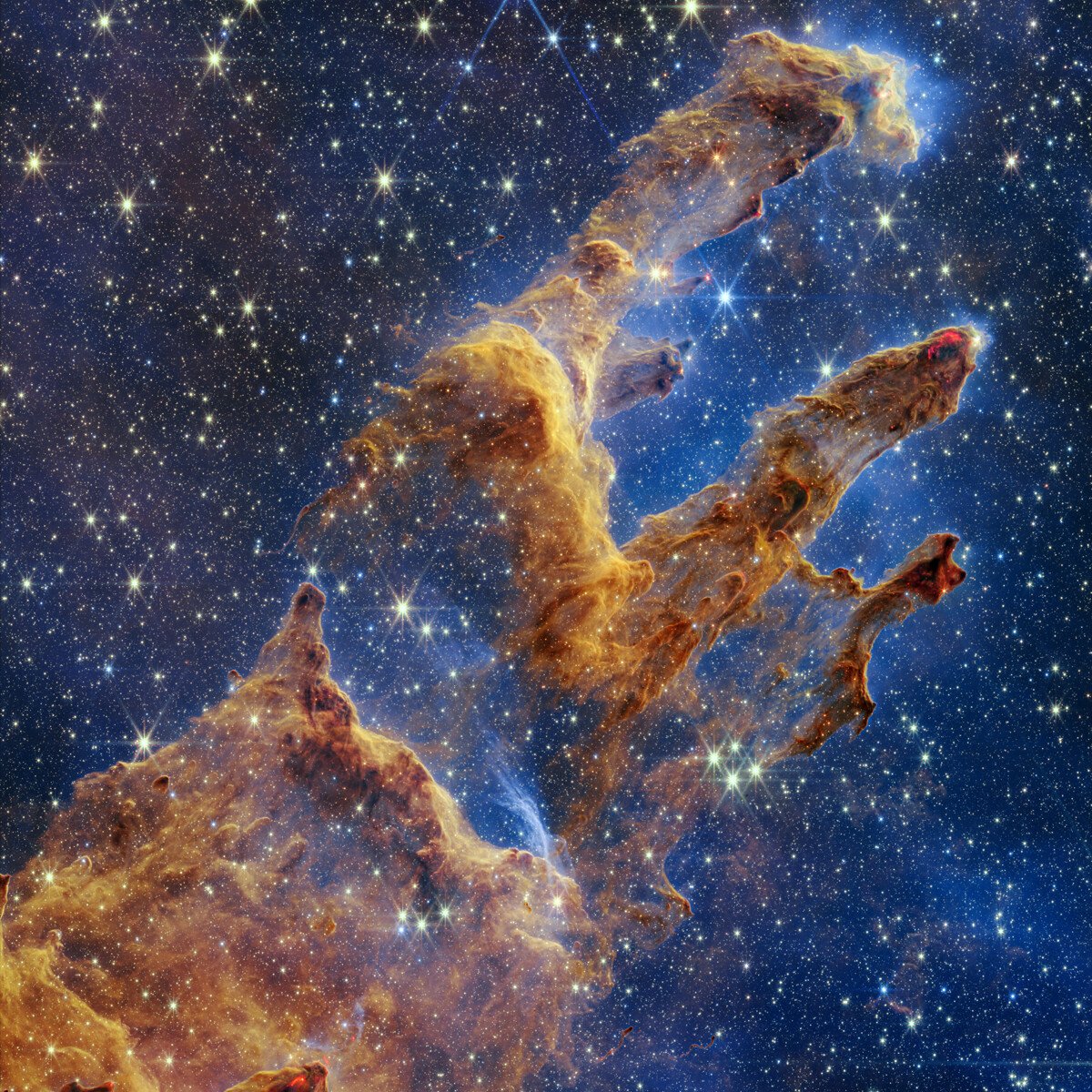
The Pillars of Creation are three towers of cold gas and dust in the Eagle Nebula, M 16, where new stars are being born: roughly 6,500 to 7,000 light-years away, with the tallest pillar about 4 light-years high – a small section of one of the best-known nebulae in the summer sky.
The Pillars of Creation explained: towers of gas as stellar nurseries
The pillars are the remains of a dense molecular cloud that has so far withstood the radiation of young stars. The gas around them was blown away long ago. What’s left are the densest clumps and the material in their “shadow” – a bit like mesas in the desert, which are harder than the surrounding rock.
The culprit is the star cluster NGC 6611 right next to the pillars. It is only around 1 to 2 million years old and contains several extremely hot, massive stars of spectral class O. Their ultraviolet light makes the gas glow and erodes it at the same time.
The name “Pillars of Creation” came with the Hubble image of 1995. It goes back to a phrase used by the British preacher Charles Spurgeon in 1857. The structures themselves had already been discovered in 1920 by John Charles Duncan on a photographic plate from Mount Wilson Observatory – back then they were called “elephant trunks”.
How do stars form in the pillars?
Inside the pillars, gas contracts under its own gravity until knots form that collapse into stars. Webb shows such protostars, meaning stars in the making, as red dots along the edges of the pillars. Researchers estimate they are only a few hundred thousand years old.
At the tips sit the EGGs, short for “Evaporating Gaseous Globules”. Each one is larger than our solar system and may contain a star in the making. Photoevaporation, the evaporation caused by UV light, uncovers them and at the same time cuts them off from fresh material: the star stops growing.
Pillars of Creation fact sheet: the key data
| Feature | Value |
|---|---|
| Object | Three “elephant trunks” of gas and dust in the Eagle Nebula |
| Catalogue | M 16 (nebula with star cluster), NGC 6611 (star cluster), IC 4703 (nebula) |
| Constellation | Serpens (Serpens Cauda), on the border with Scutum and Sagittarius |
| Distance | around 6,500 light-years (NASA/ESA), other figures 5,700 to 7,000 light-years |
| Length of the left pillar | around 4 light-years, up to about 5 depending on where you draw the line |
| Mass of the pillars | around 200 solar masses |
| Mass loss | around 70 solar masses per million years |
| Expected remaining lifetime | perhaps another 3 million years |
| Illuminating star cluster | NGC 6611, age 1 to 2 million years |
| Brightness of M 16 (star cluster) | around 6.4 mag |
| Coordinates of M 16 (J2000) | RA 18h 19m, Dec. −13° 47′ |
| Maximum altitude in Germany | 23° (Hamburg) to 28° (Munich) |
| Famous images | Hubble 1995 and 2014, Webb 2022 |
Sources: ESA/Webb, ESA/Hubble, ESO (MUSE study McLeod et al. 2015), Wikipedia; altitudes calculated by us.
Size and distance of the pillars: how big are they really?
The left and largest pillar is around 4 light-years long – roughly the distance from the Sun to the nearest star. So light takes four years to travel from its base to its tip. The scale bar in the annotated Webb image agrees with this – the exact figure depends on where you place the base of the pillar.
The fingers at the tips look tiny, yet each one is larger than our entire solar system. Even so, the gas is extremely thin: the pillars are so translucent that Webb can partly see through them in the near infrared.
For the distance, NASA and ESA now give around 6,500 light-years. ESO and many older sources say about 7,000, while some more recent estimates come in at around 5,700 light-years. The spread arises because different methods measure different stars in the cluster – either way, the light you catch today set off around 4500 BC.
Hubble vs. Webb: the same pillars, different eyes
There are three famous versions of the image because of wavelengths. Hubble mainly photographs visible light and therefore shows the opaque dust pillars. Webb looks in the infrared and so sees through part of the dust.
| Image | Instrument | Light | What it shows |
|---|---|---|---|
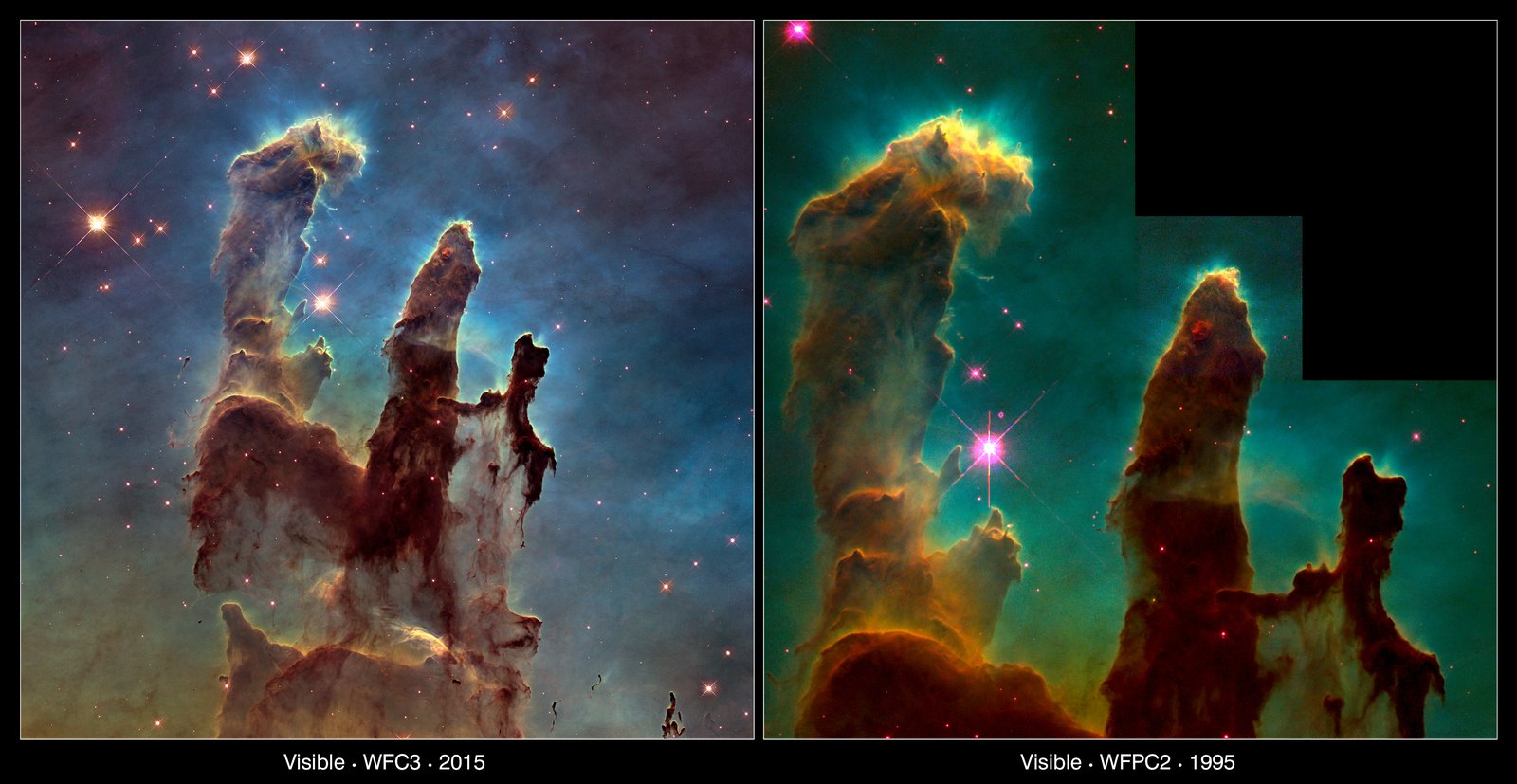
| Hubble, 1 April 1995 | WFPC2, 32 individual frames from 4 cameras | visible, three line filters (oxygen, hydrogen, sulphur) | Dark, dense pillars with glowing edges, EGGs at the tips |
| Hubble, late 2014 (released Jan. 2015) | WFC3 | visible, plus an extra near-infrared image | Sharper and a wider field; in the infrared the pillars become silhouettes against a field of stars |
| Webb, released 19 October 2022 | NIRCam | near infrared, 0.9–4.7 µm | Semi-transparent pillars, thousands of stars, red protostars and jets |
| Webb, released 28 October 2022 | MIRI | mid-infrared, 7.7–15 µm | Almost nothing but dust; most stars disappear, only young stars still wrapped in dust remain visible |
Sources: ESA/Hubble heic1501, NASA, ESA/Webb weic2216, NASA Science (MIRI image), ESA.
The 1995 Hubble image: Hester and Scowen
The original image was taken by astronomers Jeff Hester and Paul Scowen of Arizona State University. It was exposed on 1 April 1995 and released in November 1995. Today it is considered the most famous image Hubble has ever taken – it ended up on T-shirts, mugs and postage stamps.
The colours were genuinely measured, but reassigned. In the original image, green stands for hydrogen, red for sulphur and blue for oxygen. This combination is still called the “Hubble palette”, and amateurs use it for their nebula photos too.
Hubble 2014: sharper and in the infrared
For the telescope’s 25th birthday, Hubble photographed the pillars again in 2014 with the newer WFC3 camera. The image is sharper and covers a wider field. At the tip of the left pillar you can see a wisp of gas that has been heated and is flying away.
Comparing the two Hubble images shows that the pillars are changing measurably. According to NASA, a jet of material from a young star grew almost 97 billion kilometres longer in the 19 years between the exposures. The additional infrared image also revealed stars that were still hidden in the dust in visible light.
James Webb 2022: NIRCam and MIRI
Webb’s NIRCam image from October 2022 is packed with stars, and the pillars look almost transparent. The red glowing dots along the edges are protostars, and the wavy lines are jets from young stars slamming into the gas. Background galaxies are missing all the same: the gas of the Milky Way blocks the view into the depths.
The MIRI image in the mid-infrared, by contrast, shows almost nothing but dust. Most stars are too faint at these wavelengths. What remains are young stars that haven’t shed their dust shell yet – you’ll find more about the telescope itself on our page about the James Webb Space Telescope.
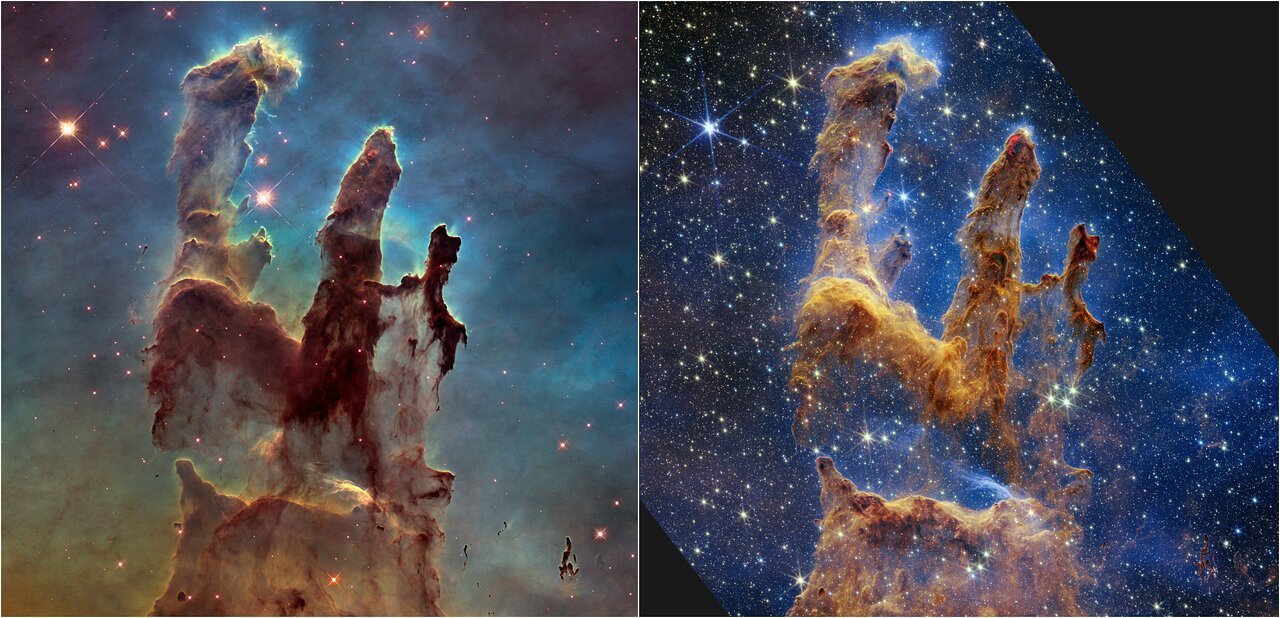
Which image is “more correct” is impossible to say – each shows a different layer of the same cloud. How Hubble earned its reputation in the first place is told in our article on the Hubble Space Telescope.
The “long destroyed” myth: is there anything to the supernova theory?
Since 2007, the claim has been doing the rounds that the pillars have in fact already been destroyed. A team led by Nicolas Flagey (Institut d’Astrophysique Spatiale, Paris) used the Spitzer Space Telescope to find a shell of hot dust near the pillars. Their interpretation: a supernova around 6,000 years ago sent out a shock wave whose effect we would only see in about 1,000 years because of the light travel time.
There was pushback even back then. Supernova researcher Stephen Reynolds (North Carolina State University) objected that a supernova remnant would have to emit much more radio and X-ray radiation. He considered the winds of the massive stars to be the simpler explanation.
In 2012, astronomers using the Herschel infrared telescope found no evidence of a supernova remnant. The dust temperatures are consistent with heating by the star cluster NGC 6611 alone (Hill et al. 2012). In 2015, a team using the MUSE spectrograph on ESO’s Very Large Telescope determined how fast the pillars are evaporating: at around 70 solar masses per million years, they have about 3 million years left.
| Year | Who | Finding |
|---|---|---|
| 2007 | Flagey et al., Spitzer | Hot dust, possibly a supernova shock wave – pillars may already be destroyed |
| 2007 | Stephen Reynolds | Too little radio and X-ray radiation for a supernova; stellar winds more likely |
| 2012 | Hill et al., Herschel | No evidence of a supernova remnant, heating by NGC 6611 is sufficient |
| 2015 | McLeod et al., ESO/MUSE | Slow evaporation, remaining lifetime around 3 million years |
Finding the Eagle Nebula M16 in the sky: Serpens, Scutum and Sagittarius
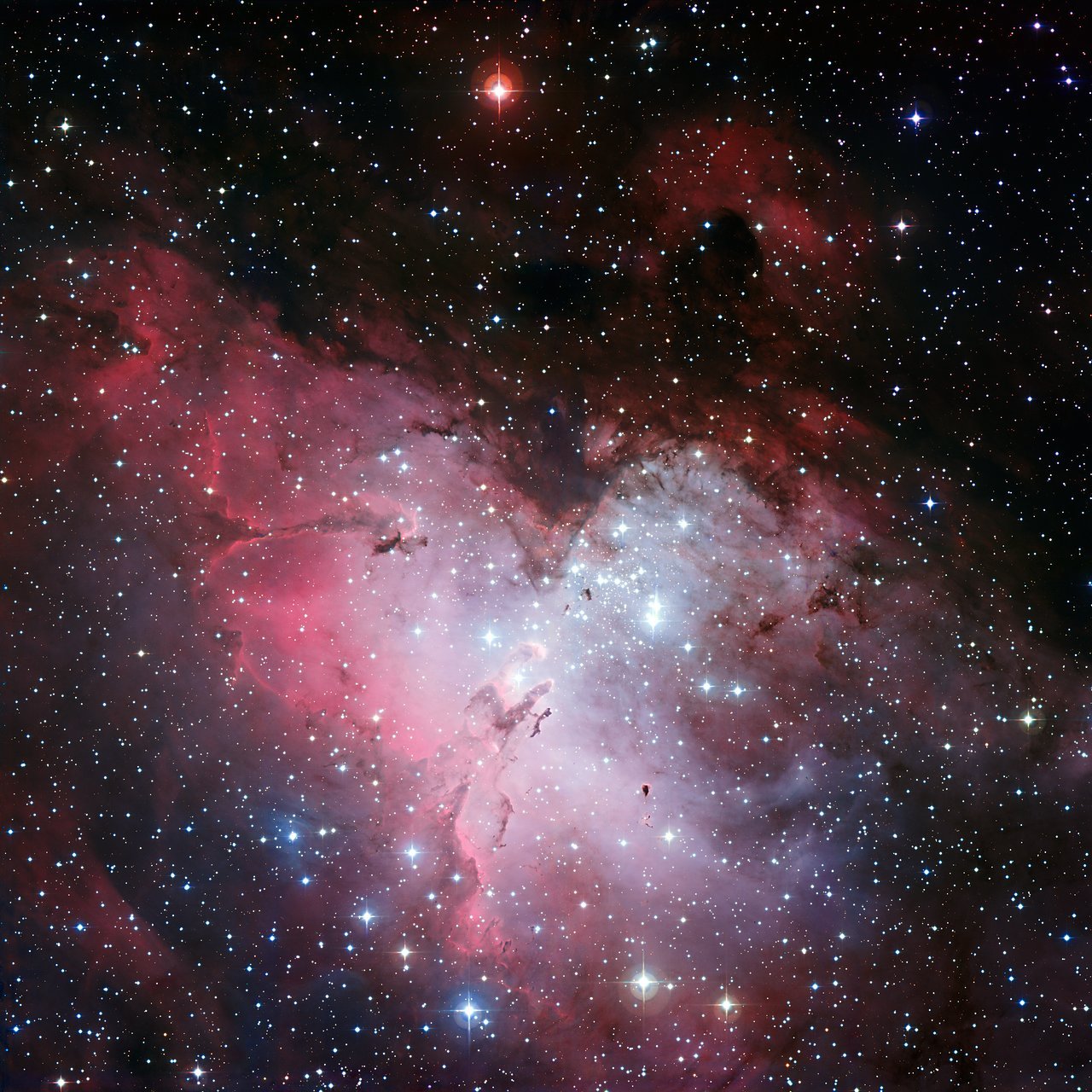
The Eagle Nebula M 16 lies in the eastern part of the constellation Serpens, the “tail of the serpent” (Serpens Cauda). This is a star-poor area in the summer band of the Milky Way, directly north of the constellations Sagittarius and Scutum. It gets its name from the dark dust figure at its centre, which resembles an eagle with outstretched wings.
The easiest way to find it is via the Omega Nebula M 17: M 16 lies around 2.4° north of it. A second signpost is the star Gamma Scuti (4.7 mag) in Scutum, about 2.6° west and 1° north of it. With binoculars, you can hop westwards from the bright star cloud in Scutum.
Visibility from Central Europe: low in the south on summer evenings
The Eagle Nebula is a summer object and always sits low when seen from Germany and similar latitudes. With a declination of around −13.8°, it reaches at most about 26° above the horizon at 50° north, 23° in Hamburg and 28° in Munich. For comparison: an outstretched fist is around 10° wide.
The best time is July to mid-August, around midnight. That’s when it is highest in the south during the darkest hour. In June the short, bright nights get in the way, and from September it disappears into twilight early in the evening.
| Date | Highest point (south) | Dark and at least 15° high | Tip |
|---|---|---|---|
| 15 May | 04:05 (twilight) | 01:15–03:50 | Early risers only |
| 15 June | 02:00 | 23:35–03:05 | Short nights |
| 15 July | 00:05 | 23:15–02:55 | Best time |
| 1 August | 22:55 | 22:40–01:45 | Very good, earlier in the evening |
| 15 August | 22:00 (twilight) | 22:05–00:50 | Right after nightfall |
| 1 September | 20:55 (twilight) | 21:25–23:45 | Already in the south-west |
| 15 September | 20:00 (still light) | 20:50–22:50 | End of the season |
Calculated for 51° north, 10° east (central Germany), Central European Summer Time; “dark” = Sun more than 12° below the horizon. The altitude at culmination there is around 25°.
The low altitude is the real problem. You look through much more air than when looking straight up, plus haze and the glow of towns to the south. An observing site with a clear view to the south is therefore more important than the telescope.
The Pillars of Creation through a telescope: what you really see
To be honest, the pillars themselves are one of the hardest visual targets in the summer sky. What you can easily see in the eyepiece is the star cluster NGC 6611 with a faint nebulous glow. The pillars show up – if at all – as a small dark notch in the brightest part of the nebula.
Experienced observers on the German forum astronomie.de agree that you won’t see the pillars with average equipment. It only becomes possible with experience, a very dark sky, at least 200 mm of aperture and an OIII filter, which only lets through the light of oxygen. English-speaking observers tend to mention 250 mm or more plus very clear, transparent air.
| Instrument | Star cluster NGC 6611 | Nebula | Pillars |
|---|---|---|---|
| Naked eye | only as a small smudge under a very dark sky | no | no |
| 10×50 binoculars | small group of stars | a faint hint at best | no |
| 130–150 mm telescope | clearly, dozens of stars | faint, better with a UHC or OIII filter | practically no |
| 200–250 mm telescope + OIII | impressive | extended, with structure | hinted at as a dark notch, dark sky needed |
| 300 mm and up + filter | impressive | bright, with dark bays | small dark V or hook shape |
Based on observing reports from forum.astronomie.de and Cloudy Nights as well as BBC Sky at Night; applies to a dark rural sky. From Germany, the low altitude costs additional contrast.
You’ll never see the colours of the space images in a telescope. In low light, only the colour-blind rods in the eye are at work, so the nebula looks grey. To see how much more another nebula target can show, take a look at the Orion Nebula, which stands much higher and brighter in winter.
Photographing the Pillars of Creation: with a smart telescope
Photographically, the pillars are much easier than visually. A camera collects light over many minutes and picks up the red hydrogen light to which your eye is almost blind at night. On the sky, however, the pillars are only a few arcminutes in size, so you need some focal length.
The easiest way is with a smart telescope that handles tracking, the camera and stacking the images by itself. Seestar S50 owners show the pillars as small dark fingers in the nebula after just 20 to 30 minutes of exposure. With one to two hours the image becomes smoother and the shape clearer, and several nights produce a detailed photo.
| Equipment | Total exposure | Result |
|---|---|---|
| Seestar S50 smart telescope, with filter | 19–30 min | Pillars recognisable as a small dark structure (Cloudy Nights, Bortle 4 sky) |
| 90/500 mm refractor, mirrorless camera, AZ-GTi | around 1.8 h (220 × 30 s) | Several pillars visible, stars not quite round due to tracking limits (forum.astronomie.de) |
| 103 mm apochromat, cooled colour camera, autoguiding | around 2.9 h (57 × 180 s) | Three-dimensional-looking pillars in the Hubble palette (forum.astronomie.de) |
| Seestar S50 smart telescope | 5.3 h over several nights | Detailed nebula under a suburban sky (Bortle 5, Offenburg) |
The figures come from published amateur images; sky conditions and processing have a big influence on the result.
Factor in the low altitude: in July, M 16 only spends a good three and a half dark hours per night higher than 15°. A smart telescope can, however, collect data on the same target over several nights. A light pollution filter helps, because it lets hydrogen and oxygen light through while dimming street lighting.
Realistic route to your own pillars photo: ZWO Seestar S50 Pro Smart Telescope
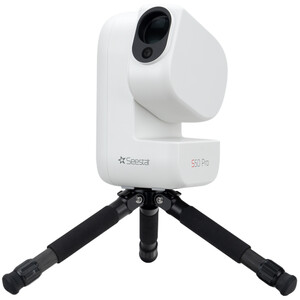
Slews to M 16 by itself, tracks and stacks live – the pillars appear after about half an hour. With its small 50 mm aperture, though, they remain a detail in the image rather than a frame-filling subject like in the Hubble shots.
Price: € 999
Cheaper and more compact is the ZWO Seestar S30 Pro All-In-One Smart TelescopeZWO Seestar S30 Pro Smart Telescope. It has a shorter focal length, so it shows more sky, but the pillars become even smaller in the image. It’s enough for the Eagle Nebula as a whole; if you specifically want the pillars, you’re better off with the S50.
The forum images with the most three-dimensional-looking pillars were taken with lens telescopes of 90 to 100 mm aperture, an astro camera and a tracking mount. More aperture and focal length make the pillars larger and sharper, but you’ll need a laptop or control computer, time to learn the ropes and a considerably bigger budget than for a smart telescope. It’s worth it if astrophotography grabs you for the long haul – our guide to deep-sky astrophotography explains how to get started.
Which models are available and how they differ is compared in our overview of the smart telescope. It also covers field of view, filters and battery life.
Frequently asked questions about the Pillars of Creation
Where are the Pillars of Creation located?
In the Eagle Nebula, M 16, in the constellation Serpens (Serpens Cauda) near the border with Scutum and Sagittarius. Within the Milky Way they lie in the Sagittarius Arm, one spiral arm further in than the Sun. From Central Europe they sit low in the south in summer.
How many light-years away are the Pillars of Creation?
NASA and ESA give around 6,500 light-years, ESO and older sources about 7,000. Some more recent estimates are around 5,700 light-years. So the light has been travelling to us for several millennia.
Do the Pillars of Creation still exist?
According to current knowledge, yes. The 2007 supernova theory is not supported by later Herschel data and is considered very unlikely. According to ESO measurements, the pillars are slowly evaporating and will last about another 3 million years.
Why are they called the Pillars of Creation?
Because new stars are being “created” inside them. The name appeared with the 1995 Hubble image and borrows a phrase from the preacher Charles Spurgeon from 1857. Before that, astronomers soberly spoke of “elephant trunks”.
Can you see the Pillars of Creation with the naked eye?
No. With the naked eye, at most the star cluster can be made out as a faint smudge under a very dark sky. Even with a telescope you need a lot of aperture, an OIII filter and a very dark site to glimpse the pillars. Photographically, on the other hand, it already works with a smart telescope.
Who took the famous photo?
Astronomers Jeff Hester and Paul Scowen of Arizona State University, using the Hubble Space Telescope, exposed on 1 April 1995. The image is made up of 32 individual exposures. Newer versions come from Hubble in 2014 and from the James Webb Space Telescope in 2022.
Links marked with an asterisk (*) are affiliate links. If you buy through them, we receive a small commission – the price stays the same for you.