By Alexander Merz · Published on · Details checked on 3 October 2026
Elongation in astronomy is the angular distance of a celestial body from the Sun, as seen from Earth: Mercury never gets further than 18 to 28 degrees from it, Venus 45 to 47 degrees, while the outer planets can reach up to 180 degrees. It decides when you can find the planets of our solar system in the evening or morning sky.
⭐ In short: Greatest elongation is the best date to look for Mercury and Venus – but no guarantee. From the UK and Ireland, the season decides: in the evening in winter and spring and in the morning in autumn, Mercury stands high enough; in the evening in late summer and autumn it stays in the horizon haze despite a large angle. The next good chances are the morning of 20 November 2026 and the evenings of 3 February and 28 May 2027.
Part of our overview: The planets of the solar system
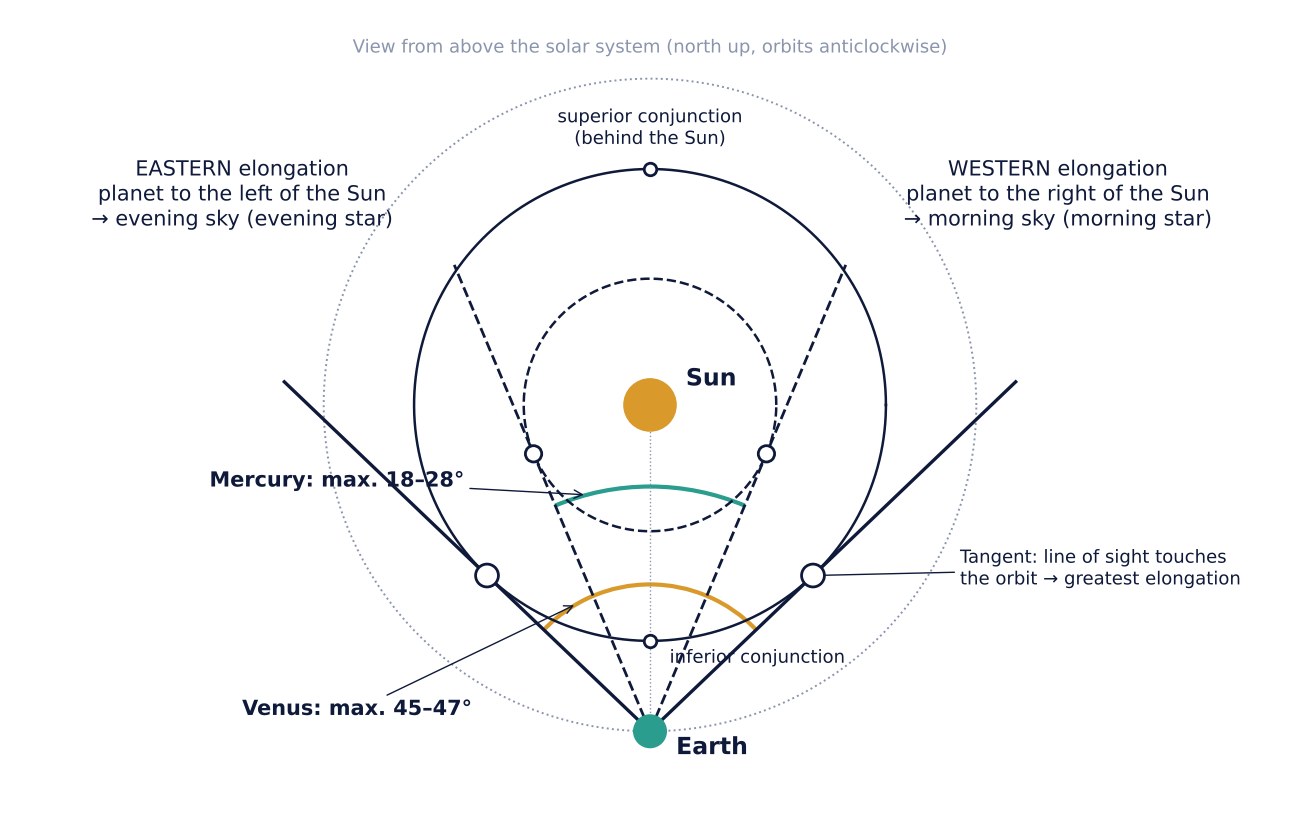
Elongation explained: the angle between the Sun and a planet
Imagine pointing one arm at the Sun and the other at a planet. The angle between your arms is the elongation. It is measured from 0 to 180 degrees, separately east and west of the Sun.
The word comes from the Latin elongatio, “distance”. In physics and biology it means something completely different: in physics the displacement of an oscillating body from its rest position, in genetics the lengthening of the RNA chain during transcription. Here we are only talking about astronomy.
| Term | Elongation | What you see in the sky |
|---|---|---|
| Conjunction | 0° | Planet stands next to the Sun, invisible |
| Greatest elongation | Mercury 18–28°, Venus 45–47° | inner planet as far from the Sun as it gets |
| Quadrature | 90° | outer planet stands at a right angle to the Sun |
| Opposition | 180° | outer planet stands opposite the Sun, visible all night |
In practice a simple rule of thumb applies. The greater the elongation, the longer a planet stays above the horizon after sunset or before sunrise – and the darker the sky you are searching it against. Which planets are how far from the Sun right now is shown on our page Which planets are visible tonight?.
Greatest elongation: why Mercury and Venus get no further
Mercury and Venus orbit the Sun inside Earth’s orbit, which is why they are called inner or inferior planets. Seen from Earth, they can never move further from the Sun than their orbit allows. They reach the limit when our line of sight just grazes their orbit – the line planet–Sun is then perpendicular to the line Earth–planet.
This leads to a simple formula: the sine of the greatest elongation equals the planet’s orbital radius in astronomical units (AU, the mean Earth–Sun distance). For Venus at 0.723 AU that gives about 46 degrees, for Mercury at 0.387 AU about 23 degrees on average.
| Property | Mercury | Venus |
|---|---|---|
| Mean distance from the Sun | 0.387 AU | 0.723 AU |
| Orbital eccentricity | 0.206 | 0.007 |
| Greatest elongation (range) | 18–28 degrees | 45–47 degrees |
| Interval between two elongations on the same side | approx. 116 days | approx. 584 days |
| Greatest elongations Oct 2026 – Dec 2028 | 15 | 3 |
So Mercury swings back and forth briskly: about six times a year it reaches a greatest elongation, alternately east and west. Venus needs more than a year and a half for a full cycle, but in return stays in the sky for months as a bright “star”.
Eastern and western elongation: evening star or morning star
If an inner planet stands east of the Sun, it sets after it – you see it in the evening sky in the west. If it stands west of the Sun, it rises before it and shows up in the morning sky in the east.
For Venus this gave rise to the old names: she shines as the “evening star” after an eastern elongation and as the “morning star” after a western one. She is of course not a star at all; you will find more in our Venus profile.
Why you never see Venus at midnight
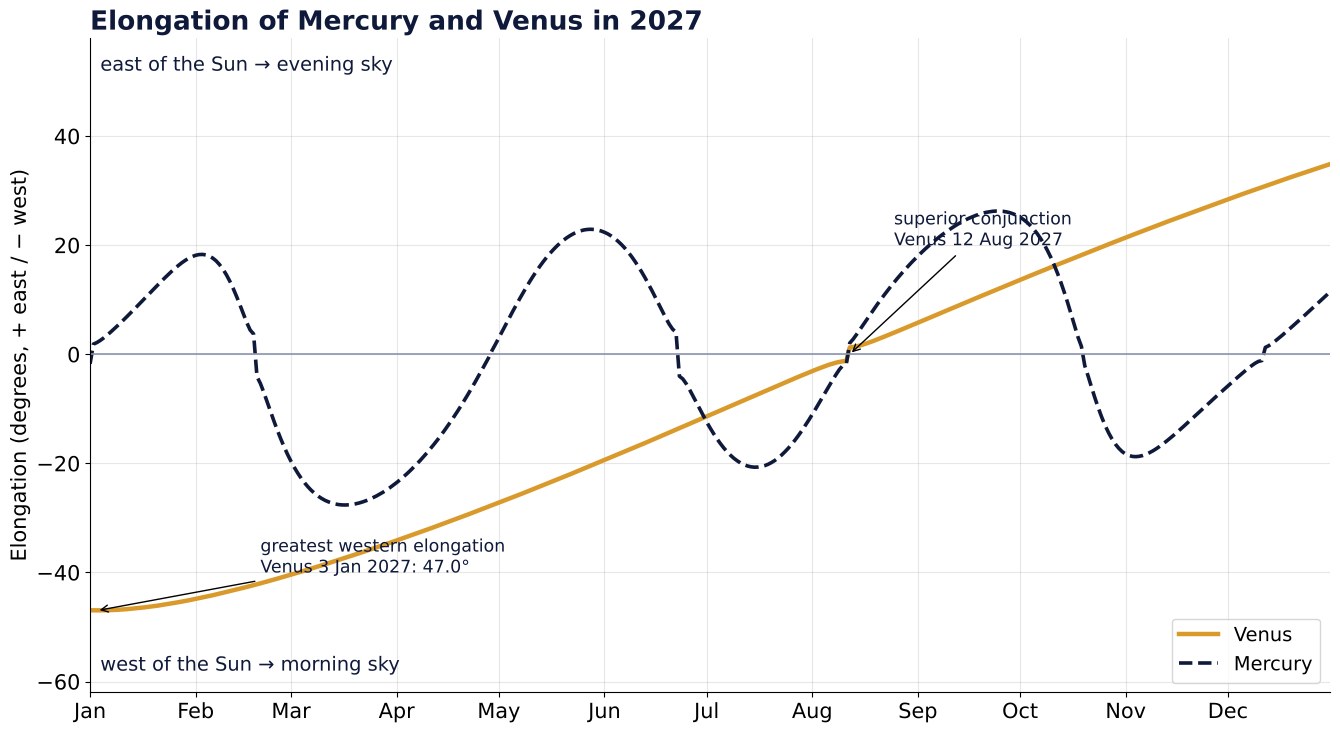
With at most 47 degrees from the Sun, Venus never stands opposite the Sun in the sky. Even at her best evening position on 22 March 2028 she sets at 22:54 in London, a good four and a half hours after the Sun. A bright point of light at midnight is therefore almost always Jupiter.
Tip: Mercury is bound even more tightly to the Sun. From the UK it practically never sets more than a good two hours after the Sun – the maximum until the end of 2028 is 134 minutes on 8 May 2028.
Greatest elongation 2026 to 2028: all dates with a verdict
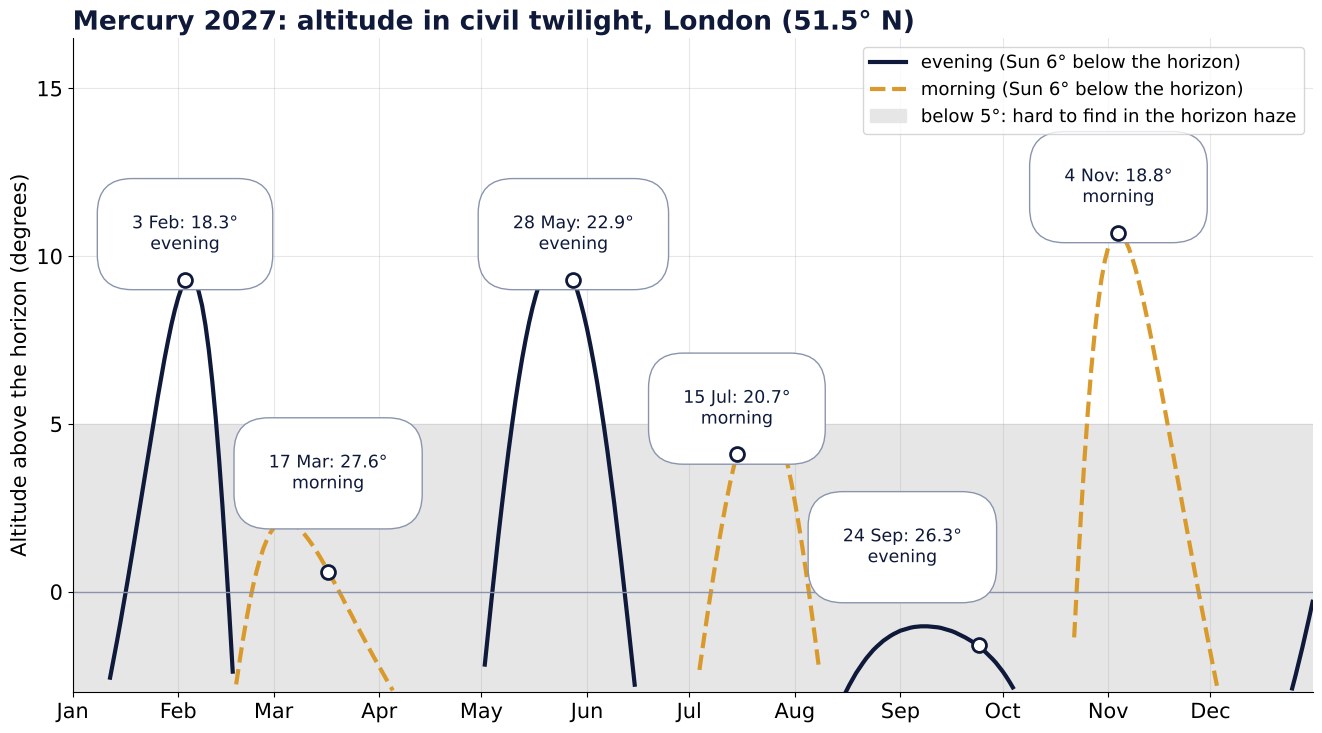
We calculated all greatest elongations of Mercury and Venus from October 2026 to the end of 2028 ourselves. For every date you can see how high the planet actually stands in London (51.5° N) when the Sun is 6 degrees below the horizon – the start or end of civil twilight. That is the moment when the sky is dark enough and the planet has not yet sunk into the haze.
| Date | Planet, side | Angle | Altitude with Sun at −6° | Brightness | Verdict for London |
|---|---|---|---|---|---|
| 12 Oct 2026 | Mercury, east, evening | 25.2° | −1.4° (below the horizon) | 0.0 mag | poor – flat autumn ecliptic, Mercury sets only 29 min after the Sun |
| 20 Nov 2026 | Mercury, west, morning | 19.6° | 10.5° (06:49, SE) | −0.5 mag | good – best morning chance of 2026, almost 2 h before sunrise |
| 3 Jan 2027 | Venus, west, morning | 47.0° | 20.3° (07:25, SSE) | −4.6 mag | good – Venus as morning star, in mid-December even 24° high |
| 3 Feb 2027 | Mercury, east, evening | 18.3° | 9.3° (17:28, WSW) | −0.5 mag | good – small angle, but steep evening ecliptic |
| 17 Mar 2027 | Mercury, west, morning | 27.6° | 0.6° (05:37, ESE) | 0.3 mag | poor – largest angle of the year, but a spring morning |
| 28 May 2027 | Mercury, east, evening | 22.9° | 9.3° (21:47, WNW) | 0.5 mag | good – high enough, only a bright sky at around 22:00 |
| 15 Jul 2027 | Mercury, west, morning | 20.7° | 4.1° (04:15, ENE) | 0.4 mag | moderate – around 22 July up to 5.6° high and brighter (−0.3 mag) |
| 24 Sep 2027 | Mercury, east, evening | 26.3° | −1.6° (below the horizon) | 0.2 mag | poor – autumn evening, below the horizon |
| 4 Nov 2027 | Mercury, west, morning | 18.8° | 10.7° (06:23, ESE) | −0.5 mag | good – classic autumn morning apparition |
| 17 Jan 2028 | Mercury, east, evening | 18.8° | 7.7° (17:01, SW) | −0.6 mag | good – highest around 20 January (8.1°) |
| 27 Feb 2028 | Mercury, west, morning | 26.9° | 2.0° (06:17, ESE) | 0.1 mag | poor – flat morning ecliptic in late winter |
| 22 Mar 2028 | Venus, east, evening | 46.1° | 35.4° (18:51, WSW) | −4.5 mag | very good – Venus sets only 4.6 h after the Sun |
| 9 May 2028 | Mercury, east, evening | 21.4° | 11.1° (21:17, WNW) | 0.4 mag | good – highest Mercury evening position in the period |
| 26 Jun 2028 | Mercury, west, morning | 22.2° | 1.3° (03:57, ENE) | 0.5 mag | poor – even in early July below 3.5° |
| 10 Aug 2028 | Venus, west, morning | 45.8° | 25.8° (05:00, E) | −4.4 mag | good – by the end of August Venus climbs to about 30° |
| 6 Sep 2028 | Mercury, east, evening | 27.1° | −1.6° (below the horizon) | 0.3 mag | poor – autumn evening, below the horizon |
| 18 Oct 2028 | Mercury, west, morning | 18.2° | 10.6° (06:56, ESE) | −0.5 mag | good – autumn morning apparition |
| 31 Dec 2028 | Mercury, east, evening | 19.6° | 5.9° (16:41, SW) | −0.5 mag | moderate – only about 6° high |
The pattern is clear: of 15 Mercury elongations, only seven are good from the UK, two are moderate and six are practically useless. London sees Mercury about half a degree lower than central Germany, but the verdicts are the same. Venus, on the other hand, is easy to see at all three dates, because she gets far enough from the Sun and is extremely bright at around −4.5 mag.
The best chances to see Mercury until 2028
| Date | Time | Gap to the Sun (rise/set) | Altitude with Sun at −6° | Direction |
|---|---|---|---|---|
| 20 Nov 2026 | morning | 119 min | 10.5° | south-east |
| 3 Feb 2027 | evening | 106 min | 9.3° | west-south-west |
| 28 May 2027 | evening | 126 min | 9.3° | west-north-west |
| 4 Nov 2027 | morning | 114 min | 10.7° | east-south-east |
| 9 May 2028 | evening | 134 min | 11.1° | west-north-west |
| 18 Oct 2028 | morning | 109 min | 10.6° | east-south-east |
On these days and for about a week before and after, your chances are best. 20 November 2026 is the next good date – Mercury then rises almost two hours before the Sun in the south-east. Current monthly overviews are in our astronomical events.
Elongation alone is not enough: the ecliptic decides
Why is an elongation of 25 degrees in October useless, but one of 18 degrees in February good? What matters is how steeply the ecliptic – the path of the Sun and planets across the sky – meets the horizon. If it is steep, the planet stands almost vertically above the set Sun; if it is flat, it creeps along just above the horizon.
At London’s latitude of 51.5 degrees north this angle varies a lot. In the evening at the spring equinox the ecliptic stands 61.9 degrees steep, at the autumn equinox only 15.1 degrees. In the morning it is exactly the other way round.
The rule of thumb for the UK and Ireland
Remember one sentence: Mercury in the evening from January to May, in the morning from September to November. Evening elongations in August and September and morning elongations from February to April can practically be written off in the UK and Ireland.
In the southern hemisphere it is exactly the other way round, by the way. Anyone in Australia or South America in September sees a high Mercury in the evening, which we miss in the UK at the same time.
| Month of elongation | evening (east) | morning (west) |
|---|---|---|
| December – February | good | poor to moderate |
| March – May | good | poor |
| June – August | moderate (light nights) | poor to moderate |
| September – November | poor | good |
Mercury’s elongation varies: the orbital eccentricity of 0.206
Mercury’s orbit is the most eccentric of all the planets, i.e. the most strongly elliptical. Its distance from the Sun varies between 0.307 and 0.467 AU (46 to 70 million kilometres). The circular-orbit formula gives limits of 17.9 and 27.8 degrees from this.
If Mercury is near the point furthest from the Sun (aphelion) at greatest elongation, the angle is large; near the closest point (perihelion) it is small. Bad luck for us: the large angles of around 27 degrees fall in March and September – exactly the seasons with a flat ecliptic in the relevant sky.
| Date | Side | Angle | Altitude with Sun at −6° |
|---|---|---|---|
| 24 Sep 2027 | evening | 26.3° | −1.6° |
| 27 Feb 2028 | morning | 26.9° | 2.0° |
| 17 Jan 2028 | evening | 18.8° | 7.7° |
| 18 Oct 2028 | morning | 18.2° | 10.6° |
For Venus this hardly matters. Her orbit is almost a circle, so her greatest elongations always lie between 45 and 47 degrees. The laws behind elliptical orbits were discovered by Johannes Kepler.
Elongation of the outer planets: up to opposition
Mars, Jupiter and Saturn orbit outside Earth’s orbit. Their elongation can take any value from 0 to 180 degrees. At 180 degrees they stand exactly opposite the Sun – at opposition –, rise at sunset and are visible all night.
At 90 degrees we speak of quadrature. At eastern quadrature an outer planet stands high in the south at sunset, at western quadrature at sunrise. Conjunction at 0 degrees, by contrast, is the time when it is invisible behind the Sun.
| Planet | Opposition | Elongation | Next conjunction |
|---|---|---|---|
| Saturn | 4 Oct 2026 | 177.3° | 7 Apr 2027 |
| Jupiter | 11 Feb 2027 | 178.9° | 31 Aug 2027 |
| Mars | 19 Feb 2027 | 175.5° | 21 Mar 2028 |
| Saturn | 18 Oct 2027 | 177.2° | 20 Apr 2028 |
| Jupiter | 12 Mar 2028 | 178.5° | 30 Sep 2028 |
| Saturn | 30 Oct 2028 | 177.3° | – |
Hardly any planet reaches exactly 180 degrees, because its orbit is slightly tilted relative to Earth’s. Mars only reaches 175.5 degrees at the 2027 opposition, because it stands almost 4.5 degrees north of the ecliptic. The double opposition of Jupiter and Mars is presented in our night sky in February 2027.
Elongation of the Moon: how the lunar phase comes about
Elongation is measured for the Moon, too. It directly determines how much of the lunar disc is lit: the illuminated fraction k follows to a good approximation from k = (1 − cos E) / 2.
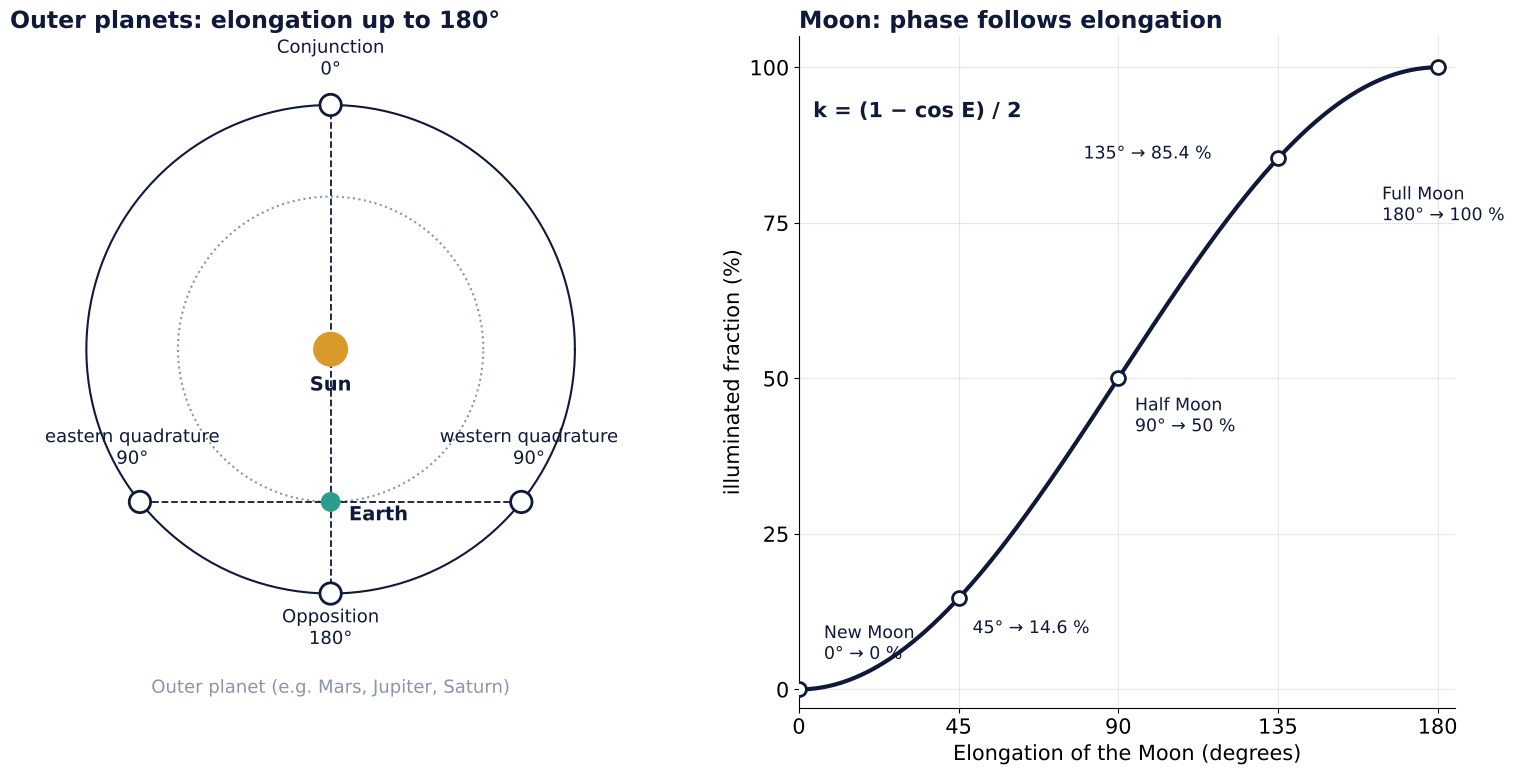
At 0 degrees it is New Moon, at 90 degrees Half Moon, at 180 degrees Full Moon. A Moon at 45 degrees elongation shows only just under 15 percent illuminated area, at 135 degrees it is already a good 85 percent. You can check the current phase in any astronomy app.
Finding Mercury at greatest elongation: how it works
Mercury is easy to see with the naked eye if you know when and where. The most important thing is a completely clear horizon towards sunset (evening) or sunrise (morning) – a field, a hill or the sea.
In the evening you start 30 to 45 minutes after sunset just above the spot where the Sun disappeared. In the morning the same applies before sunrise; after that the twilight quickly outshines the planet.
- Date: greatest elongation ± 7 days from the table above, only dates marked “good”
- Place: clear view down to the horizon in the direction given in the table
- Time: 30–45 minutes after sunset or before sunrise
- Help: an astronomy app or a nearby crescent Moon as a signpost
Search with binoculars – but only after sunset
Binoculars make the search much easier, because Mercury is often only a faint point in the bright twilight sky. Even a pair of 10×50 binoculars shows it as a clear point of light if you sweep horizontally back and forth just above the horizon.
Warning: Never sweep binoculars or a telescope while the Sun is still above the horizon – not even “briefly” near it. Concentrated sunlight causes permanent eye damage in a fraction of a second. So in the evening you only search once the Sun has completely set, and in the morning you stop before it rises. How to observe the Sun safely is explained in our guide Observing the Sun safely.
If you only want to buy one instrument, read our comparison Telescope or binoculars first. A normal pair of astronomy binoculars is enough to find Mercury, for phases you need a telescope.
Phases of Venus at greatest elongation: half Venus in the telescope
Since Galileo in 1610 we have known: Venus shows phases like the Moon – and at greatest elongation she is roughly half lit. That was one of the strong pieces of evidence for the heliocentric model.
| Date | Illuminated | Disc |
|---|---|---|
| Venus, 3 Jan 2027 | 50 % | 25 arcseconds |
| Venus, 22 Mar 2028 | 51 % | 23 arcseconds |
| Mercury, 3 Feb 2027 | 51 % | 7 arcseconds |
| Mercury, 28 May 2027 | 36 % | 8 arcseconds |
After an eastern elongation the crescent of Venus becomes narrower and larger day by day. Venus is brightest not at greatest elongation, but about five weeks before or after it – according to our calculation on 25 November 2026 at −4.9 mag. You can usually only make out Mercury’s tiny phase in steady air from about 100× magnification.
Tip: Observe Venus in the telescope while the twilight is still bright, not only once the sky is dark. Against a dark background she is dazzling, and low on the horizon the turbulent air blurs the crescent.
You do not need a big instrument for the phases of Venus and Mercury’s half disc. A 130 mm reflector shows the crescent of Venus clearly; more about planetary optics in Which telescope for planets?.
Telescope recommendation: phases of Venus for beginners
Our beginner pick: Skywatcher Dobson Telescope N 130/650 Heritage FlexTube
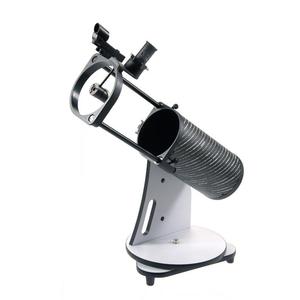
A compact tabletop Dobson with a true parabolic mirror. Folds down, fits in a bag: the Moon, planets and the bright deep-sky classics.
Price: € 265
130 mm aperture (the diameter of the main mirror) on a compact tabletop mount, set up quickly for the short twilight window. For Mercury low in the horizon haze every telescope reaches its limits, this one included – but it is light enough to carry to a spot with a clear horizon. Our guide to beginner telescopes compares more models.
If you want more: the 200 mm Dobsonian for planetary detail
For advanced observers: Skywatcher Dobson Telescope N 200/1200 Skyliner Classic
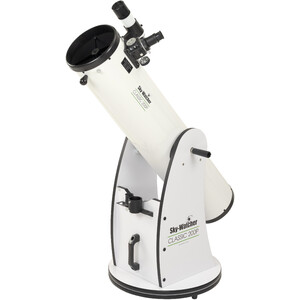
200 mm of aperture — the most sky for your money. Set it on the ground, point by hand: nebulae, clusters and galaxies for years to come.
Price: € 479
With 200 mm the Dobsonian gathers more than twice as much light and resolves finer detail. On Venus this changes little, but on Mars, Jupiter and Saturn it changes a lot – cloud belts, polar caps and the Cassini Division become much clearer. The extra cost is worth it if you want to observe planets seriously all year round and have room for a 1.2 m long tube.
Links marked with an asterisk (*) are affiliate links. If you buy through them we earn a small commission – the price stays the same for you.
Frequently asked questions about elongation
What does greatest eastern elongation mean?
The planet stands as far east of the Sun as is possible in this orbit. It then sets after the Sun and can be seen in the evening sky in the west. Greatest western elongation is the counterpart in the morning sky in the east.
How large is the maximum elongation of Mercury and Venus?
Depending on its orbital position, Mercury reaches 18 to 28 degrees, Venus 45 to 47 degrees. More is geometrically impossible, because both orbit the Sun inside Earth’s orbit.
When is Mercury’s greatest elongation in 2027?
In 2027 there are six dates: 3 February, 17 March, 28 May, 15 July, 24 September (UK time) and 4 November. From the UK and Ireland the evenings around 3 February and 28 May and the mornings around 4 November are good.
When is the next greatest elongation of Venus?
On 3 January 2027 Venus stands 47.0 degrees west of the Sun and is the morning star. The next eastern elongation follows on 22 March 2028, one of the best evening apparitions of all.
What is the difference between elongation and conjunction?
Elongation is an angle, conjunction a particular position with an elongation close to 0 degrees. For inner planets a distinction is made between superior conjunction (behind the Sun) and inferior conjunction (between Earth and Sun).
What is a quadrature in astronomy?
Quadrature is reached when an outer planet or the Moon stands 90 degrees from the Sun. The Moon is then a Half Moon, and an outer planet stands high in the south at sunset or sunrise.
Why is Mercury seen so rarely?
It never stands more than 28 degrees from the Sun and can therefore only be seen low on the horizon in twilight. In the UK and Ireland the often flat ecliptic adds to this, so only about every second greatest elongation is really good. More in our Mercury profile.
What does elongation mean outside astronomy?
In physics, elongation is the instantaneous displacement of an oscillation from its rest position. In biology it is the phase of transcription or translation in which the RNA or protein chain is lengthened.
Read more on Sterngucker
- Our planets – all planets of the solar system at a glance
- Mercury – profile and apparitions of the planet closest to the Sun
- Venus – evening star, morning star and data for 2026/27
- Planets visible tonight – how to find out what is in the sky right now
- Astronomical events – what is happening in the sky month by month
- Night sky in February – the double opposition of Jupiter and Mars 2027
- Heliocentric model – how the phases of Venus proved Copernicus right