By Alexander Merz · Updated on · Details checked on 14 September 2026
November 2026 is the month of the two halves of the sky. In the evening the stage belongs to Saturn, and at the end of the month Uranus reaches opposition – as high and as well placed as it gets only once a year. In the morning, though, the real spectacle takes place: Mars and Jupiter pass within a good degree of each other in Leo, Venus returns as an unearthly bright morning star, and in mid-November Mercury even joins them. In between lies the night of the Leonids. Here you will find all the dates, times and finder charts for Germany – calculated for Berlin, all times in Central European Time (CET).
⚡ The quick answer: The four most important dates in November 2026 are 16 November (Mars and Jupiter just 1.2° apart in the morning sky), the night of 17/18 November (maximum of the Leonids, best window 02:00 to 05:30), 24 November (full moon, the “Beaver Moon”, close beside the Pleiades in the evening) and 26 November (Uranus at opposition, in Taurus all night long). The darkest nights for deep-sky observing fall around new moon on 9 November. Saturn stands high in the south in the evening, Venus from about 05:00 as a brilliant morning star in the east.
The highlights of November 2026 at a glance
This year November brings an unusual amount together: two planetary encounters of rare closeness, an opposition, a meteor shower and a full moon right next to the loveliest star cluster in the sky. This table is your diary for the month – all times in CET for Berlin; at other places in Germany they differ by a few minutes.
| Date | Event | When and how to observe |
|---|---|---|
| 5 Nov | Maximum of the South Taurids | all night, around 5 meteors per hour – the Moon is only 18% illuminated and hardly interferes |
| 7 Nov | slender crescent Moon beside Venus and Spica | from about 06:00 in the east, Moon–Venus separation 2.7° – but all three stand only around 5° high |
| 9 Nov | New moon at 08:02 | the darkest nights of the month – the deep-sky week par excellence |
| 9 Nov | Venus 1.2° from Spica | from 06:00 low in the east – the brightest planet right beside the leading star of Virgo |
| 12 Nov | Maximum of the North Taurids | all night, around 5 meteors per hour – with only 7% moonlight, ideal conditions |
| 16 Nov | Mars and Jupiter just 1.2° apart | 03:00 to 06:00 in Leo, more than 50° high towards the end of the night – the highlight of the month |
| 17/18 Nov | Maximum of the Leonids | best window 02:00 to 05:30, once the half moon has set at 23:30 |
| 20 Nov | Moon 5.5° below Saturn | from 19:00 high in the south – comfortable to watch, and no getting up in the night |
| 21 Nov | Mercury at greatest western elongation (19.6°) | around 07:00 low in the east-south-east, roughly 10° above the horizon |
| 24 Nov | Full moon (the “Beaver Moon”) at 15:53 | in the evening the full Moon stands just 4.5° from the Pleiades |
| 26 Nov | Uranus at opposition | in Taurus all night long, more than 58° high at 00:34 – the best night of the year for the ice giant |
| 26 Nov | Mars 1.7° from Regulus | from 03:00 in Leo – the red planet beside the bluish-white lead star |
The Moon in November 2026: new moon, Beaver Moon and dark nights
The Moon matters twice over in November: once because it is in the way – and once because it is the target itself. The darkest nights of the month lie around new moon on 9 November, and they fall exactly in the period when the Andromeda Galaxy and the Pleiades stand highest. And the full moon on 24 November creeps to within 4.5° of the Pleiades in the evening – pretty to look at, but the end of the night for anything faint.
| Date | Time (CET) | Moon phase | What that means for you |
|---|---|---|---|
| 1 November | 21:28 | Last quarter | the moon-free evenings begin – the Moon does not rise until well after midnight |
| 9 November | 08:02 | New moon | the darkest nights of the month – the best time for galaxies and star clusters |
| 17 November | 12:47 | First quarter | on the Leonid night the half moon sets at 23:30 – after that the sky is clear |
| 24 November | 15:53 | Full moon (the “Beaver Moon”) | the brightest night of the month, close beside the Pleiades in the evening |
| 1 December | 07:08 | Last quarter | the next dark stretch is announcing itself |
The name Beaver Moon for the November full moon comes from North America: it was the time when the beaver traps had to be set before the waters froze over. In the German-speaking world the same moon is traditionally called Nebelmond (fog moon) or Windmond (wind moon) – names that, to be honest, suit November in this part of the world rather better. You will find all the dates of the year in the full moon calendar.
For observing the Moon itself, incidentally, full moon is the worst phase: because the Sun is then shining straight down onto the lunar surface, no crater casts a shadow and the landscape looks flat. The Moon becomes interesting between new moon and half moon, when the crater rims throw long shadows along the day–night boundary. Good evenings for that in November are 12 to 19 November. More about this on our Moon page.
The planets in November 2026
In November all seven of the other planets of the Solar System can be seen – you just have to catch the right time of day. The evening belongs to Saturn and Neptune, Uranus is in the sky all night long, and the second half of the night becomes the big stage for Jupiter, Mars, Venus and Mercury. The figures apply to the middle of the month (15 November) and to Berlin.
| Planet | Brightness | Constellation | Visible | Rise/set on 15 Nov |
|---|---|---|---|---|
| Mercury | −0.5 mag | Libra | morning twilight, 17–25 Nov | rises 05:44 |
| Venus | −4.2 to −4.9 mag | Virgo | morning star, all month | rises 04:46 |
| Mars | +0.8 to +0.4 mag | Leo | second half of the night | rises 23:01 |
| Jupiter | −2.0 to −2.2 mag | Leo | second half of the night | rises 23:06 |
| Saturn | +0.5 to +0.6 mag | Cetus | evening until midnight | rises 14:58, sets 03:10 |
| Uranus | 5.6 mag | Taurus | all night long (opposition 26 Nov) | rises 16:37, sets 08:36 |
| Neptune | 7.7 mag | Pisces | evening | rises 14:40, sets 02:36 |
Saturn: the star of the evening sky
After its opposition at the beginning of October, Saturn is now already well placed early in the night: on 15 November it culminates – reaches its highest point – at 21:02 at an altitude of 38° and remains well observable until after midnight. At +0.5 mag it is the most conspicuous point of light in an otherwise star-poor region of the sky – because it stands in Cetus, the whale, and not in neighbouring Pisces, where many charts still place it. Its disc measures around 19 arcseconds; after the extremely edge-on ring position of 2025 the rings are clearly open again and can be made out as a ring even in a small telescope from about 50x magnification. If you look patiently, you will also find its moon Titan beside it as a little star of 8th magnitude.
Uranus: opposition on 26 November
Uranus reaches its opposition on 26 November and is therefore visible all night long – at 00:34 it stands 58° high, better placed than at any other time this year. At 5.6 mag it is theoretically at the limit of naked-eye visibility; in practice that takes a genuinely dark sky and a trained eye. In binoculars it is easy to find once you know where to look – more on that further down, including a finder chart.
Neptune: the target for the early part of the night
Neptune has had its opposition behind it since September and is slowly moving into the evening sky. On 15 November it culminates at 20:35 at an altitude of 37°, which puts it early enough for an ordinary night out. At 7.7 mag and with a disc of only 2.3 arcseconds it is, however, the most demanding planetary target of all: in binoculars it stays one little star among many, and only from about 150x magnification does a tiny, bluish disc appear. It stands in Pisces, less than 15° from Saturn – so Saturn is the perfect starting point for the search.
Jupiter and Mars: the Leo stage in the morning
The most exciting development of the month plays out in Leo. Jupiter and Mars both stand there, rise at around 23:00 and are more than 50° high towards the end of the night – at last, then, at an altitude at which atmospheric turbulence no longer ruins everything. At −2.1 mag Jupiter is about twelve times brighter than Mars and shows its four large moons even in binoculars; in a telescope the cloud belts and the Great Red Spot are within reach. Mars, by contrast, is still small at 6 to 8 arcseconds of disc diameter – it is only now approaching its opposition in February 2027. On 16 November the two meet; on the 26th Mars additionally passes close to Regulus.
Venus: the slender crescent becomes the morning star
Venus put its inferior conjunction – its passage between Earth and Sun – behind it at the end of October and is now emerging in the morning sky, and in its most spectacular phase at that. At the beginning of November it still stands very low, but at 60 arcseconds it is as large as it ever gets: a wafer-thin crescent that can be recognised as such even in steadily mounted binoculars. Over the course of the month the disc shrinks to 39 arcseconds and the crescent grows thicker – and because the two almost cancel each other out, its brightness nevertheless keeps rising, to −4.9 mag. At the same time it climbs from 12° to 23° in altitude. On 9 November it stands just 1.2° from Spica, the leading star of Virgo – an extreme contrast in brightness that you should not let pass.
Mercury: greatest western elongation on 21 November
Mercury delivers its best morning apparition of the year in November. It reaches its greatest western elongation on 21 November at 19.6° – its apparent angular distance from the Sun is then at its largest. The best visibility does not fall exactly on that date, though, because the angle of the ecliptic to the horizon has a say as well: Mercury is best placed from 17 to 25 November, when it stands around 10° high at the start of civil twilight. Its maximum is on 20 November at 10.3°. Look for it at around 07:00 low in the east-south-east – most easily by working down and to the left from far brighter Venus towards the horizon. Binoculars help with the first sighting; after that it is usually visible to the naked eye as well.
Why autumn of all seasons is good for Mercury
Mercury is not hard to see because it is faint – at −0.5 mag it is brighter than most stars. The problem is the shallow angle at which the ecliptic, the apparent path of the Sun, meets the horizon on spring mornings: Mercury is then a long way from the Sun sideways, but barely any higher. In autumn the ecliptic stands steeply in the morning, and the same angular distance translates into real altitude above the horizon. That is why the morning apparitions in autumn and the evening apparitions in spring are the good ones.
Mars meets Jupiter on 16 November 2026
The finest event of the month needs no equipment, just an alarm clock. In the morning hours of 16 November Mars and Jupiter stand only 1.2° apart in Leo – a good two full-moon widths. The pair is above the eastern horizon from about 23:00, but it only becomes really good in the second half of the night: at around 06:00 both stand more than 50° high in the south-east, and you should not go lower than that altitude for a look through the telescope anyway.
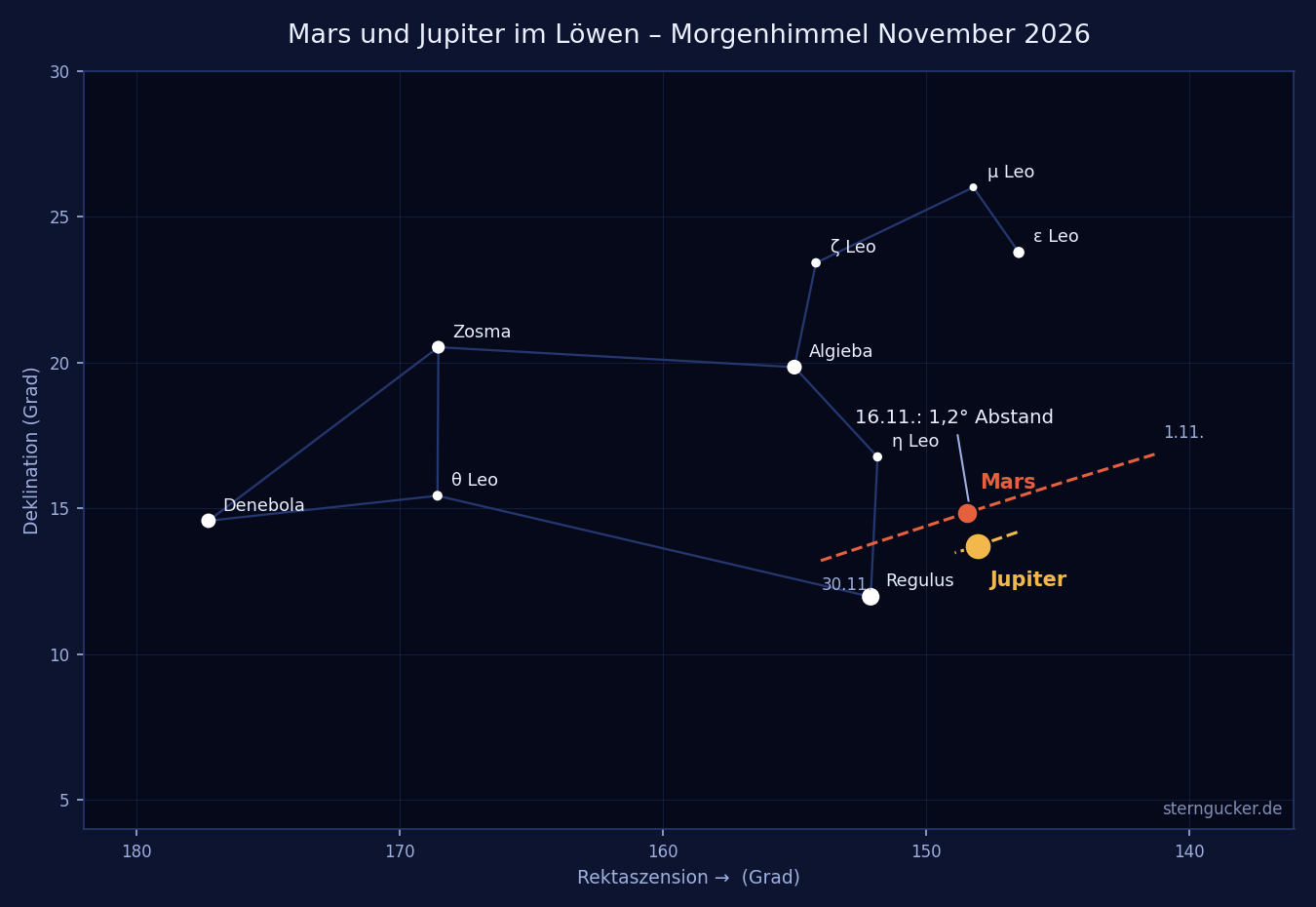
The appeal lies in the contrast. Jupiter shines white and steady at −2.1 mag, Mars beside it noticeably fainter and in a warm orange. If you take binoculars along, you will see the two comfortably in the same field of view – together with Jupiter’s four Galilean moons, which stand in a line as tiny points of light. In a telescope both still fit into the picture together at low magnification; for detail it is then worth going in separately on Jupiter’s cloud belts.
The encounter is not a one-off moment but drags out: on 15 November the separation is 1.2°, on the 16th it is at its minimum, and on the 17th it is 1.3°. So if one night is cloudy, the next is almost as good. From 20 November the scene is rounded off by Mars’s approach to Regulus: on 26 November only 1.7° separate the two, and side by side you can see how differently a planet and a star shine – Regulus twinkles, Mars stays steady.
The Uranus opposition on 26 November 2026
On 26 November the Earth stands exactly between the Sun and Uranus. The ice giant therefore rises at sunset, culminates at midnight and sets at sunrise – it is there all night long, and at 58° altitude it stands higher than on any other night of the year. At 5.6 mag and with a disc of 3.8 arcseconds it is not an easy target, but a very rewarding one.
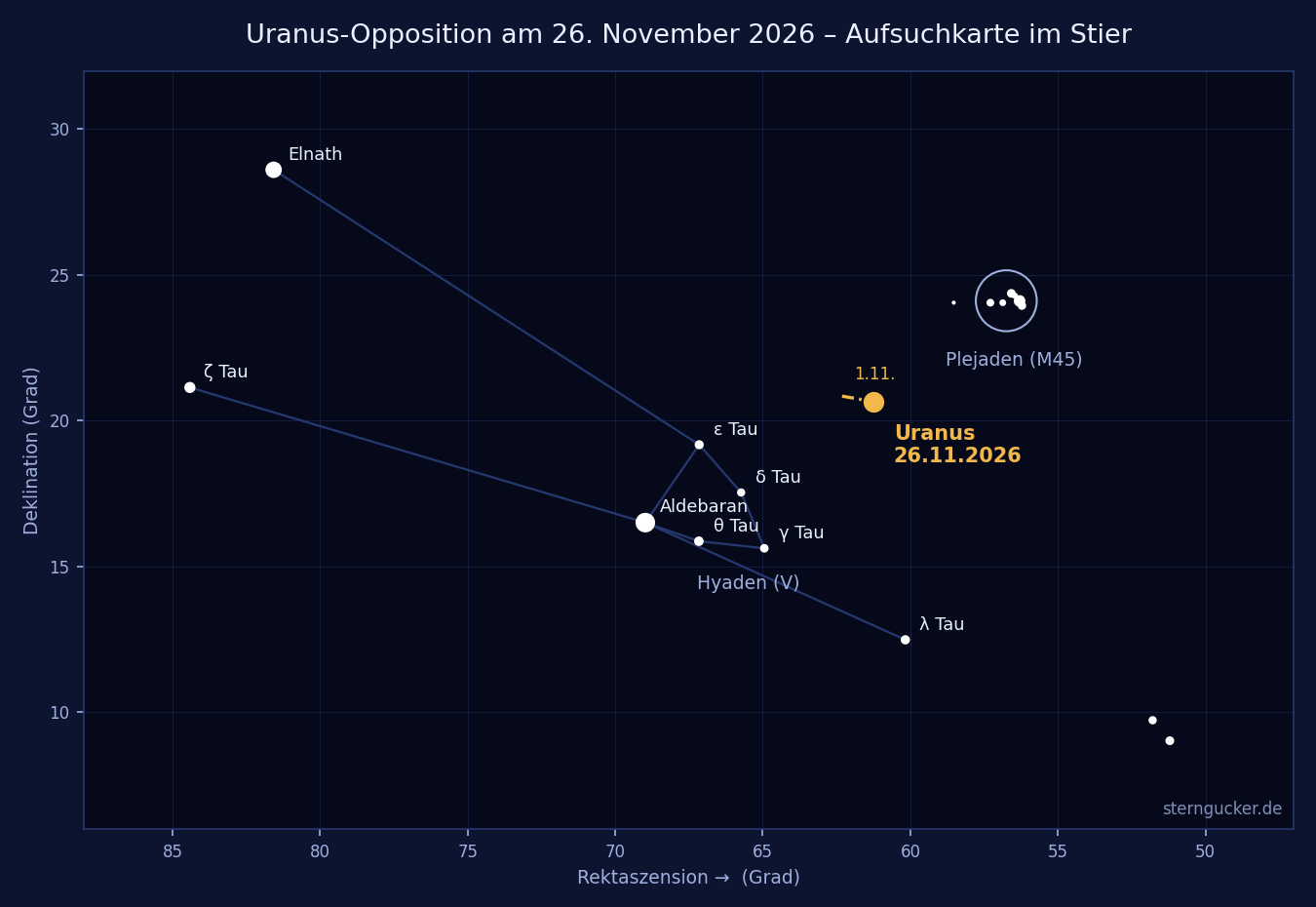
How to find it: in 2026 Uranus stands in Taurus, and practically exactly between the two most conspicuous star clusters of the winter sky – around 5° south-east of the Pleiades and about 8° north-west of Aldebaran, the orange lead star of the Hyades. Both are impossible to miss with the naked eye. Centre the Pleiades in your binoculars and pan slowly from there towards Aldebaran: a little short of halfway there stands a “star” of 5.6 mag that differs from the real stars around it by its calm, faintly greenish-pale colour. It does not twinkle – that is the surest way of recognising it.
What you will see: in binoculars Uranus stays a point of light. Only a telescope from about 100x magnification turns it into a tiny but unmistakable disc of pale blue-green – the moment at which it becomes clear that you are not looking at a star but at a world 51,000 kilometres across at a distance of 2.8 billion kilometres. Its five large moons, at 14th to 16th magnitude, remain reserved for telescopes from about 25 cm of aperture – the diameter of the main lens or mirror – upwards.
Why an opposition is more than just a date
At opposition an outer planet has three advantages at once: it is closest to the Earth, so it is at its largest and brightest. It is fully lit by the Sun, so it shows no phase. And it stands exactly opposite the Sun, so it culminates at midnight – in the winter half of the year that also means maximum altitude above the horizon and therefore the least atmospheric turbulence. That is why it is worth observing an object like Uranus deliberately in its opposition week rather than at some random point in the year.
Shooting stars in November 2026
November is not a record month for shooting stars – but it is one of the most varied. Four showers are active at once, and in 2026 the two most important of them fall on nights with little or no moonlight. On top of that, the November sky gets dark early: on 15 November astronomical darkness begins as early as 18:13 and lasts until 05:28 – more than eleven hours of potential observing time per night.
| Meteor shower | Maximum 2026 | Meteors per hour | Parent body | Moon conditions |
|---|---|---|---|---|
| South Taurids | 5 November | approx. 5 | Comet 2P/Encke | good – Moon 18% illuminated |
| North Taurids | 12 November | approx. 5 | Comet 2P/Encke | very good – Moon 7% illuminated |
| Leonids | 17/18 November | approx. 15 | Comet 55P/Tempel-Tuttle | good from 23:30, when the half moon sets |
| Alpha Monocerotids | 21/22 November | fewer than 5, rare outbursts | unknown | good – the waxing Moon sets early |
The Leonids in the night of 17/18 November
The Leonids are the best-known shower of the month – and the fastest of all: their particles hit the atmosphere at 71 km/s, because they come head-on towards the Earth. The result is strikingly bright, whitish-blue meteors, many of which leave behind a trail that glows on for seconds. In 2026 the maximum falls on 17 November at around 15:52 – during the day, then, which is why the nights before and after both come into question. The better one is the night of 17/18 November.
How that night unfolds: the radiant in Leo – the point from which the meteors appear to come – rises at 22:25, the half moon, 54% illuminated, disappears below the horizon at 23:30, and from about 02:00 the radiant stands high enough for decent rates. The best window therefore lies between 02:00 and 05:30, before dawn sets in. Reckon on around 15 meteors per hour under a dark sky – considerably fewer if you are observing from a town.
The Taurids: fireballs at the beginning of November
The Taurids deliver little in terms of numbers, but in terms of quality often the best of the month. Both branches – the southern one with its maximum on the 5th, the northern one on 12 November – come from Comet 2P/Encke and consist of comparatively large fragments. They hit the atmosphere at only about 28 km/s and therefore cross the sky as slow, unhurried trails of light. Time and again there are decidedly bright fireballs among them, lighting up the whole sky for a moment. Because both maxima fall close to new moon in 2026, conditions are excellent – all you need is patience, because five meteors an hour means being able to wait. You will find an overview of all the showers of the year in the meteor shower calendar, and the background is explained on our page about the meteor shower.
How to watch shooting stars properly
For meteors you need no instrument – on the contrary, binoculars and telescopes only do harm, because they narrow the field of view. What counts is as large a patch of sky as possible, and dark adaptation: reckon on 20 to 30 minutes before your eyes reach their full sensitivity, and use no white light during that time. Lie down flat – a camping mat or a deckchair is the most important piece of equipment – and do not look directly at the radiant but about 40° to one side; the meteors appear longer there. And find yourself a spot away from the town: light pollution quickly costs you three quarters of all the meteors.
The dates that are actually worth it are often months apart – and easily forgotten. So you do not miss one:
One short email, in good time – with the times and an honest take on whether it is worth getting up for.
You will get a confirmation email in a moment. Your address stays with us – no sharing, no third-party ads.
The constellations in November 2026
November is the month of transition: the autumn sky stands highest in the evening, while the great winter constellations are already coming up in the east. If you go outside at 22:00, you have both in the sky at the same time – that is the real appeal of this month. The figures below apply to 15 November, 22:00 CET.
High in the south and at the zenith: the Great Square
Almost directly overhead stands Cassiopeia, the distinctive W in the sky, which practically reaches the zenith at 21:08 at an altitude of 86°. Right beside it Perseus stretches along the Milky Way; its lead star Mirfak culminates at 23:52 at an altitude of 87°. South of it the Great Square of Pegasus opens out, with the chain of stars of Andromeda starting at its upper left corner. Lower down in the south stand the faint constellations Pisces, Aries and Cetus – with Cetus taking on an unaccustomed prominence this year thanks to Saturn. Very low on the southern horizon Fomalhaut blinks, reaching its maximum altitude of a meagre 8° as early as 19:26.
In the east: the winter sky comes up
This is where the exciting things happen in November. Taurus with the Pleiades (rising 15:53) and orange Aldebaran (17:33) already stands high in the evening – and this year it is also home to Uranus. At around 20:11 Orion’s Belt pushes above the horizon, and Betelgeuse is there from 19:44. High in the north-east stands Auriga, the charioteer, with bright Capella, which never sets at all as seen from Germany and reaches an altitude of 84° at 01:48. Gemini follows after midnight, and at 22:45 Sirius finally comes up, the brightest star in the entire sky – although at a maximum altitude of 21° it always stays close to the horizon.
In the west and north: farewell to summer
Of the Summer Triangle, only the farewell is left to see in the evening sky: Vega had its highest point back at 15:05, Deneb at 17:09. Early in the evening both still stand reasonably high in the west, but they sink away over the course of the night – Deneb, as a circumpolar star, stays just above the northern horizon. In the north the Plough turns its lowest round and lies flat above the horizon in the evening; extending the line of its two rear stars leads, as always, to the Pole Star, which stands unchanged at an altitude of 52°. And after midnight Leo rises in the east: Regulus appears at 23:33 – and with it Jupiter and Mars.
Deep sky in November: the best targets of the month
For faint objects November is outstanding: long nights, an autumn sky standing high, and with new moon on 9 November a whole week without disturbing moonlight. The times in the table are the culminations on 15 November – the moment at which an object stands highest and therefore best.
| Object | Constellation | Culmination | Altitude | What to observe it with |
|---|---|---|---|---|
| M31 Andromeda Galaxy | Andromeda | 21:11 | 79° | naked eye (dark sky), binoculars ideal |
| h and χ Persei | Perseus | 22:48 | 85° | binoculars – the finest pair of open clusters in the sky |
| M33 Triangulum Galaxy | Triangulum | 22:02 | 68° | binoculars, but only under a genuinely dark sky |
| M45 Pleiades | Taurus | 00:15 | 62° | naked eye and binoculars – too large for a telescope |
| M35 | Gemini | 02:40 | 62° | binoculars and telescope |
| M42 Orion Nebula | Orion | good from 02:00 | 36° | telescope – the winter highlight is announcing itself |
Two objects are worth singling out in November. At 79° the Andromeda Galaxy stands as high as it can possibly get – 2.5 million light years away and yet, under a dark sky, just about discernible to the naked eye as a pale smudge. And h and χ Persei, the pair of open clusters between Cassiopeia and Perseus, is perhaps the most rewarding binocular target of the whole year: two swarms of a few hundred young stars each, close together in the same field of view. You will find more targets in our deep-sky overview.
The Sun in November 2026: the days grow short
November shortens the day noticeably: between 1 and 30 November Germany loses around an hour and a half of daylight. For stargazers that is the good news – you no longer have to wait until midnight for it to get properly dark.
| Date | Sunrise | Sunset | Length of day | Altitude at noon |
|---|---|---|---|---|
| 1 November | 07:03 | 16:37 | 9 h 34 min | 23.0° |
| 10 November | 07:19 | 16:21 | 9 h 02 min | 20.3° |
| 20 November | 07:37 | 16:07 | 8 h 30 min | 17.7° |
| 30 November | 07:53 | 15:57 | 8 h 04 min | 15.8° |
What is decisive for observing, though, is not sunset but the end of astronomical twilight – only then is the sky really black. On 15 November that is the case at 18:13, and the darkness holds until 05:28 in the morning. That is more than eleven hours at a stretch. For comparison: in June it is zero at some places in Germany. You can learn more about our own star on the Sun page.
Which instrument is worth it for the November sky?
November is a telescope month. The defining events are Uranus at opposition, Saturn with its rings, Jupiter’s cloud belts and the crescent Venus – all targets where magnification and resolution are what count, and where binoculars run into their limits by their very nature. Binoculars are still worth having, but for other objects: for the Pleiades, for Andromeda, for h and χ Persei. If you can only buy one instrument and really want to explore the sky, reach for the telescope; binoculars are the addition, not the substitute.
The best choice for the November sky: Skywatcher Dobson Telescope N 130/650 Heritage FlexTube
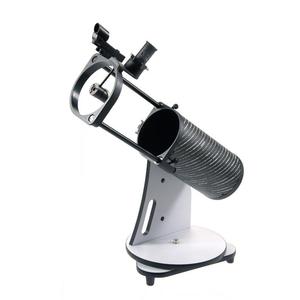
A compact tabletop Dobson with a true parabolic mirror. Folds down, fits in a bag: the Moon, planets and the bright deep-sky classics.
Price: € 265
With 130 mm of aperture – the diameter of the main mirror – this instrument shows exactly what November is about: Saturn’s rings clearly separated, Jupiter’s cloud belts and its four moons, the crescent Venus – and Uranus as an unmistakable disc instead of a point. The collapsible design makes it compact enough to take along to a dark observing site, which is handy for the Leonid night in particular. If you want to compare things first, our overview telescopes under 300 euros will help, or – if it may be a little larger – the guide to the Dobsonian telescope.
The complement for the Pleiades and Andromeda: Celestron Cometron 7x50 Binoculars
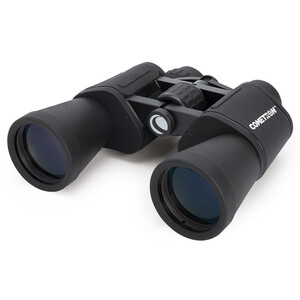
The astronomy classic among affordable binoculars: 7×50 with a large exit pupil for bright handheld views of the Moon and Milky Way – the ideal first step before a telescope.
Price: € 65
For the large-scale objects of the November sky, binoculars really are superior to a telescope: the Pleiades fit into no telescope field of view, the Andromeda Galaxy is six times as wide as the full Moon, and h and χ Persei only unfold their effect side by side in the same image. For the Mars–Jupiter encounter on 16 November binoculars are the quicker tool as well – and for the first hunt for Mercury in the twilight they are the obvious choice anyway.
The classic for every observing night: Oculum Swivelling Sky Map 29 cm

Set date and time, hold it up, find the constellations: the swivelling star chart shows exactly the sky above you at that moment. No battery, no signal, no screen glare.
Price: € 19.90
A planisphere – a rotating star chart – shows you for every date and every time what is currently above the horizon, with no battery and no display to destroy your dark adaptation. In November in particular, when autumn and winter constellations stand in the sky at the same time, it helps you to sort things out.
* Affiliate link: if you buy through this link we may earn a small commission from Astroshop or High Point Scientific, at no extra cost to you.
Giving astronomy as a present: in November it gets serious
November is the month in which the present question is settled. Order by the end of November and you have the choice and a quiet December. Wait, and for the popular beginner telescopes you will often find nothing but delivery times in the new year.
27 November 2026 is Black Friday, and in the days before it the astro offers come thick and fast. Two things help: note down an instrument’s price beforehand, so you can judge the discount – and do not let the magnification printed on the box guide you.
That number is the most common bad buy of the season. On a 60 mm refractor the limit is around 120 times, whatever the box promises; above that the image only gets bigger and mushier. Aperture and a stable mount decide, not magnification.
What is actually worth it, sorted by budget – from the poster through binoculars to the first real telescope –, is in the overview of astronomy gifts. For children the telescope for kids buying guide gets to the right instrument fastest, for adults with no previous knowledge the beginner telescope guide.
And if you do not know what is already in the cupboard: with a telescope a voucher is not a fallback. Which first instrument fits depends a lot on what the recipient wants to observe and how much weight they are willing to carry into the garden.
Frequently asked questions about the night sky in November 2026
When can you see shooting stars in November 2026?
On four dates: the South Taurids reach their maximum on 5 November, the North Taurids on 12 November, the Leonids in the night of 17/18 November and the Alpha Monocerotids on 21/22 November. The most productive night is the Leonid one, with around 15 meteors per hour – best between 02:00 and 05:30, once the half moon has set at 23:30. The best moon conditions, on the other hand, come on 12 November, with the Moon only 7% illuminated.
What is the shooting star shower in November?
That usually means the Leonids. They are called that because their meteors all appear to come from the constellation Leo, and at 71 km/s they are the fastest major meteor shower of all. Their origin is Comet 55P/Tempel-Tuttle, which orbits the Sun every 33 years and leaves fresh material behind as it does so. In the years after such a pass, real meteor storms with tens of thousands of meteors per hour can occur – most recently from 1999 to 2002. 2026 is a normal year; the next outburst is expected around 2033 at the earliest.
When is the full moon in November 2026?
On 24 November 2026 at 15:53 CET. Because the Moon has not yet risen in Germany at that moment, you will see it practically full in the night of 24/25 November – and then in a particularly pretty arrangement, namely just 4.5° from the Pleiades. New moon is on 9 November at 08:02.
Which constellations can you see in November?
In November the autumn constellations stand highest: Cassiopeia almost at the zenith, with Perseus and Andromeda beside it, and south of them the Great Square of Pegasus as well as faint Pisces, Aries and Cetus. At the same time the winter constellations are already coming up in the east – Taurus with the Pleiades, from about 20:00 Orion, and Auriga with Capella. Gemini, Sirius and finally Leo follow after midnight. In the west the Summer Triangle is taking its leave.
Which planets can you see in November 2026?
All seven. In the evening Saturn (in Cetus) and Neptune (in Pisces) are up, Uranus is in Taurus all night long and reaches its opposition on 26 November. In the second half of the night Jupiter and Mars join in, in Leo, from about 05:00 Venus as a brilliant morning star, and between 17 and 25 November Mercury as well, low beneath it. Of these, Mercury, Venus, Mars, Jupiter and Saturn are visible to the naked eye.
Is a comet visible in November 2026?
No bright comet that would be visible to the naked eye. Comet 2P/Encke, the parent body of the Taurids, is in the sky, but it remains an object for larger telescopes. Bright comets fundamentally cannot be predicted a long way in advance – the most spectacular ones are often only discovered a few months beforehand. The meteors of the Taurids and Leonids are themselves cometary material, though: what you see flaring up on those nights are grains of dust that once belonged to a comet’s nucleus.
By when should you order a telescope as a Christmas present?
By the end of November. The recommendable beginner instruments regularly sell out in the run-up to Christmas, and a telescope bought early can be assembled and aligned in peace before the day – on 24 December that rarely works. Which instrument suits which budget is in the overview of astronomy gifts.
Read on
➡️ What comes next: The night sky in December 2026 – with the Geminids, the strongest meteor shower of the year.
⬅️ The month before: The night sky in October 2026 – with the Saturn opposition on 4 October, the Draconids and the Orionids.
Fitting for this month: The Leonids · Uranus · The constellation Taurus · The Geminids in December · Full moon calendar 2026