By Alexander Merz · Updated on · Details checked on 14 September 2026
On 2 August 2027 there is a partial solar eclipse in the morning across the UK and Ireland. The Moon covers between 15% of the Sun in Lerwick (Shetland) and 51% on Jersey – the further south-west you are, the bigger the bite. The eclipse is only total along a narrow strip over southern Spain, North Africa and the Arabian Peninsula, peaking at 6 minutes 23 seconds near Luxor. To watch it you absolutely need certified eclipse glasses or a front-mounted solar filter – never look at the Sun without a filter.
On 2 August 2027 the Sun goes dark over North Africa for more than six minutes – longer than any other eclipse this century whose maximum falls on land.
Here in the UK and Ireland it stays bright. But you can still see it: everywhere from Shetland to the Channel Islands the Moon moves in front of the Sun during the morning – covering between 15 and 51 per cent of its face, depending on where you are.
Looking at the partly covered Sun destroys your retina in seconds, and it does so painlessly – you only notice the damage hours later. Sunglasses, smoked glass, foil emergency blankets, exposed film or CDs are not protection. The only safe options are eclipse glasses certified to EN ISO 12312-2 and, for binoculars or a telescope, a certified solar filter that fits over the front opening (the aperture). Filters that screw into the eyepiece at the back can crack from the concentrated heat.
When and how much: the eclipse over the UK and Ireland
The eclipse takes place on the morning of 2 August 2027. We calculated the times for 33 places in England, Wales, Scotland, Northern Ireland, the Channel Islands and Ireland ourselves – it starts between 08:57 and 09:23, peaks between 09:54 and 10:05 and ends between 10:48 and 11:01 BST.
More important than the exact minute is how the eclipse changes across the country: the further south-west you are, the bigger the bite – Cornwall and the Channel Islands lead. The Sun is well up in the sky everywhere (34° to 41° at maximum), so a clear view of the horizon is not an issue this time.
33 of 33 places
| Place | Start | Maximum | End | Obscuration | Sun altitude at max. |
|---|---|---|---|---|---|
| Aberdeen | 09:15 | 10:02 | 10:51 | 23.6% | 36.9° |
| Aberystwyth | 09:03 | 09:57 | 10:55 | 38.9% | 37.2° |
| Belfast | 09:07 | 09:58 | 10:51 | 31.6% | 35.4° |
| Birmingham | 09:04 | 09:59 | 10:57 | 38.6% | 38.7° |
| Brighton | 09:02 | 10:00 | 11:00 | 44.4% | 40.4° |
| Bristol | 09:02 | 09:58 | 10:57 | 42.3% | 38.5° |
| Cambridge | 09:05 | 10:01 | 10:59 | 39.4% | 40.1° |
| Cardiff | 09:02 | 09:58 | 10:56 | 42.2% | 38.1° |
| Cork (IE) | 09:00 | 09:54 | 10:51 | 40.5% | 34.3° |
| Dover | 09:04 | 10:01 | 11:01 | 43.0% | 41.3° |
| Dublin (IE) | 09:04 | 09:56 | 10:52 | 35.7% | 35.5° |
| Edinburgh | 09:11 | 10:00 | 10:52 | 27.3% | 36.7° |
| Exeter | 09:00 | 09:57 | 10:57 | 45.0% | 38.0° |
| Galway (IE) | 09:03 | 09:54 | 10:49 | 35.7% | 33.7° |
| Glasgow | 09:11 | 10:00 | 10:51 | 27.6% | 36.1° |
| Inverness | 09:15 | 10:01 | 10:49 | 22.8% | 35.6° |
| Isles of Scilly | 08:57 | 09:54 | 10:54 | 47.9% | 36.2° |
| Jersey (St Helier) | 08:58 | 09:57 | 11:00 | 50.6% | 39.5° |
| Leeds | 09:07 | 10:00 | 10:56 | 34.1% | 38.5° |
| Lerwick (Shetland) | 09:23 | 10:05 | 10:48 | 15.4% | 36.2° |
| Limerick (IE) | 09:01 | 09:54 | 10:50 | 37.8% | 34.1° |
| Liverpool | 09:06 | 09:59 | 10:55 | 35.5% | 37.7° |
| London | 09:04 | 10:00 | 11:00 | 41.9% | 40.2° |
| Manchester | 09:06 | 10:00 | 10:55 | 35.2% | 38.1° |
| Newcastle upon Tyne | 09:10 | 10:01 | 10:54 | 30.3% | 38.0° |
| Norwich | 09:07 | 10:02 | 11:00 | 37.7% | 40.8° |
| Nottingham | 09:06 | 10:00 | 10:57 | 36.9% | 39.0° |
| Oxford | 09:03 | 09:59 | 10:58 | 41.1% | 39.3° |
| Penzance | 08:58 | 09:55 | 10:55 | 47.2% | 36.7° |
| Plymouth | 08:59 | 09:56 | 10:56 | 46.2% | 37.7° |
| Sheffield | 09:07 | 10:00 | 10:56 | 35.5% | 38.7° |
| Southampton | 09:02 | 09:59 | 10:59 | 44.2% | 39.5° |
| Swansea | 09:02 | 09:57 | 10:55 | 41.7% | 37.5° |
Where the eclipse is total
The Moon's full shadow (the umbra) first hits Morocco, then grazes the southern coast of Spain – putting a piece of Europe in the path of totality once again – before sweeping across North Africa.
Algiers lies just outside, while central and southern Tunisia are right in the middle. In eastern Libya totality already lasts more than six minutes, and it reaches its maximum over central and Upper Egypt.
After that the shadow crosses the Red Sea, darkens south-western Saudi Arabia and Yemen and ends over the Indian Ocean.
| Region | What happens there |
|---|---|
| Southern Spain | The umbra grazes the south coast – a second totality within a year of 12 August 2026 |
| Tunisia | Centre and south in the path of totality, the first of three totalities there this century |
| Eastern Libya | Totality of more than six minutes |
| Luxor, Egypt | Maximum of 6 min 23 s, plus statistically the best weather prospects |
| Saudi Arabia, Yemen | Last stops on land before the Indian Ocean |
The fact that the maximum falls over Upper Egypt is a stroke of luck: skies there are almost always clear in early August. As a result, trips and accommodation there get booked up early.
Solar eclipse 2027 in Spain: how long totality lasts
For travellers from the UK and Ireland, southern Spain is the obvious destination. The path of totality only covers the far south around the Strait of Gibraltar – if you stay in Seville or Granada, the Sun won't quite disappear.
| Place | Mid-totality | Duration of totality | Context |
|---|---|---|---|
| Tangier | 10:47 | about 4 min 50 s | Morocco, close to the centre line |
| Ceuta | 10:48 | 4 min 48 s | Spanish exclave in North Africa |
| Tarifa | 10:47 | about 4 min 40 s | longest totality on the Spanish mainland |
| Algeciras | 10:48 | about 4 min 30 s | across the bay from Gibraltar |
| Marbella | 10:48 | about 3 min 20 s | Costa del Sol |
| Cádiz | 10:47 | 2 min 54 s | city on the edge of the path – a few kilometres further south are worth it |
| Málaga | 10:49 | 1 min 48 s | near the northern limit, short totality |
| Seville, Granada, Huelva | 10:48 | none – just partial (98–99%) | outside the path, head south for totality |
What you need to watch it
For viewing with the naked eye, certified eclipse glasses are enough. Buy them early – before 12 August 2026 they were out of stock for weeks.
The minimum for everyone: Omegon Solar Eclipse Glasses Solar Safe
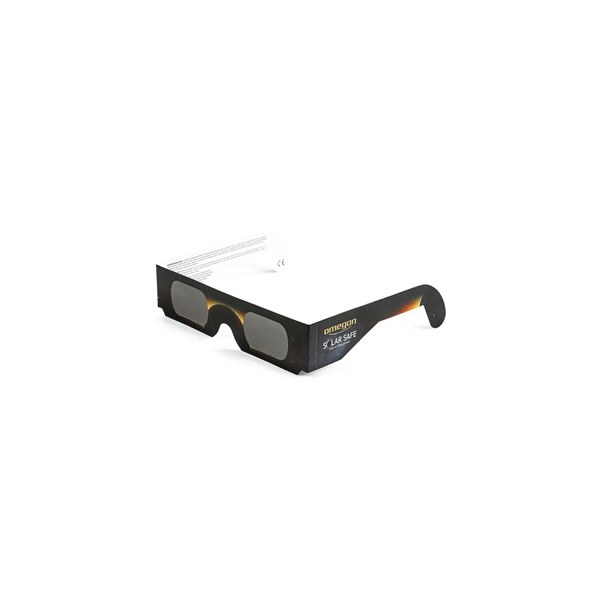
Certified to ISO 12312-2 – the only safe way to look at an eclipsed Sun with the naked eye. A few euros only, so there is no reason to improvise: buy several for the whole family.
Price: € 5
If you're kitting out a group – a school class, a club, a family gathering – a multipack works out cheaper: 3-pack for € 13, 5-pack for € 20 instead of € 5 per single pair.
Couldn't get hold of glasses, or out and about with children? A home-made pinhole projector for the solar eclipse shows the crescent as a projection – without ever looking at the Sun.
It only gets really exciting with magnification. Through a telescope with a front-mounted solar filter you see the Moon's edge sharply against the Sun's disc – and, with a bit of luck, sunspots being covered by it.
The filter always goes over the front opening, never into the eyepiece. What that looks like in practice is explained in detail in our guide to observing the Sun.
What proved its worth in 2026 is in the table: the glasses were by far the most-bought item, followed by filter film and the ready-made filter for the Seestar S50.
| Product | What for | Price |
|---|---|---|
| Omegon Solar Eclipse Glasses Solar Safe | ⭐ The minimum for everyoneGlasses to EN ISO 12312-2 for naked-eye viewing | € 5 |
| Omegon Solar Eclipse Glasses Solar Safe, pack of 5 | Five pairs for family, club or school class | € 20 |
| Omegon Solar Safe Deluxe Eclipse Glasses | Comfort glasses with a sturdy frame instead of cardboard arms | € 40 |
| Baader AstroSolar ECO-size Safety Film OD 5.0 (14x15.5 cm) | Filter film to make your own filter for binoculars or a small telescope | € 25 |
| Baader AstroSolar Visual Film OD 5.0 (Sheet)Baader AstroSolar Safety Film OD 5.0 | Large sheet for telescopes from about 100 mm aperture and camera lenses | $36.00€ 40 |
| Omegon 50 mm solar filter (Seestar S50 & binoculars) | Ready-made solar filter for the Seestar S50 and 50 mm binoculars | € 34.90 |
| Lunt Mini Sunocular 6×30 OD5 | Solar binoculars with a built-in filter – unpack and look | € 69 |
| Celestron EclipSmart 10×42 | More magnification for the Moon's edge and sunspots | € 119 |
| Oculum Verlag Solar Eclipse Atlas | Atlas of all eclipses up to 2100 – for planning your trip into the path of totality (in English) | € 29.90 |
Why this eclipse is special
Six minutes of totality is exceptional. Most total solar eclipses last two to three minutes; anything longer is rare and depends on the Moon being close to Earth while Earth is far from the Sun.
The eclipse belongs to Saros cycle 136 – the same one that produced the longest eclipse of the century so far in 2009.
And one more figure for perspective: the next total solar eclipse visible from the UK is on 23 September 2090, across Cornwall. Until then you have to travel – the nearest option in 2027 is southern Spain. From North America the 2027 eclipse is not visible at all.
Frequently asked questions about the 2027 solar eclipse
Can you see the 2027 solar eclipse from the UK and Ireland?
Yes, but only as a partial eclipse. It is visible across the whole of the UK and Ireland on the morning of 2 August 2027, with coverage ranging from 15 per cent in Lerwick (Shetland) to 51 per cent on Jersey. It only becomes total further south, from southern Spain and North Africa.
How long does totality last on 2 August 2027?
At the point of greatest eclipse near Luxor in Egypt, the total phase lasts 6 minutes and 23 seconds. That makes it the longest solar eclipse of the 21st century whose maximum falls on land.
What time is the 2027 solar eclipse in the UK?
Depending on where you are, it starts between 08:57 and 09:23 BST, reaches its maximum between 09:54 and 10:05 and ends between 10:48 and 11:01. The exact times for your town are in the table above.
Where is the best place to see the 2027 solar eclipse?
Total and longest in Upper Egypt around Luxor, where the weather in early August is also the most reliable. In Europe the path of totality only covers the far south of Spain; on the Spanish mainland it lasts longest near Tarifa, at about four and a half minutes.
What glasses do I need for the solar eclipse?
Eclipse glasses that meet the EN ISO 12312-2 standard. Sunglasses, smoked glass, foil emergency blankets or exposed film do not protect you. For binoculars and telescopes you also need a certified solar filter that fits over the front opening.
When is the next total solar eclipse in the UK?
On 23 September 2090, across Cornwall. Until then you have to travel – the nearest option in 2027 is southern Spain.
Will it get dark at 50 per cent coverage?
No. Your eyes compensate almost completely for the loss of light; you only start to notice it from about 90 per cent coverage. Without eclipse glasses you wouldn't even notice the eclipse in the sky.
Further reading
- Observing the Sun: safely and with the right filter
- Make a pinhole projector for the solar eclipse
- The solar eclipse of 12 August 2026
- DWARF 3: a smart telescope for eclipse photography
- Sunspots: what's happening on the Sun
- Astronomy gifts: ideas for every budget
Links marked with * are affiliate links. If you buy through them, we receive a small commission – the price stays the same for you.