By Alexander Merz · Updated on · Details checked on 3 November 2026
The Sun is the only star we can see up close – and yet hardly anyone has a feel for how huge it really is. In the sky it looks exactly as big as the full Moon. That illusion only disappears once you start doing the maths: how many times does the Earth actually fit into the Sun?
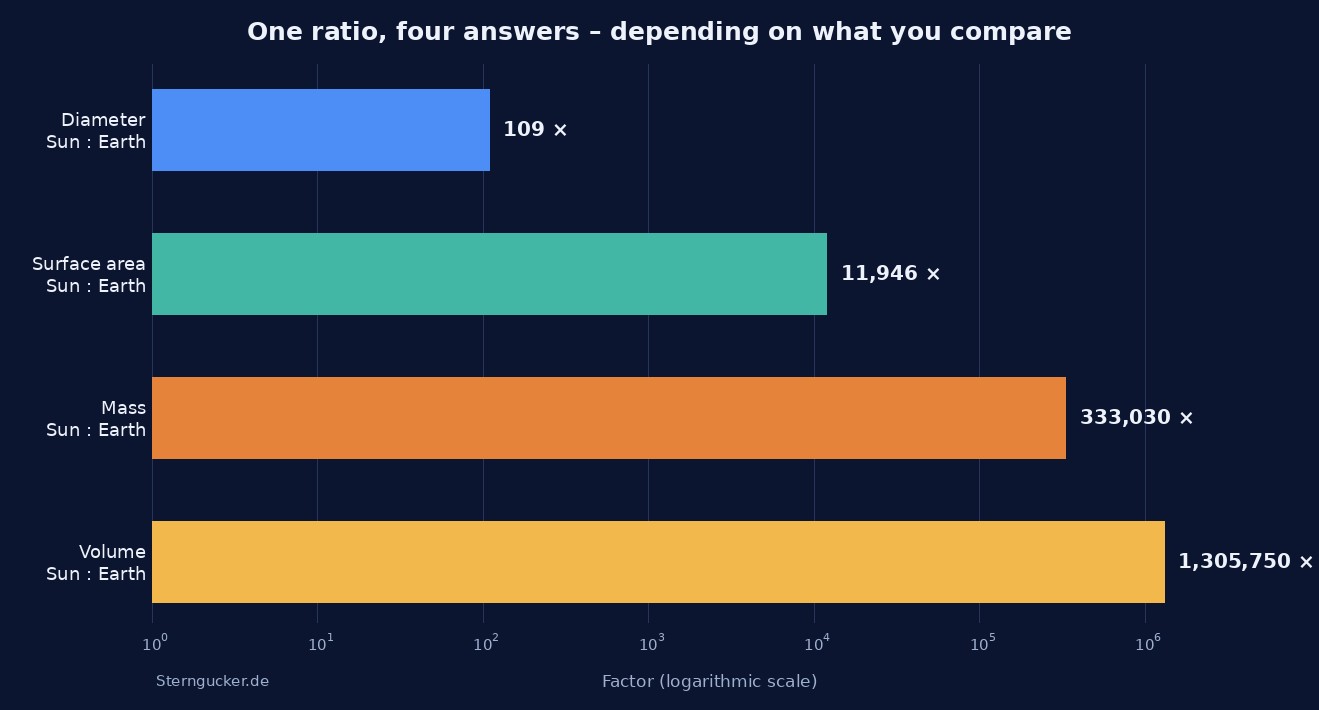
The honest answer: it depends on what you compare. Line Earths up side by side and you get about 109. Fill the Sun with Earth-sized balls and you get about 1.3 million. Weigh the two and the Sun is only 333,000 times heavier. All three numbers are correct – and this article explains why they are so far apart.
⚡ The answer in three numbers
- Diameter: 109 Earths fit side by side across the Sun (1,392,700 km versus 12,742 km).
- Volume: about 1.3 million Earths would fit inside the Sun (1,305,750 by calculation).
- Mass: the Sun weighs as much as 333,000 Earths – less than the volume suggests, because it is built much more lightly.
The Sun alone accounts for 99.86% of the total mass of our solar system. All eight planets together are just the rest.
How many Earths fit in the Sun?
Type this question into a search engine and, depending on the source, you will read 109, 1.3 million or 330,000. That looks contradictory, but it is not. The three numbers simply answer three different questions.
The diameter is a length, a one-dimensional quantity. The volume grows with the cube of that length – which is why the factor 109 turns into 109³ ≈ 1.3 million. The mass also depends on how densely a body is packed, and the Sun is much more loosely built than the Earth. That is why the mass factor of 333,000 ends up smaller than the volume factor.
| Comparison | Sun | Earth | Ratio |
|---|---|---|---|
| Diameter | 1,392,700 km | 12,742 km | 109 : 1 |
| Circumference | 4,375,300 km | 40,030 km | 109 : 1 |
| Surface area | 6.09 × 10¹² km² | 5.10 × 10⁸ km² | 11,946 : 1 |
| Volume | 1.41 × 10¹⁸ km³ | 1.08 × 10¹² km³ | 1,305,750 : 1 |
| Mass | 1.989 × 1030 kg | 5.972 × 1024 kg | 333,030 : 1 |
| Mean density | 1.41 g/cm³ | 5.51 g/cm³ | 1 : 3.9 |
| Surface temperature | about 5,500 °C | about 15 °C | – |
Diameter: 109 Earths in a row
Measured across its visible surface, the photosphere, the Sun is about 1,392,700 kilometres wide. The Earth has a mean diameter of 12,742 kilometres. Divide one by the other and you get 109.3.
In plain terms: if you threaded Earths like beads on a string and laid that chain across the solar disc, you would need 109 Earthsto get from one edge to the other. That is exactly what the following graphic shows – to scale, every blue dot is a whole Earth.
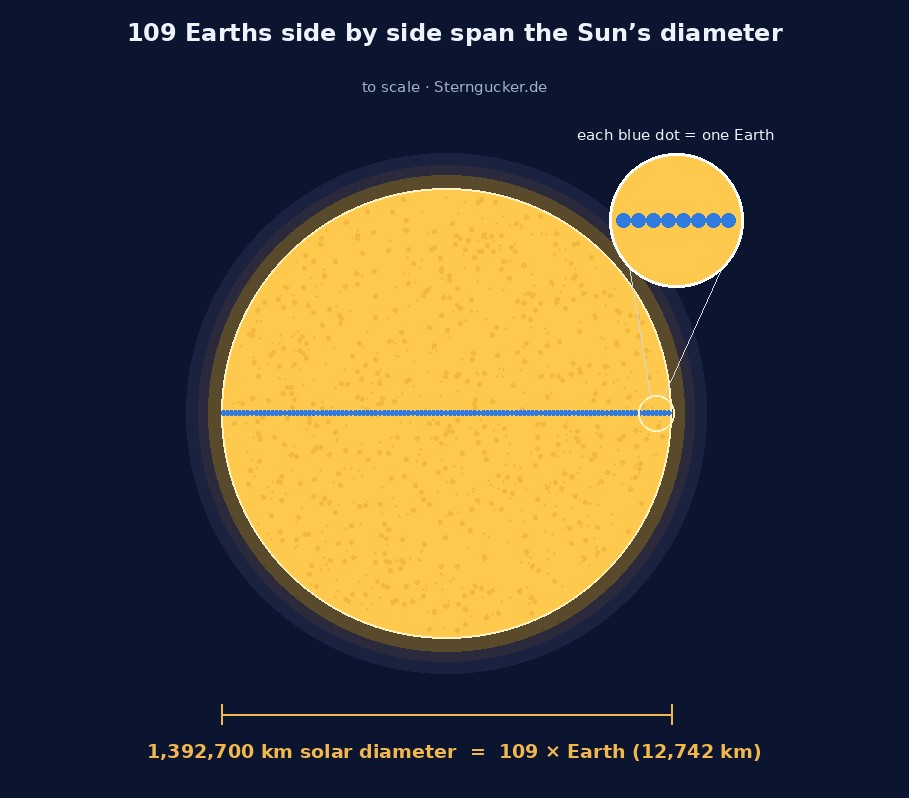
By the way, the same factor applies to the circumference: the Sun measures about 4,375,000 kilometres around, the Earth 40,075 kilometres at the equator. Again a ratio of 109 to 1 – logically, because the circumference is nothing more than the diameter times π.
🔭 A quick reality check
In the sky, the Sun and the Moon look almost exactly the same size – both about half a degree across. That is purely down to distance: the Sun is 400 times larger than the Moon, but it is also roughly 400 times further away. Without this coincidence there would be no total solar eclipses like the one on 12 August 2026.
Volume: about 1.3 million Earths
As soon as the question is about “fitting inside”, length no longer counts – volume does. And volume grows brutally fast: double the diameter of a sphere and its volume becomes eight times larger. With a factor of 109 in diameter you therefore end up at 109.3 × 109.3 × 109.3 = 1,305,750.
The Sun’s volume is about 1.41 × 10¹⁸ cubic kilometres, the Earth’s 1.08 × 10¹² cubic kilometres. Purely by calculation, about 1.3 million Earths would fit inside the Sun. You will find this number in almost every textbook – and it is the usual answer to the question in the title.
Why only about 960,000 Earths really fit inside
The 1.3 million only holds if you first squash the Earth into mush and fill the space without gaps. Spheres, however, cannot be stacked without gaps: even in the densest possible packing – the way oranges are stacked at the greengrocer’s – spheres fill only 74.05 per cent of the available space. The rest is gaps.
Factor that in honestly and, instead of 1,305,750, only about 967,000 real, round Earths fit inside the Sun. Roughly a million, then. Almost every source leaves out this detail – but the big number is still not wrong; it simply answers the question “how much Earth volume” instead of “how many Earth spheres”.
🧮 Do the maths yourself
Volume of a sphere: V = 4/3 · π · r³
- Sun: r = 696,350 km → V ≈ 1.41 × 10¹⁸ km³
- Earth: r = 6,371 km → V ≈ 1.083 × 10¹² km³
- Ratio: 1.41 × 10¹⁸ ÷ 1.083 × 10¹² ≈ 1.3 million
- With real sphere packing (74.05 %): ≈ 967,000
Mass: 333,000 Earths
Now it gets interesting. If 1.3 million Earths fit inside the Sun – why does the Sun only weigh as much as 333,000 Earths? The answer is density.
The Earth is a rocky planet with a core of iron and nickel. It has a mean density of 5.51 grams per cubic centimetre – more than five times as dense as water. The Sun, on the other hand, is a ball of hydrogen and helium gas and averages only 1.41 g/cm³. So per unit of volume it is almost four times lighter than the Earth.
The sum works out exactly: 1,305,750 × (1.41 ÷ 5.51) ≈ 333,000. Exactly the mass factor the measurements give. The Sun weighs 1.989 × 1030 kilograms, the Earth 5.972 × 1024 kilograms.
That the Sun is so light on average is deceptive about its interior, though: in the outer layers the gas is thinner than air, while in the core it is squeezed to more than 150 g/cm³ – ten times denser than lead. Temperatures there reach about 15 million degrees, and only there does the nuclear fusion take place that drives the Sun’s activity.
☀️ 99.86 per cent
That is the Sun’s share of the total mass of the solar system. All the planets, moons, asteroids and comets together make up the remaining 0.14 per cent – and the lion’s share of that is Jupiter alone. The Earth contributes a mere three millionths.
Surface area and circumference
Between length and volume there is also area, and it is almost never mentioned. Areas grow with the square of the length: 109.3² gives 11,946. So you could wallpaper the surface of the Sun with just under twelve thousand Earth surfaces.
This number is more than a curiosity. Because the Sun has so much surface area, it radiates an enormous output despite a moderate surface temperature of about 5,500 °C: some 3.8 × 1026 watts. Only one two-billionth of that actually reaches the Earth – and that is enough for all life, all weather and all auroras.
| Grows with … | Factor Sun/Earth | Why |
|---|---|---|
| Length (diameter, circumference) | 109 | directly proportional |
| Area (surface) | 11,946 | 109² – two-dimensional |
| Space (volume) | 1,305,750 | 109³ – three-dimensional |
| Mass | 333,030 | Volume × density ratio (1.41 : 5.51) |
Scale models: Sun and Earth
Numbers with six zeros mean little to the mind. Scale models, on the other hand, stick at once. All the following pairs are calculated exactly – if you like, you can build them in your living room or in the school playground.
| If the Earth is as big as … | … then the Sun is | Scale |
|---|---|---|
| a pinhead (1 mm) | a grapefruit (10.9 cm) | 1 : 12.7 billion |
| a pea (8 mm) | an exercise ball (87 cm) | 1 : 1.6 billion |
| a marble (1.6 cm) | a body 1.75 m tall – a person | 1 : 800 million |
| a tennis ball (6.7 cm) | a house 7.3 m high | 1 : 190 million |
| a basketball (24 cm) | a tower 26 m high | 1 : 53 million |
And the other way round: if the Sun were a football 22 centimetres across, the Earth would be a little ball of 2 millimetres – about the size of a match head. If the Sun were a hot-air balloon of 20 metres, the Earth would be the size of a grapefruit (18 cm).
📏 The model experiment for outdoors
Put an exercise ball (87 cm) on a lawn as the Sun. The Earth is then a pea – and at this scale it would have to lie 93 metres away. Only then is the distance of 149.6 million kilometres correct as well. This is exactly the mismatch most textbook pictures fail to explain: they draw the planets far too close together.
For these models you need nothing but a pea and an exercise ball – that is the honest part of the answer. If it turns into real interest, the first target in the sky is still not the Sun but the Moon: even a small instrument shows craters and mountain ranges.
The Sun itself remains a special case and is observed only with a certified filter (further down you will find what matters). Which instruments are really good for children and which only disappoint is explained in our buying guide for kids’ telescopes.
11,741 Earths to the Sun
A variation of the original question is: how many Earths actually fit between the Earth and the Sun? The mean distance is 149.6 million kilometres, one astronomical unit. Divided by the Earth’s diameter of 12,742 kilometres, that gives 11,741 Earths, lined up like beads on a string.
For comparison: only 109 Earths fit across the Sun’s diameter. The empty space between us and the Sun is therefore a good hundred times wider than the Sun itself – and the solar system consists almost entirely of exactly this nothingness.
Light needs 8 minutes and 20 secondsfor this distance. So we always see the Sun as it looked a good eight minutes ago – more on this in How long does light take to travel from the Sun to the Earth?
The Sun among the stars
Compared with the Earth, the Sun is a giant. Among stars it is middle of the road. Astronomers classify it as a yellow dwarf of spectral type G2V – and the name says it all.
- Proxima Centauri, the nearest star, has only about 14 per cent of the Sun’s diameter. It is barely larger than Jupiter.
- Betelgeuse in Orion, a red supergiant, measures about 700 times the Sun’s diameter. If it stood in the Sun’s place, its surface would reach beyond the orbit of Mars.
- The largest known stars reach more than a thousand times the Sun’s diameter – around a billion Suns would fit inside them.
- At the same time, about three quarters of all stars in the Milky Way are red dwarfs and therefore smaller and lighter than the Sun.
All in all, the Sun belongs to the larger ten to twenty per cent of stars – a solid average star, not a record holder. More on this on our page How big is the Sun?
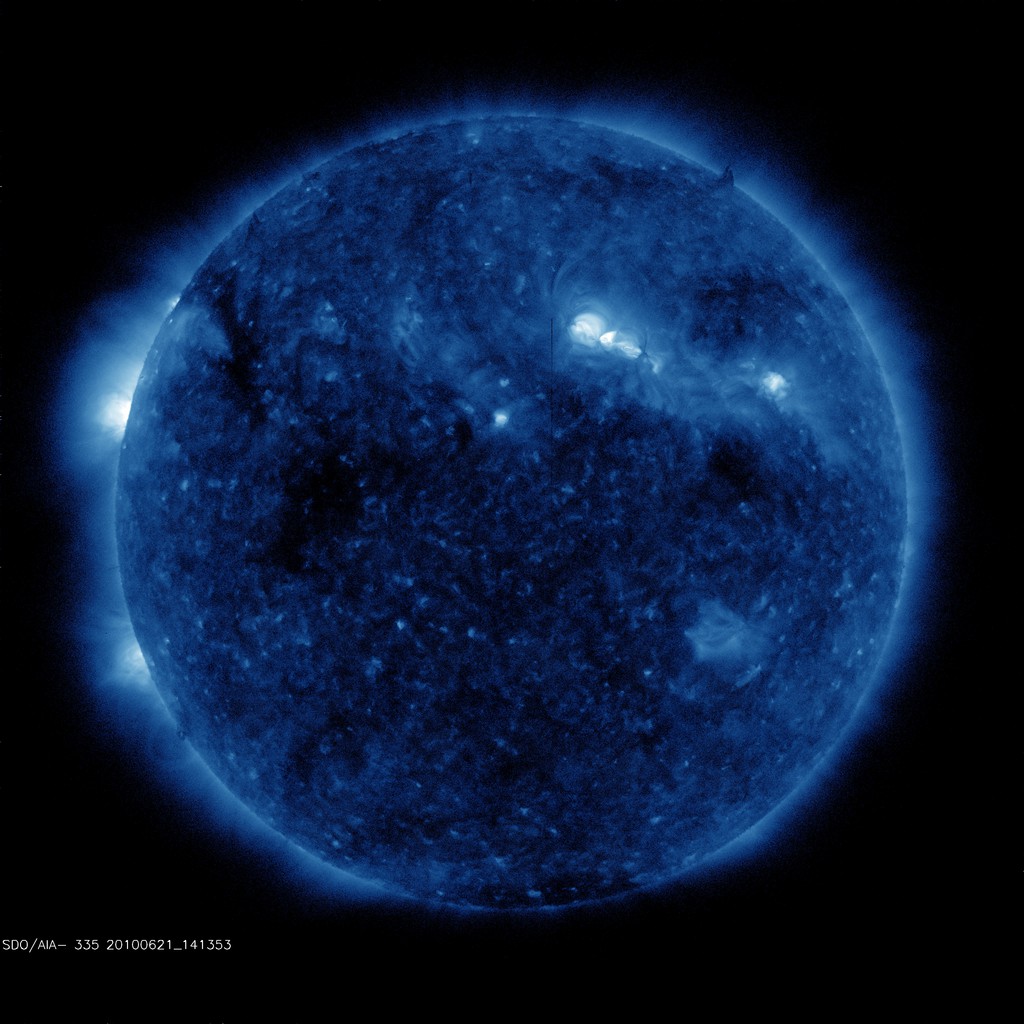
One detail that makes the dimensions tangible: a medium-sized sunspot group easily measures 50,000 kilometres, making it four times wider than the Earth. Large groups can already be seen as dark islands in a small telescope with a solar filter.
Explained for kids
If you want to answer the question for a child, you do not need powers of ten. Three pictures are all it takes.
- The string of beads: You would have to lay 109 Earths side by side to get across the Sun once.
- The sandpit: About a million Earths would fit inside the Sun – that is how many grains of sand fit into a big bucket.
- The pea and the exercise ball: If the Sun is an exercise ball, the Earth is a pea. And the pea lies almost a football pitch away.
Why does the Sun still look so small? Because it is unimaginably far away. A car 100 metres away also looks like a toy – and the Sun is 149.6 million kilometres away. If you like questions like these, you will find more of them in our astronomy quiz.
Observing the Sun safely
The Sun is the only object in the sky that you must never look at without protection – not even briefly, not even through haze, and certainly not through binoculars or a telescope. The concentrated radiation destroys the retina within seconds, painlessly and permanently. Sunglasses, a space blanket, exposed film or a CD are no protection.
On 12 August 2026 the moment came: Across the UK and Ireland the Moon covered up to around 90 per cent of the Sun, with the highest values in the far west – the biggest sky event there in years. The recap with times and coverage for the main cities is in the eclipse guide, along with the safety rules for every further look at the Sun. The next solar eclipse follows on 2 August 2027 – certified glasses are usually sold out for weeks before such dates – if you want to be on the safe side, buy early rather than in the last week.
How to observe safely →All times and coverage values for your location: Solar eclipse on 12 August 2026
If you want to observe the Sun permanently and not just during an eclipse, you need a filter in front of the telescope’s aperture – never one that screws into the eyepiece. The classic is a film that you cut to fit a cardboard mount yourself:
Solar filter for telescope and binoculars: Baader AstroSolar Safety Film OD 5.0
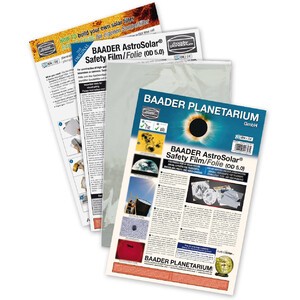
The standard film for safe solar observing: OD 5.0 passes just 1/100,000 of the light. Cut it, mount it – and sunspots snap into razor-sharp view.
Price: € 29
How to cut the film and which filter suits which instrument – from binoculars to smart telescopes – is shown step by step in our guide Observing the Sun safely.
And if you are thinking about seeing all this for yourself anyway: a telescope shows you not only sunspots but also lunar craters, Saturn’s rings and Jupiter’s moons – everything binoculars are not enough for. If you can only buy one instrument and really want to explore the sky, go for a telescope; binoculars are the complement, not the replacement.
Beginner telescope with a solar filter option: Skywatcher Dobson Telescope N 130/650 Heritage FlexTube
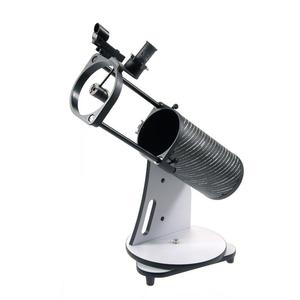
A compact tabletop Dobson with a true parabolic mirror. Folds down, fits in a bag: the Moon, planets and the bright deep-sky classics.
Price: € 265
More on choosing one in our buying guide for telescopes under 300, an overview of telescope filters and the big models in our telescope buying guide.
* Affiliate link: if you buy through this link we may earn a small commission from Astroshop, High Point Scientific or another linked retailer, at no extra cost to you.
FAQ about the Sun and Earth
How many Earths fit in the Sun (by volume)?
Purely by calculation, about 1.3 million times (exactly 1,305,750). If you take into account that spheres cannot be stacked without gaps, about 967,000 real Earth spheres fit inside.
How many Earths fit across the Sun (diameter)?
109 times. The Sun’s diameter is 1,392,700 km, the Earth’s 12,742 km. 109 Earths side by side reach exactly from one edge of the Sun to the other.
How many Earths fit in the Sun (by mass)?
333,030 times. The Sun weighs 1.989 × 1030 kg, the Earth 5.972 × 1024 kg. The factor is smaller than for volume because, at 1.41 g/cm³, the Sun is much less dense than the Earth at 5.51 g/cm³.
How big is the Sun compared to the Earth?
About 109 times larger in diameter, almost 12,000 times in surface area, 1.3 million times in volume and 333,000 times in mass. Which number is right depends on which property you compare.
How many Earths fit between the Earth and the Sun?
At a mean distance of 149.6 million kilometres, about 11,741 Earths fit in a row between the Earth and the Sun – a good hundred times more than fit across the Sun’s diameter.
How big is the Sun’s circumference?
About 4,375,000 kilometres. The Earth measures 40,075 kilometres around the equator. Here too the ratio is 109 to 1.
How many Earths fit side by side in a row on the Sun?
Exactly 109 times, because a row corresponds to the diameter. If, on the other hand, you lay the Earths flat across the solar disc, you get about 9,400 – the Sun’s disc area is 11,946 times that of the Earth, but circles fill an area only to just over 90 per cent.
Is the Sun the largest star in the universe?
No, far from it. Red supergiants such as Betelgeuse reach about 700 times the Sun’s diameter, the largest known stars more than a thousand times. The Sun is an average yellow dwarf – though larger than about three quarters of all stars in the Milky Way.
Read more
How big is the Earth?
The Earth has a mean diameter of 12,742 kilometres – at the equator it is slightly more at 12,756 km than from pole to pole (12,714 km), because its rotation flattens it slightly. The circumference at the equator is about 40,075 kilometres, the mass about 5.97 sextillion tonnes. Sounds enormous, but in the solar system it is middling: the Sun has 109 times the diameter.
How big is the Sun?
The Sun’s diameter is about 1,392,700 kilometres – roughly 109 times that of the Earth. Its mass amounts to 333,000 Earth masses and thus 99.86 per cent of the mass of the entire solar system. Everything else – all eight planets, all moons, asteroids and comets together – shares the paltry rest.
How many Earths fit in Jupiter?
About 1,320 times by volume. By diameter, the Earth fits into it about eleven times: Jupiter measures 139,820 kilometres. That makes it by far the largest planet – and still tiny next to the Sun, into which it fits about a thousand times itself.
How many Moons fit in the Sun?
By volume, about 64 million times. The Moon is 3,474 kilometres across, so the Sun is about 400 times wider. These 400 are the reason for one of the most beautiful coincidences in the sky: the Sun is also about 400 times further away than the Moon – which is why both look almost exactly the same size from Earth, and why there are total solar eclipses.