By Alexander Merz · Updated on · Details checked on 14 November 2026
Your child asks about the planets, already knows a few constellations — and you are wondering whether a kids telescope of their own is the right next step. The short answer: the mount matters more than the age. A wobbly tripod ruins the fun for any child faster than any optics can save it.
More in our overview: Buying a telescope.
Which telescope at which age? The short version
- From age 4: no telescope of their own yet. Looking at the Moon together with binoculars is plenty and makes them want more.
- From age 6: the first real telescope on a sturdy alt-azimuth mount — always together with an adult. A good fit: Celestron AstroMaster 70AZ RefractorOmegon Telescope AC 70/700 AZ-2 for $199.95€ 129.
- From age 8: now your child focuses alone and finds the Moon without help. A stable tabletop Dobsonian like the Orion SkyScanner 100mm Tabletop Reflector TelescopeSkywatcher N 100/400 Heritage Telescope ($129.95€ 179) forgives almost everything.
- From age 10: time for more aperture. Sky-Watcher Heritage 130 Tabletop DobsonianSkywatcher Dobson Telescope N 130/650 Heritage FlexTube ($269.00€ 265) shows the first deep-sky objects and lasts for many years.
- From age 12: teenagers can handle the same instruments as adult beginners — from here on, our beginner guide takes over.
Not ready to buy yet? Our beginner guide explains calmly what matters — and why aperture is more important than any magnification claim.
As a Christmas gift: three kids telescopes that arrive quickly
- Under $100€100: Omegon Telescope AC 60/700 AZ-1 (about $99€ 99) – our best-selling kids telescope, set up without tools. In stock · ready for shipping in 24 h
- From age 6: Celestron AstroMaster 70AZ RefractorOmegon Telescope AC 70/700 AZ-2 ($199.95€ 129) – sturdy mount, Moon craters on the very first evening. In stock · ready for shipping in 24 h
- From age 10: Sky-Watcher Heritage 130 Tabletop DobsonianSkywatcher Dobson Telescope N 130/650 Heritage FlexTube ($269.00€ 265) – 130 mm aperture, stands on a table and lasts for many years. In stock · ready for shipping in 24 h
The delivery status is updated continuously from the shop – still, check the delivery time in the cart. Tips for the first evening: A telescope as a Christmas present.
Rather watch than read? In the video (in German) we sum up this guide in 10 minutes – age groups, the typical bad buys and our picks from age 6, 8 and 10.
Our kids telescope picks by age (2026)
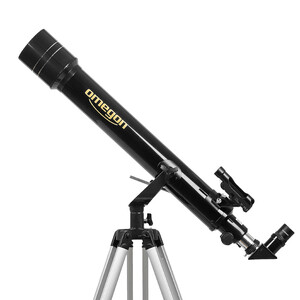
Sturdy, simple refractor: hardly any maintenance, ready to use straight away, ideal for the Moon and bright planets. The perfect first taste.
- Set up in a few minutes – no tools needed
- Survives impatient children’s hands
- Sharp Moon craters on the very first evening
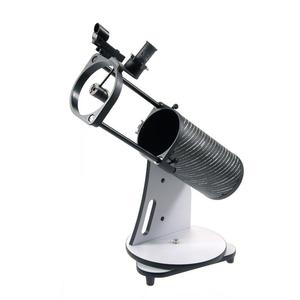
The step up to real aperture: a 130 mm mirror shows star clusters and the bright nebulae, and the Dobsonian handling stays child’s play – set it down, swing it round, focus. Collapsed, it fits on a shelf, and it is set up in a minute. In stock · ready for shipping in 24 h
- 130 mm aperture: about three times as much light as a 70 mm
- Stands on a table, nothing to knock over
- Collapsed, it fits on a shelf, even in a child’s room
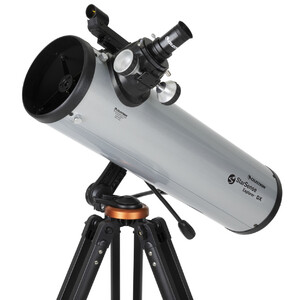
Finds objects via smartphone navigation – the app guides you to the target. Motivates teenagers who want quick results.
- App guides you to the object in real time
- Large 130 mm optics for planets and deep sky
- Ideal when patience is not (yet) a strength
Prices are matched with the shop automatically every day – details and alternatives are further down in this guide.
If you want more: the Dobsonian that lasts a lifetime
The three telescopes above are designed for children’s hands: light, set up in minutes, uncomplicated. But if your child has been at it for a year, finds objects alone and starts asking about galaxies, the next sensible step is not another kids’ instrument but a full-size Dobsonian with 200 millimetres of aperture (the mirror diameter). That is more than twice the light-gathering area of the 130 – and it turns faint fuzzy patches into globular clusters in which you can separate individual stars for the first time.
To be honest: The instrument weighs a good 25 kilograms and is carried outside in two parts. Until about 14, that is a job for the parents. So for a six-year-old it is not the better telescope but simply the wrong one – the extra cost only pays off once curiosity has turned into a hobby and someone is there to help carry it.
For advanced observers: Omegon Advanced X N 203/1200 Dobsonian
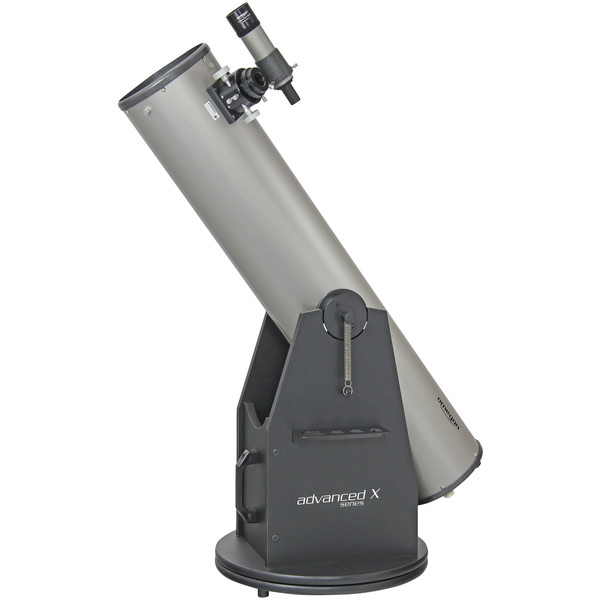
8-inch Dobsonian: maximum aperture for the money - no-frills deep-sky observing, set up in minutes.
Price: € 499
Kids telescope by age: the comparison table
Age does not decide the optics, it decides the handling. A six-year-old needs something they cannot knock out of adjustment; a twelve-year-old needs aperture, or they will be bored after three evenings.
| Age | Kids telescope | Type & aperture | Why this one | Price |
|---|---|---|---|---|
| from 4 years | none yet | Binoculars 10×50 | Looking at the Moon together is plenty. A telescope of their own at this age almost always ends up in the basement. | – |
| from 6 years | Celestron AstroMaster 70AZ RefractorOmegon Telescope AC 70/700 AZ-2 | Refractor, 70 mm, alt-azimuth | Two control knobs, nothing to adjust, set up in minutes. Survives impatient children’s hands – and shows Moon craters on the very first evening. In stock · ready for shipping in 24 h | $199.95€ 129 |
| from 8 years | Orion SkyScanner 100mm Tabletop Reflector TelescopeSkywatcher N 100/400 Heritage Telescope | Tabletop Dobsonian, 100 mm | No wobbly tripod to topple over: set it down, sit down, swing it round. From here on the child focuses alone and finds the Moon without help. Available to order | $129.95€ 179 |
| from 10 years | Sky-Watcher Heritage 130 Tabletop DobsonianSkywatcher Dobson Telescope N 130/650 Heritage FlexTube | Dobsonian, 130 mm, collapsible | ⭐ Our top pickThe point where curiosity becomes a hobby: 130 mm shows star clusters and the bright nebulae. Dobsonian handling, set up in a minute, and collapsed it fits on a shelf. In stock · ready for shipping in 24 h | $269.00€ 265 |
| from 12 years | Celestron StarSense Explorer DX 130AZCelestron StarSense Explorer DX 130 AZ | Newtonian, 130 mm, StarSense | The app guides you to the object in real time. Just right when patience while searching is not yet a strength – and for teenagers who want quick results. | $449.95€ 599 |
How we chose
- Stability: Mount and tripod must stand still, otherwise the child gives up after three minutes.
- Ease of use for the age: Can the child set the instrument up, focus it and point it at the Moon on their own?
- Aperture, not magnification: We compare the lens or mirror diameter, never the advertising claim “up to 600x”.
- Price and availability: Prices and delivery status come from the shop every day; anything not available is marked.
How we review telescopes in general is openly explained on How we review telescopes.
That number is made up: what a telescope can show depends on its aperture, not on magnification. A 70 mm refractor tops out at 140x – anything above that is just a bigger, mushier blob.
The evening on which the child cannot make anything out is the evening on which the hobby ends. That is why nothing under $100€100 is listed here. Not out of snobbery – but because cheaper simply does not work.
Kids telescopes compared by price: up to €150, €200 and €300
Want to decide by budget? Here are our tested budget alternatives – from an affordable first optic to a full-featured beginner telescope:
| Budget | Kids telescope | For whom & why | Price |
|---|---|---|---|
| up to $100€100 | Omegon Telescope AC 60/700 AZ-1 | Our best-selling kids telescope: 60 mm instead of 70, otherwise the same principle as the AC 70/700 – set up without tools, Moon craters on the first evening. In stock · ready for shipping in 24 h | about $99€ 99 |
| up to $150€150 | Celestron AstroMaster 70AZ RefractorOmegon Telescope AC 70/700 AZ-2 | The sturdy start from about age 6: alt-azimuth mount with two control knobs that is hard to break. Shows Moon craters sharp and bright. | $199.95€ 129 |
| up to $200€200 | Orion SkyScanner 100mm Tabletop Reflector TelescopeSkywatcher N 100/400 Heritage Telescope | Compact tabletop Dobsonian without a wobbly tripod: set it up, sit down, observe. Fits on the garden table and in any car boot. | $129.95€ 179 |
| up to $300€300 | Sky-Watcher Heritage 130 Tabletop DobsonianSkywatcher Dobson Telescope N 130/650 Heritage FlexTube | ⭐ Our pick from about age 10130 mm mirror, Dobsonian handling, collapsible for shelf and balcony. Shows star clusters and bright nebulae. In stock · ready for shipping in 24 h | $269.00€ 265 |

Want to buy a telescope? Here is the quick check.
A kids telescope as a Christmas present: how the first evening works
A kids telescope under the tree rarely fails because of the optics, but because of the first evening. It is new, it is dark, the family is waiting – and nobody has set the instrument up beforehand.
- Order early: Popular beginner models are often only available with a waiting time in December. Early December is a sensible latest date.
- Set it up yourself first: Put it together once on your own and focus on a distant church tower or mast during the day. Align the finder scope while you are at it.
- The first target is the Moon: In December 2026 the Moon is at first quarter on 17 December – then the craters are lit from the side. On Christmas Eve the Moon is full, bright and low in contrast, but still an experience for children.
- The second target is Saturn: On December evenings it is in the south to south-west around 8 pm. The rings are visible from about 50x magnification.
- Keep it short: Twenty minutes with two targets beat an hour of searching in the cold.
Telescope for kids – how skilled does the child need to be?
The most important quality your child should have is an interest in astronomy. Of course your child needs a certain amount of dexterity (see the next section), but for a telescope to be a sensible investment, it is important to judge the interest and the expectations correctly.
Because if the interest is only a flash in the pan and the expectations are very high, the astronomical experience will surely be a disappointment and the telescope will be put away. This should be taken into account in the budget.
From what age can I give a child a telescope?
There is certainly no general age limit for using a telescope, but the child clearly needs enough dexterity to operate it. That is why a telescope with a stable, sturdy mount is recommended, even if it means less optical performance for the same budget. Pointing the telescope should be intuitive via two control knobs, which is why an alt-azimuth mount is the first choice.
With a telescope for kids, aim for a compromise between stability, intuitive handling and optical performance.
The following ages are based on experience, not rules. What matters is whether your child is calm enough to focus on their own – some manage it at six, others need until nine.
From age 4: no telescope of their own yet
At this age a telescope of their own almost always ends up in the cupboard. Bringing one eye to an eyepiece while squeezing the other shut is hard motor work, and a shaky image frustrates immediately.
Instead, look at the Moon together with binoculars – both eyes open, a huge image, and you can point with your finger to where your child should look. That makes them want more than any instrument.
Telescope for kids from age 5
In short: Not alone yet, but a lot works together. At five, some children manage to look through the eyepiece if an adult sets it up and the image is steady.
A telescope of their own is only worth it once the interest lasts beyond three evenings; until then, a pair of binocularsbinoculars or the parents’ family telescope is enough. Which binoculars suit children at which age is shown in our guide Binoculars for kids. If it really has to be a present: the Omegon Telescope AC 60/700 AZ-1 (about $99€ 99) is the cheapest start with real glass optics, and it will grow with them until about eight.
Telescope for kids from age 6
In short: Yes, but only with a sturdy alt-azimuth mount (two control knobs for up/down and left/right instead of the tilted axes of an equatorial mount) – and always together with an adult.
At six, your child cannot yet adjust and observe at the same time. You do it together: you find the Moon, your child looks. That is why stability matters more than optics here – a wobbly tripod spoils the fun faster than any lens can save it.
A simple refractor (a lens telescope) on a solid tripod is just right: Celestron AstroMaster 70AZ RefractorOmegon Telescope AC 70/700 AZ-2 for $199.95€ 129. If you want to spend less: the Omegon Telescope AC 60/700 AZ-1 (about $99€ 99) is our best-selling kids telescope, 60 instead of 70 millimetres, otherwise the same principle.
Telescope for kids from age 7
In short: The in-between stage. At seven, many children already focus on their own but cannot find the Moon alone yet.
The Celestron AstroMaster 70AZ RefractorOmegon Telescope AC 70/700 AZ-2 ($199.95€ 129) is the safest choice here: alt-azimuth, sturdy, nothing to adjust. If you have a calm child who likes to tinker, you can already go for the eight-year-olds’ tabletop Dobsonian.
Telescope for kids from age 8
In short: Now your child focuses alone and finds the Moon without help. A stable tabletop Dobsonian is the most forgiving design.
A Dobsonian is a reflecting telescope that simply stands on a table and is swung round by hand – no axes, no alignment, no tech frustration. You push it to where you want to look.
That is exactly why eight-year-olds manage it on their own: Orion SkyScanner 100mm Tabletop Reflector TelescopeSkywatcher N 100/400 Heritage Telescope for $129.95€ 179. Moon craters are sharp from the very first evening.
Keep in mind: The tabletop Dobsonian needs a firm base – a garden table, a wall or a stool. On a wobbly balcony railing or in a warm living room behind the window, the image becomes unsteady.
Telescope for kids from age 10
In short: Time for more aperture – from 130 to 150 millimetres of mirror diameter you get beyond the Moon.
At ten, patience lasts longer, and at some point the Moon is no longer enough. Aperture means light-gathering area: the 130 collects about three times as much light as a 70 mm refractor (the secondary mirror takes a little away, otherwise it would be three and a half), and that is the difference between “there is a smudge” and “that is a star cluster”.
Our pick is the Sky-Watcher Heritage 130 Tabletop DobsonianSkywatcher Dobson Telescope N 130/650 Heritage FlexTube for $269.00€ 265: 130 millimetres of aperture, Dobsonian handling, set up in a minute, and collapsed it fits on a shelf. It will grow with them into their teens. In stock · ready for shipping in 24 h
Telescope for kids from age 12
In short: From here on, the same instruments apply as for adult beginners – you no longer need a “kids telescope”. As a present for 12-year-olds, a full-featured beginner telescope is a better fit than any toy telescope.
Teenagers can handle any beginner telescope. If impatience is the issue, smartphone navigation helps: the app shows with arrows where to swing, and that takes the edge off “I can’t find anything” – Celestron StarSense Explorer DX 130AZCelestron StarSense Explorer DX 130 AZ for $449.95€ 599. Lighter siblings of the DX 130 are covered in our Celestron StarSense Explorer comparison. Otherwise our buying guide for beginner telescopes takes you calmly through the options.
For teenagers and the whole family: a smart telescope
A smart telescope finds nebulae and galaxies by itself and sends the finished photo to your phone. For tech-loving teenagers from about 12, this is often the fastest way to the first wow moment – and the family watches along on the tablet.
The honest downside: You cannot look through it, planets stay small, and it costs several times as much as any kids telescope on this page. For getting started, the ZWO Seestar S30 Pro Smart TelescopeZWO Seestar S30 Pro Smart Telescope ($664.00€ 699), more light for galaxies comes from the ZWO Seestar S50 Pro All-in-One Smart TelescopeZWO Seestar S50 Pro Smart Telescope ($999.00€ 999).
Which model suits whom is shown in our smart telescope finder.
What to look for in a kids telescope
Mount and tripod
As mentioned above, an alt-azimuth mount has advantages:
- intuitive handling
- simple, sturdy construction
- inexpensive
An equatorial mount is also possible as an alternative, even though its advantages will probably not be used.
The mount should sit on a tripod with three extendable aluminium legs so the height can be adjusted.
Mounts that point at a celestial object automatically (so-called GoTo mounts) are explicitly not recommended. The benefits of such a system only come into play with correspondingly powerful optics. For beginners, the drawbacks outweigh them:
- set-up, calibration and use are not trivial (astronomy knowledge required)
- combined with weak optics, most of the stored objects cannot be seen
- expensive
Optics
A refractor is the recommended optical system for a kids telescope. A refractor shows easy and frequently observed objects such as the Moon and planets best. Some deep-sky objects (the Orion Nebula, star clusters) can also be observed.
In addition, aiming the telescope at the night sky is easy when the viewing direction and the optical axis are the same. A refractor can also be used for nature observation during the day (with an erecting prism).
Answer a few short questions and we will send you a personal recommendation that fits your budget, your experience and what you want to observe.
Find my telescope →The alignment of the lenses to each other (collimation) is fixed by the tube and usually stays put. This makes the lens telescope (refractor) a robust, low-maintenance telescope.
Unlike refractors, reflecting telescopes (reflectors) have to be adjusted from time to time. Most children would find that too much.
But if you really want to get the most optical performance out of your kids telescope, a small tabletop Dobsonian is a very good and affordable start. Keep the drawbacks of reflecting telescopes described above in mind, though.
Telescope for teenagers from age 10
- Sturdy build that forgives the occasional bump.
- Simple mount: set it down, point it, observe – no polar alignment.
- Enough aperture for Moon craters, Saturn’s rings and the bright nebulae.
- Good value: you pay for mirror and mechanics, not for electronics.
Recommended from age 10: Skywatcher Dobson Telescope N 150/1200 Skyliner Classic DOB
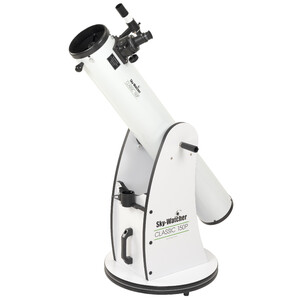
150 mm of aperture at an entry price: the classic Dobson when the 8-inch is too big or too expensive.
Price: € 359
The beginner guide compares both designs in detail. Smaller and collapsible for the shelf: Sky-Watcher Heritage 130 Tabletop DobsonianSkywatcher Dobson Telescope N 130/650 Heritage FlexTube for $269.00€ 265.
Beware of department-store telescopes
Department-store telescopes are strongly discouraged. They often state higher performance figures than telescopes from a well-known manufacturer (for example a Skywatcher telescope) at the same price. The reason is that department-store telescopes cut corners massively on the quality and workmanship of their components.
Star oracle
Find out which star you are!
The lenses are made of plastic, so are moving parts prone to wear, and the collimation of the optical components is so inaccurate that no usable image can form at all. The abundant accessories are often useless and completely superfluous. Disappointment is guaranteed.
The image quality of a telescope from a well-known manufacturer at the same price beats the department-store telescope by miles – even if its stated performance figures look much weaker at first glance.
What about Kosmos, National Geographic, Bresser and Vtech? Vtech and the toy brands sell toys with a lens, not telescopes; they are no good for the Moon. Kosmos and National Geographic mostly sell relabelled instruments from the 50 to 70 mm class, often made by Bresser: not bad, but often more expensive than the same instrument under its original name, and the mounts are wobbly.
The exception is the Bresser Junior Telescope AC 70/900 EL (about $139€ 139): real glass optics with 70 mm, a complete set, and for years one of the best-selling kids telescopes through our pages. Our first choice is still the Celestron AstroMaster 70AZ RefractorOmegon Telescope AC 70/700 AZ-2 with the steadier mount.
Bresser Junior: is the kids range any good?
The Junior range is what most parents find first – it is in electronics stores, toy shops and on every gift list. Within the range, the models are worlds apart.
The tabletop instruments from about $26€26 to $80€80 have small apertures and thin plastic tripods. Every touch sets the image moving, and by the time it settles, the Moon has drifted out of view. The included 4 mm eyepieces and Barlow lenses are impressive on paper and useless in practice.
From about $100€100, the range becomes usable. The Bresser Junior Telescope AC 60/700 AZ (about $109€ 109) has a steadier image than the short models thanks to its 700 mm focal length, and the Bresser Junior Telescope AC 70/400 (about $79.90€ 79.90) is light enough for a child to set it up alone.
What to watch for with this range: the magnification claims on the box are consistently too high. With 70 mm aperture, around 100x is the sensible maximum, no matter what the box says.
What can I observe with a telescope for kids?
So that expectations are right: this is how the Moon with the crater Copernicus looks in a typical kids telescope with 70 mm aperture – and this is how small Saturn stays. You can enter the values of any instrument.
Object
- Magnification
- –
- True field of view
- –
- Exit pupil
- –
- Limiting magnitude
- –
- Resolution (Dawes)
- –
Drawn to scale: the circle is the eyepiece view, the objects appear at the size that follows from magnification and field of view. Colours and brightness are simplified – the nebula stays grey in the eyepiece, the galaxy a faint glow.
This telescope delivers this view
Skywatcher Dobson Telescope N 130/650 Heritage FlexTube

A compact tabletop Dobson with a true parabolic mirror. Folds down, fits in a bag: the Moon, planets and the bright deep-sky classics.
Price: € 265
This telescope delivers this view
Skywatcher Dobson Telescope N 200/1200 Skyliner Classic
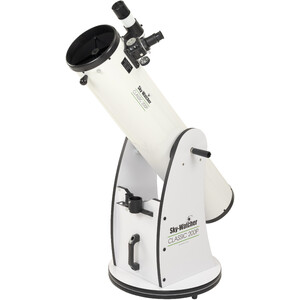
200 mm of aperture — the most sky for your money. Set it on the ground, point by hand: nebulae, clusters and galaxies for years to come.
Price: € 479
This telescope delivers this view
Omegon Telescope AC 70/700 AZ-2

The no-pitfall starter refractor: Moon, Saturn's rings and Jupiter's moons from the very first night. No collimation.
Price: € 129
This telescope delivers this view
ZWO Seestar S50 Pro Smart Telescope
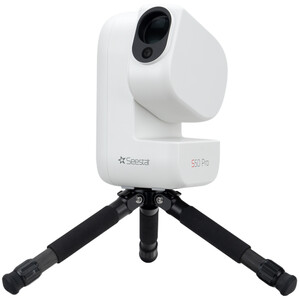
The direct successor to the Seestar S50: a 50/260 apochromatic quadruplet, two cameras and a built-in dual-band filter that pulls nebulae out of a city sky.
Price: € 999
This telescope delivers this view
Celestron Cometron 7x50 Binoculars
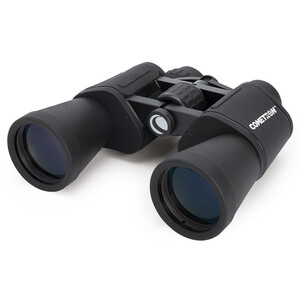
The astronomy classic among affordable binoculars: 7×50 with a large exit pupil for bright handheld views of the Moon and Milky Way – the ideal first step before a telescope.
Price: € 65
As described above, a telescope for children is a compromise. Squeezing out the maximum optical performance for a given budget makes no sense, because handling and pointing would become much harder. With a refractor, however, many objects that are easy to find can be observed:
- Moon with its crater landscapes (especially along the terminator)
- Saturn with rings
- Jupiter with four moons and coarse cloud bands
- Venus as a disc in different phases
- Mars as a disc
- Orion Nebula
- star clusters (Pleiades)
- nature observation (with a prism for a correct image)
Here is an overview: Astronomy highlights in the northern hemisphere: a comprehensive overview of the year
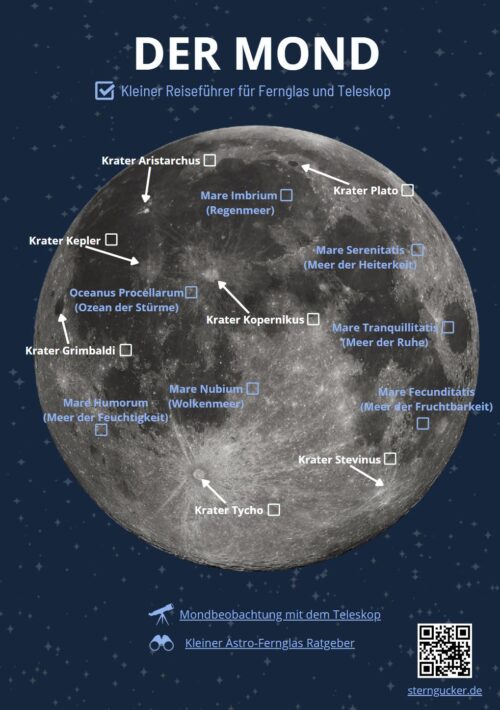
Parents often ask “How do you explain the stars to children?”. Our page about the stars answers it with simple examples and comparisons from everyday life that help children understand.
Where is the best place to use a kids telescope?
At first, use the kids telescope on your own balcony or in the garden. That way you can warm up indoors in between or check something about the evening sky on your star chart or online (even if your eyes lose their dark adaptation).
Once you have a routine with the telescope and the tools, go to a remote dark spot to see the difference between town (light pollution) and countryside.
If the child is still too young for a telescope, a globe is the gentler start. Our Moon globe guide shows which models suit a child’s room.
Telescope for kids: which accessories make sense?
Be very sparing with accessories at first. The accessories supplied with the telescope are completely sufficient to begin with.
If the interest in astronomy stays or deepens, you can always add more. There are, however, a few sensible additions to the telescope and its accessories:
- Moon filter
Improves the contrast and reduces the brightness of the otherwise dazzling Moon - Solar filter
ABSOLUTELY necessary if you want to observe the Sun! - Planisphere
Adjustable star chart made of sturdy material showing the most important objects - Red light
home-made or bought
Kids telescope recommendation
For the reasons explained above, a refractor with a simple mount is recommended for a kids telescope. Which telescope depends on the budget.
Our specific model picks with a price comparison are higher up in this article.
Best kids telescope: what do consumer tests say?
This is a common search – and the answer is sobering: Germany’s consumer testing foundation Stiftung Warentest has so far tested neither kids telescopes nor astronomical telescopes at all (as of August 2026). So there is no official “test winner”.
The seals on comparison portals almost always come from data sheets and shop reviews, not from observing nights with children. So rely on the criteria from this guide instead: a stable mount, easy handling and real optics instead of department-store promises.
Frequently asked questions about telescopes for kids
Most beginner models for children fall within a price range of $100 to $500about €90 to €300.
What matters with a kids telescope is a good compromise between stability, optical performance and easy handling.
For this, we have explained one pick per price category.
It is certainly not possible to define a general age limit for using a telescope for kids, but the child clearly needs enough dexterity to operate it.
That is why a telescope with a stable, sturdy mount is recommended.
From a specialist retailer — online or in a specialist store, not in a department store. Once you have read up in this guide on what matters, you can order the telescope conveniently online.
A very good and affordable telescope for children to start with is a tabletop Dobsonian.
How the telescopes recommended here compare with other models is covered in our beginner telescope guide.
If it does not have to be a telescope right away: more ideas are in Astronomy gifts.
Sources
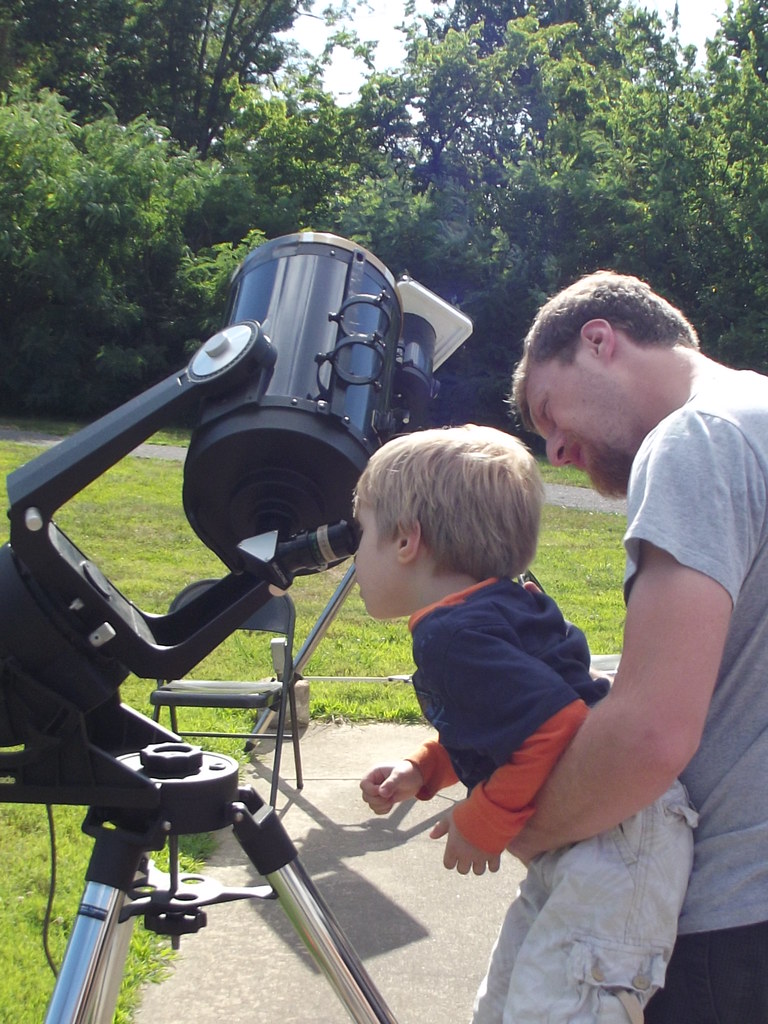
- “Golden Pond Observatory” by LandBetweentheLakesKYTN is licensed under CC BY-SA 2.0, retrieved 04.01.2020