By Alexander Merz · Updated on · Details checked on 14 September 2026
A microscope for kids is a sturdy, easy-to-use microscope with LED lighting that matches your child’s patience: a stereo microscope with about 20x for ages 4 to 7, and a compound microscope up to 400x from about age 8. Good models sit in the budget to mid-range price class.
The number on the box hardly matters – what counts is what your child wants to look at.
Stereo or compound for your child: the most important decision
A compound microscope lights the specimen from below – so it has to be paper-thin and let light through. That means cutting, squashing, placing it on a slide (a small glass plate) and putting a cover glass on top.
A stereo microscope lights things from above, like a desk lamp, and shows a three-dimensional image through two eyepieces (the parts you look into). You simply put down whatever you’ve found: a leaf, a feather, the ladybug.
In return, a compound microscope shows things that stay hidden to a stereo microscope: cells, protozoa and the green chloroplasts in plant cells. At 20x to 40x, a stereo microscope never gets that far into the tiny world.
So the question before you buy isn’t “how much magnification?” but “what does my child want to look at?”.
How does a microscope work? Explained for kids
The short answer: a microscope is like two magnifying glasses, one after the other. You can read the box below straight to your child.
🔬 Explained for kids
Your find lies on a little table, and a lamp makes it bright. Right above it sits the first magnifying glass, called the objective. It makes a big picture of your thing.
At the top you look through the second magnifying glass, called the eyepiece. It makes that picture bigger once more, just as if you were looking at a photo through a magnifying glass. That’s why you multiply: 10 times 40 makes 400 times bigger.
With the wheel on the side, you move the table up and down until everything is sharp. And that’s the whole secret!
If you want to know more, you’ll find the light path and all the components in our article on the parts of a microscope. The principle is similar to a refracting telescope, which we explain in how a telescope is built and how it works – only one looks far away and the other looks at the very small.
Microscope for kids: which model for which age?
Manufacturers’ age recommendations are generous – Bresser, for example, lists stereo from 4 and compound from as early as 6. What matters is less the age than the patience and the fine motor skills needed to prepare slides.
| Age | Microscope type | Model | Why | Price |
|---|---|---|---|---|
| 4–6 years | Stereo (top light), 20x | Bresser Junior Stereo 20x | Nothing to prepare, nothing to break: put it down and look. | € 79.90 |
| 6–8 years | Stereo with top and bottom light, 20x to 50x | Bresser Junior Stereo 50x | Grows with your child once the first thin specimens become exciting. | € 89.90 |
| from about 8 | Compound up to 400x, LED | Omegon VisioStar 40x–400x | ⭐ Our pickTop and bottom light, honestly up to 400x, five prepared slides included. | € 99 |
| from about 8 | Compound set in a case | Bresser Junior Biotar set | The affordable classic with tools and specimens. | € 59.90 |
| 10–12 years | Beginner microscope with fine focus and mechanical stage | Omegon Nabla I Mono | Focusing and moving the slide just like on a real microscope. | € 149 |
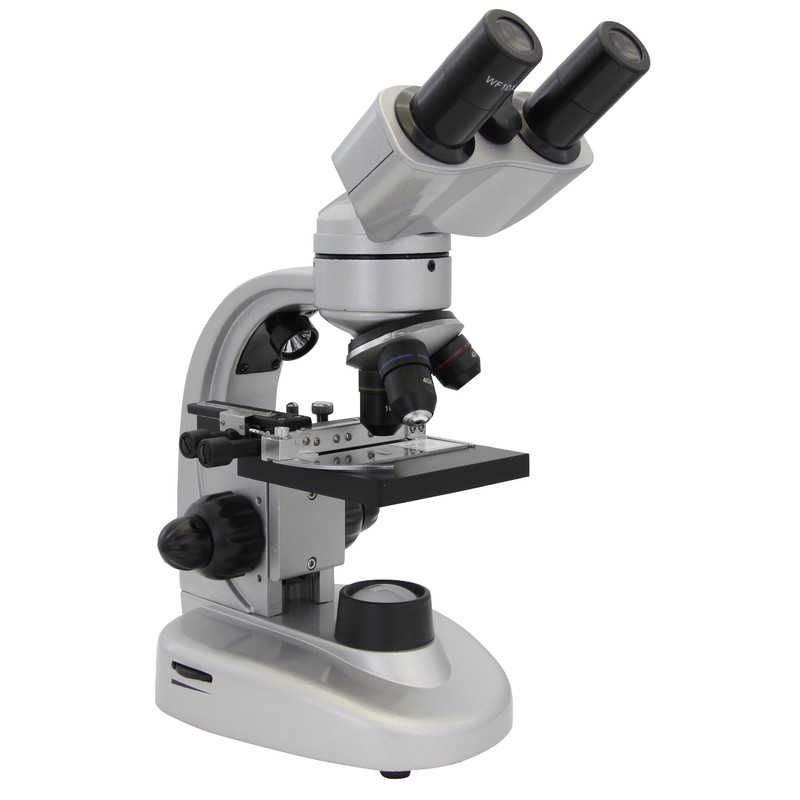
| Teens / school | Binocular, 40x to 800x | Omegon Binofield | Viewing with both eyes, mechanical stage, coarse and fine focus. | € 149 |
Links marked with an asterisk are affiliate links. Prices updated daily from Astroshop.
Ages 4 to 6: stereo microscope with 20x
Preschoolers want to see things right away, not prepare them. A stereo microscope with about 20x shows finds from the yard and the woods without any prep, upright and correctly oriented.
Microscope for kids 8 and up: compound up to 400x
At around eight, most kids can handle slides and cover glasses. Now a compound microscope with LED and objectives up to 40x is worth it, which gives you 400x with a 10x eyepiece. That’s enough for onion cells, pollen and pond water.
Ages 10 to 12: fine focus and mechanical stage
From about ten, kids work more precisely. A fine focus knob – a second, finely geared focusing wheel – is what makes 400x truly usable; a mechanical stage moves the slide with millimeter precision using two knobs.
Teens and school: student microscope with two eyepieces
For older kids who use a microscope regularly, a binocular – a microscope with two eyepieces – is much more comfortable. Viewing with both eyes is less tiring.
1200x on the box: is 1000x worth it for kids?
Magnification works the same way in a microscope as in a telescope: you can push it as high as you like without revealing more detail. Beyond a certain point, the image just gets bigger and mushier – that’s called empty magnification.
The limit is set by the numerical aperture (NA), a number printed on the objective that tells you how much light it gathers. Useful magnification is roughly 500 to 1000 times the NA: a typical 40x objective with NA 0.65 therefore manages about 650x at most.
True 1000x needs a 100x objective with immersion oil, a drop of special oil between lens and cover glass. That’s lab work and almost never necessary for kids. Even then, bacteria only show up as tiny dots, and viruses never – at 15 to 400 nm they’re too small for any light microscope.
Toy or real kids’ microscope? How to tell the difference
Many bargain-priced kids’ microscopes are more toy than tool. The problem isn’t the bright colors – it’s the optics and mechanics: simple lenses with color fringes, wobbly plastic, no precise focusing.
An honest take: Omegon MonoView microscopy set 1200x
The set currently costs € 29.90 and advertises 1200x. It’s toy class: good for kids who first want to find out whether microscopy grabs them.
Onion skin and hair work; the simple optics aren’t made for more. If you already know the interest is there, you’re better off investing right away in a proper entry-level model a step up in price.
| Feature | Toy | Real beginner microscope |
|---|---|---|
| Optics | simple lenses, no specs | glass objectives with the NA printed on them |
| Focusing | coarse only, jumps easily | coarse and fine focus |
| Light | weak LED or mirror | bright, often dimmable LED |
| Stand | light, plastic | heavy, metal stand |
| Size | well under 30 cm (12 in) | stand around 30 cm (12 in) tall |
| Advertising | 1200x and more | honestly up to 400x or 1000x |
A toy microscope isn’t a bad buy if you see it as a test run. It only gets disappointing when it’s expected to do more than it can. For an overview of all microscope types for adults, see our microscope buying guide.
Our picks: the best microscopes for kids by age
We haven’t tested these models ourselves – our selection is based on spec sheets and experience shared in microscopy forums. Sorted by age.
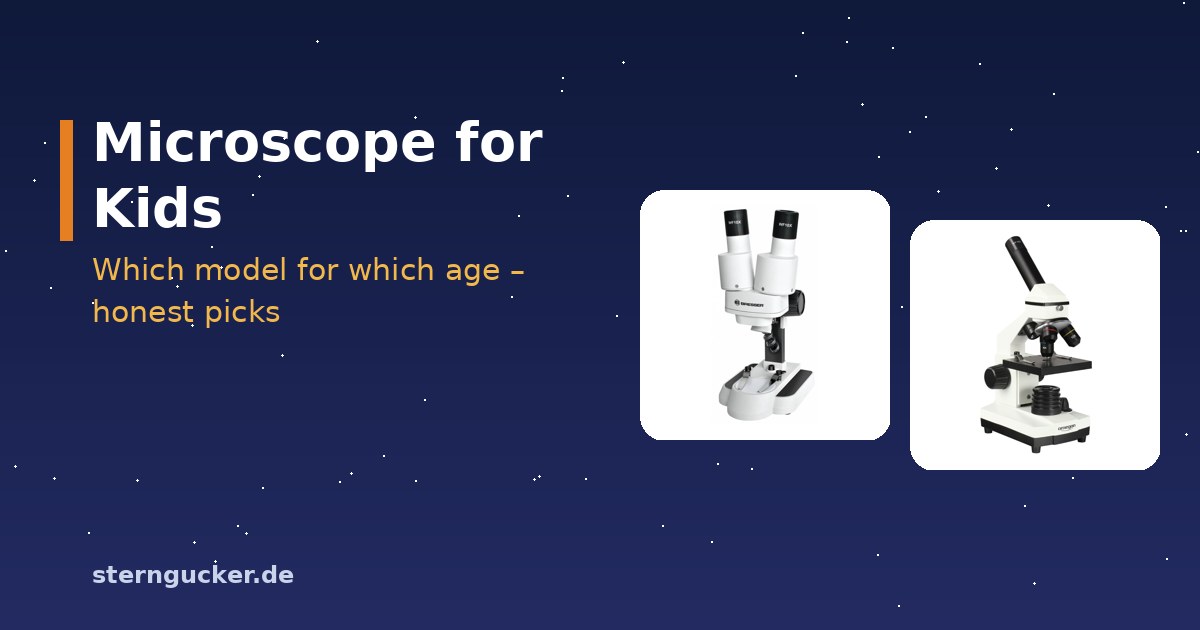
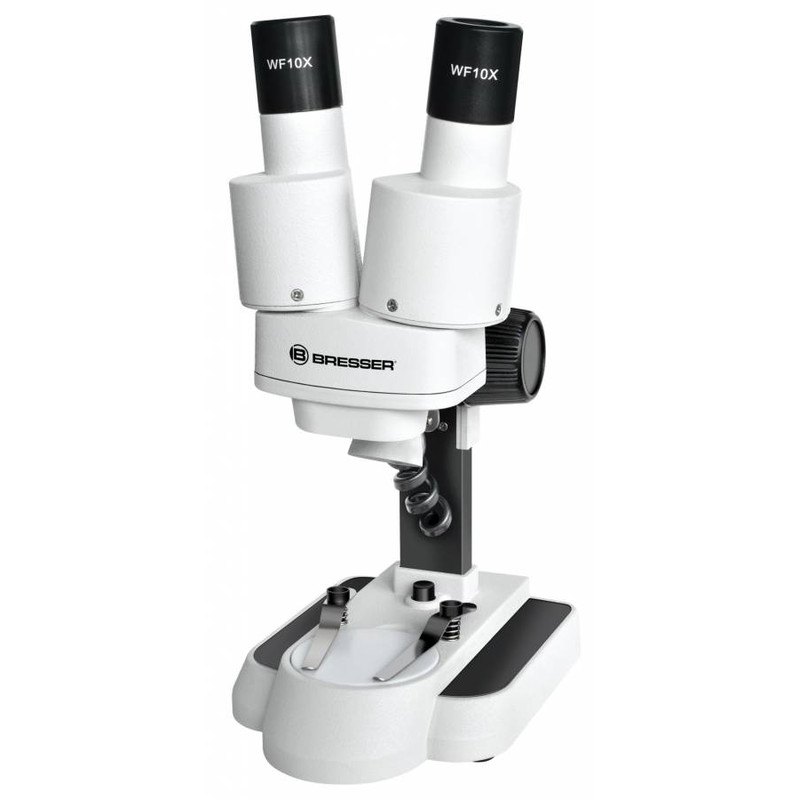
For kids aged 4 to 7: Bresser Junior Stereo 20x
Best first microscope: Bresser Junior binocular microscope, 20X
Top-lit stereo microscope with 20x and two eyepieces: beetles, flowers, rocks and coins appear three-dimensional and correctly oriented. No slides, no nosepiece – just right for preschool and the first grades.
Price: € 79.90
Just one magnification, no slides – that’s exactly why the Bresser Junior 20x works. Put a flower underneath and the amazement starts right away.
From age 8: Omegon VisioStar 40x–400x
Our pick from age 8: Omegon VisioStar microscope, 40x–400x (LED)
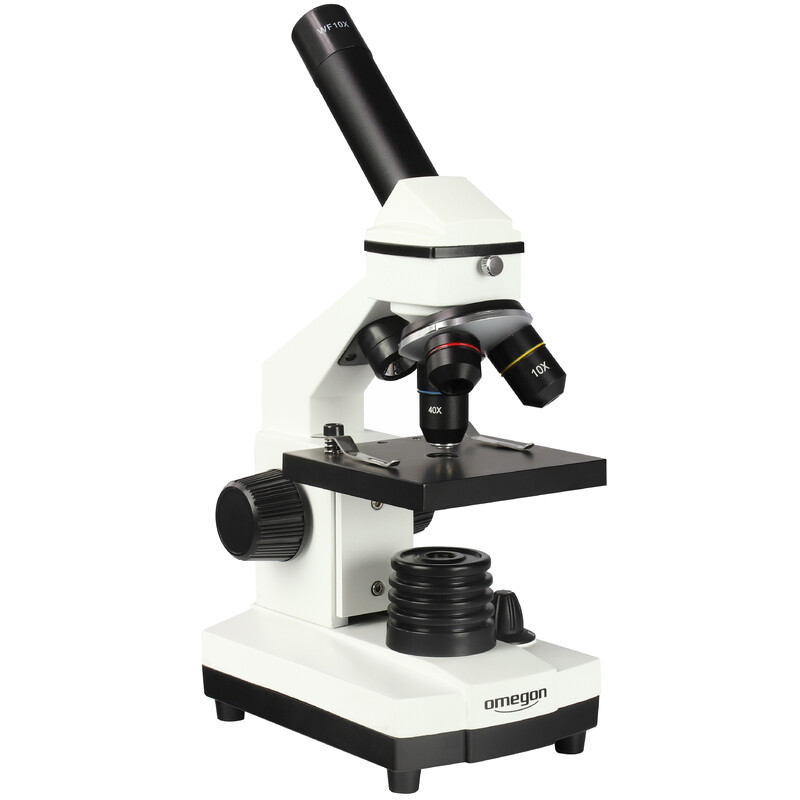
Beginner microscope with top and bottom light up to 400x: enough for cells, pollen and water fleas. Five prepared slides are included, so the first afternoon doesn't start with cutting.
Price: € 99
The VisioStar covers both worlds: top light for beetles and coins, bottom light for onion skin and pond water. At 400x, it honestly tops out.
Smaller budget? The Bresser Junior Biotar set in a case with tools and specimens is the affordable classic. The stage is light and the focus is coarse, but up to 400x it does what it’s supposed to.
Ages 10 to 12: Omegon Nabla I Mono
Real beginner microscope: Omegon Nabla I Mono microscope (up to 400x)
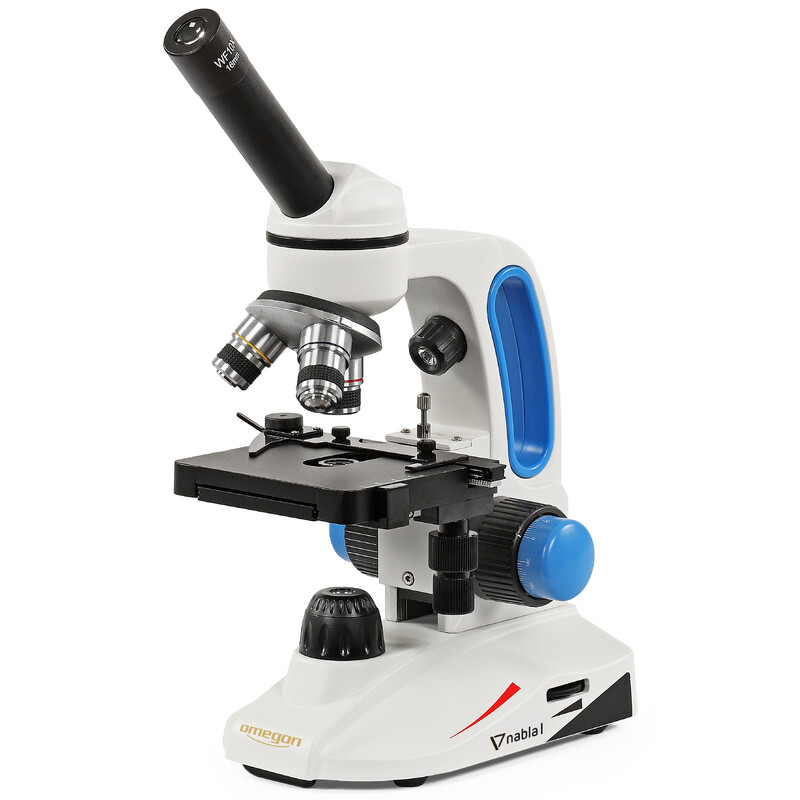
Up to 400x with a mechanical stage plus coarse and fine focus – honestly limited to the range in which a beginner microscope stays sharp. Also works as a student microscope for middle school biology.
Price: € 149
If you want more: Omegon Nabla I Bino
For kids from about twelve who are still at the microscope months later, viewing with both eyes is the biggest upgrade. The Nabla I Bino has the same mechanics as the mono model, but a head with two eyepieces.
The extra cost pays off if your child uses it regularly and for long sessions, for example for school projects. For elementary school kids it’s too much: setting the eye distance and merging both images is often hard for younger children.
For advanced users: Omegon Nabla I Bino microscope (up to 400x)
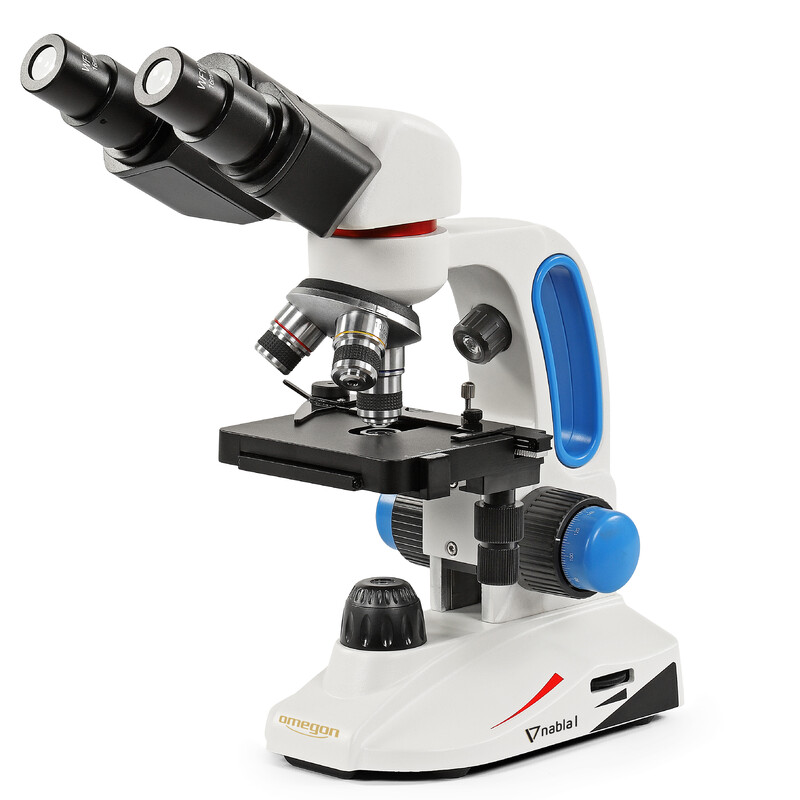
Binocular beginner microscope up to 400x with mechanical stage, coarse and fine focus. The next step for teens who are seriously sticking with it – more relaxed during long sessions than any mono model.
Price: € 199
Digital microscope for kids: screen and smartphone
A digital microscope or a smartphone adapter turns a solo view into a family experience – and whatever gets photographed gets passed around.
The difference matters: USB handheld microscopes are top-lit magnifier cameras, really about 20x to 200x. They don’t show cells, but they’re great for coins, insects and fabrics.
| Model | Type | Strengths and limitations | Price |
|---|---|---|---|
| Bresser Junior Biolux CA | Compound with smartphone adapter | Stable stage, fine focus; the 1024x is empty magnification. | € 149 |
| National Geographic 40x–1280x | Compound with smartphone adapter | Objectives 4/10/40, useful up to about 400x to 600x. | € 114.90 |
| Omegon DigitalView USB | USB handheld microscope | 2 MP, up to 200x, software included; top light, no cells. | € 59 |
Links marked with an asterisk are affiliate links. Prices updated daily from Astroshop.
Digital for kids: Omegon DigitalView USB handheld microscope
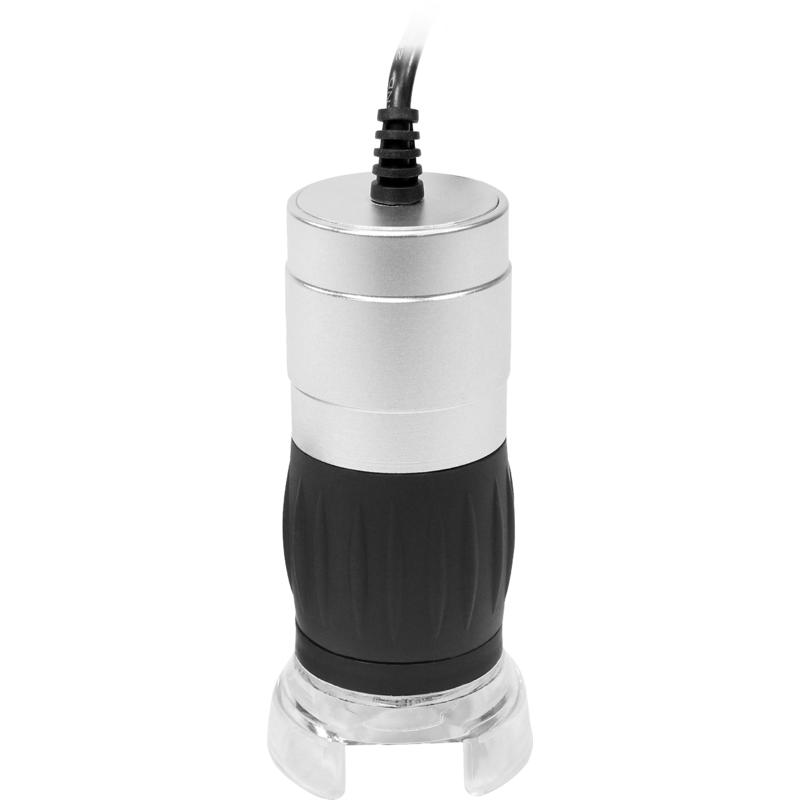
USB handheld microscope with 2 megapixels and up to 200x: coins, feathers, insects and fabrics appear live on the laptop, and the whole family can watch. It's not a microscope for cells – that takes transmitted light.
Price: € 59
Everything about cameras, software and real resolution is in our digital microscope guide. For kids, a smartphone adapter is usually enough, since the phone has the better camera anyway.
Outdoor, mini and pocket microscopes for on the go
A pocket microscope is a small tube with a lens and LED, usually 60x to 120x, that you hold right up to bark or leaves. For outings, a small stereo microscope with battery light is often the better choice, because it stands steady and uses both eyes.
The Omegon StereoView 20x runs on a battery LED and fits on any picnic table. Still, a good magnifying glass remains the simplest companion for the woods – light, rugged and always ready.
Edubini, VTech, Kosmos, Edurino: well-known brands in context
Many parents search specifically for these names. Our partner shop doesn’t carry microscopes from these brands, so we give a neutral assessment and name an alternative from our range for each.
| Brand | What it is | What to look for | Alternative |
|---|---|---|---|
| Edubini | Compound sets for elementary school kids, some digital | Don’t overrate claims above 400x; check the focus | Omegon VisioStar |
| VTech | Educational toys for preschool and elementary school | Real optics or a camera with a screen? | Bresser Junior Stereo 20x |
| Kosmos | Science kits with an instruction book | Features vary widely from kit to kit | VisioStar + Kosmos book |
| Edurino | Learning games with a tablet app, roughly ages 4–8 | Is a tablet or an app required? | Bresser Junior Stereo 20x |
Links marked with an asterisk are affiliate links. Prices updated daily from Astroshop.
Edubini microscope: experiences and assessment
Edubini mainly sells compound sets with plenty of accessories online, aimed at elementary school kids. How people rate them depends heavily on expectations: up to about 400x such sets work as a starting point, while the advertised maximum values are empty magnification. Our alternative with top and bottom light is the Omegon VisioStar.
VTech microscope: an educational toy for the youngest
VTech is known for electronic learning toys, and the brand’s microscope is aimed at younger kids accordingly. Check the specific model to see whether you’re getting real optics or a camera with a screen – both can be fun. For a real look into the tiny world at this age, we recommend a 20x stereo microscope.
Kosmos microscope: a science kit with instructions
Kosmos is a classic German maker of science kits, including kits for microscopy. Their strength lies in the instructions, which guide you step by step through your first slides. Our partner carries the Kosmos book – paired with the VisioStar, it makes a similar package.
Edurino microscope: a playful start with an app
Edurino is known for learning games for kids aged about four to eight that connect play figures with a tablet app. Before you buy, find out whether the microscope requires a tablet or an app. As pure optics for this age, we recommend the Bresser Junior 20x.
Microscope for kids: what to look at? The 10 best first objects
The pictures on the packaging often come from lab instruments. These ten objects, on the other hand, work reliably, split by microscope type.
| # | Stereo / top light (whole, no prep) | Compound (thin, on a slide) |
|---|---|---|
| 1 | Ladybug or fly (found dead) | Onion skin: cell walls like paving stones |
| 2 | Feather with tiny hooks | Pond water or hay infusion with protozoa |
| 3 | Flower with pollen | Waterweed leaf: chloroplasts in every cell |
| 4 | Sand and small pebbles | Salt or sugar crystals from a dried solution |
| 5 | Cushion of moss | Your own hair next to animal hair |
| 6 | Coin with its embossing | Cheek cells from a cotton swab |
| 7 | Bill or postage stamp | Scales from a butterfly wing |
| 8 | Tree bark with lichen | Yeast in sugar water |
| 9 | Velcro and fabrics | Textile fibers: wool, cotton, synthetic |
| 10 | Your own fingertip | Prepared slides from the set |
The most reliable wow moment is pond water: protozoa such as the paramecium, about 0.2 to 0.3 mm long, dart across the view as tiny dots even at 40x. At 400x you can even see the fine cilia along the edge.
What doesn’t work is part of the picture too: you can’t see bacteria and viruses with kids’ microscopes, and blood cells only with difficulty. Anyone promising that is just trying to sell you something.
Safety when using a microscope with kids
A microscope itself is harmless, but the things around it aren’t always. Scalpels, stains and thin glass belong in adult hands or under supervision.
⚠️ Safety at a glance
- Cutting: an adult handles the scalpel and razor blade; kids use tweezers and a pipette.
- Stains: methylene blue and Lugol’s iodine stain skin and clothing and must never go in the mouth – only under supervision and with gloves.
- Glass: cover glasses break easily; pick up shards with tape.
- Pond water and hay infusion: wash your hands afterward and clean the container thoroughly.
- Light: LED instead of halogen – halogen lamps get hot and dry out living specimens. On old microscopes with a mirror, never reflect direct sunlight into the microscope, as it can damage your eyes.
- Small parts: specimen sets aren’t suitable for children under three.
It’s best to do your first microscope sessions together – it’s safer and more fun for both of you.
A microscope as a gift: Christmas and set ideas
At Christmas, one argument speaks for a microscope: it works in any weather and in the middle of the afternoon. Between December and February the sky is often cloudy for weeks, but the kitchen table never is.
A good gift set has three parts: microscope, prepared slides and a book. Prepared slides deliver images right away, and the Kosmos book on microscopy explains specimens in a way that lets parents help out.
The perfect extra: Omegon prepared slide set, 20 pieces (wooden box)
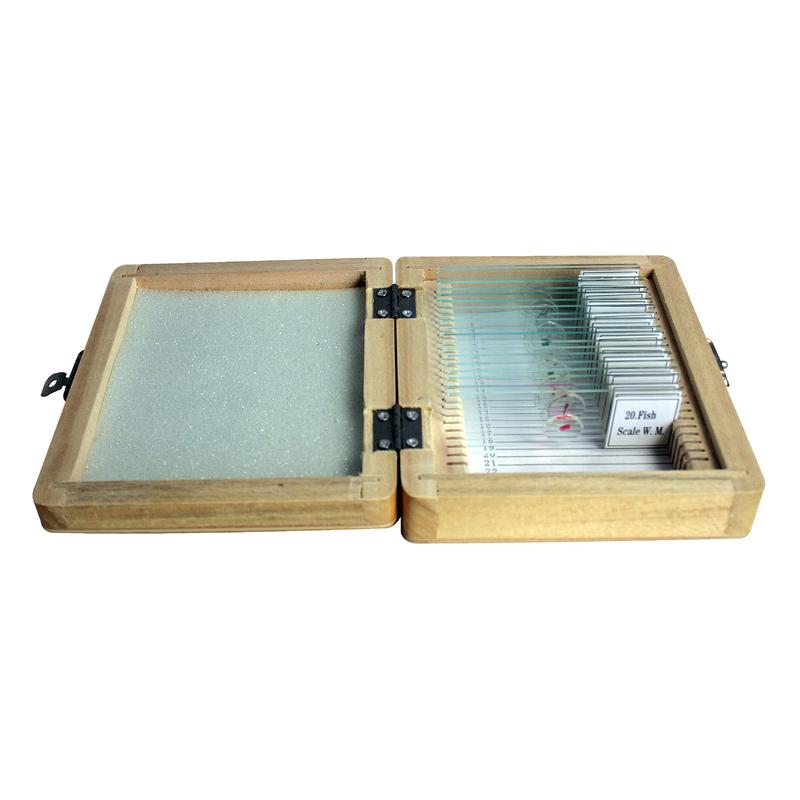
20 ready-made prepared slides in a wooden box: cells, tissue and insect parts, stained and long-lasting. They deliver sharp images on the very first evening, even before the first homemade slide works out.
Price: € 44.90
| Budget | Set idea | For whom |
|---|---|---|
| Budget | Bresser Junior Stereo 20x + bug viewer | Kids aged 4 to 7 |
| Mid-range | Omegon VisioStar + 20 prepared slides | Elementary school kids from about 8 |
| Upper mid-range | Omegon Nabla I Mono + prepared slides + Kosmos book | Kids 10 and up |
Links marked with an asterisk are affiliate links. Prices updated daily from Astroshop.
You’ll find more ideas in our astronomy gifts. Add a few blank slides and a pair of tweezers, and your child can start examining their own finds right away.
Telescope or microscope?
The honest answer depends on the child: a telescope rewards patience and darkness, a microscope rewards curiosity at the kitchen table. If you can’t decide, the National Geographic telescope and microscope set offers both, each at entry level.
For a proper first telescope, read our guide to the telescope for kids. Many families end up with both – just not on the same evening.
Frequently asked questions about microscopes for kids
At what age does a microscope for kids make sense?
A top-lit stereo microscope works from about age four, because it doesn’t require any prep. Classic compound microscopes with slides are worth it from about age eight.
Which microscope is right for a child aged 8 and up?
A compound microscope with LED and 4x, 10x and 40x objectives, so up to 400x. Ideally it also has top lighting, so beetles and rocks work too.
How much magnification does a kids’ microscope need?
For stereo microscopes, 20x is enough; for compound microscopes, 400x. That lets you see cells, crystals and tiny creatures from the pond. Higher numbers on the packaging make the image bigger, but not more detailed.
Is a microscope with 1000x magnification worth it for kids?
Usually not. True 1000x requires a 100x oil objective, immersion oil and lots of practice – more something for teens with a serious interest. On kids’ microscopes, 1000x and more almost always comes from strong eyepieces and is empty magnification.
Can you see bacteria with a kids’ microscope?
No. Bacteria are 0.3 to 1 µm in size and need 1000x with oil immersion, usually plus staining. Viruses are too small even for that and are only visible in an electron microscope.
How much does a good microscope for kids cost?
A usable stereo microscope is available in the budget class, and a solid compound model costs a bit more. With fine focus and a mechanical stage you’re in the mid-range, while the cheapest bargain-bin sets are usually toy class.
Keep reading: Buying a microscope: the guide · What to look at under the microscope · Stereo microscope · Telescope for kids
Links marked with an asterisk (*) are affiliate links. If you buy through them, we earn a small commission – the price stays the same for you.