By Alexander Merz · Published on · Details checked on 10 October 2026
In May 2027 the nights get short – and yet there is a lot going on. Mercury shows itself in the evening sky for two weeks, as well as it rarely does during the year, and Mars passes just over a degree from Regulus, the lion’s star.
On top of that, the Eta Aquariids fall at new moon, and on 13 May the Moon, Mars, Regulus and Jupiter gather in the evening sky. From 24 May it no longer gets completely dark at night in central Germany.
Which instrument suits the short nights is explained in our buying guide for beginners.
More in our overview: Astronomical Events.
The highlights at a glance
- Mercury in the evening sky: roughly from 12 to 30 May, low in the north-west, best around 20 May
- 6 May: new moon and Eta Aquariids – a dark sky, but the radiant is low from our latitudes
- 13 May, 22:30: Moon, Mars and Regulus close together, Jupiter a little further to the right
- 14–16 May: Mars at Regulus – only 1.2° apart on 15 May
- 20 May, 12:58: full moon, the “Flower Moon”
- From 24 May no more astronomically dark nights in central Germany, in Hamburg already from 13 May
- Looking ahead: The night sky in June brings the summer solstice and the brightest nights of the year
Sky events in May 2027: the calendar
All times in CEST, calculated for central Germany. Further west, rise and set times shift up to 20 minutes later, further east they come earlier.
| Date | Event | What you get out of it |
|---|---|---|
| 6 May, 12:58 | New moon | The darkest nights of the month |
| Morning of 6/7 May | Eta Aquariid maximum | No Moon, but before dawn the radiant is only 13° high – realistically around 7 meteors per hour |
| from 12 May | Mercury in the evening sky | Low in the north-west after sunset, bright at first at −1 mag |
| 12 May, 22:30 | Moon at Jupiter | Only 2.2° apart, just under 40° high in the south-west |
| 13 May, 06:43 | First quarter | Half moon in the evening |
| 13 May, 22:30 | Moon at Regulus and Mars | Regulus 2.8°, Mars 4.2° from the Moon, all a good 40° high in the south-west |
| 14–16 May | Mars at Regulus | Closest on 15 May at 1.2° – the orange planet next to the bluish-white star |
| 20 May, 12:58 | Full moon, “Flower Moon” | Rises in the south-east in the evening |
| around 23 May | Mercury at its highest | Around 10° high in the north-west at the end of twilight |
| 24 May | End of astronomical night | In central Germany the sky stays slightly bright even at midnight until July |
| 28 May | Mercury at greatest distance from the Sun | 22.9° east of the Sun, but it is already fading |
| 28 May, 15:57 | Last quarter | Moon-free evenings at the end of the month |
When does it get properly dark in May?
In May the dark night disappears. On 1 May it is still astronomically dark from 23:07 to 3:21, by mid-May only from midnight until just before half past two.
From 24 May the Sun in central Germany no longer sinks more than 18° below the horizon. In Hamburg that is already the case from 13 May, whereas in Munich it never happens – there a short dark phase remains even in June.
Mercury in the evening sky: the best chance of the year
Mercury is the planet most people have never consciously seen. It never strays far from the Sun and only appears in the twilight for a few weeks at a time. May 2027 offers one of these windows – and on spring evenings it stands more steeply above the horizon than at any other time of year.
Look for it about 45 minutes after sunset, low in the north-west. On 20 May it is around 10° high at about 21:50 – one hand’s width above the horizon at arm’s length. It is then roughly as bright as the brightest stars.
| Date | Altitude at end of twilight | Brightness |
|---|---|---|
| 11 May | 6° | −1.1 mag |
| 14 May | 8° | −0.7 mag |
| 20 May | 10° | −0.1 mag |
| 23 May | 10° | +0.1 mag |
| 29 May | 9° | +0.6 mag |
More about the smallest planet in our Mercury profile.
Mars at Regulus, with the Moon joining in
In mid-May Mars passes just over a degree from Regulus, the brightest star in Leo. On 15 May the gap is 1.2° – in binoculars both fit comfortably into one view, and to the naked eye the difference in colour stands out: Mars orange, Regulus bluish-white.
Two evenings earlier the Moon joins them. On 13 May at 22:30 the half moon stands 2.8° from Regulus and 4.2° from Mars, with Jupiter shining a little further west. The evening before, on 12 May, the Moon is only 2.2° from Jupiter.
Mars is now much fainter than in winter: +0.5 mag, with its little disc only around 8 arcseconds across. It hardly shows any surface detail now – this time the show is one for the naked eye.
The Eta Aquariids on 6/7 May: dark, but low
The Eta Aquariids are dust from Halley’s Comet, the same comet that gives us the Orionids in October. In the southern hemisphere they deliver up to 50 meteors per hour, in Germany far fewer.
In 2027 the Moon plays along: new moon on 6 May, so the Moon does not interfere at all. The radiant in Aquarius, however, only climbs just above the horizon in the morning twilight – around 13° high at about 4:15. Realistically, expect about seven meteors per hour under a dark rural sky.
If you want to give it a go, lie down facing east from 3:30. The meteors are fast and often draw long trails low across the sky. More on this under Eta Aquariids.
The phases of the Moon in May 2027
| Phase | Date and time | In the sky |
|---|---|---|
| New moon | 6 May, 12:58 | Invisible – dark nights at the start of the month |
| First quarter | 13 May, 06:43 | Half moon in the evening in the south-west |
| Full moon | 20 May, 12:58 | Visible all night, “Flower Moon” |
| Last quarter | 28 May, 15:57 | Half moon in the morning sky |
All the dates and names are in the full moon calendar for May and in our full moon calendar overview.
The planets in May 2027
| Planet | Visibility | Brightness | Where |
|---|---|---|---|
| Jupiter | Evenings in the south-west, until after midnight | −2.1 to −1.9 mag | back in Leo from about 10 May |
| Mars | Evenings in the south-west, until after midnight | +0.3 to +0.7 mag | Leo, at Regulus in mid-May |
| Mercury | About 12–30 May, evenings in the north-west | −1.1 to +0.6 mag | Taurus, finally Gemini |
| Saturn | From late May in the morning, very low in the east | +0.7 mag | Pisces |
| Venus | Not visible | – | – |
| Uranus | Not visible | – | – |
Jupiter and Mars are slowly sliding into the west. At the end of twilight they are still 30 to 40° high at the end of May, after which their window gets shorter every week. Saturn reappears at the end of the month, but at dawn it is only 3 to 7° high.
The constellations in May: Virgo, Boötes and the first hint of summer
Around 23:00, Virgo with Spica and Boötes with Arcturus stand in the south. Leo sinks towards the south-west, and the Big Dipper is high in the north-west.
Every observer knows the way there: follow the curve of the Dipper’s handle to orange Arcturus and carry it on to bluish Spica. From midnight the Summer Triangle rises in the east with bright Vega – the summer sky is announcing itself.
Deep sky in May: the Virgo Cluster and globular clusters
Between Leo and Virgo lies the Virgo Cluster of galaxies, a good 50 million light years away. A 200 mm telescope shows several galaxies at once in a single field of view there, for example along Markarian’s Chain with M 84 and M 86.
High in the south stands the globular cluster M 3 in Canes Venatici, and later in the evening M 13 in Hercules rises in the east. Globular clusters cope with the bright May nights better than galaxies – from 150 mm of aperture they resolve into individual stars at their edges.
The worthwhile dates are often weeks apart – and easily forgotten. So that you don’t miss any of them:
One short email, in good time – with the times and an honest take on whether it is worth getting up for.
You will get a confirmation email in a moment. Your address stays with us – no sharing, no third-party ads.
Equipment for the May sky
For Mercury and the meeting of Mars and Regulus, binoculars are enough. For Jupiter’s belts and the globular clusters you need a telescope – a 130 mm reflector already shows M 3 and M 13 as grainy balls of light.
The starter scope for the spring sky: Skywatcher Dobson Telescope N 130/650 Heritage FlexTube
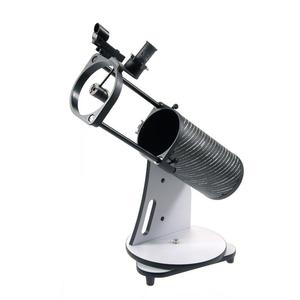
A compact tabletop Dobson with a true parabolic mirror. Folds down, fits in a bag: the Moon, planets and the bright deep-sky classics.
Price: € 265
If you want more: With 200 mm of aperture the globular clusters resolve into stars right down to their cores, and far more galaxies show up in the Virgo Cluster. The extra cost is worth it for anyone who wants to observe beyond the planets and the Moon.
For advanced observers: Skywatcher Dobson Telescope N 200/1200 Skyliner Classic
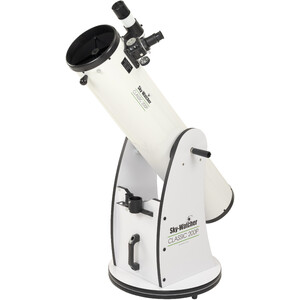
200 mm of aperture — the most sky for your money. Set it on the ground, point by hand: nebulae, clusters and galaxies for years to come.
Price: € 479
* Affiliate link: if you buy through this link we may earn a small commission from Astroshop, High Point Scientific or another linked retailer, at no extra cost to you.
Frequently asked questions about the night sky in May
When can you see Mercury in May 2027?
Roughly from 12 to 30 May in the evening, around 45 minutes after sunset, low in the north-west. It is highest from around 20 to 23 May, at about 10° above the horizon.
When is the full moon in May 2027?
On 20 May 2027 at 12:58 CEST. The May full moon is called the “Flower Moon”.
When are the Eta Aquariids in 2027?
The maximum falls on 6 May 2027; it is worth observing on the mornings of 6 and 7 May. The Moon does not interfere, but from Germany the radiant is low – realistically, expect about seven meteors per hour.
Which planets can you see in May 2027?
In the evening, Jupiter and Mars in the south-west, plus Mercury low in the north-west from about 12 May. Saturn appears in the morning sky at the end of May; Venus and Uranus are not visible.
Why does it no longer get properly dark at night in May?
At midnight the Sun no longer sinks far enough below the horizon. In central Germany it stays less than 18° below the horizon from 24 May, in Hamburg already from 13 May – a bright glow remains in the north all night.
Which constellations can you see in May?
Around 23:00, Virgo and Boötes stand in the south, and Leo sinks in the south-west. From midnight the Summer Triangle with Vega rises in the east.
➡️ What comes next: The night sky in June – with the summer solstice and the shortest nights of the year.
⬅️ The month before: The night sky in April 2027 – with the Moon between Mars and Jupiter.