By Alexander Merz · Published on · Details checked on 14 September 2026
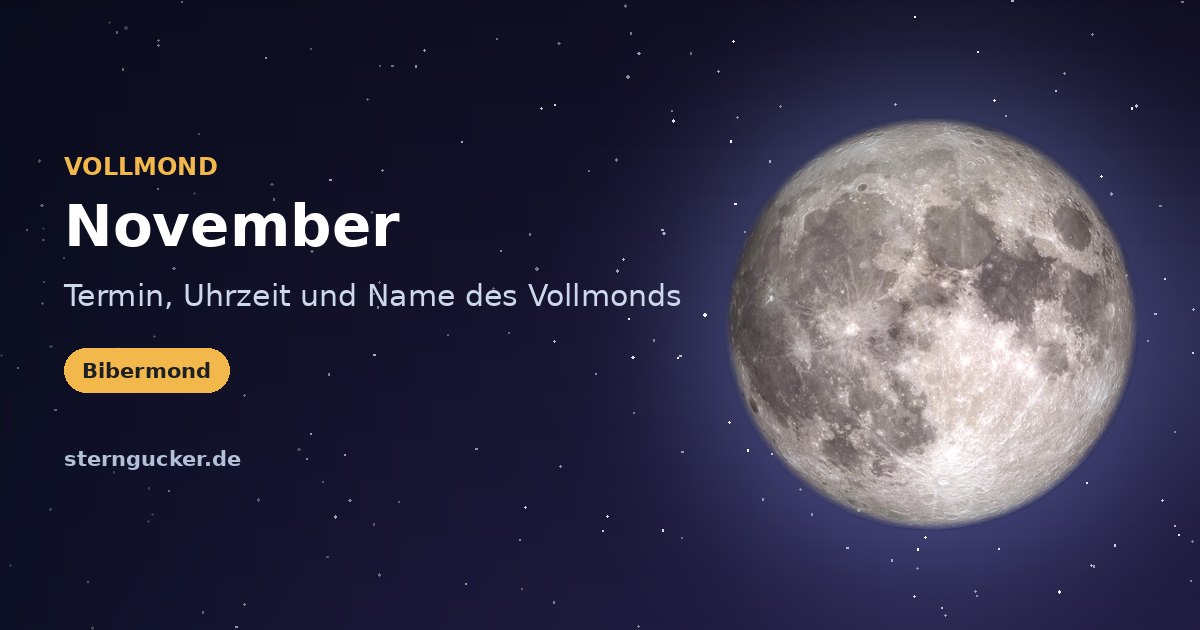
The next full moon in November falls on Tuesday, November 24, 2026 at 15:53 CET.
Name: Beaver Moon – when beavers finish their lodges for the winter
Still 62 days to go.
Here you will find the exact date of the full moon in November – with the time for Germany, Austria and Switzerland, the traditional name of the month’s full moon and the dates for the years ahead.
And if you want to see the Moon closer than with the naked eye: our buying guide for beginners explains which telescope makes sense to start with, what budget to plan for and which classic mistakes to avoid.
How the full moon sits in the sky in November
In November the full moon stands high and lights up the long nights almost from end to end. For deep-sky observing – the faint objects beyond our solar system such as galaxies and nebulae – this is the worst time of the year; for observing the Moon, the best.
Beaver Moon – where the name comes from
The Beaver Moon has two handed-down explanations that do not rule each other out: in November the beavers finish their lodges for the winter, and in the same weeks the beaver traps were set before the waters froze over. The German Nebelung, the month of fog, needs no explanation, and nor does Windmond, the wind moon.
Almost all of the full moon names in common use today come from North America and were popularised by American almanacs. German-speaking countries had their own names for the months: November was called Nebelung or Windmond. Both traditions mean the same thing – an attempt to pin the course of the year to what is actually happening outdoors.
What else is happening in the sky in November
November brings the Leonids, which every 33 years can produce spectacular outbursts. Otherwise it is the season of the first clear frosty nights with especially steady air.
Full moon in November: the dates for the coming years
| Year | Date | Time |
|---|---|---|
| 2024 | Friday, November 15 | 22:28 CET |
| 2025 | Wednesday, November 5 | 14:19 CET |
| 2026 | Tuesday, November 24 | 15:53 CET |
| 2027 | Sunday, November 14 | 04:25 CET |
| 2028 | Thursday, November 2 | 10:17 CET |
| 2029 | Wednesday, November 21 | 05:03 CET |
| 2030 | Sunday, November 10 | 04:30 CET |
| 2031 | Saturday, November 29 | 00:18 CET |
The interval from one full moon to the next averages 29 days, 12 hours and 44 minutes. Because our calendar months are longer, the date shifts forward year by year – which is why the full moon in November never falls on the same date. All upcoming dates are listed in the full moon calendar, and our page on the Moon explains how the phases come about.
The dates that are actually worth it are often months apart – and easily forgotten. So you do not miss one:
One short email, in good time – with the times and an honest take on whether it is worth getting up for.
You will get a confirmation email in a moment. Your address stays with us – no sharing, no third-party ads.
Observing the full moon – an honest note
As lovely as the full moon is to the naked eye, in a telescope this is precisely the phase in which it is least interesting. Because the Sun shines straight down onto the lunar surface, the shadows are missing and craters look flat. You see considerably more a few days before or after full moon along the day-night boundary, the so-called terminator. If you still want to look at the full moon through a telescope, you should use a moon filter, a grey filter that dims the brightness – without one the glare is uncomfortable. There is more on this in our buying guide to observing the Moon.
A high full moon, plenty of light: a moon filter: Omegon Premium Moon Filter 1.25″
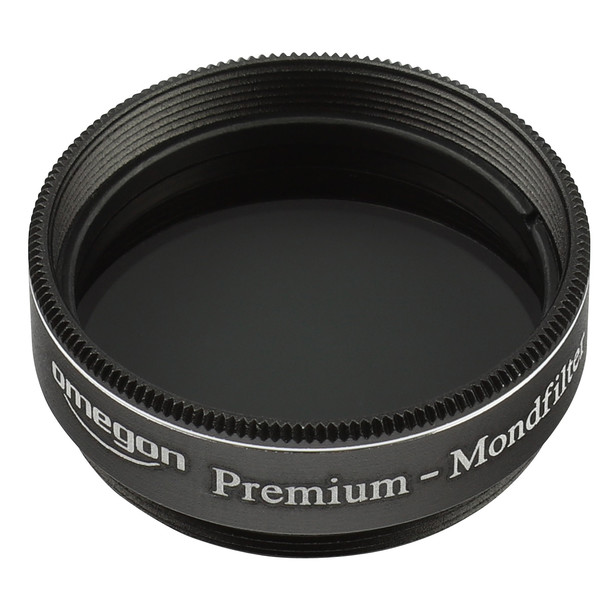
Dims the harsh moonlight, is easy on the eyes and brings out far more contrast and detail – our best-selling filter and the number-one pick to start with.
Price: € 19.90
← October · Calendar · December →