By Alexander Merz · Published on · Details checked on 6 November 2026
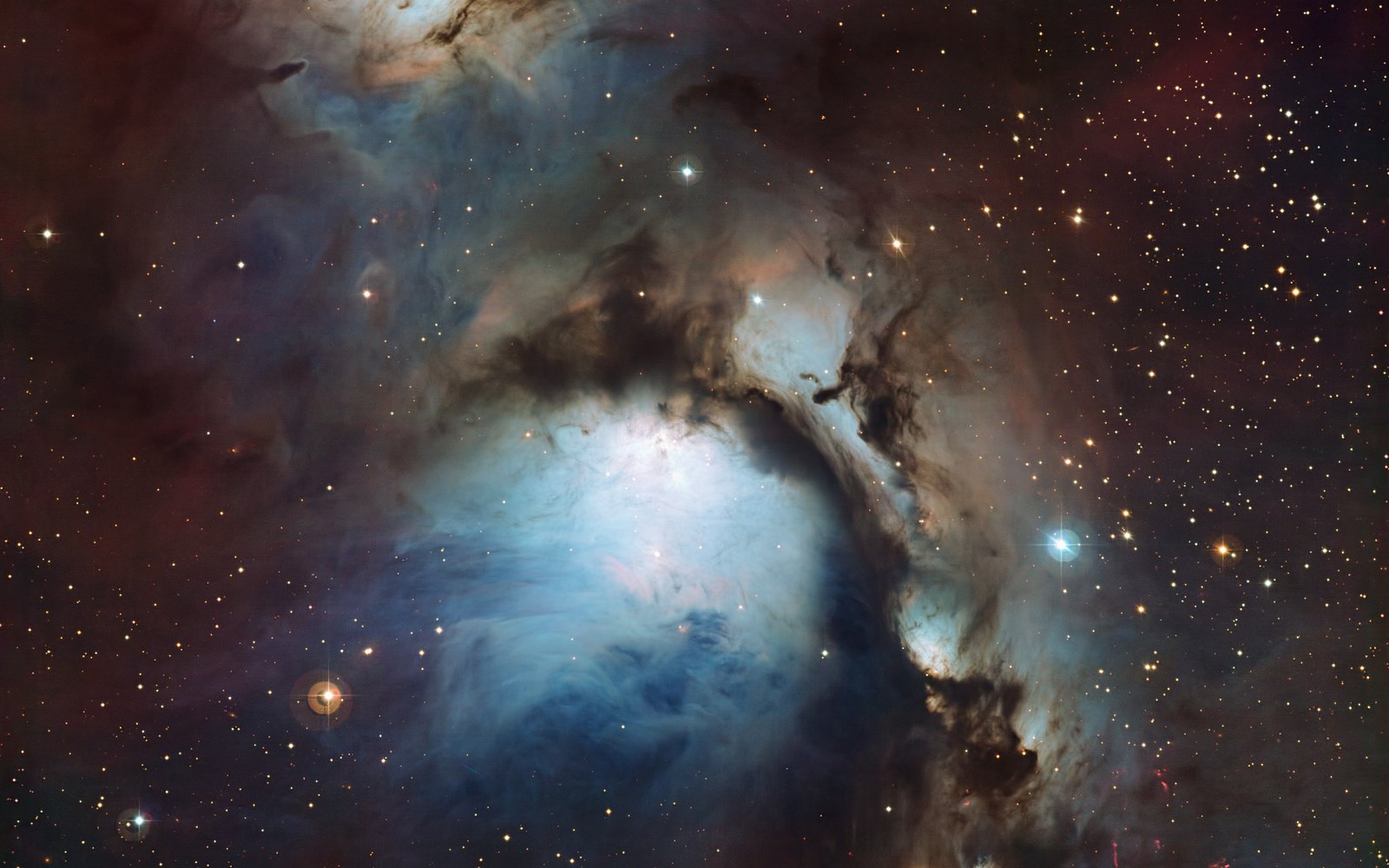
A reflection nebula is a cloud of interstellar dust that does not glow by itself but scatters the light of nearby stars. That is why it almost always looks blue in photos.
About 500 reflection nebulae are known, most of them in our Milky Way (Wikipedia: Reflexionsnebel, in German). It is one of the five types of nebulae in space.
What is a reflection nebula?
Strictly speaking, a reflection nebula does not “reflect” – it scatters. Tiny dust grains deflect the light of a neighbouring star in all directions, and only that makes the cloud visible. The nebula’s light therefore has the same spectrum as the star that illuminates it (Wikipedia, in German).
The difference from an emission nebula lies in the temperature of the star. If the star is not hot enough to ionise the gas, it cannot make it glow by itself either – all that remains is scattered light. Edwin Hubble described this distinction in 1922 (Wikipedia, in German).
Reflection and emission nebulae often occur together. In the Trifid Nebula M 20 in Sagittarius the southern part glows red and the northern part blue. Astronomers therefore also group both together as “diffuse nebulae”.
Why are reflection nebulae blue?
Fine dust scatters blue light more strongly than red. It is the same effect that makes the daytime sky blue and the sunset red. A reflection nebula is, in a sense, a piece of blue sky in space.
If the illuminating star is itself red, the nebula turns yellowish to red as well. The best-known example is the dust around the red giant Antares in Scorpius (Wikipedia, in German). More about the star itself is on our page about Antares.
Reflection nebula vs emission nebula: the difference
For observing, the difference is not theory – it decides which filter to use. An emission nebula glows in individual spectral lines, a reflection nebula in the continuous spectrum of its star. A line filter therefore only helps with the former (Wikipedia: Emissionsnebel, in German).
| Feature | Reflection nebula | Emission nebula | Dark nebula |
|---|---|---|---|
| Where the light comes from | scattered starlight | gas glows by itself | no light, hides the background |
| Colour in photos | blue | red to pink, partly green | black to brown |
| Spectrum | like the star (continuous) | individual lines | – |
| UHC/OIII filter | harms | helps clearly | only helps with the nebula behind it |
| Example | M 78, Pleiades nebula | Orion Nebula | Horsehead Nebula |
How strong this effect is in practice is shown by an observing report from Cygnus in a German-language forum. On the nebula complex NGC 6914 the UHC filter showed the glowing gas parts, whereas without a filter the faint reflection parts stood out (forum.astronomie.de, January 2025, in German). So if you want to see both types in one object, observe twice: with and without a filter.
Well-known reflection nebulae in the northern sky
Most reflection nebulae are faint and spread out. What matters is therefore less the total brightness than the surface brightness, i.e. how bright a piece of nebula is per area. The table lists the objects within reach from mid-northern latitudes such as Central Europe or the northern United States.
| Object | Constellation | Size in the sky | Well placed | With what? |
|---|---|---|---|---|
| ⭐ Best first targetM 78 | Orion | 8′ × 6′, 8.0 mag | Dec–Feb | binoculars/telescope from approx. 50 mm |
| Merope Nebula (NGC 1435) in the Pleiades | Taurus | approx. 30′ | Oct–Feb | visually difficult, easy to photograph |
| Iris Nebula (NGC 7023) | Cepheus | 10′ × 8′ | all year, best in autumn | telescope, dark sky |
| Trifid Nebula M 20 (northern part) | Sagittarius | approx. 28′ in total | Jul–Aug, low in the south | telescope; blue part only clear in photos |
| Witch Head Nebula (IC 2118) | Eridanus | approx. 180′ × 60′ | Dec–Jan | photo only, wide angle |
M 78 is the brightest reflection nebula in the sky and can be seen from about 50 mm of aperture (Wikipedia: Messier 78, in German). It lies north-east of Orion’s Belt, about 1,600 light years away. How to find your way around the constellation is shown on our page about the Orion constellation.
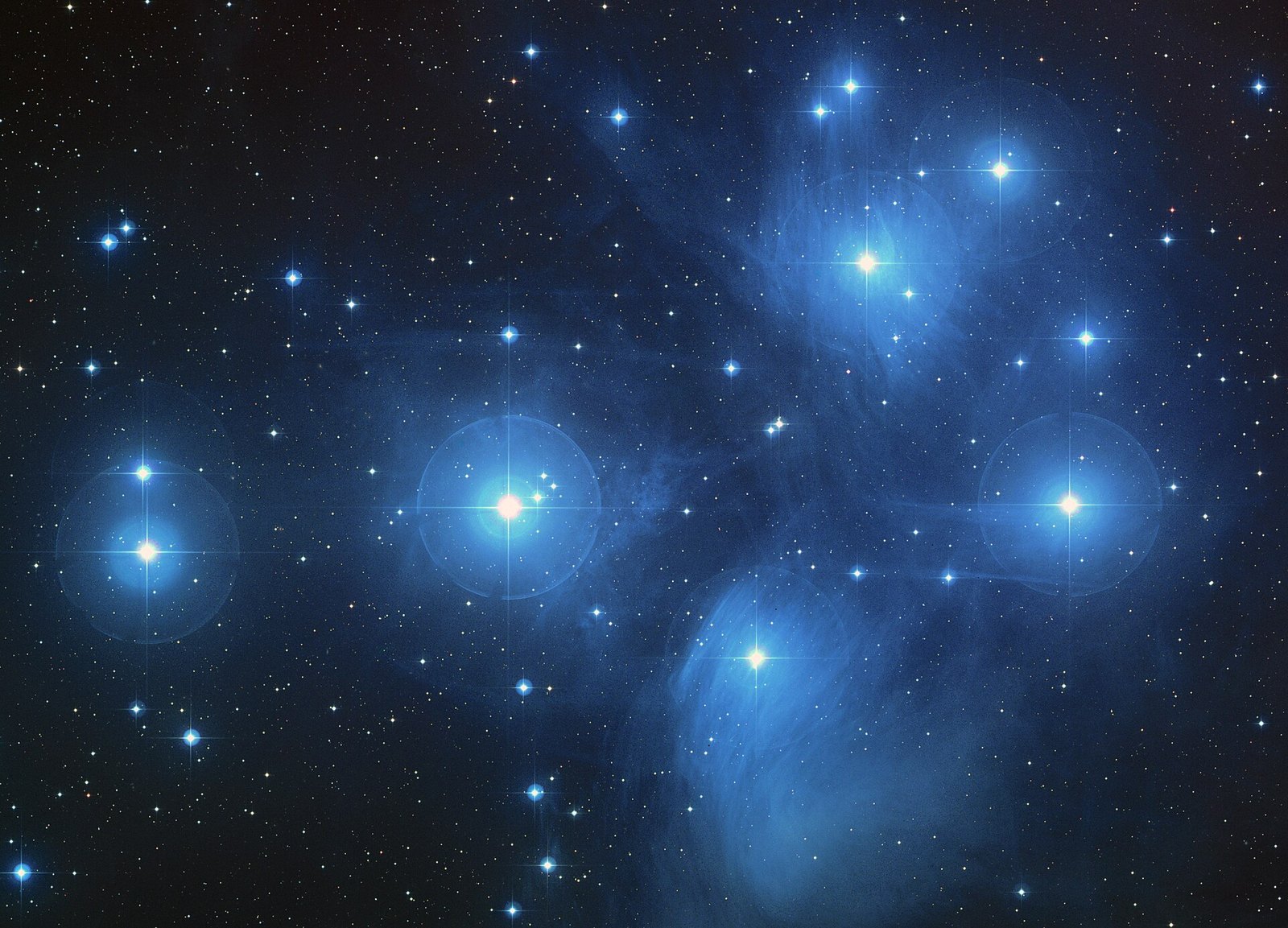
The veil around the Pleiades is the most famous example – and visually one of the trickiest. The Merope Nebula has a total brightness of magnitude 6.8, but spreads its light so thinly that it barely rises above the sky background (Wikipedia: Merope-Nebel, in German). On a long exposure, by contrast, it is impossible to miss.
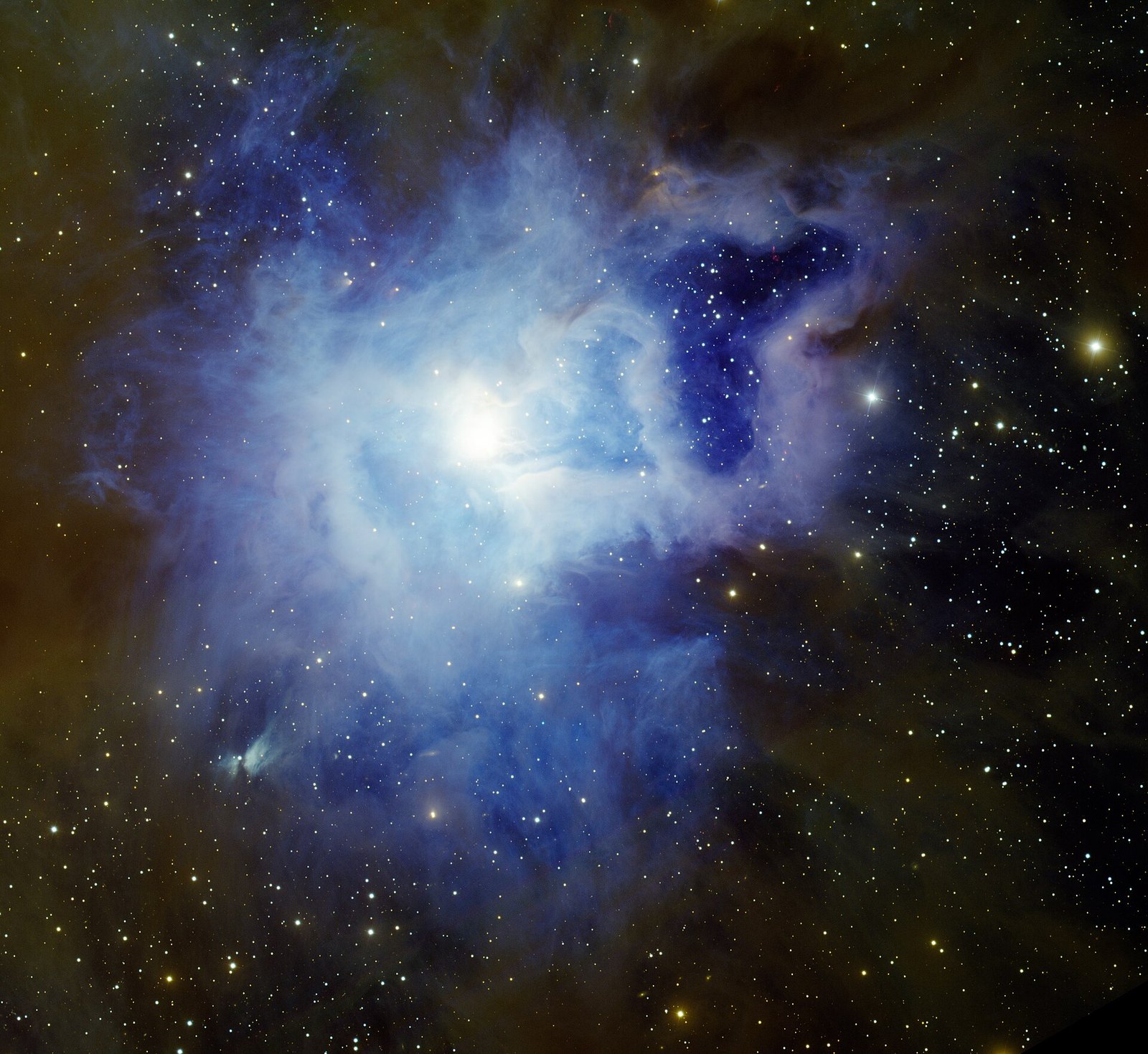
For observers north of about 22° N – all of Europe and the continental United States – the Iris Nebula never sets. The constellation of Cepheus is circumpolar there, so you can look for it all year round; it stands highest on autumn evenings. Its central star shines at magnitude 7.1 and helps you find it (Wikipedia: NGC 7023, in German).
Low on the southern horizon lies one of the most colourful regions of the sky. Around Antares and Rho Ophiuchi, blue and yellow reflection nebulae mix with red gas and dark dust. From Central Europe the region only climbs just above the horizon in summer – a target for photographers with a clear view to the south. From the southern United States it stands noticeably higher.
Observing reflection nebulae: what you see in a telescope
Expect grey, delicate veils around bright stars, not blue clouds. At night the eye barely sees colour, and reflection nebulae are too faint to change that. Why nebulae look grey in the eyepiece is explained in our nebula overview.
A dark sky counts for more than any accessory. Reflection nebulae shine across the whole spectrum, just like light pollution – no filter can separate the two. How dark your site is can be found out with our guide to light pollution and the Bortle scale.
Not every glow around a bright star is a nebula. Fogged optics, stray light or haze create halos that look deceptively like a reflection nebula. The cross-check: swing to a star of similar brightness without a nebula – if it shows the same halo, the cause is the optics or the air.
Low magnification and averted vision help most. A wide-field eyepiece with a large exit pupil concentrates the little light there is, and the edge of the retina is more sensitive than the centre. It is best to push the bright star in the nebula just outside the field of view so that it does not dazzle you.
Which telescope for reflection nebulae?
For M 78 a beginner’s instrument is enough; for the faint objects every centimetre of aperture counts. If, according to Wikipedia, M 78 is visible from about 50 mm, a 130 mm tabletop Dobsonian has plenty in reserve for it. A 200 mm Dobsonian collects well over twice as much light and, under a dark sky, also makes the Iris and Merope Nebulae realistic targets.
First telescope: Skywatcher Dobson Telescope N 130/650 Heritage FlexTube
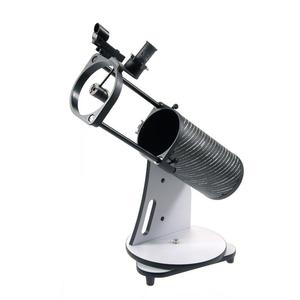
130 mm aperture on a compact tabletop Dobsonian: shows M 78 and the bright gas nebulae in Orion. For the delicate reflection nebulae around the Pleiades it needs a truly dark sky.
Price: € 265
Lots of aperture for the money: Skywatcher Dobson Telescope N 200/1200 Skyliner Classic
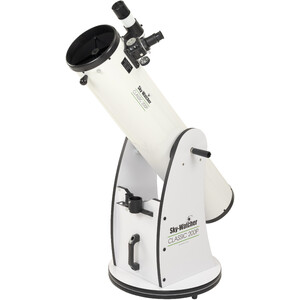
200 mm mirror on a simple rocker box: collects almost 2.4 times as much light as the 130 and turns faint reflection nebulae such as NGC 7023 into realistic targets. Big and heavy – check your storage space first.
Price: € 479
For advanced observers: Omegon Dobson Telescope Advanced X N 254/1250
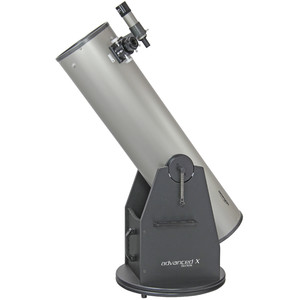
254 mm aperture for everyone who wants to hunt the faint vdB and NGC reflection nebulae after the Messier objects. Only worth it if you regularly drive to a dark site.
Price: € 699
Photographing reflection nebulae: tips for beginners
Photographically, reflection nebulae are rewarding, but they take time. In a recent project on NGC 7129 in a German-language forum, around 14 hours of total exposure were collected (forum.astronomie.de, September 2026, in German). For M 78 or the Pleiades, a fraction of that is enough for a fine image.
Shoot in broadband, i.e. without narrowband or dual-band filters. These filters only pass the red and green gas lines and cut off the blue starlight. Even ZWO recommends broadband mode on the Seestar for reflection nebulae instead of the built-in light pollution filter (Seestar guide to the LP filter).
A smart telescope is the easiest way to your first blue nebula image. In a German-language forum, owners show images of the Iris Nebula taken with a Seestar S50 Pro (forum.astronomie.de, gallery, September 2026). Remember to switch off the light pollution filter for these targets.
Blue nebulae, no experience needed: ZWO Seestar S50 Pro Smart Telescope
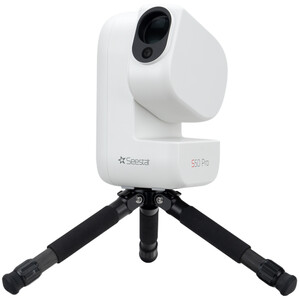
Smart telescope with 50 mm aperture: slews to M 78, the Pleiades or the Iris Nebula by itself and stacks live. Switch off the built-in LP filter for reflection nebulae. No view through an eyepiece possible.
Price: € 999
With a camera and your own optics: a dark sky comes before long focal length. Many reflection nebulae are large; the Witch Head Nebula spans about three degrees (Wikipedia: IC 2118, in German). A telephoto lens on a tracking mount suits these better than a long telescope – more on this under equatorial mounts for tracking and Deep-sky astrophotography.
FAQ about reflection nebulae
What are reflection nebulae?
Clouds of interstellar dust that scatter the light of nearby stars. They do not glow by themselves, because the stars near them are not hot enough to make the gas shine. In photos they usually appear blue.
Which is the brightest reflection nebula?
Messier 78 in Orion, at magnitude 8.0. It can already be seen as a small, fuzzy patch in binoculars and small telescopes from about 50 mm of aperture.
Can you see reflection nebulae with the naked eye?
Practically not. Even the Pleiades nebula has such a low surface brightness that it only shows up as a glow in a telescope under a very dark sky. The Pleiades themselves, on the other hand, are easy to see without any aid.
Does a UHC filter help with reflection nebulae?
No. UHC and OIII filters only pass the light of glowing gas. A reflection nebula, however, consists of scattered starlight across the whole spectrum – exactly what the filter blocks.
What kinds of nebulae are there?
Five types: emission nebulae, reflection nebulae, planetary nebulae, supernova remnants and dark nebulae. The overview with examples is on our page Nebulae in space.
How many reflection nebulae are there?
About 500 are known. Many of them are listed in the catalogue of Sidney van den Bergh, a list of reflection nebulae (Wikipedia). That is where the designations “vdB” plus a number come from, which you will find in star charts.
* Affiliate link: if you buy through this link we may earn a small commission from Astroshop, High Point Scientific or another linked retailer, at no extra cost to you.