By Alexander Merz · Published on · Details checked on 6 November 2026
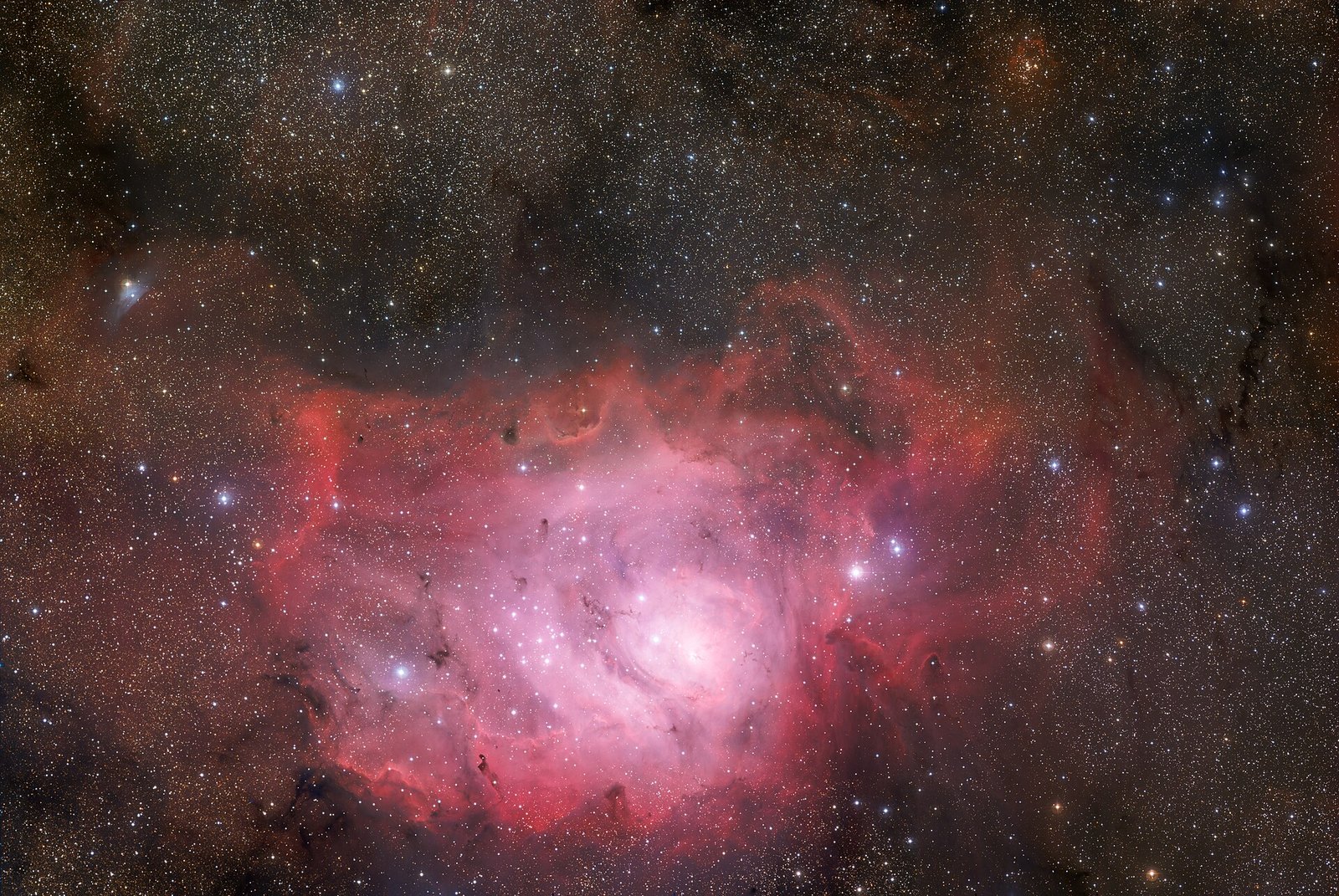
An emission nebula is a cloud of interstellar gas that glows by itself because hot young stars excite it with ultraviolet light. It consists of around 90 percent hydrogen, which shines mainly red at 656.3 nm (Wikipedia, in German: Emissionsnebel).
Most emission nebulae are birthplaces of new stars. This page shows how they differ from the other nebulae in space.
What is an emission nebula?
An emission nebula produces its own light. Very hot stars of spectral types O and B emit so much UV light that they strip the electrons from the atoms in the gas. When the atoms recapture them, they emit light at very specific wavelengths (Wikipedia, in German).
Because the light comes in only a few lines, the spectrum shows individual bright lines instead of a rainbow. That is the decisive difference from a reflection nebula, which only scatters a star’s light. And it is the reason why nebula filters work so well on emission nebulae.
H II regions, planetary nebulae, supernova remnants
“Emission nebula” is an umbrella term for three very different kinds of object. The largest group are H II regions, in which hydrogen is ionised and thousands of stars are forming right now (Wikipedia, in German: H-II-Gebiet). Then there are planetary nebulae and supernova remnants.
| Type | What makes it glow | Example |
|---|---|---|
| H II region | young, hot O and B stars | Orion Nebula M 42, Lagoon Nebula M 8 |
| Planetary nebula | hot core of a dying star | Ring Nebula M 57 |
| Supernova remnant | shock wave of a stellar explosion | Crab Nebula M 1, Veil Nebula |
Why do emission nebulae glow red?
The red comes from hydrogen, the brightest line of almost every emission nebula. It is called H-alpha and lies at 656.3 nm. If the exciting radiation is more energetic, oxygen and other elements glow as well – then green and blue tones are added (Wikipedia, in German).
The best-known emission nebulae and when to see them
The finest emission nebulae are spread over two seasons. In winter Orion with its great nebula stands high; in summer the Milky Way with Sagittarius and Cygnus arcs across the sky. Brightness and size figures come from the Wikipedia articles linked in each case.
| Nebula | Constellation | Brightness, size | Best time | With what? |
|---|---|---|---|---|
| ⭐ Best starting pointOrion Nebula M 42 | Orion | 3.7 mag, approx. 1° | Dec–Mar | naked eye, binocular, any telescope |
| Lagoon Nebula M 8 | Sagittarius | 6.0 mag, 90′ × 35′ | Jul–Aug, low in the south | binocular, telescope |
| Omega Nebula M 17 | Sagittarius | 6.0 mag, approx. 15′ | Jul–Aug | telescope, UHC helps |
| Eagle Nebula M 16 with the Pillars of Creation | Serpens | 6.0 mag | Jul–Aug | telescope + filter, pillars only in photos |
| North America Nebula NGC 7000 | Cygnus | 120′ × 100′ | Jul–Oct | binocular, dark sky, UHC |
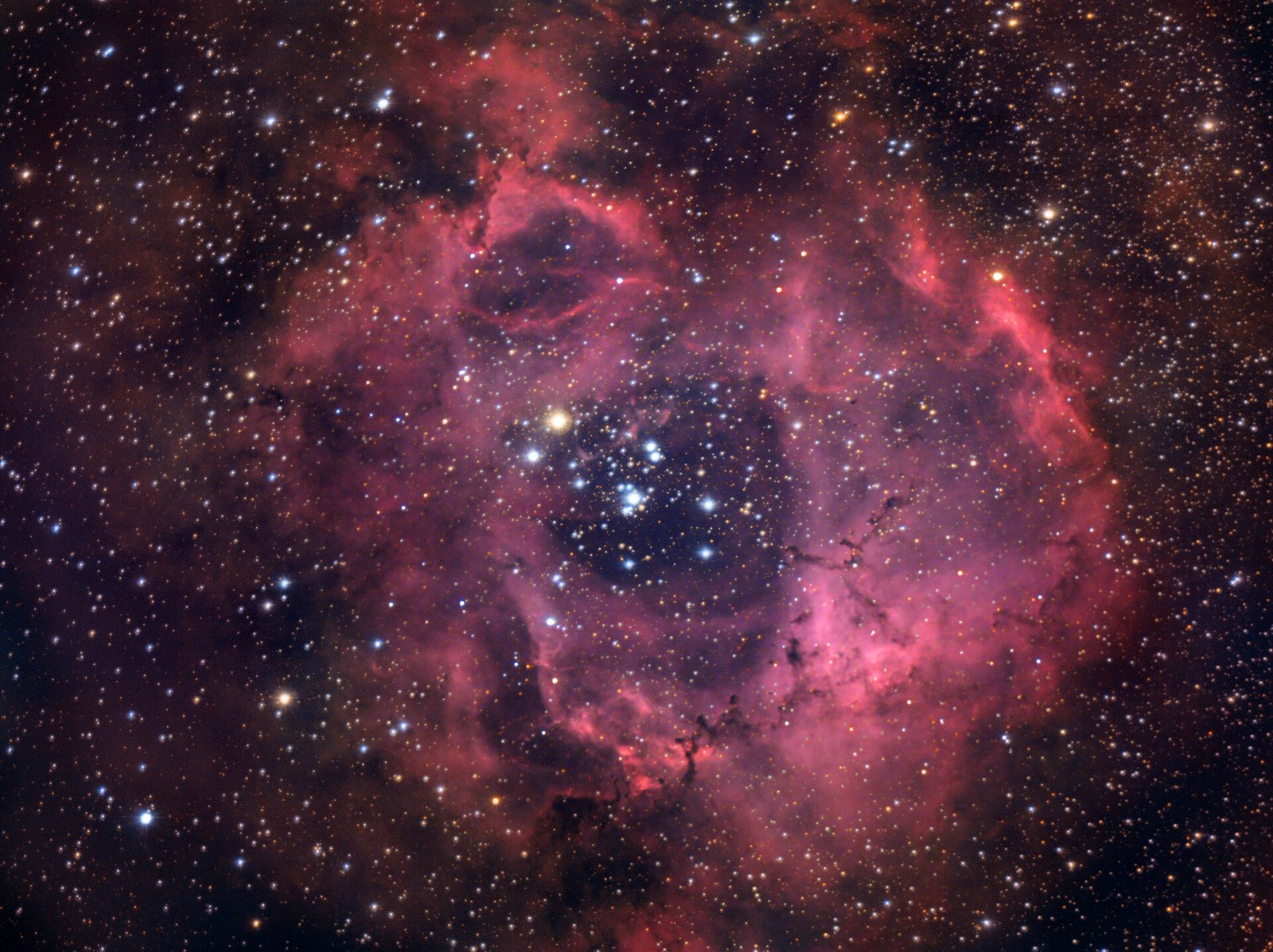
| Rosette Nebula NGC 2237 | Monoceros | 6.0 mag, 80′ × 60′ | Jan–Mar | binocular/short telescope + UHC |
| IC 1396 with the Elephant’s Trunk | Cepheus | 3.5 mag, 170′ × 140′ | Aug–Nov | mainly photo |
The Orion Nebula is the textbook example and has its own detailed page. There you can read how to find it and what each instrument shows: observing and photographing the Orion Nebula. It is around 1,350 light years away and the nearest large star-forming region.
In summer the Lagoon Nebula is the brightest target. At around 90 × 35 arcminutes it is about three times as long as the full moon is wide, and around 5,200 light years away (Wikipedia, in German: Lagunennebel). From Central Europe (around 50° N), however, it stands low – find a spot with a clear view to the south. From the southern US it climbs noticeably higher.
The North America Nebula is larger than the field of view of most telescopes. It measures 120 × 100 arcminutes, or around four full-moon widths (Wikipedia, in German: Nordamerikanebel). A binocular or a short-focal-length telescope with a filter shows the “coastline” best.
Observing emission nebulae: what you really see
In the eyepiece, emission nebulae are grey to slightly greenish, not red. The strong H-alpha red lies where the dark-adapted eye perceives almost nothing. A member of a German-language forum sums it up: what visual observers see is mainly the light around 500 nm (forum.astronomie.de, January 2022, in German).
For emission nebulae, aperture and a dark sky count – and here a filter really does help. Because the nebula glows in only a few lines, a nebula filter can darken the sky background without weakening the nebula. Our guide to light pollution helps you find out how brightened your sky is.
UHC, OIII or H-beta: the right nebula filter
| Filter | Passes | Typical targets |
|---|---|---|
| ⭐ First filterUHC | H-beta, OIII (and H-alpha) | Orion, Lagoon, Omega, Rosette, North America Nebula |
| OIII | oxygen only | Veil Nebula, planetary nebulae, parts of M 42 and M 8 |
| H-beta | hydrogen at 486 nm only | Horsehead background IC 434, California Nebula, Pacman Nebula |
To start with, the UHC is the most versatile filter. It suits almost all bright emission nebulae and is worthwhile even on smaller telescopes, as several observers in a German-language forum confirm (forum.astronomie.de, in German). OIII and H-beta are more specialised and pay off when you hunt specific objects.
A report from a 12-inch Dobsonian shows how much difference an H-beta filter can make. With it, the observer saw the Pacman Nebula NGC 281 directly at just 48× magnification (forum.astronomie.de, December 2023, in German). Without the right filter it often stays invisible under a suburban sky.
Filter for gas nebulae: Omegon Pro 1.25" UHC Filter
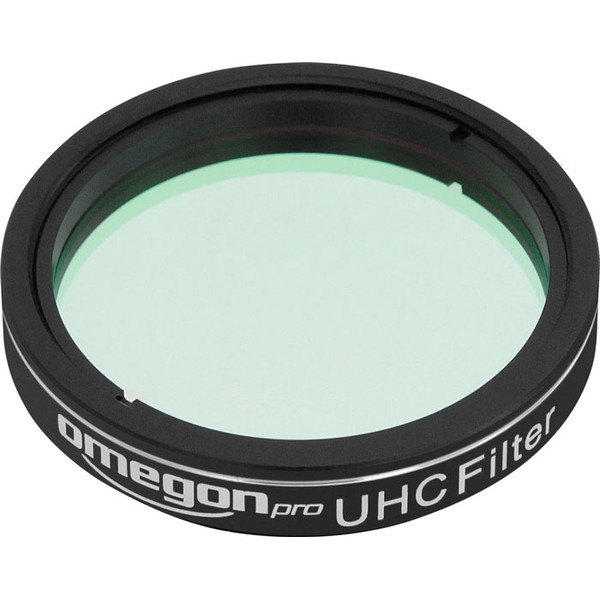
Affordable UHC filter in 1.25-inch format: lifts the Orion, Lagoon and Omega Nebulae visibly from the sky background. Not intended for galaxies and reflection nebulae.
Price: € 59
Which telescope for emission nebulae?
For the large emission nebulae, a fast telescope with a short focal length is ideal. It shows a wide field into which the Lagoon or Rosette Nebula fits completely. With more aperture, the faint outer regions come into view.
First telescope: Skywatcher Dobson Telescope N 130/650 Heritage FlexTube
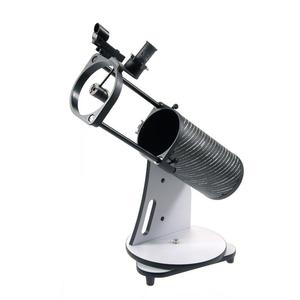
130 mm aperture with a short focal length: shows the Orion Nebula with its wings, the Lagoon Nebula with its dust lane and the Omega Nebula. With a UHC filter the Rosette Nebula is worthwhile too.
Price: € 265
Our recommendation: Skywatcher Dobson Telescope N 200/1200 Skyliner Classic
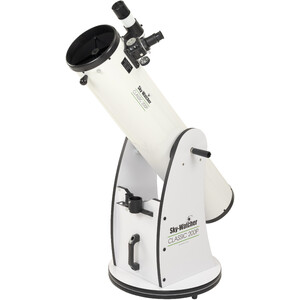
200 mm aperture: collects almost 2.4 times as much light as the 130. With a UHC or OIII filter, even large, delicate nebulae such as the Veil Nebula become a real experience.
Price: € 479
For advanced observers: Omegon Dobson Telescope Advanced X N 254/1250
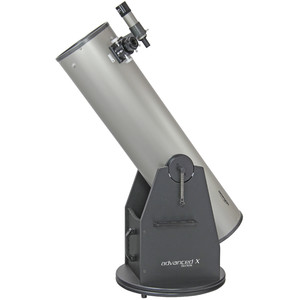
254 mm aperture for faint H II regions and nebulae with an H-beta filter. Only worthwhile if you regularly drive to a dark site.
Price: € 699
Photographing emission nebulae: tips
Emission nebulae are the easiest deep-sky targets for a camera. They are bright and large, and with filters you can capture them even from the city. A dual-band filter that passes only H-alpha and OIII blocks out much of the light pollution.
Smart telescopes often have such a filter built in already. ZWO explicitly recommends the Seestar’s built-in LP filter for emission nebulae and bright city skies (Seestar guide to the LP filter). For galaxies and reflection nebulae, on the other hand, you should switch it off.
Nebulae in colour, no experience needed: ZWO Seestar S50 Pro Smart Telescope
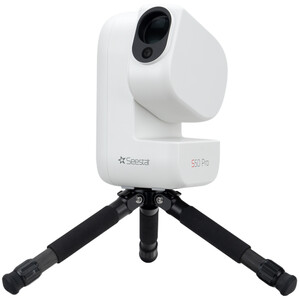
Smart telescope with 50 mm aperture and a built-in dual-band filter: shows the Orion, Lagoon or North America Nebula in colour on your phone after a few minutes. No view through an eyepiece possible.
Price: € 999
With your own camera, it is worth looking at its red sensitivity. Standard mirrorless and DSLR cameras pass only part of the H-alpha light; astro-modified cameras reach about three times the sensitivity there, as Canon stated for the 60Da (diglloyd.com). Our guides to astrophotography and deep-sky astrophotography show how to get started.
FAQ about emission nebulae
Why do emission nebulae glow?
Because hot young stars ionise the gas with ultraviolet light. When the atoms recapture their electrons, they release light at fixed wavelengths – above all the red of hydrogen.
Why does hydrogen glow red?
When an electron in a hydrogen atom drops from the third to the second shell, light at 656.3 nm is released: the H-alpha line. It is the brightest line of almost every emission nebula and lies in the red part of the spectrum (Wikipedia, in German: Balmer-Serie).
What is the difference between an emission and a reflection nebula?
An emission nebula glows by itself, usually red. A reflection nebula only scatters the light of a nearby star and therefore appears blue. Nebula filters only help with emission nebulae.
Can you see emission nebulae with the naked eye?
The Orion Nebula, yes, as a small smudge below Orion’s Belt. Under a very dark sky the Lagoon Nebula and the North America Nebula join it. The colours remain hidden from the eye.
Is the Orion Nebula an emission nebula?
Yes, mainly. It is an H II region in which stars are forming right now, but at its edges it also contains bluish reflection components. Everything about observing it is on our Orion Nebula page.
* Affiliate link: if you buy through this link we may earn a small commission from Astroshop, High Point Scientific or another linked retailer, at no extra cost to you.