By Alexander Merz · Updated on
A microscope is an optical instrument that uses lenses to magnify tiny objects roughly 10 to 1000 times – from an insect’s leg all the way down to a single cell.
A decent beginner model sits in the upper budget price range, not the bargain bin. When you buy, optics and mechanics matter – not the number printed on the box.
🔬 All our microscope guides at a glance
What is a microscope – and how does it work?
The classic instrument for home use is the light microscope: it works with visible light and two lens systems. The objective – the lens right above the specimen – creates a magnified intermediate image, and the eyepiece – the lens at your eye – magnifies that image once more, like a magnifying glass.
That’s why total magnification is simply objective magnification times eyepiece magnification. A 40x objective with a 10x eyepiece gives you 400x.
Electron microscopes, which can show viruses and molecules, cost as much as a house and live in research labs. For hobby, school and family use, it’s always about light microscopes – in three types.
Which type of microscope do you need?
The most important question before you buy isn’t “how powerful?” but “what do you want to look at?”. That decides whether you need a compound, a stereo or a digital microscope.
| Type | Useful magnification | Ideal for | Limitations |
|---|---|---|---|
| Compound microscope | 40x to 400x, 1000x with oil | Cells, protozoa, algae, blood, pollen, bacteria (with oil) | Specimens must be paper-thin; image is upside down |
| Stereo microscope | 10x to 40x, zoom up to about 80x | Insects, rocks, coins, flowers, electronics – no prep needed | No cells, no detail on protozoa |
| Digital/USB microscope | really about 20x to 200x | Viewing surfaces together on a screen, photos, solder joints | Usually only about 2 MP real resolution, wobbly stands |
Compound microscope: the light microscope for cells
In a compound microscope, the lamp shines up from below through the specimen. That only works with thin, translucent objects such as a piece of onion skin or a drop of pond water on a glass slide.
If you want to hunt paramecia or see cell nuclei, there’s no way around it. Our guide what to look at under the microscope shows you how to make your first slides. In microscopy forums, this type is the clear recommendation for adults, because hunting protozoa is the most popular part of the hobby.
Stereo microscope: a 3D view with no slide prep
A stereo microscope lights the object from above and uses two separate light paths to show a three-dimensional, correctly oriented image. You simply put down whatever you’ve found and see it right away.
For younger kids it’s often the better first choice, as we explain in our guide to the best microscope for kids. Many families end up with both: stereo for their finds, compound for pond water.
Stereo with top and bottom light: Omegon StereoView stereo microscope, 20x–80x (incident and transmitted light)
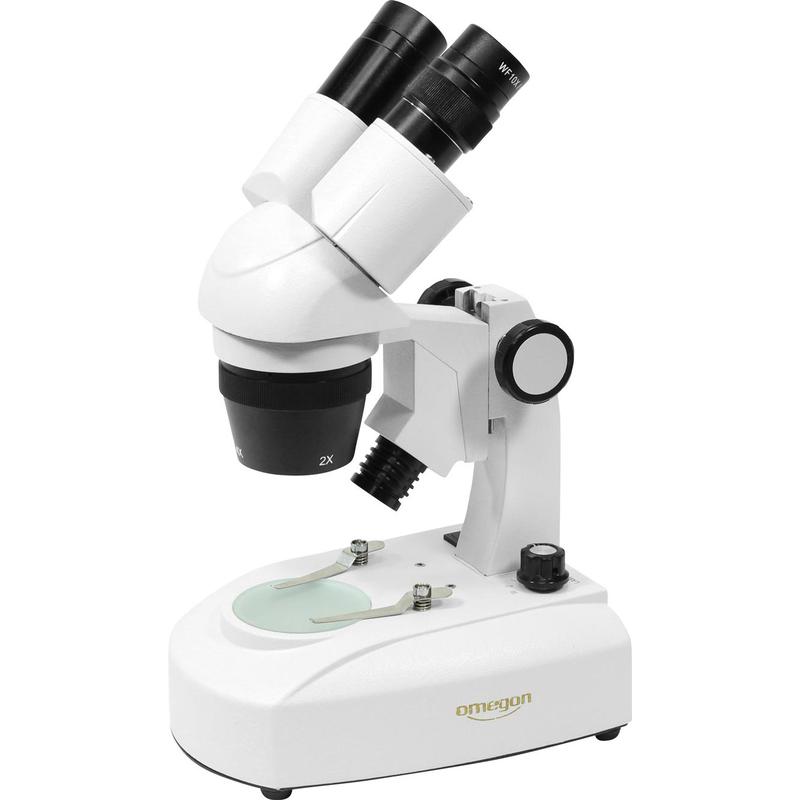
Two pairs of eyepieces for 20x and 80x, light from above and below in three levels, runs on mains power or batteries. Ideal for insects, rocks and flowers – by design, it won't show you cells.
Price: € 259
Digital microscope: a camera instead of an eyepiece
USB and handheld microscopes are basically top-lit magnifier cameras with about 20x to 200x real magnification. Claims like “1000x” usually refer to how big the picture looks on a large monitor.
They’re handy for coins, stamps and circuit boards, but not for cells. How to find a decent model or upgrade your light microscope with an eyepiece camera or your phone is covered in our digital microscope guide. A phone held to the eyepiece often takes better pictures than a cheap USB device.
Buying a microscope: what to look for
You can tell whether a microscope is good by just a few features. If one of them is missing, microscopy quickly becomes a test of patience. The list applies to compound microscopes, the instruments for cells and protozoa.
| Feature | What to look for | Why |
|---|---|---|
| Objectives | Achromats 4x, 10x, 40x with the NA printed on them | Sharp image without heavy color fringes |
| Fine focus | Separate coarse and fine focus knobs | Otherwise nearly impossible to focus at 400x and up |
| Condenser | With iris diaphragm, ideally height-adjustable | Contrast on unstained specimens |
| Mechanical stage | Moves the slide with control knobs | Above 200x you’ll never find anything again otherwise |
| Illumination | LED, continuously dimmable | Less light brings more contrast |
| Viewing head | Mono, bino or trino | Bino is less tiring, trino for a camera |
| Eyepiece | 10x, at most 12.5x | Stronger eyepieces only magnify blur |
| Stand | Metal, at least about 30 cm (12 in) tall | Stable and low on vibration |
Objectives: achromats with the NA printed on them
Achromats are objectives made of several lenses that correct color errors – toy microscopes, by contrast, often use single lenses with colorful fringes. A good objective carries numbers like “40/0.65 160/0.17”: magnification, numerical aperture, tube length in millimeters and cover glass thickness.
The numerical aperture (NA) describes how much light the objective gathers and therefore how fine the details are that it can separate at all. If there’s no NA printed on the objective, that’s a clear warning sign.
Mechanics: fine focus, mechanical stage, metal stand
At 400x the depth of field is razor-thin, and even a fraction of a turn on the coarse focus knob overshoots the target. Experienced microscopists advise against buying a microscope without fine focus.
A mechanical stage holds the slide in place and moves it in two directions with control knobs. Up to about 200x you can slide it by hand, but above that a darting paramecium is gone from view in an instant.
Light: condenser, iris diaphragm, dimmable LED
The condenser is a converging lens under the stage that focuses the light onto the specimen. Its iris diaphragm lets you control contrast: unstained cells only become visible once you close the diaphragm a little.
A continuously dimmable LED is the most convenient option for beginners. Some purists swear by a mirror and an external lamp, so on older used microscopes a mirror is no deal-breaker.
Binocular microscope: viewing with both eyes
A binocular microscope has two eyepieces, so you can look through it comfortably with both eyes. For sessions longer than half an hour, that’s a real gain in comfort. A trinocular adds a third port for a camera.
The downside: bino costs more, and you have to set the eye distance and diopter once. Some beginners need a few evenings before both images merge into one.
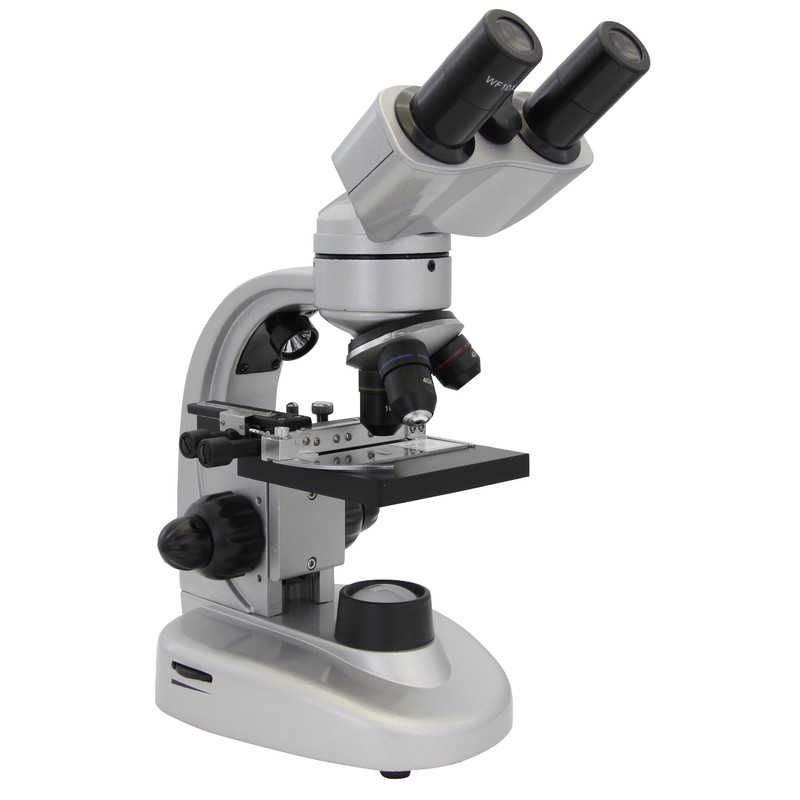
Affordable bino: Omegon Binofield microscope, 40x–800x (LED)
One of the most affordable true binocular microscopes: mechanical stage, coarse and fine focus and a filter wheel with five colors. The 800x on the spec sheet is empty magnification with a 40x objective – you'll get sharp, useful views up to about 400x.
Price: € 149
The truth about microscope magnification
What magnification should a microscope have? For cells and protozoa, 40x to 400x is plenty; for bacteria you need 1000x with oil immersion. No light microscope can do more than that.
The rule of thumb in microscopy is: useful magnification is 500 to 1000 times the numerical aperture of the objective. Anything beyond that is called empty magnification – the image gets bigger but shows no new details, only more blur.
| Objective | Typical NA | Useful maximum magnification | What you’ll see |
|---|---|---|---|
| 4× | 0.10 | approx. 100x | Overview: water fleas, pollen as tiny grains, rows of cells in onion skin |
| 10× | 0.25 | approx. 250x | Cell walls, paramecia with their shape, algal filaments, tardigrades |
| 40× | 0.65 | approx. 650x | Stained cell nuclei, chloroplasts, cytoplasmic streaming, individual yeast cells |
| 100× oil | 1.25 | approx. 1250x | Bacteria as dots and rods – only with immersion oil and staining |
The bottom line: true 1000x is only possible with a 100x oil objective, where a drop of immersion oil goes between the objective and the cover glass. It’s fiddly, and even advanced hobbyists use it fairly rarely.
How much does a microscope cost? Price classes at a glance
Prices range from pocket money to well into four figures. The key threshold is the upper end of the entry-level class: below that, fine focus, a mechanical stage or usable objectives are almost always missing.
| Price class | Example | What you get | Price |
|---|---|---|---|
| Toy, bargain price | Omegon MonoView microscopy set, 1200x | A first taste for kids; simple optics, “1200x” is empty magnification | € 29.90 |
| Entry level | Omegon VisioStar microscope, 40x–400x (LED) | Top and bottom light up to 400x, five prepared slides included | € 99 |
| Entry level | Omegon Nabla I Mono microscope (up to 400x) | ⭐ Our pickUp to 400x, mechanical stage, coarse and fine focus – honestly limited to the sharp range | € 149 |
| Entry-level bino | Omegon Binofield microscope, 40x–800x (LED) | View with both eyes, mechanical stage, filter wheel | € 149 |
| Solid mid-range | Omegon Nabla II Mono microscope (up to 1000x) | Up to 1000x with oil, Abbe condenser, mechanical stage with vernier scale | € 249 |
| Workhorse microscope, upper class | Omegon Nabla III Bino microscope (Köhler) | Bino, DIN achromats up to 100x oil, Köhler illumination, coaxial mechanical stage | € 489 |
What is a good microscope for beginners?
Our assessment is based on spec sheets and experience shared in microscopy forums – we haven’t tested these models ourselves. For most beginners, a monocular model up to 400x with fine focus and a mechanical stage is the right fit.
Our pick: Omegon Nabla I Mono microscope (up to 400x)
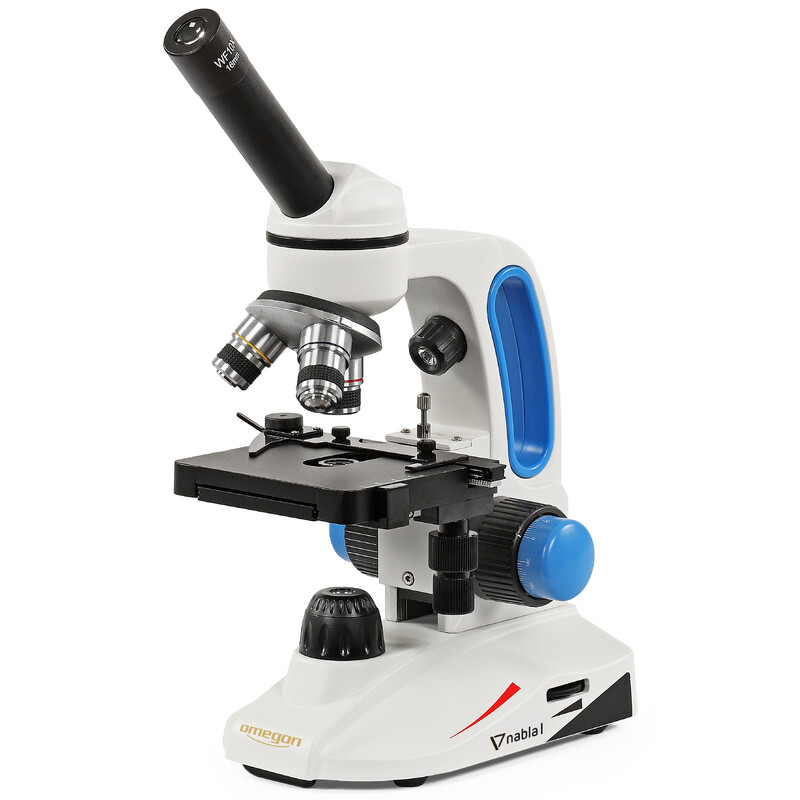
Current beginner model up to 400x with a mechanical stage plus coarse and fine focus. It doesn't promise fantasy magnification – it covers exactly the range in which cells, pollen and protozoa look sharp. For bacteria, it lacks an oil objective.
Price: € 149
If you know you’ll stick with it and want to look at bacteria later on, you’re better off with a model that has an Abbe condenser and a 100x oil objective. An Abbe condenser is a two-lens condenser that delivers enough light for high magnifications.
Solid mid-range: Omegon Nabla II Mono microscope (up to 1000x)
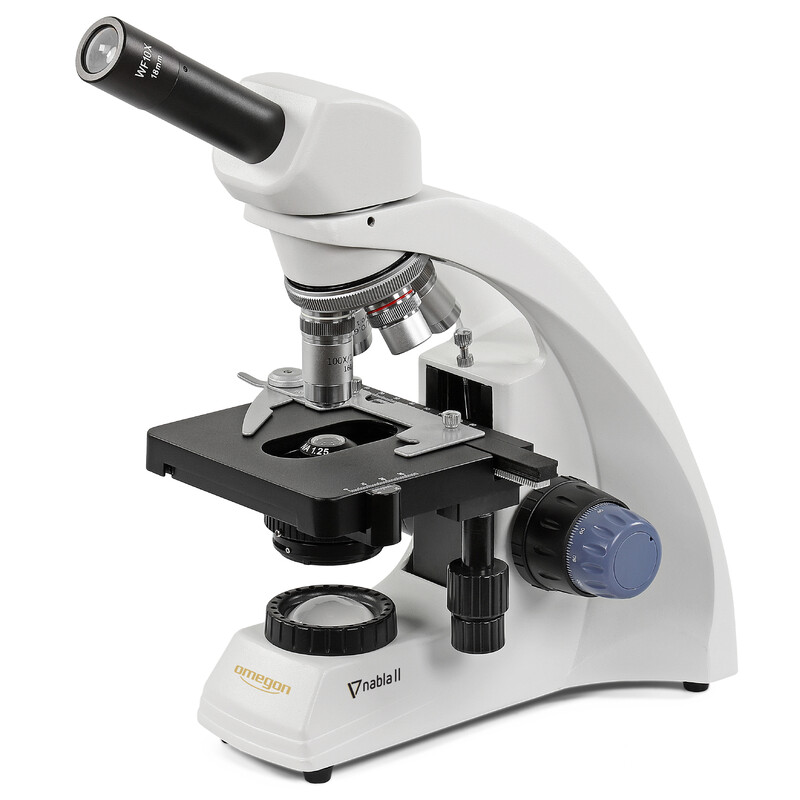
Up to 1000x with oil immersion, Abbe condenser, LED and a mechanical stage with a vernier scale that helps you find spots again. Only one eyepiece – more tiring than bino during long sessions.
Price: € 249
For advanced users: the Omegon Nabla III Bino
The Nabla III is the first instrument on this list that deserves to be called a true working microscope. It has DIN achromats up to a 100x oil objective, an Abbe condenser with NA 1.25 and Köhler illumination – which lets you set up the light so the image is evenly bright and full of contrast. On top of that come a binocular head and a large coaxial mechanical stage.
The extra cost pays off if you use a microscope regularly and for hours at a time, or want to see bacteria and fine cell structures. For the occasional onion-skin evening, a beginner model is perfectly fine.
For advanced users: Omegon Nabla III Bino microscope (Köhler)
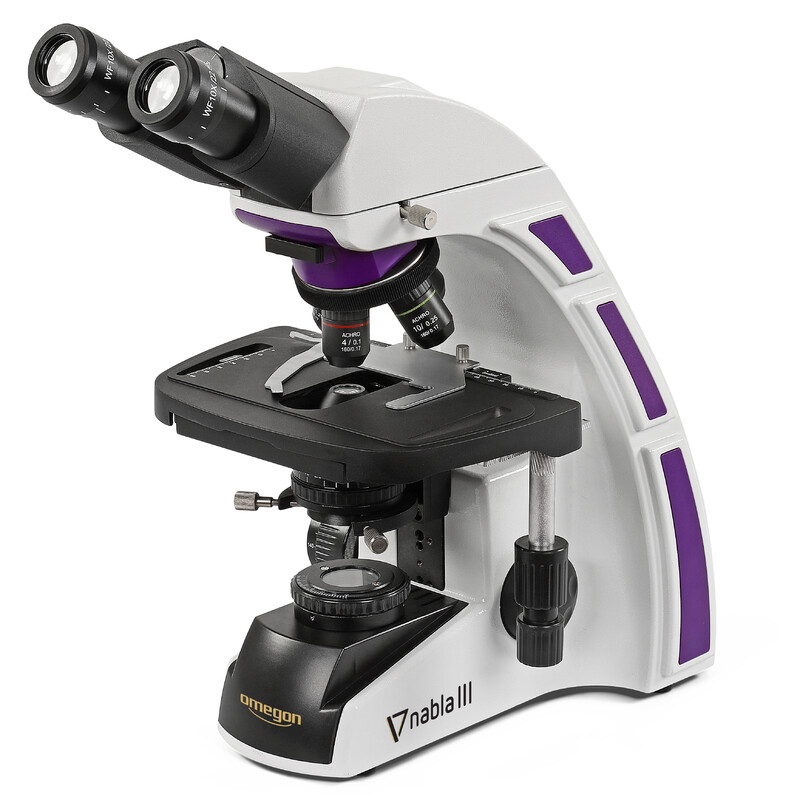
Binocular working microscope with Köhler illumination, DIN achromats 4/10/40/100 oil, Abbe condenser NA 1.25, coaxial mechanical stage and filter wheel. The next step for anyone who wants to take the hobby further.
Price: € 489
How to spot a toy: the warning signs
Lots of cheap sets look like real microscopes and come in a case packed with accessories. After a few evenings they often end up in the closet, because at higher magnification all you see is a dark mush.
- it’s advertised with 1200x or more but has no 100x oil objective,
- the objectives show no NA and don’t say “achromat”,
- there’s no fine focus and no mechanical stage,
- the stand is plastic and well under 30 cm (12 in) tall,
- it comes with 16x, 20x or even stronger eyepieces,
- the price including case and chemistry kit is in bargain-bin territory.
For a six-year-old who just wants to try it out for a few weeks, a set like that may still do. But a simple stereo microscope is usually the more honest choice, since it delivers instant wins without any slide prep.
Bresser, Zeiss, Leica: which brands are out there?
Microscope brands fall roughly into two worlds. Zeiss, Leica and Olympus (now Evident) build lab and research instruments that cost several thousand when new.
| Brand | Positioning | Good for hobby use? |
|---|---|---|
| Zeiss | Lab and research, very expensive new | Used, yes – older horseshoe stands are sought after |
| Leica / Leitz | Lab and medicine, very expensive new | Used, yes – old Leitz instruments are known to be robust |
| Olympus / Evident | Lab and clinic | Used, yes – spare parts are easy to find |
| Bresser | Hobby, school, kids – wide range | Yes, from kids’ sets to working microscopes |
| Omegon | Hobby and entry level, Astroshop’s house brand | Yes, clearly tiered beginner lines |
| National Geographic | Kids and beginners | For kids; read magnification claims critically |
Bresser, Omegon and National Geographic are the typical hobby brands. Quality varies a lot within a single brand, so always check the features rather than the logo.
New or used: are used microscopes worth it?
Yes – more so than with almost any other hobby instrument. A used brand-name microscope from Zeiss, Leitz or Olympus is a real alternative to a new beginner model, because the optics of these lab instruments barely age.
Classic horseshoe stands with DIN objectives, which use a 160 mm tube length, are especially popular. Because it’s an old standard, objectives and eyepieces from many manufacturers fit and are easy to add later.
- Hold the objectives up to the light: haze, fungus or separated cement layers (delamination, a known issue with old optics) make them useless.
- Turn the coarse and fine focus knobs all the way: they must run smoothly and must not drift down on their own.
- Check that it’s complete: condenser, iris diaphragm, mechanical stage and illumination.
- Avoid non-standard threads and special tube lengths so you can find replacements.
- Ideally inspect it in person or buy from dealers who accept returns.
The downside: you need some know-how or an experienced friend, or you might end up with an instrument that’s missing parts. If you don’t want to deal with that, a new beginner microscope with a warranty is the more relaxed option.
Microscope accessories you actually need
Many sets include accessories you’ll never use while the basics are missing. There are three things you really need: prepared slides, blank slides with cover glasses and a small dissecting kit.
| Accessory | What for | Example | Price |
|---|---|---|---|
| Prepared slides | Instantly sharp images, ideal for practice | Omegon prepared slide set, 40 pieces (wooden box) | € 69 |
| Slides + cover glasses | For your own specimens from onion, water, pollen | Bresser slide and cover slip pack | € 15.90 |
| Dissecting kit | Tweezers, needle and scalpel for preparing specimens | Omegon microscopy dissecting kit, 7 pieces | € 29.90 |
| Experiment kit | Stains and small parts for your first experiments | Omegon microscopy experiment kit | € 19.90 |
| Eyepiece camera | Images on your computer if you want to take photos | Bresser MikrOkular Full HD eyepiece camera | € 67.90 |
Success from day one: Omegon prepared slide set, 40 pieces (wooden box)
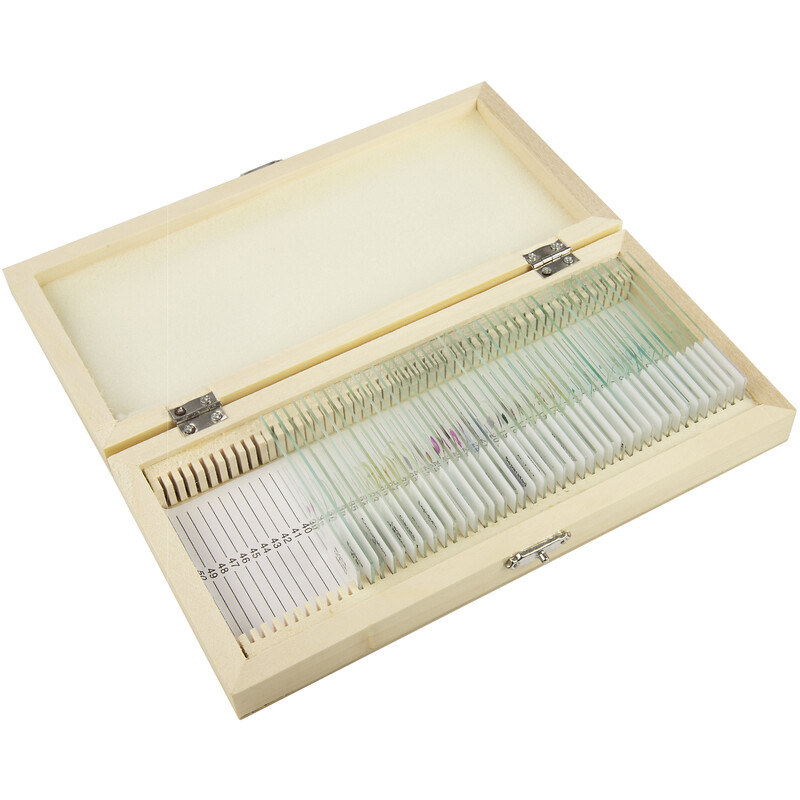
40 ready-made prepared slides in a wooden box: practice focusing and adjusting the diaphragm before you make your own slides. A great start especially for kids, because there's something to see right away.
Price: € 69
You can buy individual eyepieces later: microscope eyepieces usually have a 23.2 mm barrel and don’t fit telescopes, whose eyepieces we explain in our guide to telescope eyepieces. Which specimens are good for getting started is covered in our guide what to look at under the microscope.
Microscope experiences: what often frustrates beginners
The same beginner problems keep coming up in microscopy forums. Most of them come down to handling, not to the instrument.
| Problem | Common cause | Solution |
|---|---|---|
| Can’t find anything | Started at high magnification | Always start with the 4x objective, then switch up |
| Cracked cover glass | Coarse focus with the 40x objective | Approach from the side; at 400x use only fine focus |
| Cells invisible | Too much light, diaphragm wide open | Close the iris diaphragm, dim the LED |
| Just a colorful blur | Specimen too thick | Peel it paper-thin, e.g. the inner onion membrane |
| Image dark and mushy | Empty magnification with a strong eyepiece | Use a 10x eyepiece, turn magnification back down |
We explain the complete setup routine step by step in our guide to using a microscope. With a bit of practice, you’ll have it down after a few evenings.
Frequently asked questions about buying a microscope
How much does a good microscope cost?
A usable beginner compound microscope with fine focus and a mechanical stage sits at the upper end of the entry-level price class. Solid models with an oil objective cost roughly twice as much, and a binocular working microscope about three to four times as much. Used brand-name instruments can be an affordable alternative.
Can you see viruses under a microscope?
No, not with a light microscope. Viruses measure about 15 to 400 nanometers, while the resolution limit of a light microscope is around 0.2 micrometers. For that you need an electron microscope.
What magnification do you need to see bacteria?
Bacteria are about 0.3 to 1 micrometer in size, which puts them close to the limit of a light microscope. Realistically you’ll only see them at 1000x with a 100x oil objective, ideally stained. At 400x they show up as tiny dots at most.
Is a microscope with 1000x magnification worth it?
Only if it comes with a real 100x oil objective with an NA of around 1.25 and an Abbe condenser. On cheap models, 1000x is often achieved with a strong eyepiece – that’s empty magnification. For cells and protozoa, 400x is all you need.
Which microscope is right for kids?
For kids up to about eight, a 20x stereo microscope is usually the better choice because it works without slide prep. From about ten, a compound microscope up to 400x is worth it. You’ll find the details in our guide to microscopes for kids.
Who invented the microscope?
The Dutch spectacle makers Hans and Zacharias Janssen are credited with inventing the compound microscope around 1590. Antoni van Leeuwenhoek became famous from the 1670s onward as the first person to describe bacteria and protozoa, using single-lens microscopes he built himself.
Mono or bino – which is better?
Bino is more comfortable because you look with both eyes and tire less. But it costs more and has to be adjusted for eye distance and diopter. Mono is enough for occasional use; if you spend many hours at the microscope, go for bino.
Keep reading: Microscope for kids · What to look at under the microscope · Stereo microscope · Digital microscope
Links marked with an asterisk (*) are affiliate links. If you buy through them, we earn a small commission – the price stays the same for you.