By Alexander Merz · Updated on
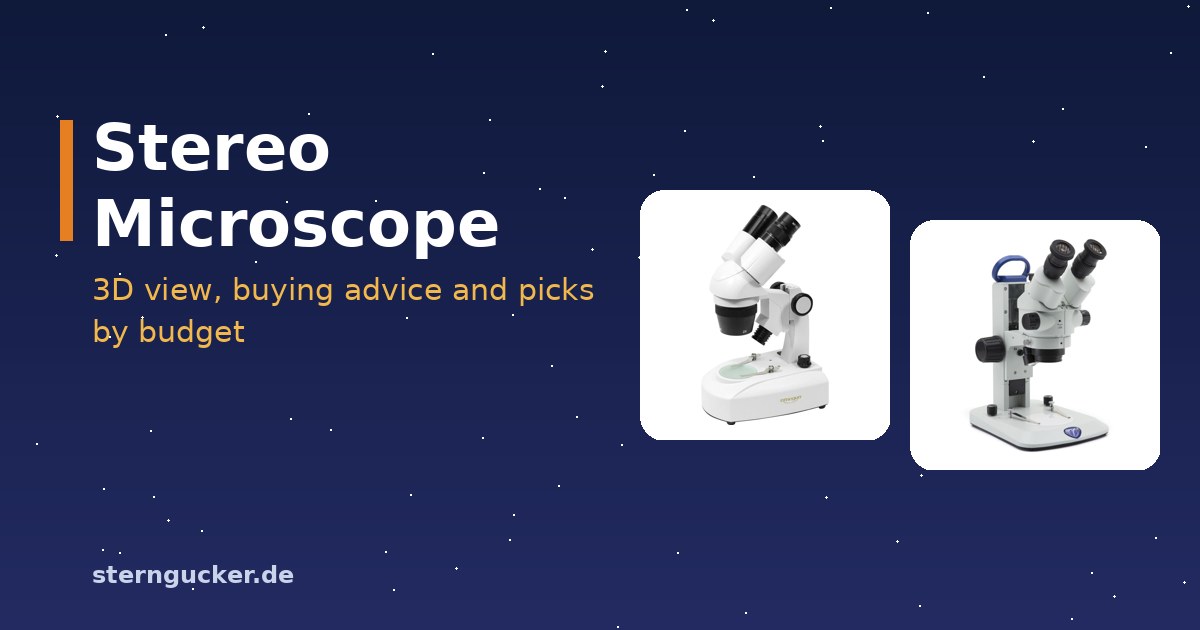
A stereo microscope is a microscope with two separate light paths that usually magnifies objects 10x to 80x while showing them upright, correctly oriented and in three dimensions. Thanks to the long working distance and top lighting, you simply put beetles, rocks or circuit boards underneath – no slide prep needed.
It’s also called a dissecting microscope or simply a stereo scope.
What is a stereo microscope?
A stereo microscope works like two small microscopes side by side, looking at the same object from slightly different angles. Your brain combines the two images into a three-dimensional impression – just like normal vision.
Typical are magnifications between 10x and 80x, usually 7x to 45x on zoom models. On top of that comes a long working distance – the free space between objective and object – often 50 to 100 mm (2 to 4 in).
The light usually comes from above, as top lighting for opaque objects. The image isn’t upside down, so you can work under the eyepiece with tweezers, a needle or a soldering iron without having to think in reverse.
Binocular microscope or stereo microscope: the difference
People searching for a “binocular microscope” or a “microscope for both eyes” often mean two different instruments. Two eyepieces alone don’t make 3D: in a binocular compound microscope, a prism splits the image of a single objective between both eyes.
So both eyes see exactly the same flat image – more comfortable than with one eye, but not three-dimensional. In a stereo microscope based on the Greenough design, each eye has its own slightly angled objective.
The table sums up which instrument is meant for which objects. The prices are rough ranges for decent new instruments.
| Stereo microscope | Binocular compound microscope | |
|---|---|---|
| Magnification | usually 10x to 80x | usually 40x to 400x, up to 1000x with oil |
| Image | upright, correctly oriented, 3D | flat, usually upside down and reversed |
| Slide prep needed? | no, place the object directly underneath | yes, paper-thin on a glass slide |
| Light | mostly top light, often bottom light too | transmitted light from below |
| Typical objects | Insects, rocks, flowers, coins, circuit boards | Cells, protozoa, pollen, blood, water fleas |
| Price | kids: budget class; hobby: mid-range to upper class | usable from the upper budget class |
Are you actually looking for a compound microscope with two eyepieces for cells and pond water? Then check out our microscope buying guide – there, the Omegon Binofield is the most affordable sensible way into binocular viewing.
And the binocular viewer for telescopes?
The term also comes up in astronomy, but there it means something completely different. A binocular viewer is an accessory that lets you look through a telescope with both eyes at the Moon and planets. It has nothing to do with microscopes.
Reflected-light microscope: dermatologist or hobby?
If you search for a “reflected-light microscope”, you’ll often end up at the dermatologist. There the term usually means the dermatoscope, an illuminated magnifier with about 10x magnification that doctors use to examine moles.
In the hobby, reflected light simply means: the light falls on the object from above and bounces back off its surface. That lets you see the colors and structures of things light can’t pass through – rocks, coins, beetle shells, solder joints.
That’s why practically every stereo microscope is also a reflected-light microscope. Many models also have a lamp in the base, but bottom light is only worth it for thin objects like leaves, insect wings or water samples in a dish.
What a stereo microscope is ideal for
The strength of a stereo microscope is instant observation with no prep. You find something in the yard, put it on the stage and look.
| Object | What you’ll see | Magnification |
|---|---|---|
| 🐞 Insects | Compound eyes, hairs, mouthparts, wing veins | 10x to 40x |
| 💎 Rocks and minerals | Crystal faces, inclusions, sparkle in sand | 10x to 30x |
| Plants | Pollen on stamens, leaf hairs, moss | 10x to 40x |
| Coins and stamps | Minting errors, printing patterns, watermark edges | 10x to 20x |
| Electronics and soldering | Solder joints, SMD components, hairline cracks in traces | 7x to 20x |
| Watches | Gears, jewel bearings, balance wheel and hairspring | 10x to 20x |
| Model building | Painting miniatures, small parts, seams | 7x to 15x |
| Dissecting | Taking apart flowers, insects or owl pellets | 10x to 20x |
When working, you’ll mostly use the low settings between 10x and 20x. Higher settings are nice for viewing but leave less depth of field and less room for your hands.
Designs: the types of stereo microscopes
Fixed magnification or zoom stereo microscope
Total magnification is eyepiece times objective: a 10x eyepiece with a 2x objective gives you 20x. Affordable models have fixed settings that you switch using interchangeable eyepieces, a rotating pair of objectives or a nosepiece.
A zoom stereo microscope, by contrast, changes magnification continuously with a control knob, typically 0.7x to 4.5x in the zoom body – so 7x to 45x with 10x eyepieces.
| Fixed settings | Zoom | |
|---|---|---|
| Magnification | 1 to 3 settings, e.g. 10x/20x/40x | continuous, usually 7x to 45x |
| Operation | Swap eyepiece or objective | Control knob, object stays in view |
| Price | from the budget class | from the upper price class |
| Good for | Kids, nature finds, collectors | Soldering, watches, dissecting, photography |
Head: mono, bino or trino
A true stereo microscope always has two eyepieces, meaning a binocular head. Instruments with only one eyepiece are magnifier microscopes without a 3D effect.
A trinocular head adds a third tube pointing up, where you can mount a camera permanently. That’s worth it if you take photos regularly or want to show images on a screen.
Stand: pillar, rack or boom arm
On beginner models, the head sits on a pillar or rack-and-pinion stand above a base plate. That’s enough for anything that fits on the table.
An articulated or boom arm clamps to the edge of the table and swings the head freely over large workpieces like circuit boards or models. That’s workshop gear and not necessary for getting started.
Illumination: top light, bottom light, ring light
The built-in top-light LED usually sits at an angle on the head and casts harsh shadows on uneven objects. With beetles and rocks, parts then disappear into darkness.
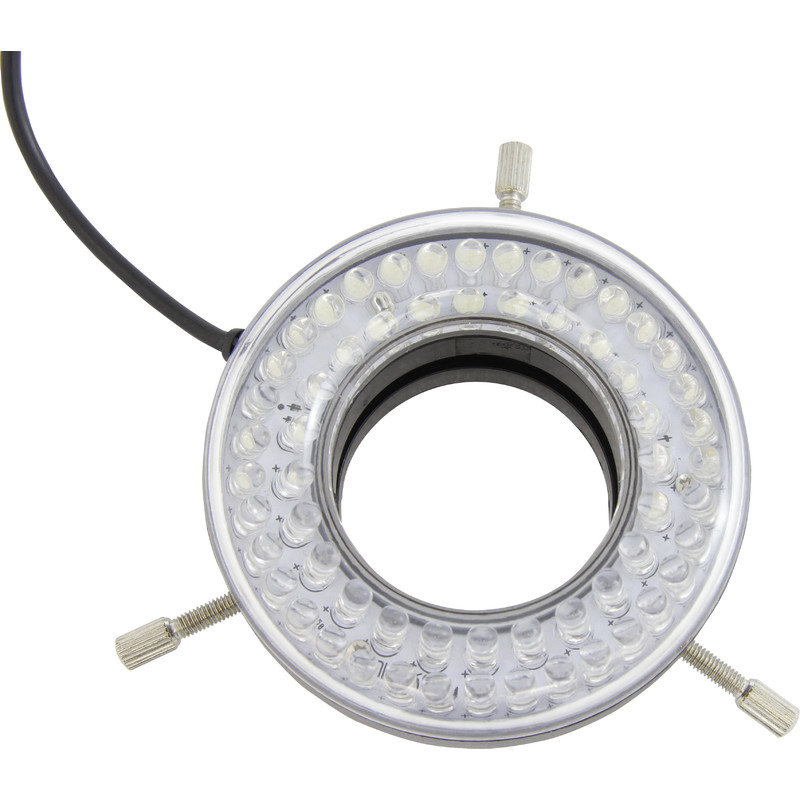
An LED ring light slips onto the bottom of the objective and lights all around. On many instruments, the Omegon LED ring light makes more of a difference than paying extra for a higher class, but check the diameter of the objective mount before you buy.
Working distance: why 60 to 100 mm matters so much
Working distance is the free space between objective and object when the image is in focus. With the 40x objective of a compound microscope, that’s often less than a millimeter.
With a stereo microscope it’s usually 50 to 100 mm. Only from about 60 mm (2.4 in) do tweezers, a needle or a soldering iron fit comfortably in between without your hand blocking the light or bumping into the objective.
Stereo microscope magnification: how much makes sense?
With a stereo microscope, more magnification means less depth of field and a smaller field of view. At 40x, often only a beetle’s eye is sharp; at 10x, the whole animal is.
For most objects, 10x to 40x is plenty. Auxiliary lenses shift the range: a 0.5x auxiliary lens halves the magnification and significantly increases the working distance.
Buying a stereo microscope: the checklist
When buying, the numbers on the box matter less than mechanics, adjustability and light. Check these points before you order.
| Criterion | What to look for |
|---|---|
| Eye distance | adjustable, ideal range 55–75 mm – otherwise kids or adults won’t see a single merged image |
| Diopter adjustment | on at least one eyepiece, so both eyes see sharply |
| Working distance | at least 50 mm; for working with tools, 60–100 mm |
| Illumination | LED, ideally dimmable; bottom light only if you want to look at thin objects |
| Eyepieces | wide-field eyepieces (WF10x) with a large field of view, eyecups for eyeglass wearers |
| Stand | metal, stable, focus without play |
| Spare parts | eyepieces, auxiliary lenses and lamps available later – more likely with brand-name manufacturers |
Useful stereo microscope accessories
The most important accessory is good light, meaning a ring light. After that come extra eyepieces, an auxiliary lens for more working distance, a dust cover, and tweezers and a dissecting needle.
Stereo microscope for kids
For preschool and elementary school kids, a stereo microscope is often the better first choice than a compound microscope. It needs no slide prep, the image is the right way up, and the beetle from the yard is under the objective in seconds.
Manufacturers often list 20x models from about age 4 to 5. An adjustable eye distance is important, because children’s eyes are closer together than adults’.
For kids: Bresser Junior binocular microscope, 20X
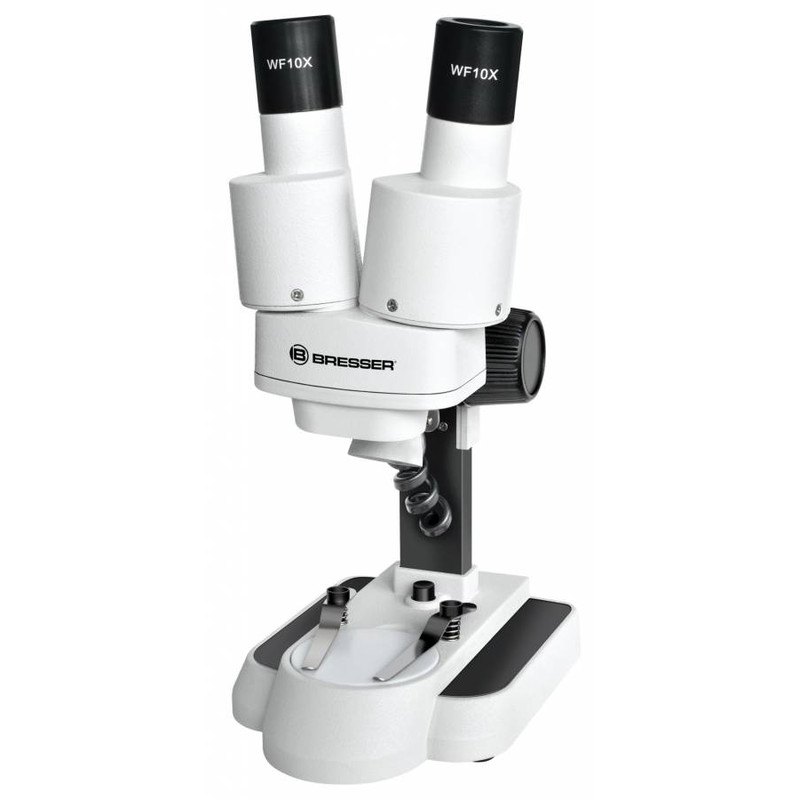
Rugged 20x stereo microscope with top-light LED, built for small hands. Leaves, feathers and beetles appear in 3D right away – it's not designed for cells.
Price: € 79.90
The Bresser Junior Incident and transmitted light microscope, 50X offers bottom light as well and up to 50x for slightly older kids. The Omegon StereoView stereo microscope, 20x (LED) is the most affordable alternative with two eyepieces and a battery-powered LED.
Which instrument suits which age and when a compound microscope makes sense is explained in our guide to the microscope for kids. Many families end up with both: stereo for nature finds, compound for pond water.
Our stereo microscopes by budget
We haven’t tested these instruments ourselves. Our selection is based on spec sheets and experience shared in microscopy forums, and prices are updated daily from the shop.
| Budget | Model | Key specs | Why this one | Price |
|---|---|---|---|---|
| Budget | Omegon StereoView stereo microscope, 20x (LED) | 20x, bino, battery LED | The most affordable way into true 3D – for nature finds and your desk. | € 59 |
| Budget | Bresser Junior binocular microscope, 20X | 20x, top-light LED | Rugged and simple – made for elementary school kids. | € 79.90 |
| Budget | Bresser Junior Incident and transmitted light microscope, 50X | up to 50x, top and bottom light | Kids’ model with a second light source for leaves and wings. | € 89.90 |
| Mid-range | Omegon StereoView stereo microscope, 20x–80x (incident and transmitted light) | 20x and 80x, top and bottom light, mains or battery | ⭐ Our pickTwo magnifications, two light sources, usable outdoors on battery power – the all-rounder for families and hobbyists. | € 259 |
| Mid-range | Novex AP-8 LED stereo microscope (binocular) | WF10x eyepieces, 45° viewing angle, eye distance 55–75 mm | School and workshop instrument with diopter adjustment, built for years of use. | € 283 |
| Upper mid-range | Optika SFX-91 stereo microscope (10x/20x/40x) | 10x/20x/40x, top and bottom light, 60 mm working distance | Three settings and enough room for dissecting. | € 368 |
| Premium | Euromex StereoBlue SB.1902-P zoom stereo microscope | Zoom approx. 7x to 45x, pillar stand | Continuous zoom with solid Euromex mechanics. | € 559 |
| Premium | Optika SLX-3 zoom stereo microscope (7x–45x, trinocular) | Zoom 7x to 45x, trino, 100 mm working distance | Zoom, plenty of room and a camera port – for soldering, watches and photos. | € 588 |
Links marked with an asterisk are affiliate links. Prices updated daily from Astroshop.
Our pick: Omegon StereoView stereo microscope, 20x–80x (incident and transmitted light)
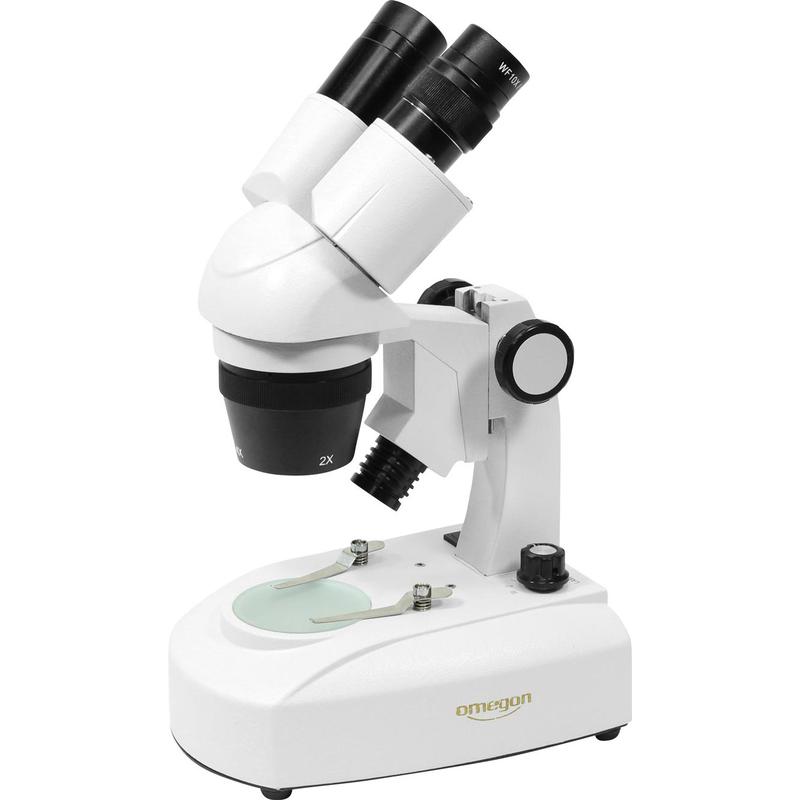
Two pairs of eyepieces for 20x and 80x, top and bottom light in three levels, and your choice of mains or battery power. Use it to look at beetles at the kitchen table and leaves on the patio. The 80x setting has little depth of field – in everyday use you'll mostly use 20x.
Price: € 259
Want to dissect under the objective, like taking apart flowers or owl pellets? Then the Optika with 60 mm working distance and three settings is the better choice.
For dissecting: Optika SFX-91 stereo microscope (10x/20x/40x)
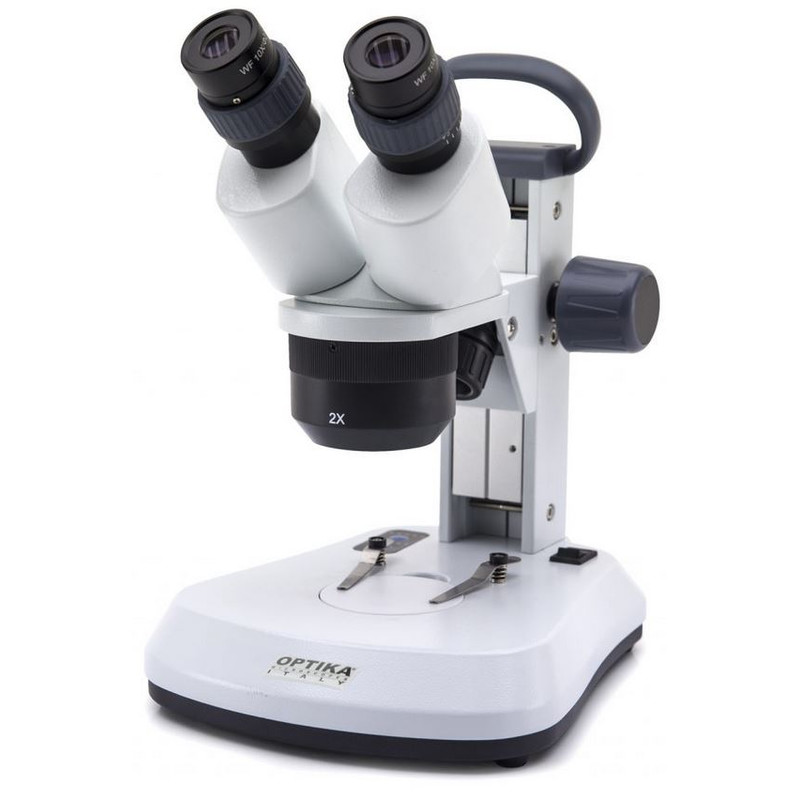
Three magnifications from 10x to 40x via a rotating objective, plus top and bottom LED light. The 60 mm working distance is enough for tweezers and a needle. A sturdy working instrument, but without zoom and without a camera port.
Price: € 368
The Optika SLX-3 zooms continuously from 7x to 45x and leaves 100 mm of room between objective and workpiece. You find a solder joint or a gear at 7x, then zoom in without losing the object – and still have enough room for a soldering iron or watchmaker’s tools. The extra cost pays off if you solder regularly, repair watches or photograph insects; for occasional nature finds, the StereoView with fixed settings is enough.
For advanced users: Optika SLX-3 zoom stereo microscope (7x–45x, trinocular)
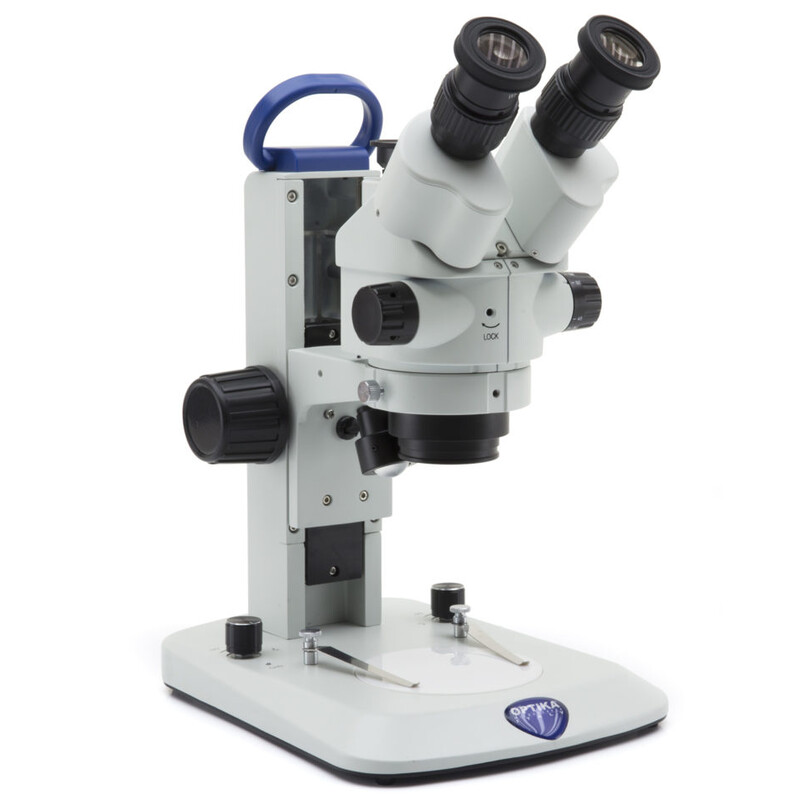
Continuous zoom from 7x to 45x, 100 mm working distance and camera port – the tool for electronics, watches and insect photography.
Price: € 588
Stereo microscope with camera
The cleanest solution is a trinocular head with its own camera tube, as on the Optika SLX-3. The camera stays permanently mounted, and you can still look through the eyepieces with both eyes.
Without a trino head, you can use an eyepiece camera that slides into the tube in place of an eyepiece. Then you lose one eye’s view – the 3D image is gone as long as the camera is in.
Add a camera: Bresser MikrOkular Full HD eyepiece camera
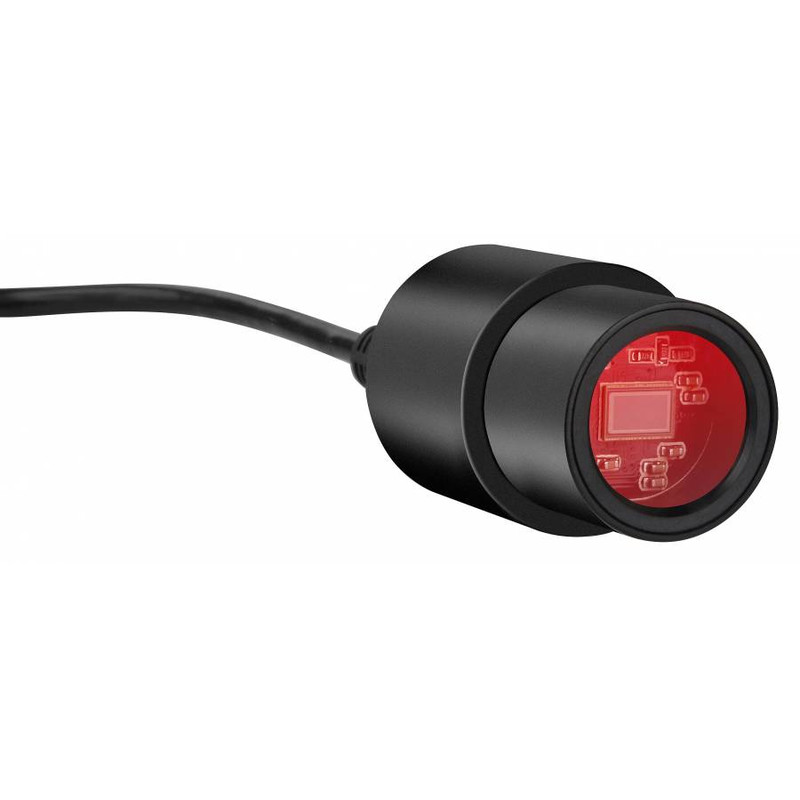
Slides into the tube in place of an eyepiece and sends Full HD to your laptop, adapter rings included. Check beforehand whether the eyepiece diameter of your stereo microscope matches one of the adapters.
Price: € 67.90
For the occasional photo, a smartphone held right up to the eyepiece or mounted with a clamp adapter works too. Other solutions are covered in our digital microscope guide, and tips for phone photos in smartphone astrophotography.
Buying a used stereo microscope
Used brand-name instruments, for example from Zeiss, Leica (Wild), Olympus or Nikon, often come from labs and workshops. The optics of these instruments last for decades if they’ve been stored dry.
Prices vary widely, and without some background knowledge it’s easy to buy an incomplete instrument. Eyepieces or illumination are often missing, and original parts are expensive.
Frequently asked questions about stereo microscopes
What magnification does a stereo microscope have?
Usually 10x to 80x, typically 7x to 45x for zoom models. For insects, rocks and electronics, you’ll mostly use 10x to 20x in everyday use. Higher claims come from extra eyepieces and cost brightness and depth of field.
Can you see cells with a stereo microscope?
No, the magnification isn’t high enough for that. Cells, bacteria and protozoa in detail need a compound microscope with 100x to 400x. Under a stereo microscope, you’ll see large protozoa as dots at most.
What is the difference between a dissecting microscope and a stereo microscope?
Usually none – both terms describe the same instrument with two light paths. “Dissecting microscope” is especially common in schools and biology and emphasizes what it’s used for: working on specimens at fairly low magnification.
Which stereo microscope is right for watchmakers?
Watchmakers usually work at 10x to 20x and need lots of room for tools. A good choice is a zoom stereo microscope with around 100 mm working distance, a good ring light and a stable stand. For large workbenches, a boom arm is handy.
What is a reflected-light microscope?
A microscope in which light falls on the object from above – ideal for opaque things like rocks or coins. Stereo microscopes are almost always reflected-light microscopes.
How much does a good stereo microscope cost?
For kids, there are usable 20x models in the budget class. A solid all-rounder with two settings and two light sources is in the mid-range, while zoom stereo microscopes start in the upper price class.
Keep reading: Buying a microscope · Microscope for kids · Digital microscope · What to look at under the microscope
Links marked with an asterisk (*) are affiliate links. If you buy through them, we earn a small commission – the price stays the same for you.