By Alexander Merz · Published on · Details checked on 30 September 2026
Draco (the Dragon) is a large, long, winding constellation of the northern sky that snakes its way between the Big Dipper and the Little Dipper. At 1,083 square degrees it is the eighth-largest of the 88 constellations and, seen from the northern US, it never sets. Its brightest star, Eltanin, reaches magnitude 2.2.
At a glance
| Latin name | Draco (abbreviation Dra) |
| Area | 1,083 square degrees (rank 8 of 88) |
| Brightest star | Eltanin (also Etamin), γ Draconis, magnitude 2.23 |
| Best-known star | Thuban (α Draconis), only magnitude 3.68, pole star around 2800 BC |
| Visibility | all year in the northern US (circumpolar), best on July to September evenings |
| Eltanin’s highest point | 86° in Seattle, 79° in New York, 73° in Los Angeles, 64° in Miami |
| Neighbors | Ursa Major, Ursa Minor, Camelopardalis, Cepheus, Cygnus, Lyra, Hercules, Boötes |
| Deep-sky highlight | Cat’s Eye Nebula NGC 6543, planetary nebula, magnitude 8.1 |
| Meteor shower | Draconids, peak October 8/9 |
How to find the Draco constellation
Draco has not a single really bright star. That’s why the best way to find it is via two neighbors you surely know: Vega and the Big Dipper. A dark sky away from town helps a lot, because many of the body’s stars are only 3rd to 4th magnitude.
The head: the small quadrilateral next to Vega
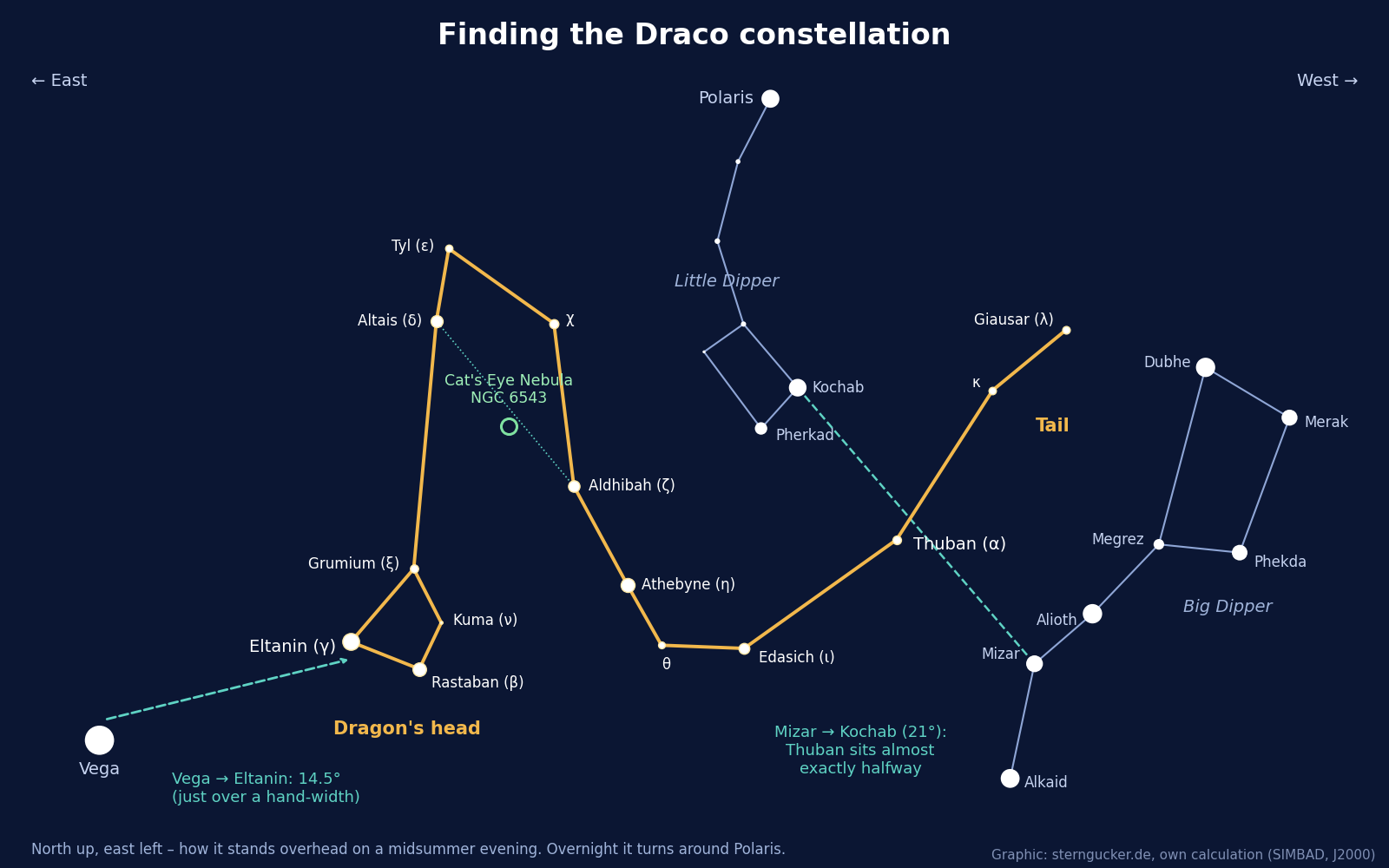
Vega in Lyra is the brightest star high in the summer sky. Go 14.5 degrees north-northwest from it and you reach Eltanin – that is just over a hand-width at arm’s length. Eltanin forms a small, lopsided quadrilateral with Rastaban, Grumium and faint Kuma: the head.
The two bright head stars, Eltanin and Rastaban, are only 4.1 degrees apart. They look like a pair of eyes gazing south toward Hercules.
The tail: Thuban between the Dippers
For the tail, take Mizar, the middle star in the handle of the Big Dipper, and Kochab, the bright bowl star of the Little Dipper. The two are 21 degrees apart, and almost exactly in the middle sits Thuban – 10.6 to 10.7 degrees from each.
From Thuban the tail winds via κ to Giausar. The tip of the tail lies only 8 degrees from Dubhe, the upper bowl star of the Big Dipper.
Because Draco circles the celestial pole, it stands upright or upside down depending on the time of night and the season. Our chart shows it the way you see it overhead on a midsummer evening – how to turn such charts is explained in our guide Identify constellations.
The stars of the Draco constellation
| Star | Magnitude | Distance | Type |
|---|---|---|---|
| Eltanin / Etamin (γ Dra) | 2.23 | 154 light-years | orange giant K5 III |
| Athebyne (η Dra) | 2.74 | 91 light-years | yellow giant G8 III |
| Rastaban (β Dra) | 2.81 | about 380 light-years | yellow supergiant G2 Ib-II |
| Altais (δ Dra) | 3.07 | 98 light-years | yellow giant G9 III |
| Aldhibah (ζ Dra) | 3.17 | about 420 light-years | blue-white giant B8 III |
| Edasich (ι Dra) | 3.29 | 100 light-years | orange giant K2 III |
| Thuban (α Dra) | 3.68 | about 260 light-years | white giant A0 III |
| Grumium (ξ Dra) | 3.75 | 112 light-years | orange giant K2 III |
| Kuma (ν Dra) | 2 × 4.9 | 98 light-years | double star, 62″ apart |
Kuma: a double star even for binoculars
Kuma (ν Draconis) is one of the prettiest easy double stars in the sky. Two equally bright white stars of magnitude 4.9 sit 62 arcseconds apart – a steadily held pair of 10×50 binoculars already splits them.
Thuban: the pole star of the pyramid age
Earth’s axis wobbles like a spinning top and traces a large circle in about 26,000 years – this is called precession. As a result, the north celestial pole slowly wanders among the stars.
Thuban came closest to the pole around 2800 BC, to within about 6 arcminutes – only a fifth of the full Moon’s diameter, and closer than our current pole star will ever get.
It stayed less than a degree from the pole from roughly 2970 to 2620 BC. When the Great Pyramid of Khufu was built, around 2560 BC, it was already a good 1.3 degrees off, but still by far the best pole star around.
Today Thuban sits almost 26 degrees from the pole. Our current North Star comes closest to the pole around the year 2100, but stays about 28 arcminutes away.
When you can see the Draco constellation
In the northern US, Draco is a circumpolar constellation: it circles the pole and never dips below the horizon. The whole figure stays up only north of about 42.4° N – its southernmost tip is still 5 degrees high in Seattle, while south of 38.5° N even Eltanin sets for a few hours. Thuban in the tail stays up all night everywhere from Seattle to Dallas; in Miami it just grazes the horizon.
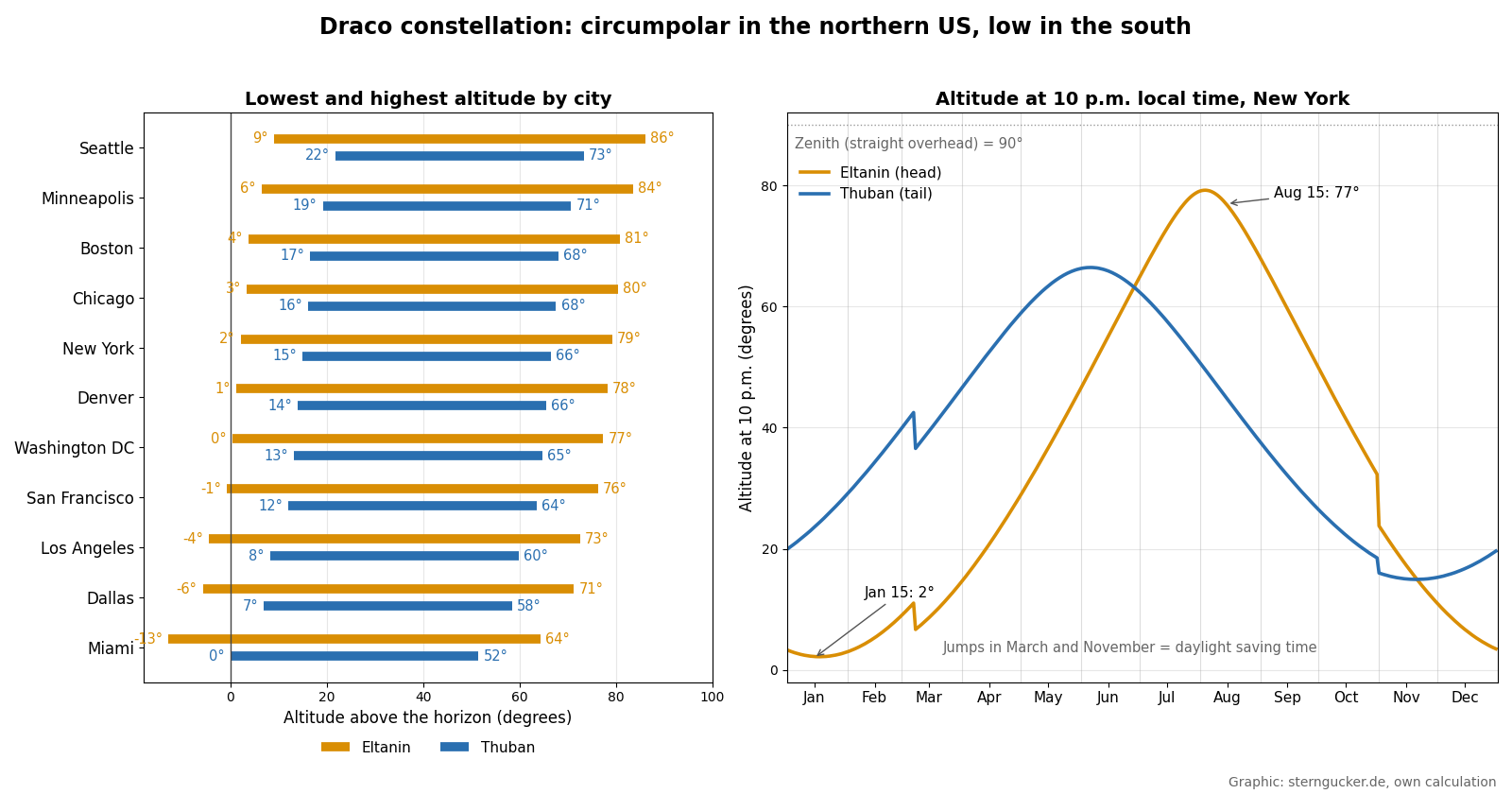
It looks best in summer. In August Eltanin stands 77 degrees high at 10 p.m. in New York – high overhead. In winter, on the other hand, the head scrapes along just 2 to 7 degrees above the northern horizon in the evening.
| Month (on the 15th) | Eltanin (head) at 10 p.m. | Thuban (tail) at 10 p.m. | Head at its highest |
|---|---|---|---|
| January | 2°, low in the north | 24° | 10:13 a.m. (daytime) |
| March | 9° | 39° | 7:21 a.m. |
| May | 37° | 63° | 3:21 a.m. |
| June | 55° | 66° | 1:19 a.m. |
| July | 73° | 58° | 11:17 p.m. |
| August | 77° | 45° | 9:15 p.m. |
| September | 60° | 32° | 7:14 p.m. |
| October | 41° | 22° | 5:16 p.m. |
| November | 17° | 15° | 2:14 p.m. (daytime) |
The head passes close to the zenith, the point straight above you, only in the far north. In Seattle Eltanin reaches 86.1 degrees, in Minneapolis 83.5 degrees. In New York it is 79.2, in Miami just 64.3 degrees.
The Sun never passes through Draco, because the whole constellation lies at least 53 degrees north of the ecliptic, the Sun’s apparent yearly path. Instead, the pole of that path, the north ecliptic pole, lies here.
The Cat’s Eye Nebula NGC 6543
The Cat’s Eye Nebula is a planetary nebula: the cast-off gas shell of a dying star that has used up its fuel. At magnitude 8.1 it is one of the brightest of its kind, but tiny – its bright core measures only about 20 arcseconds.
You find it on the imaginary line from Aldhibah (ζ) to Altais (δ). About 5 degrees past Aldhibah, a good two-fifths of the way, sits the Cat’s Eye – only 0.17 degrees from the north ecliptic pole.
The typical beginner mistake is to overlook it. At low magnification the nebula looks like a slightly blurry star; only from about 100x does it turn into a small blue-green disk. You won’t see the cat’s-eye structure of the Hubble images visually – that takes large aperture, very steady air or photography.
It was with the Cat’s Eye that William Huggins proved in 1864 that such nebulae consist of glowing gas. Its distance is uncertain; depending on the method, values range from 3,000 to 4,500 light-years.
Galaxies for larger telescopes
About 3 to 4 degrees southwest of Edasich (ι) lie NGC 5866, often identified as the mysterious M 102, and the edge-on galaxy NGC 5907. Both are only worthwhile from about 150 to 200 mm (6 to 8 in) of aperture under a dark sky.
The Draconids in October
In early October the Draconids, a meteor shower from comet 21P/Giacobini-Zinner, seem to come out of the Dragon’s head. Their peak falls on the night of October 8 to 9. In normal years you see only a few shooting stars per hour.
Their reputation comes from rare outbursts. In 1933 and 1946 thousands of meteors per hour rained down, and in 2011 still around 250. No storm is expected for 2026, but the Moon will hardly interfere: new moon is on October 10.
Here the early evening pays off. On October 8 the radiant stands 59 degrees high at 8 p.m., but only 13 degrees at 2 a.m. (New York) – so look right after dark.
Mythology: what the Dragon stands for
In the best-known Greek legend, the dragon is Ladon, guardian of the golden apples in the Garden of the Hesperides. Heracles slew it during one of his twelve labors, and Hera placed it in the sky. Fittingly, the constellation Hercules kneels right next to the Dragon’s head.
Binoculars or telescope
For Draco, the telescope wins. Its highlights are small: the Cat’s Eye Nebula and the galaxies need magnification, and there are no wide star fields here like in winter. Binoculars do split Kuma, but the pair looks much nicer in a telescope.
For the Cat’s Eye and Kuma: Skywatcher Dobson Telescope N 130/650 Heritage FlexTube
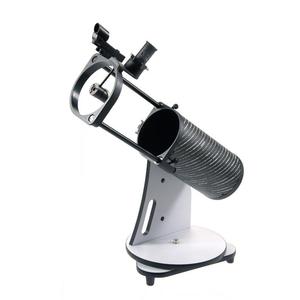
A compact tabletop Dobson with a true parabolic mirror. Folds down, fits in a bag: the Moon, planets and the bright deep-sky classics.
Price: € 265
The Skyliner 200/1200 DobsonianSkyliner 200/1200 Dobsonian collects a good twice as much light as a 130 with its 200 mm (8 in) aperture. Here that means the galaxies NGC 5866 and NGC 5907 really come into their own, and in steady air you can make out the Cat’s Eye’s central star and slightly elongated shape. The extra cost is worth it if deep-sky observing keeps drawing you in – for Kuma and the view of the constellation you don’t need it.
For advanced observers: Skywatcher Dobson Telescope N 200/1200 Skyliner Classic
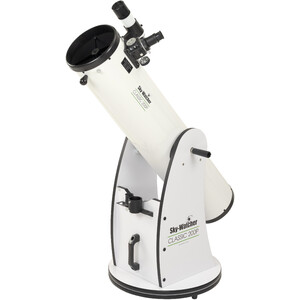
200 mm of aperture — the most sky for your money. Set it on the ground, point by hand: nebulae, clusters and galaxies for years to come.
Price: € 479
Frequently asked questions about the Draco constellation
What is the brightest star in the Draco constellation? (crossword)
The brightest star is ELTANIN (7 letters), in older books and crosswords also ETAMIN (6 letters). If the clue asks for the former pole star, the answer is THUBAN (6 letters). Other star names in Draco are ALTAIS (6), EDASICH (7), GRUMIUM (7) and RASTABAN (8).
What is the Latin name of the Draco constellation?
DRACO, 5 letters – it simply means dragon. The official abbreviation of the International Astronomical Union is Dra, and its stars are named, for example, Alpha Draconis.
How do I find the Draco constellation in the sky?
From Vega, go just over a hand-width (14.5 degrees) north-northwest to the quadrilateral of the Dragon’s head. Thuban in the tail sits almost exactly halfway between Mizar in the Big Dipper and Kochab in the Little Dipper.
What is the meaning of the Draco constellation?
In Greek mythology it usually stands for Ladon, the dragon that guarded the golden apples of the Hesperides and was slain by Heracles. Astronomically it matters because of Thuban, the pole star about 4,800 years ago, and because the north ecliptic pole lies within it.
Can you see Draco all year round?
Yes, from the northern US it never sets; farther south the head dips below the horizon for a few hours on winter nights. It is best placed on July to September evenings, when the head stands high overhead. In winter the head lies low in the north in the evening, but Thuban is still 15 to 24 degrees high (New York).
When are the Draconids best seen in 2026?
On the evening of October 8, right after dark, because that is when the radiant stands highest. With new moon on October 10, conditions are good. But expect only a few meteors per hour; outbursts are rare.
Further reading
- All constellations – our catalog at a glance
- Big Dipper – the signpost to the Dragon’s tail
- Little Dipper – the Dragon winds around it
- Vega – the bright neighbor at the Dragon’s head
- Circumpolar constellations – what you can see all year
- North Star – Thuban’s successor at the pole
* Affiliate link: if you buy through this link we may earn a small commission from Astroshop or High Point Scientific, at no extra cost to you.