By Alexander Merz · Published on · Details checked on 14 September 2026
⚡ The short version
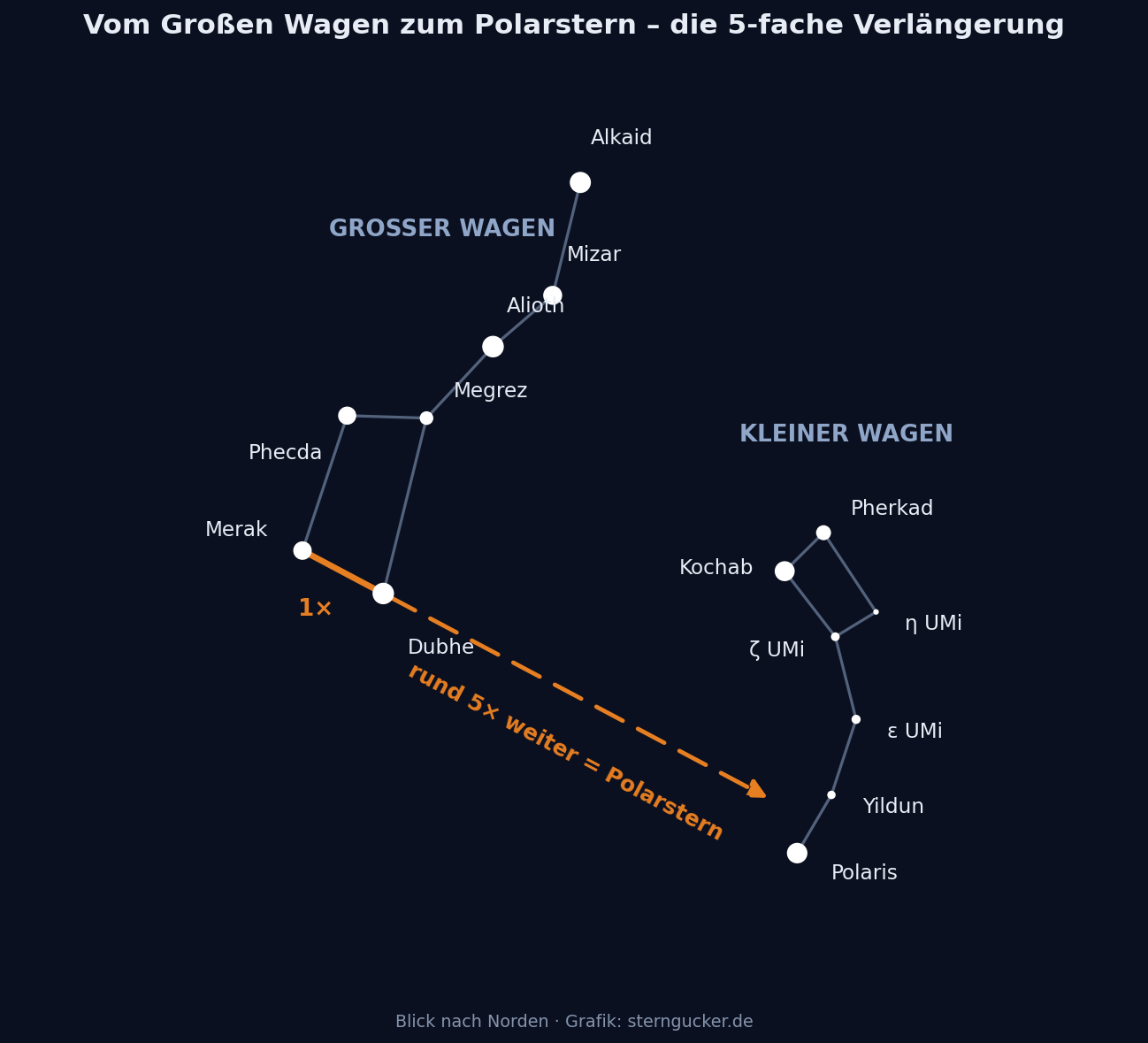
The Little Dipper is the conspicuous part of the constellation Ursa Minor (Latin Ursa Minor, German Kleiner Wagen). It is made up of seven stars, and at the tip of its handle sits the Pole Star. You find it by way of the Big Dipper: the rear edge of the bowl, Merak → Dubhe, extended about five times, lands on the Pole Star.
The figure is far less striking than the Big Dipper – it spans only 16.6° instead of 25.7° and, apart from Polaris (1.98 mag) and Kochab (2.08 mag), contains only stars between 3.0 and 5.0 mag. In the city you therefore usually see only two of its seven stars.
From Germany, Austria and Switzerland, Ursa Minor is circumpolar: it never sets and is visible on every clear night of the year – only its orientation changes from month to month.
The Little Dipper is a special case among the constellations: almost everyone knows its name, but very few have ever seen it in full. That is not down to a lack of attention, but to hard numbers – five of its seven stars are so faint that they simply vanish in any light-polluted sky. Anyone who has seen it complete, however, knows very precisely how good their observing site is.
This article gives you everything you need for the search: the precise finding method with angular distances, an altitude table for eleven cities in the German-speaking region, a monthly table for the changing orientation, the self-test for your sky quality, and the answer to why the Pole Star does not actually stand exactly due north.
Little Dipper or Ursa Minor: why the constellation has two names
Strictly speaking, the Little Dipper does not exist as a constellation. The International Astronomical Union recognises 88 constellations, and one of them is called Ursa Minor, in English the Lesser Bear or Little Bear. The “Little Dipper” is an asterism: a well-known figure of stars that does not form a constellation in its own right.
Here, though, the difference is smaller than with its larger counterpart. In the case of the Big Dipper, the asterism comprises only seven of the roughly 20 visible stars of Ursa Major – the rest make up the head, paws and snout. In Ursa Minor, by contrast, it is the same seven stars: what makes up the dipper also makes up the bear. Ursa Minor is therefore essentially the Little Dipper under a different label.
The names in other languages
| Language | Name |
|---|---|
| German | Kleiner Wagen / Kleiner Bär |
| Latin (IAU) | Ursa Minor, genitive Ursae Minoris, abbreviation UMi |
| English | Little Dipper (asterism) / Ursa Minor (constellation) |
| French | Petite Ourse / Petit Chariot |
| Italian | Orsa Minore / Piccolo Carro |
| Spanish | Osa Menor |
| Dutch | Kleine Beer |
Notably, in English the figure is called the Little Dipper – the same reinterpretation as with the Big Dipper. The shape of the bowl is read as a ladle, the handle as its stem. Anyone using German star charts should bear this in mind: Little Dipper and Kleiner Wagen mean exactly the same seven stars.
Not a zodiac sign
Ursa Minor is not a sign of the zodiac. It lies at the north celestial pole and is thus about 66° from the ecliptic – the path along which the Sun, Moon and planets travel. The Sun can never cross it. Anyone searching for a “star sign Ursa Minor” is confusing it with one of the twelve zodiacal constellations; we explain the difference in detail in Zodiac signs and constellations.
Finding the Little Dipper: the fivefold extension from the Big Dipper
The Little Dipper is almost never found directly – it is too faint for that. The standard route runs by way of the Big Dipper, which in every season stands somewhere in the north and, thanks to its seven bright stars, is visible even from the inner city.
- Look for the Big Dipper in the north. Depending on the season it stands high (spring), upper left (summer), low (autumn) or to the right (winter).
- Find the rear edge of the bowl: the two stars furthest from the handle. These are Merak (bottom) and Dubhe (top). Their separation is 5.4° – about three finger-widths at arm’s length.
- Extend the line from Merak beyond Dubhe, always straight ahead, by about five times this distance. After 28.7° you reach a moderately bright, lone star: the Pole Star.
- The Pole Star is the end of the Little Dipper’s handle. From there the figure swings away in a shallow arc – first three faint stars, then the bowl.
- If you cannot see the bowl: look for Kochab, the second-brightest star of the figure. It stands 16.6° from the Pole Star and is almost as bright as it. Polaris and Kochab are the two “Guardians of the Pole” – once you have both, you have the figure.
The hand span as an angle gauge
At arm’s length, a finger-width corresponds to about 1.5°, a fist-width to about 10° and a spread hand (thumb to little finger) to about 20°. Merak → Dubhe are therefore a good three finger-widths, and the stretch Dubhe → Pole Star just under three fist-widths. This works about equally well for everyone, because larger hands go with longer arms.
The route without the Big Dipper: searching via Cassiopeia
If trees or houses hide the Big Dipper – in autumn it stands very low – the W of the constellation Cassiopeia on the other side of the pole comes to the rescue. Polaris lies almost exactly between the two: the Pole Star, the Big Dipper and Cassiopeia always face each other. Extend the central axis of the W – the tip of the middle peak points roughly towards the Pole Star, about 30° away. The method is less precise than the Dipper pointer, but it is enough to get you into the right region of the sky.
Big and Little Dipper: the difference in numbers
Both figures have seven stars, both consist of a bowl and a handle – and yet, once you have seen them both, they are hard to confuse. The Little Dipper is smaller, fainter, and its handle curves the other way.
| Feature | Big Dipper | Little Dipper |
|---|---|---|
| Length of the figure | 25.7° (Dubhe → Alkaid) | 16.6° (Polaris → Kochab) |
| Size ratio | 100 % | about 65 % |
| Brightest star | Alioth, 1.77 mag | Polaris, 1.98 mag |
| Stars brighter than 3 mag | 7 of 7 | 2 of 7 |
| Faintest star of the figure | Megrez, 3.31 mag | η UMi, 4.95 mag |
| Curvature of the handle | outward, away from the bowl | inward, towards the bowl |
| Visibility in a large city | complete | only 2 stars |
| Area of the constellation | 1280 square degrees (rank 3) | 256 square degrees (rank 56) |
| Circumpolar in Central Europe | yes (barely) | yes (fully) |
The practically most important row is the fourth: in the Big Dipper all seven stars are brighter than 3 mag, in the Little only two. That is why the Big Dipper appears as a coherent whole under almost any sky, while under city conditions the Little Dipper is reduced to two isolated points with literally nothing to be seen between them. This is the main reason why so many people believe they have never found the Little Dipper – they have found it, but it was incomplete.
The curvature as a distinguishing feature
If you see a figure and are unsure which of the two it is: look at the handle. In the Big Dipper it curves away from the bowl, outward – the last star, Alkaid, lies off the line of extension. In the Little Dipper it is the reverse: the handle swings towards the bowl. The two figures are therefore not simply a large and a small version of each other, but are curved as mirror images.
The seven stars in detail: brightness, colour and distance
The seven stars of the figure are a surprisingly mixed bunch: a pulsating supergiant, two orange giants, a blue-white giant and three unremarkable main-sequence stars. Their distances range from 97 to almost 500 light-years – the figure is a pure trick of perspective; physically, these stars have nothing to do with one another.
| Star | Proper name | Brightness (mag) | Spectral type | Distance (ly) | Role in the figure |
|---|---|---|---|---|---|
| Polaris (α UMi) | Pole Star, North Star | 1.98 | F7 Ib, yellow supergiant | ~446 | tip of the handle; Cepheid, 3.97 d period |
| Kochab (β UMi) | Kochab | 2.08 | K4 III, orange giant | ~131 | rear bowl star, “Guardian of the Pole” |
| Pherkad (γ UMi) | Pherkad | 3.05 | A3 II–III, white giant | ~487 | second Guardian, variable |
| ε UMi | Urodelus | 4.21 | G5 III, yellow giant | ~350 | eclipsing variable, 39.5 d |
| ζ UMi | Akhfa al Farkadain | 4.29 | A3 Vn | ~369 | transition handle/bowl |
| δ UMi | Yildun | 4.36 | A1 V, white | ~172 | second star after Polaris |
| η UMi | Anwar al Farkadain | 4.95 | F5 V | ~97 | faintest star of the figure |
A note on the proper names: only Polaris, Kochab, Pherkad and Yildun are officially confirmed by the IAU. “Urodelus”, “Akhfa al Farkadain” and “Anwar al Farkadain” are traditional, mostly Arabic-derived designations that are assigned differently in various star catalogues – which is why, on charts, these three stars almost always appear only under their Greek letters.
Remarkable is the contrast between η UMi and Pherkad: at 97 light-years, η UMi is by far the nearest star of the figure and yet the faintest – a perfectly ordinary star, barely larger than the Sun. Pherkad lies five times further away and appears almost two magnitudes brighter, because it is a giant with more than 1,000 times the Sun’s luminosity.
Polaris: the sky’s best-known variable star
The Pole Star is a triple system. The main component, Polaris Aa, is a yellow supergiant with about five solar masses and 46 times the Sun’s diameter. It is a Cepheid – a pulsating star that rhythmically changes its size and brightness, with a period of just under four days.
This pulsation is perhaps the Pole Star’s most unusual property: its amplitude is fading away. Before 1963 the brightness varied by more than 0.1 mag; after 1966 the variation fell rapidly to below 0.05 mag – the star almost stopped pulsating. Since the 2000s the amplitude has been increasing slightly again. Why is still not conclusively understood. Incidentally, the period lengthens by about 4.5 seconds each year.
| Component | Type | Brightness | Notable feature |
|---|---|---|---|
| Polaris Aa | F7 Ib, yellow supergiant | ≈ 1.98 mag | 5.1 solar masses, 46 solar radii |
| Polaris Ab | F6 V, main-sequence star | ≈ 9 mag | orbit in 29.3 years, only 6.2 AU apart at minimum |
| Polaris B | F3 V, main-sequence star | 8.7 mag | separation of 18.2″ – resolvable with a telescope from 6 cm |
Polaris B is a rewarding observing target: with 18.2 arcseconds of separation it is far enough apart to appear as a tiny companion even in a small telescope at 60 to 100× magnification. The brightness difference of almost seven magnitudes nonetheless makes the task demanding – a clean, well-cooled instrument and steady air are essential. You can read more about the star itself in our portrait Finding the Pole Star.
The Pole Star does not stand exactly north: 37 arcminutes off
The Pole Star is regarded as the fixed point in the sky – and it is, but not perfectly. It currently stands 37.4 arcminutes from the exact north celestial pole, a good half a degree. That is about 1.25 full-Moon diameters.
In practice this means that Polaris does not stand still either, but describes a small circle around the true pole over the course of 24 hours. The diameter of this circle is about 1.25°. If you point a camera at the pole for an hour, Polaris traces a short arc – it is only almost the motionless pole.
Two figures worth keeping apart
Altitude above the horizon = geographic latitude. In Munich (48.1° N) the Pole Star stands 48° high, in Hamburg (53.6° N) almost 54°. This rule of thumb is accurate to about half a degree – no more, precisely because Polaris lies 37 arcminutes off the pole and appears now a little higher, now a little lower over the course of the day.
Azimuth = almost exactly north. The deviation from due north varies with the time of day between 0° and at most about 0.9° – utterly negligible for finding your way in the field, but decisive for the precise alignment of a mount.
The distance to the pole is still shrinking, by the way: Polaris continues to approach the north celestial pole and will reach its smallest distance around the year 2102, at about 27 arcminutes. After that it will move away again – slowly at first, then ever faster.
How high the Little Dipper stands: altitude table for eleven cities
Because Ursa Minor encircles the north celestial pole, it is circumpolar from all of Central Europe: it never sets, on no night of the year. Its altitude above the horizon depends solely on the geographic latitude – and for Kochab, the brightest bowl star, it varies considerably over the course of the day.
| City | Latitude | Altitude of Pole Star | Kochab highest point | Kochab lowest point |
|---|---|---|---|---|
| Hamburg | 53.6° N | 53.6° | 110.5° (past the zenith) | 37.6° |
| Berlin | 52.5° N | 52.5° | 111.5° | 36.6° |
| Dresden | 51.1° N | 51.1° | 113.0° | 35.1° |
| Cologne | 50.9° N | 50.9° | 113.1° | 35.0° |
| Frankfurt am Main | 50.1° N | 50.1° | 113.9° | 34.2° |
| Stuttgart | 48.8° N | 48.8° | 115.3° | 32.8° |
| Vienna | 48.2° N | 48.2° | 115.8° | 32.3° |
| Munich | 48.1° N | 48.1° | 115.9° | 32.2° |
| Zurich | 47.4° N | 47.4° | 116.7° | 31.4° |
| Graz | 47.1° N | 47.1° | 117.0° | 31.1° |
| Bern | 46.9° N | 46.9° | 117.1° | 31.0° |
The values above 90° in the fourth column are not an error: at its upper culmination, Kochab passes beyond the zenith onto the southern side of the sky. In Hamburg it then reaches 110.5°, which corresponds to an actual altitude of 69.5° in the south. Anyone looking north at that moment will not find it – it is already behind them.
The last column is the more important one: at lower culmination, Kochab sinks to 31° in Bern, but still to 37.6° in Hamburg. Thus the Little Dipper remains, even in the least favourable case, well above a typical horizon obstruction – unlike the Big Dipper, which in autumn almost touches the horizon in southern Germany.
The handle turns over the year: orientation month by month
Circumpolar constellations do not rise and set – they rotate. The Little Dipper makes a full circuit around the Pole Star in one year, if you always look at it at the same time of night. The following table tells you, for the 15th of each month at 10 p.m. local time, where the bowl of the Little Dipper stands relative to the Pole Star. Direction of view: north.
| Month (15th, 10 p.m.) | The bowl stands … of the Pole Star | Note |
|---|---|---|
| January | lower right | bowl near its lowest position |
| February | right | figure lies horizontal, handle to the left |
| March | right | bowl rising slowly on the eastern side |
| April | right | the Big Dipper stands high near the zenith at the same time |
| May | upper right | good time for the completeness test |
| June | vertically above | figure stands upright – the classic “Little Dipper” |
| July | vertically above | best orientation of the year, but short nights |
| August | upper left | bowl tips towards the west |
| September | left | figure horizontal again, handle to the right |
| October | left | the Big Dipper now stands low in the north |
| November | lower left | bowl sinks towards lower culmination |
| December | vertically below | figure stands upside down, bowl at its lowest |
Important for the search: the famous dipper shape, with the bowl above the handle, only occurs in early summer. In December the same figure stands upside down; in February it lies on its side. Anyone searching for the Little Dipper while rigidly looking out for an upright dipper will not find it in three seasons out of four.
For other times of night, a simple rule applies: two hours later corresponds to about one month further into the year. Anyone looking in October at midnight sees the November position. A rotating planisphere carries out exactly this conversion mechanically.
Polaris was not always the pole star: Thuban, Kochab and Vega
The Earth’s axis is not fixed in space. Driven by the pull of the Sun and Moon on the Earth’s equatorial bulge, it describes a slow cone, like a spinning top running down. One full circuit takes about 25,772 years. This precession makes the north celestial pole trace a circle of 23.44° radius across the sky, and whichever star happens to lie near this circle is the pole star.
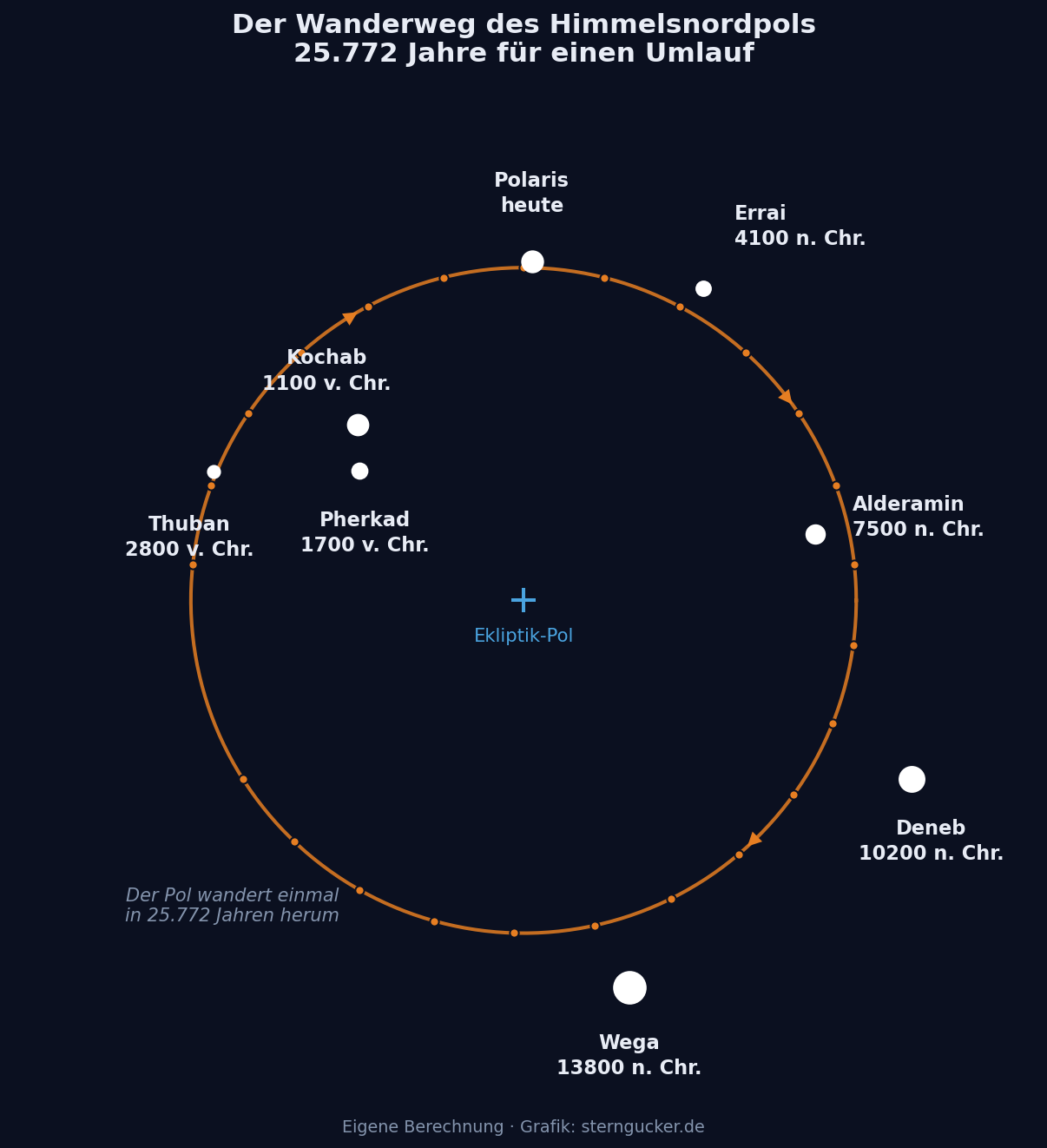
| Epoch | Pole star | Brightness (mag) | Note |
|---|---|---|---|
| c. 2800 BC | Thuban (α Draconis) | 3.65 | pole star of the pyramid builders; came within 6′ of the pole |
| c. 1000 BC | Kochab (β UMi) | 2.08 | the better of the two “Guardians” – the pole lay between Kochab and Pherkad |
| today (2026) | Polaris (α UMi) | 1.98 | the brightest pole star of the entire cycle, 37.4′ from the pole |
| around 2102 | Polaris | 1.98 | smallest distance: about 27′ |
| c. AD 3000 | Errai (γ Cephei) | 3.21 | next incumbent, comes within about 3° |
| c. AD 7500 | Alderamin (α Cephei) | 2.45 | bright pole star, but nearly 3° away |
| c. AD 10,000 | Deneb (α Cygni) | 1.25 | the brightest star ever to come near the pole – but only to 7° |
| c. AD 13,700 | Vega (α Lyrae) | 0.03 | comes within about 4° of the pole |
| c. AD 27,800 | Polaris | 1.98 | the cycle closes |
Two things stand out in this table. First: we live in a distinctly good epoch. Polaris is both bright and extremely close to the pole – this combination occurs only once in the entire cycle. For the next few millennia, navigation by the North Star will work considerably less well.
Second: of all stars, it was Kochab, the second star of our figure, that was itself the pole star about 3,000 years ago. Ursa Minor has thus hosted the north pole twice over. Its Greek name Kynosura (“dog’s tail”) and the epithet of Vega as a future pole star belong to the same long history.
Why Egypt proves it
Precession is not merely a theoretical model. The shafts of the Great Pyramid are aligned with stellar positions around 2500 BC – the northern shaft of the Queen’s Chamber aims at the then position of Kochab, that of the King’s Chamber at Thuban. If you wind precession back, the angles fit. With today’s stellar positions they do not.
A self-test with seven stars: how dark is your sky
The Little Dipper has one property that makes it valuable for observers: its seven stars are spread very evenly across the brightness range from 2.0 to 5.0 mag – and they all sit close together, high in the sky, all year round. This makes it a perfect, always-available yardstick for the limiting magnitude of your observing site.
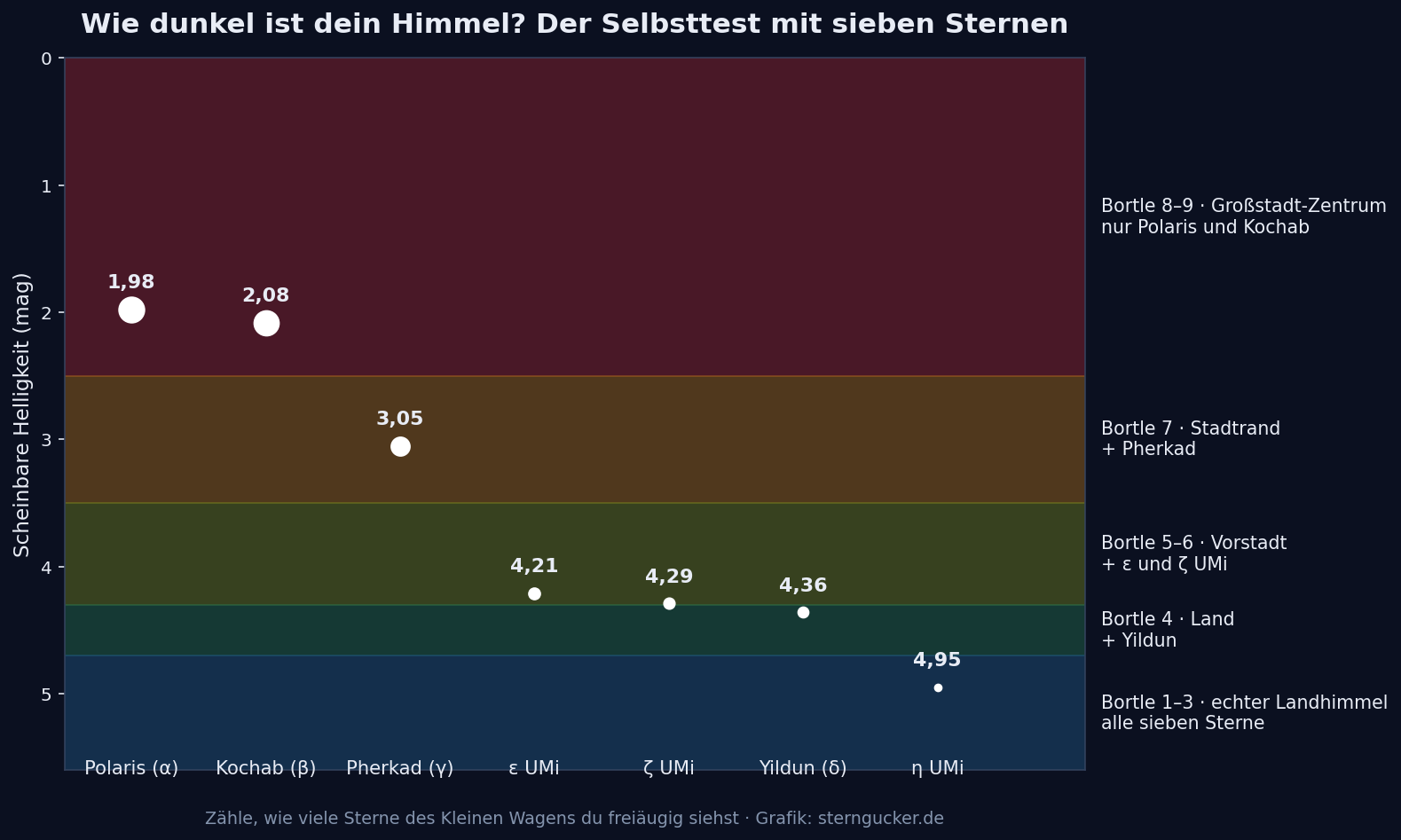
| Visible stars | Limiting magnitude | Bortle class | Typical site |
|---|---|---|---|
| 2 (Polaris, Kochab) | from 2.1 mag | 8–9 | inner city of a large city |
| 3 (+ Pherkad) | from 3.1 mag | 7 | city outskirts, bright suburb |
| 5 (+ ε and ζ UMi) | from 4.3 mag | 5–6 | suburb to transition zone |
| 6 (+ Yildun) | from 4.4 mag | 4 | rural, but with light domes |
| 7 (all, incl. η UMi) | from 5.0 mag | 1–3 | genuine rural sky |
Here is how the test works: pick a moonless night, keep at least 20 minutes away from any light source so your eyes adapt, then count at your leisure. The order matters: after Polaris and Kochab, Pherkad is next, then ε and ζ UMi almost level with each other, then Yildun, and last of all η UMi. Anyone who can reliably see η UMi has a sky that only a few regions in Germany still offer.
A common mistake: looking straight at them. Stars near the perception threshold are better captured with averted vision – that is, by looking just to one side, because the more light-sensitive rods sit outside the centre of the retina. This often gains you half a magnitude. Where the sky glow comes from and what helps against it is explained in our article on light pollution.
Deep-sky in Ursa Minor: a dwarf galaxy and distant spirals
Ursa Minor is not deep-sky territory. It lies far from the plane of the Milky Way, so there are no gas nebulae and no open clusters here – and because the line of sight leads almost perpendicularly out of our Galaxy, what you see is mainly very distant galaxies. Three objects are nonetheless worth the effort.
NGC 6217: the barred spiral galaxy with a Hubble history
NGC 6217, at about 11 mag, is the brightest deep-sky object in the constellation. It stands 2.5° east of Zeta Ursae Minoris, measures about 3′ × 2.5′ and is roughly 67 million light-years away. In a telescope from about 20 cm aperture it shows itself as an oval smudge with a brighter centre; the barred structure and the spiral arms only become visible in photographs.
It owes its fame to a coincidence: in 2009, NGC 6217 was the first object imaged by the freshly repaired Advanced Camera for Surveys of the Hubble Space Telescope after the final servicing mission – chosen, among other reasons, because as a circumpolar target it was reachable at any time.
The Ursa Minor Dwarf Galaxy: the invisible neighbour
The Ursa Minor Dwarf Galaxy is a companion galaxy of our Milky Way at a distance of about 225,000 light-years, discovered in 1955 on photographic plates of the Palomar Survey. It is a spheroidal dwarf made up predominantly of very old stars and is among the darkest known galaxies of all.
For visual observation it is unsuitable – that has to be said plainly. Its total brightness of about 11.9 mag is spread over more than half a degree of sky area, so its surface brightness lies far below any sky glow. Even in large amateur telescopes it remains invisible. Anyone who claims to have “seen” it has in all likelihood seen something else.
NGC 6251: an active galactic nucleus for advanced observers
NGC 6251 is a giant elliptical galaxy of about 12.5 mag at roughly 340 million light-years. It is less interesting at the eyepiece than in radio astronomy: its supermassive black hole drives a jet of matter several hundred thousand light-years long. Visually, all that remains of it is a small, round patch of light – an object for 25 cm aperture and up, under a dark sky. You will find further worthwhile targets in our deep-sky overview.
The Ursids in December: the overlooked meteor shower
Ursa Minor has its own meteor shower, and hardly anyone knows it: the Ursids. They are active from 17 to 26 December with a peak around 22 December – on the longest night of the year of all times, and right before Christmas, which is why they regularly get lost in the bustle.
| Feature | Value |
|---|---|
| Activity period | 17 to 26 December |
| Peak | around 22 December |
| Zenithal hourly rate (ZHR) | normally 5–10, in outburst years over 100 |
| Radiant | near Kochab, in the bowl of the Little Dipper |
| Speed | about 33 km/s – rather slow |
| Parent body | comet 8P/Tuttle |
| Best observing time | the last hours before dawn |
The great advantage of the Ursids: their radiant is circumpolar. It never sets, so you can observe all night. It stands highest in the hours before sunrise – which is also when the rate is best, because the leading side of the Earth runs into the meteor stream.
Ursids 2026: unfortunately a poor year
The peak on 22 December 2026 falls just two days before the full Moon on 24 December. The Moon, then more than 90 % illuminated, is in the sky for almost the whole night and all but completely outshines the already faint Ursids. Realistically, only the brightest meteors will remain. Anyone who wants to try anyway should put the Moon behind a building and look in the opposite direction of the sky. You will find all the dates of the year in the meteor shower calendar.
Mythology and names: from Kynosura to the North Star
Ursa Minor is one of the few constellations whose introduction can be attributed to a person: antiquity credited it to Thales of Miletus, in the 6th century BC. He probably took the figure over from Phoenician seafarers, who had long navigated by it – which is why the Greeks at times called the constellation Phoinike, “the Phoenician one”.
The older Greek name is Kynosura, “dog’s tail”. Where it comes from is unclear; possibly the figure was originally a dog and was only later reinterpreted as a bear, to match the neighbouring Great Bear. The long tail that both celestial bears bear, and which no real bear has, has survived as a legacy of the handle.
In the best-known version of the myth, the Little Bear is Arcas, the son of the nymph Callisto and of Zeus. Callisto was turned into a bear by the jealous Hera; when, years later, Arcas nearly killed his own mother while hunting, Zeus placed them both in the sky. Hera saw to it that the two might never bathe in the sea – the mythological reason why the bears never set in Greece.
The names of the individual stars
| Name | Origin | Meaning |
|---|---|---|
| Polaris | Latin stella polaris | “pole star” – only in use since the modern era |
| Kochab | Arabic al-kaukab | “the star” – a short form of “star of the north” |
| Pherkad | Arabic farqad | “the calf”; Kochab and Pherkad together are called farqadain |
| Yildun | Turkish yıldız | “star” – a modern name from the 19th century |
| Kynosura | Greek kynos oura | “dog’s tail” – old name of the whole figure |
The double name farqadain for Kochab and Pherkad is still in use today: the two stars are often referred to as “the Guardians of the Pole”, because in antiquity they circled the pole like sentries – at a time when Polaris itself still stood several degrees off.
Equipment for Ursa Minor: from the eye to the telescope
For the figure itself you need nothing at all – just a dark sky and 20 minutes of dark adaptation. Equipment becomes interesting as soon as you want to go beyond counting the seven stars: splitting Polaris B, spotting NGC 6217, or perceiving the colour differences between Kochab (orange) and Yildun (white).
Binoculars: the fastest gain
A pair of 10×50 binoculars instantly turns two visible stars into seven, even in the middle of the city. It also clearly shows the colour contrast of the giant stars and reveals the little ring of stars around Polaris known as the Engagement Ring – a pretty circle of faint stars with Polaris as the “diamond”. Which design suits you is clarified in our binocular guide; the fundamental question is dealt with in Telescope or binoculars.
Telescope: for Polaris B and the galaxies
Polaris B at 18.2″ is already resolvable with 6 cm aperture, and becomes comfortable from about 10 cm. A compact Dobsonian telescope offers the best value for money here, because practically the whole budget goes into aperture rather than into a mount:
A compact entry point for Polaris B and the brighter targets
Our beginner recommendation: Skywatcher Dobson Telescope N 130/650 Heritage FlexTube
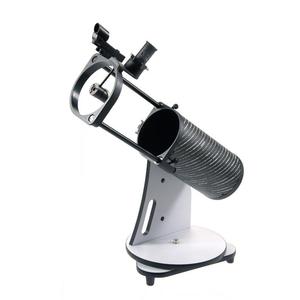
A compact tabletop Dobson with a true parabolic mirror. Folds down, fits in a bag: the Moon, planets and the bright deep-sky classics.
Price: € 265
For NGC 6217, however, that is not enough. An 11-mag galaxy with low surface brightness needs light, and considerably more of it: from about 20 cm aperture, under a reasonably dark sky, it becomes a sure object rather than a guessing game. Anyone who knows that galaxies will become their thing should take this step straight away – the jump from 13 to 20 cm collects a good two and a half times as much light and is the only path that really changes anything in deep-sky:
The honest recommendation for galaxies like NGC 6217
The better choice for deep-sky: Skywatcher Dobson Telescope N 200/1200 Skyliner Classic
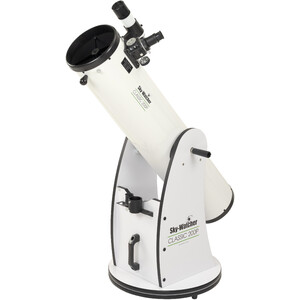
200 mm of aperture — the most sky for your money. Set it on the ground, point by hand: nebulae, clusters and galaxies for years to come.
Price: € 479
What you do not need: a GoTo mount. The Little Dipper is the constellation on which you learn to search – and manual alignment on the Pole Star is the first step of every mount anyway. More on the basics in our guide Sky observation for beginners and in the overview Telescope for galaxies.
* Affiliate link: if you buy through this link we may earn a small commission from Astroshop or High Point Scientific, at no extra cost to you.
Frequently asked questions about the Little Dipper
How many stars does the Little Dipper have?
The figure consists of seven stars – just like the Big Dipper: four form the bowl (Kochab, Pherkad, η and ζ UMi), three the handle (ε UMi, Yildun and Polaris). The whole constellation of Ursa Minor contains, under a very dark sky, about 20 stars visible to the naked eye, but only these seven belong to the well-known figure.
What is the Little Dipper called in German?
Kleiner Wagen, literally “little cart”. The official constellation is called Kleiner Bär (“Little Bear”) in German, or Ursa Minor as in Latin. The Big Dipper is accordingly Großer Wagen, the constellation Ursa Major.
When can you see the Little Dipper?
From Central Europe on every clear night of the year – it is circumpolar and never sets. Only its orientation changes: in June and July it stands upright above the Pole Star in the evening, in December at the same time upside down below it. The best combination of favourable position and long darkness is offered by the months of September to November.
What is the difference between the Big and the Little Dipper?
The Little Dipper, at 16.6° long, is only about 65 % of the size of the Big Dipper (25.7°) and much fainter: in the Big Dipper all seven stars are brighter than 3 mag, in the Little only two. In addition, the handle is curved the opposite way – in the Big Dipper it curves away from the bowl, in the Little towards it. And: the Pole Star belongs to the Little Dipper, not the Big.
Why can’t I find the Little Dipper?
Almost always it is down to the sky, not the observer. Five of the seven stars are fainter than 3 mag and disappear even under moderate light pollution. If you see Polaris and Kochab but nothing in between, you have already found the figure – you are just missing the dark sky. A simple pair of 10×50 binoculars shows all seven stars at once.
Does the Pole Star belong to the Little Dipper?
Yes. Polaris is the star at the tip of the handle and, at the same time, the brightest star of the constellation Ursa Minor (1.98 mag). It is thus the only truly well-known star of the figure – many people know the Pole Star without realising that it belongs to a constellation.
Does the Pole Star stand exactly north?
Almost, but not exactly: it currently stands 37.4 arcminutes from the north celestial pole and therefore describes a small circle around the true pole over the course of a day. The deviation from due north stays below 1° – irrelevant for finding your way in the field, but important for aligning a telescope mount. Around the year 2102 the distance will shrink to about 27 arcminutes.
Is Ursa Minor a zodiac sign?
No. Zodiac signs are exclusively the twelve constellations along the ecliptic, that is, the Sun’s apparent path. Ursa Minor lies at the north celestial pole and is thus about 66° away from it – the Sun can never cross it.
How can I tell whether my sky is dark enough?
Count the stars of the Little Dipper. Two visible stars mean a big-city sky (Bortle 8–9), three the city outskirts, five to six a rural setting. Anyone who can see all seven, including η UMi (4.95 mag), is standing under a genuine rural sky with a limiting magnitude of 5 mag or better. Important: at least 20 minutes of dark adaptation and no moonlit night.
What does the Little Dipper mean as a tattoo motif?
Most often the figure stands for orientation and constancy – because the Pole Star is the only one to keep its position in the sky and served navigation for centuries. Anyone who wants the figure tattooed true to life should pay attention to two details: the largest dot belongs at the end of the handle (Polaris), and the handle curves towards the bowl, not away from it. This is precisely how you can spot the many templates that in truth show the Big Dipper.
Read on at Sterngucker
- Big Dipper – the starting figure for every search in the northern sky
- Finding the Pole Star – the portrait of the figure’s most important star
- Circumpolar constellations – what never sets in Central Europe
- Cassiopeia – the counterpart on the other side of the pole
- Light pollution – why five of seven stars are missing
- Meteor shower calendar – all the showers of the year, Ursids included
- All constellations at a glance – the entry point to our catalogue