By Alexander Merz · Updated on · Details checked on 13 October 2026
Our detailed buying guides
Shopping for astronomy gifts can feel impossible when you don’t know a finderscope from an eyepiece yourself. The good news: from a first telescope and a pair of binoculars to illustrated books and a handful of wonderfully offbeat ideas, there’s a present for every budget and every kind of stargazer. Use this list as a source of inspiration to find something that truly lands.
⚡ The quick answer: The best astronomy gift comes down to budget, not taste. Under $25€25, a planisphere or a real meteorite works every time. Around $100€100, a home planetarium gives you the most effect per dollareuro. From $269.00€ 265 it gets serious: a tabletop Dobsonian shows lunar craters and Saturn’s rings – and it actually gets used, unlike most department-store telescopes.
What makes a good astronomy gift?
A great gift for an astronomy fan is one that brings them closer to the sky — whether by helping them observe it, dream about it, or learn from it. You don’t need to know anything about telescopes to choose well: just keep the recipient’s experience level and interests in mind. A curious child won’t want the same present as a seasoned astrophotographer.
The ideas fall into four broad families: observing instruments (binoculars, refractors, telescopes), décor and collector’s pieces (posters, globes, meteorites), things to learn from (books, magazines, games), and atmosphere gifts like a home planetarium. There’s something for every taste — and, crucially, every wallet. Thinking of naming a star as a gift? Read buy a star: what you really get first.
Astronomy gift ideas by budget (2026)
To help you zero in quickly, here’s a round-up of the best gift ideas grouped by how much you’d like to spend.
| Budget | Gift | Why it lands | Price |
|---|---|---|---|
| up to $25€25 | Orion Star Target PlanisphereOculum Swivelling Sky Map 29 cm | Shows which constellations are up on any given night. The gift that gets used the longest. | $7.95€ 19.90 |
| up to $25€25 | Campo del Cielo Iron Meteorite in Gift Pouch | 4.5 billion years old, from the Campo del Cielo in Argentina. It sits heavy in the hand and needs no explaining. Available to order | about $16.90€ 16.90 |
| up to $100€100 | National Geographic Astro Planetarium | The starry sky on the ceiling, with spoken explanations. For children from about six years old.In stock · ready for shipping in 24 h | about $97.90€ 97.90 |
| up to $100€100 | Celestron 7x50 Cometron BinocularsCelestron Cometron 7x50 Binoculars | Bright binoculars for the Milky Way, star clusters and comets. No setup, and they travel anywhere.In stock · ready for shipping in 24 h | $47.95€ 65 |
| up to $200€200 | Sega Toys Homestar Flux | The best home planetarium: 60,000 real stars, adjustable focus. It works in the rain and at full Moon too.In stock · ready for shipping in 24 h | about $189€ 189 |
| up to $300€300 | Sky-Watcher Heritage 130 Tabletop DobsonianSkywatcher Dobson Telescope N 130/650 Heritage FlexTube | ⭐ Our recommendationThe classic first telescope: a genuine parabolic mirror, collapsible, showing lunar craters and Jupiter’s moons.In stock · ready for shipping in 24 h | $269.00€ 265 |
| up to $500€500 | Apertura AD8 8" Dobsonian TelescopeSkywatcher Dobson Telescope N 200/1200 Skyliner Classic | For anyone who already knows they’ll stick with it. 200 mm of aperture shows galaxies and nebulae as objects, not smudges.In stock · ready for shipping in 24 h | $699.95€ 479 |
| up to $800€800 | ZWO Seestar S30 Pro Smart TelescopeZWO Seestar S30 Pro Smart Telescope | A smart telescope that tracks and photographs by itself. The gift for tech lovers with no patience for polar alignment.In stock · ready for shipping in 24 h | $699.00€ 699 |
When to order: Astronomy is a small market with small warehouses. Home planetariums and popular beginner telescopes regularly sell out from mid-November, and restocks often don’t arrive until January. If it’s meant to be under the tree, order in October – the first week of November at the latest. For smart telescopes it is also worth a look at the status line shown with the product: it tells you whether a device is in stock or only available to order.
More choice in every price bracket? Our buying guides: beginner telescopes, telescopes under $300€ 300, telescopes for kids and smart telescopes.
Astronomy advent calendars: what actually exists – and what lasts longer
Every year from October onwards, astronomy advent calendars are in demand, and by November the well-known ones are usually sold out. The honest starting point first: the widely sold Franzis and Kosmos calendars are craft and experiment calendars for children. Behind the doors are small experiments, not equipment for the real sky.
Our partner Astroshop currently carries exactly one advent calendar: the Kosmos “Winter Moments in Nature” Advent Calendar at about $20€ 20. It counts down the winter in 24 nature moments – an atmospheric run-up to Christmas, but not an astronomy calendar. We only recommend it if that is precisely what you are after. And it has to be there on 1 December: the delivery status at the retailer is shown here: Available to order
A single well-chosen present from the budget table above usually lasts longer: a swivelling star chart, a home planetarium, or a first pair of binoculars.
And the December sky opens a door of its own on every clear evening. Our meteor shower calendar shows which nights are worth staying up for – the Geminids around 14 December are among the strongest showers of the year.
Binoculars and telescopes: the gift that gets them observing
If you want to give a present that unlocks the real sky, an observing instrument makes the biggest impression. For a first step, nothing beats a pair of astronomy binoculars: no setup, just grab them and head out for a night walk. A 10×50 pair already delivers a stunning view of the Moon’s craters, star clusters and the larger nebulae.
These versatile binoculars double up for birdwatching, hiking and hunting too — a gift that never ends up gathering dust in a cupboard.
Perfect starter: Celestron Cometron 7x50 Binoculars
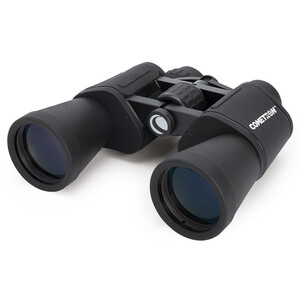
The astronomy classic among affordable binoculars: 7×50 with a large exit pupil for bright handheld views of the Moon and Milky Way – the ideal first step before a telescope.
Price: € 65
Feeling a little more ambitious? An entry-level refractor like the Omegon AC 70/700 is ideal for discovering the Moon, Saturn’s rings and the phases of Venus. Easy to use and easy on the wallet, it makes an excellent first telescope to give.
Best value: Omegon Telescope AC 70/700 AZ-2
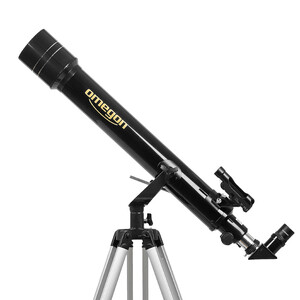
The no-pitfall starter refractor: Moon, Saturn's rings and Jupiter's moons from the very first night. No collimation.
Price: € 129
Best for advanced observers: Skywatcher Dobson Telescope N 200/1200 Skyliner Classic
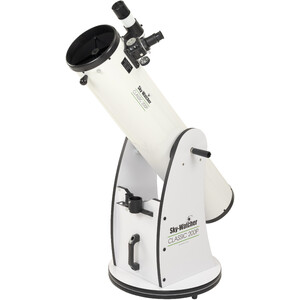
200 mm of aperture — the most sky for your money. Set it on the ground, point by hand: nebulae, clusters and galaxies for years to come.
Price: € 479
For a genuinely modern gift, a smart telescope is a game-changer: controlled from a smartphone, it automatically finds targets and stacks images to reveal galaxies and nebulae in colour. The Seestar S30 Pro is the dream present for anyone who wants to try astrophotography without the steep learning curve – and it arrives complete, with tripod and solar filter in the box.
High-tech pick: ZWO Seestar S30 Pro Smart Telescope

ZWO's benchmark smart telescope: a polished app, mosaic mode and stunning results in minutes.
Price: € 699
* Affiliate link: if you buy through this link we may earn a small commission from Astroshop or High Point Scientific, at no extra cost to you.
Not sure which model to choose? Take a look at our guide to the best beginner telescopes before deciding — and remember that an eyepiece kit is a great way to round out a telescope you’ve already given.
Completes the gift: Omegon Eyepiece Starter Kit
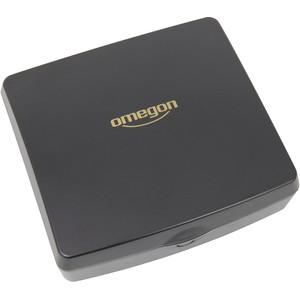
Eyepieces, filters and a Barlow in one case: everything to round out your telescope at once, cheaply.
Price: € 89
The starter set to give
A telescope on its own is half a present. The standard accessories of most entry-level telescopes are thin – usually two eyepieces, covering only part of the useful magnifications. Two additions turn the box into a complete package that works from the very first evening.
| Part | Why it belongs in the set | Price |
|---|---|---|
| Sky-Watcher Heritage 130 Tabletop DobsonianSkywatcher Dobson Telescope N 130/650 Heritage FlexTube | The basis: a real parabolic mirror, collapsible. It shows lunar craters, Jupiter’s moons and the rings of Saturn. | $269.00€ 265 |
| Celestron AstroMaster Accessory KitOmegon Eyepiece Starter Kit | Two extra eyepieces, a 2x Barlow and filters for higher magnifications – a moon filter is already included. | $89.95€ 89 |
| Orion Star Target PlanisphereOculum Swivelling Sky Map 29 cm | It answers the first question of every night: what is up right now? No app, no battery. | $7.95€ 19.90 |
The fourth building block would be a good beginner’s handbook – the one we recommend is published in German only. Our guide to beginner telescopes does the same job, and it is free.
Decorating the astro-cave: posters, globes and star maps
Astronomy is, above all, a visual feast — so it’s no surprise that images of the cosmos look spectacular on a wall or a desk. Beautiful photographs of the night sky printed on canvas are a daily reminder of the vastness of the Universe, and a safe bet for making a fan smile.
Scientific maps and posters
Beyond a simple print, there are detailed maps of the Moon, Mars and the solar system, drawn from the data of the latest space missions. Perfect for decorating a curious child’s bedroom or an enthusiast’s home office.
Two we keep coming back to: the National Geographic Poster Universe (about $24.90€ 24.90) is the classic reference chart – the whole universe on one sheet, scientifically clean rather than decorative kitsch. If you want a single object instead of an overview, the Oklop Andromeda Galaxy Poster 45×30 cm (about $39.90€ 39.90) is a real photograph of our neighbouring galaxy at 45 × 30 cm.
Globes of other worlds
Everyone knows the terrestrial globe — but you can also find globes of the Moon, Mars, Jupiter and even Pluto. Their surfaces are packed with detail from current research and spacecraft missions. An original gift idea that always earns a place of pride on a shelf.
These are hand-finished 40 cm globes, all at about $399€ 399 each: the Columbus Moon Globe 40 cm (hand-finished) is the obvious first choice, and the Columbus Jupiter Globe 40 cm, Columbus Mars Globe 40 cm and Columbus Pluto Globe 40 cm cover the rest. One honest note before you order for a fixed date: these globes are made by hand and the lead time changes. Each one states its current status at the retailer below – read it before you count on a globe for Christmas or a birthday.
Moon: In stock · ready for shipping in 24 h
Mars: Available to order
Jupiter: Available to order
Pluto: Available to order
The constellations in a glass sphere
This borosilicate glass sphere contains all 88 official constellations, represented by more than 5,000 stars. Available in a 2D version (the classic projection onto the celestial sphere) or a 3D version (the real distances of the stars from Earth are mapped on a logarithmic scale), it’s as decorative as it is fascinating — often with built-in LED lighting.
Learn and play: books, games and a home planetarium
To pass on the passion, nothing beats a beautiful book. A 300-page astronomy coffee-table book with hundreds of images of planets, stars and galaxies invites hours of daydreaming and suits every age. Well-explained, richly illustrated titles are often the first step towards becoming an amateur astronomer.
The home planetarium
A home planetarium uses LED technology to project pre-programmed constellations onto the ceiling. While a telescope depends on the weather, a star projector brings the sky indoors even under cloud. It doubles beautifully as mood lighting or a sleep aid — especially for children.
The two that keep winning our comparison: the National Geographic Astro Planetarium (about $97.90€ 97.90) projects a genuine star field onto the ceiling, and the Omegon Universe2go+ Handheld Planetarium (about $79€ 79) is the pocket version – you hold it up to your eye and it names what you are looking at.
Not sure which model? Our home planetarium comparison walks you through the choice.
The night sky to go: the pocket planetarium
A gift that explains the real sky: with the Universe2go+, you slide your smartphone into the viewer and simply look up. The app knows where you are looking and overlays constellations, planets and nebulae right into your field of view.
It works on the very first try, with no prior knowledge needed. That makes it a lovely gift for anyone who wants to get to know the sky before a first telescope comes along.
Omegon Universe2go+ Handheld Planetarium
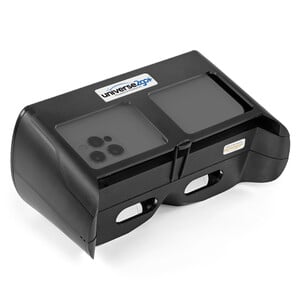
Slide in your smartphone and look up: augmented reality labels constellations, planets and nebulae live as you scan the sky.
Price: € 79
Board games and funny T-shirts
On the playful side, a space-themed board game such as CATAN – Starfarers sends 3 to 4 players off to explore distant planetary systems. And for a gift that guarantees a grin, humorous astronomy T-shirts — the cheeky nod to Pluto’s “demotion” being a perennial favourite — always hit the mark.
Truly unusual gifts: meteorites, magazines and collector’s pieces
Want to go off the beaten track? Giving someone a piece of another planet is unforgettable. A Martian meteorite — a fragment of rock blasted off Mars by an impact before landing on Earth — is a gift that’s both scientific and poetic. Iron meteorites and lunar meteorites are also available for collectors.
The one we give ourselves is the Genuine Martian Meteorite NWA 4766 (about $24.90€ 24.90) – a genuine fragment of Mars with a certificate naming its classification and find site, and that certificate is what separates a real gift from a pebble in a box. If you would rather spend less, the iron meteorite in the budget table further up does the same job for under twenty dollarseuros.
Another reliable choice is a subscription to an astronomy magazine. These publications cover astrophysics and spaceflight as well as gear and astrophotography, delivering a regular fix that keeps the enjoyment going all year round.
The gift voucher: the safe bet when you’re unsure
Not confident you’ll hit the mark? A gift voucher is hard to beat. The enthusiast will be sure to find exactly what they actually need — a book, a telescope, or the accessory that was missing from their kit: an eyepiece, a filter or an adapter. It’s the guarantee of never getting it wrong while leaving the pleasure of choosing to them.
A telescope as a gift only works if it fits the person who gets it.
Six short questions, an honest answer by email – even when binoculars are the better choice.
Frequently asked questions about astronomy gifts
What astronomy gift should I get for a child?
Illustrated books, a home planetarium, a pair of binoculars or a small tabletop telescope are perfect for children. Choose an instrument that is simple to handle and sturdy, so the excitement lasts well beyond the first night out.
How much should I budget for a first telescope?
Expect to spend between $150 and $250€100 and €150 for a good entry-level refractor, and around $350 to $700€250 to €400 for a Dobsonian that will keep a beginner happy for years. Below $30€30, a book or a poster is the smarter choice.
Binoculars or a telescope for a beginner?
Binoculars are simpler, lighter and ready to use — ideal for a first taste of the sky. A telescope shows more detail on the Moon and planets but takes a little more learning. For a risk-free gift, a pair of 10×50 binoculars is an excellent place to start.
What’s a genuinely original astronomy gift?
A real meteorite, a glass sphere depicting the 88 constellations, a globe of Mars or a smart telescope for astrophotography all stand out from the crowd and will delight any fan looking for a present that’s truly out of the ordinary.
What else does a telescope need when you give it as a present?
An eyepiece kit for higher magnifications and a swivelling star chart. With those two, the telescope is fully usable from the very first evening, with nothing to order afterwards. The specific parts are listed above under “The starter set to give”.
Read next:
- Best beginner telescopes
- Which telescope should you buy for a child?
- How to choose astronomy binoculars
This article is also available in other languages: Deutsch · Français · Italiano