By Alexander Merz · Updated on · Details checked on 13 October 2026
📅 All the dates at a glance: Our Shooting Star Calendar 2026/2027 shows every peak with a moon rating.
⚡ The next meteor shower
Orionids – 21–22 October 2026 (tomorrow night), up to 20 meteors/h. Good80 % illuminated, the Moon sets at 03:09. Best time 05:39, radiant 56° high. Realistically about 10 meteors/h under a dark rural sky. Fast meteors from Halley’s Comet, radiant high after midnight.
All showers with moon forecast in the meteor shower calendar →
In our solar system we can observe numerous interesting phenomena. One of them is shooting stars.
The main meteor showers at a glance
A meteor shower happens when the Earth crosses the dust trail of a comet. Because every particle arrives from the same direction, the meteors appear to come from a single point in the sky – the radiant. Each shower is named after the constellation that point lies in.
- Perseids (July/August, radiant in Perseus) – the best known shower, up to 100 meteors an hour. Everything about the 2026 peak: Perseids 2026.
- Kappa Cygnids (3 to 25 August, radiant in Cygnus) – only around three meteors an hour, but unusually slow and bright fireballs. Because Cygnus stands almost overhead in August, the radiant is easy to find.
- Alpha Aurigids (late August/early September, radiant in Auriga) – a small shower with the occasional surprise.
- Orionids (October, radiant in Orion) – dust from Halley’s Comet, very fast meteors.
- Leonids (November, radiant in Leo) – at 71 km/s the fastest meteors of all.
- Geminids (December, radiant in Gemini) – with up to 150 meteors an hour the richest shower of the year.
- Quadrantids (early January) and Lyrids (April, radiant in Lyra) – the two highlights of the first half of the year.
Every peak, with a moon rating and a visibility forecast, is listed in the Shooting Star Calendar 2026/2027.
Do you need a telescope for this?
No – and that will not change. Meteors are fast and can appear anywhere in the sky, while binoculars and telescopes narrow exactly the field of view that matters. What you need is a dark spot, a blanket and patience.
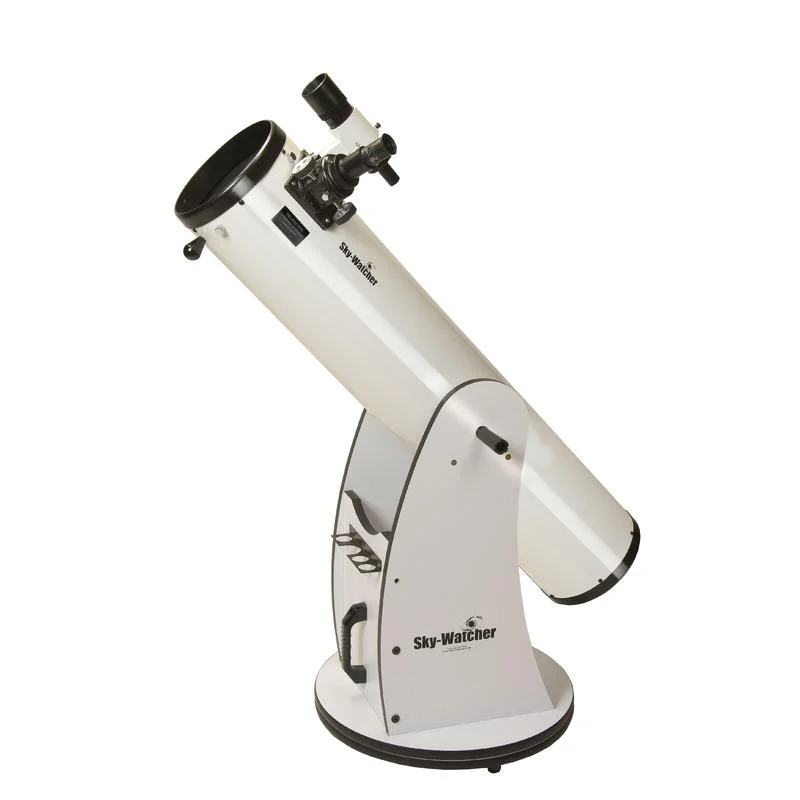
It is a different matter once the rest of the sky makes you curious while you wait – Saturn’s rings, the lunar craters, the moons of Jupiter. For those an instrument really is needed, and getting started costs less than most people expect.
Which design suits you is sorted out in the beginner’s telescope guide; once the budget is fixed, the telescope under $300300 euros comparison helps.
What is a shooting star or meteor?
Besides the planets, countless grains of sand and dust also orbit the Sun. Along their paths they collide with our Earth as well. These particles, known as meteoroids, enter the Earth’s atmosphere at several tens of thousands of km/h, briefly glow as a meteor (shooting star) and vaporize. As they burn up, air particles are ionized (recombination glow). We call the several-thousand-degree hot gas around the disintegrating bodies a shooting star or meteor. The few bodies that make it all the way to the Earth’s surface are called meteorites.
When the brightness is greater, we speak of fireballs or bolides. “The amount of meteor dust that rains down on the Earth every day is estimated at several hundred tons per day.”
Meteor shower night – especially many meteors in the sky
Shooting stars are best seen in the second half of the night. The observer is then located on the leading side of the Earth’s motion around the Sun. A meteor shower night with especially many meteor swarms occurs with the Perseids in August or the Geminids in December.
Can I buy a shooting star?
Not the shooting star itself – that vaporises 80 km up. But the fragments that survive the fall are meteorites, and those are traded quite openly. As a present for a birth, a birthday or an anniversary they are hard to beat: a stone older than the Earth, in a box.
Be clear about what the money buys, though. At the prices below you get a fragment of a few grams behind glass, not a museum specimen. The one thing that decides whether it is worth anything is the certificate, which should name the classification and the place the meteorite was found.
The usual way in is the Campo del Cielo Iron Meteorite in Gift Pouch for € 16.90 – iron from the Campo del Cielo strewn field in Argentina, ready to hand over. One step up, the Genuine Martian Meteorite NWA 4766 is a certified splinter of Mars weighing 0.007 to 0.014 grams, € 24.90. The Genuine Moon Meteorite NWA 10203 is the one that ends conversations at € 69.90: lunar rock from North West Africa.Whichever dealer you use, insist on a certificate that names the classification and the find location. On the meteorite market that document, not the asking price, is what separates a genuine fragment from a lump of industrial slag.
And for watching rather than owning: shooting stars need no equipment at all – a dark spot, a reclining chair and half an hour for your eyes to adapt beat any telescope. If you want one anyway, our beginner’s guide sorts the sensible options by budget.
What does “Sternschnuppe” mean in English?
“Sternschnuppe” in English means: “shooting star”.
Sources
The vast majority of meteors burn up completely. Only a tiny fraction survives the flight through the atmosphere – what happens then, in a meteorite impact, you can read here.