By Alexander Merz · Published on · Details checked on 14 September 2026
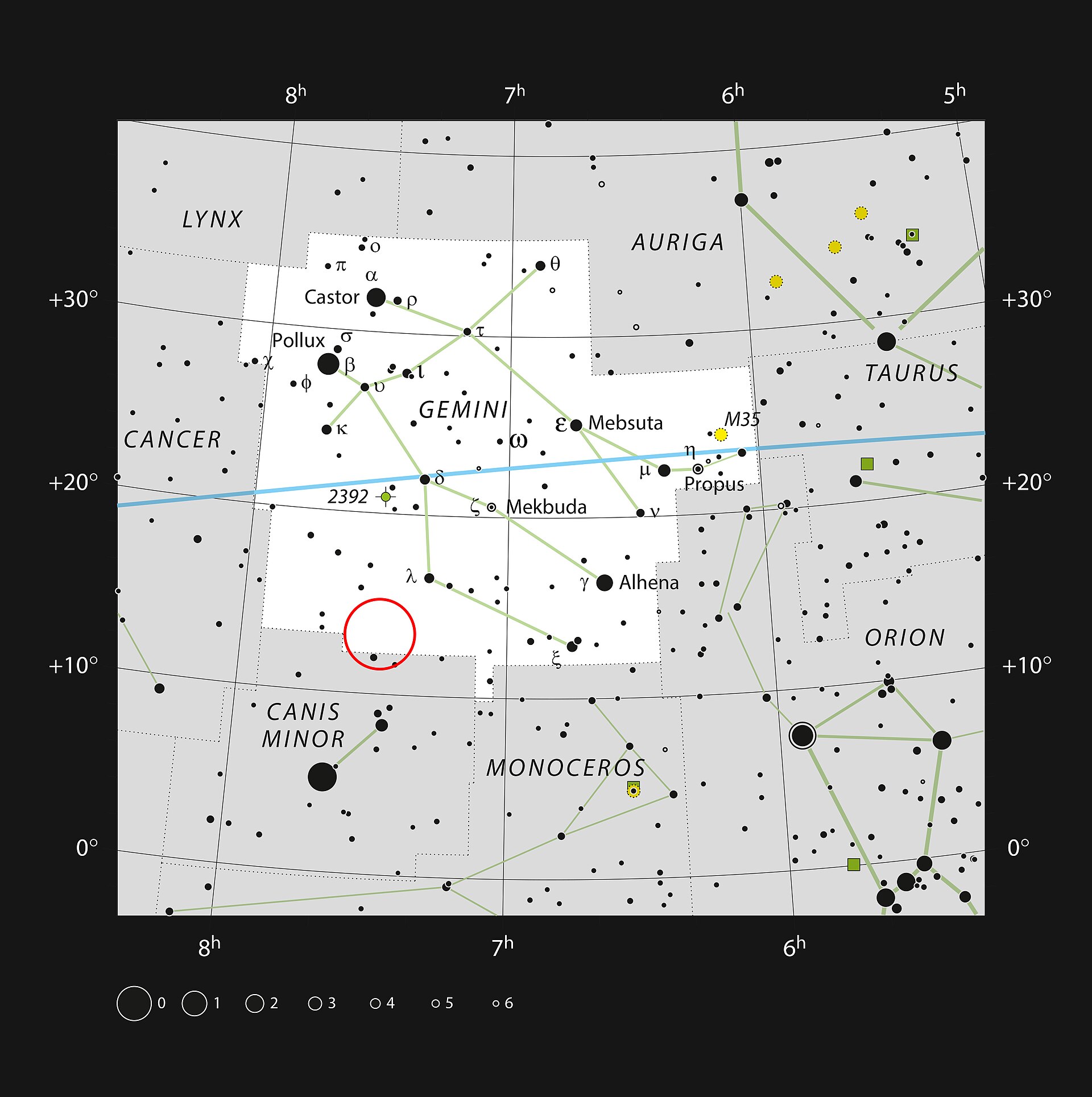
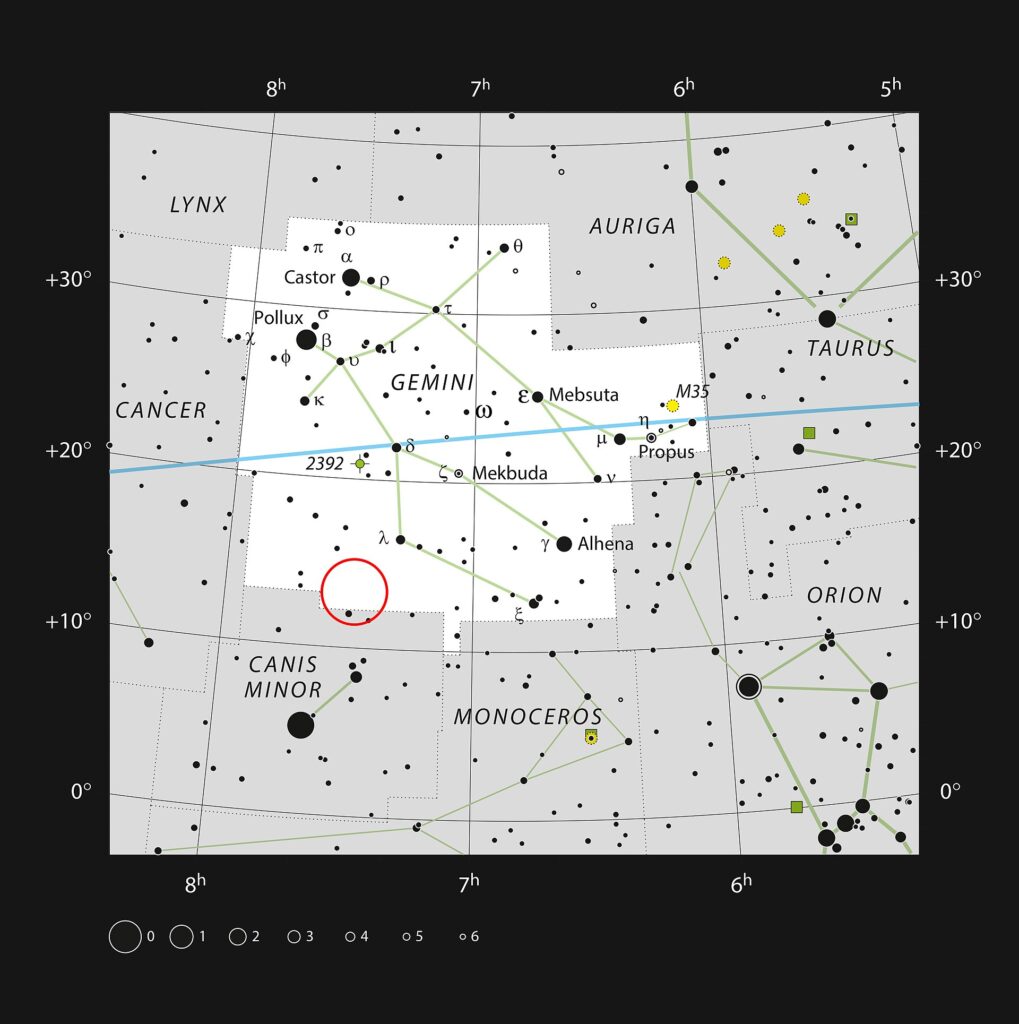
Even among non-astronomers, the constellation Gemini is an astronomical celebrity. In the winter sky, every year during Advent, the Geminids stream from this radiant on the ecliptic. This rich meteor shower delights “wish-hunters” as much as astronomers, as it makes very bright shooting stars flare up in the sky. The second-brightest star, “Castor”, is visible to the naked eye. In the telescope it reveals itself, like other stars of the constellation, to be a multiple star system.
Arabic view and Greek mythology around the main stars
For the mythological interpretation of the constellation Gemini, the most prominent depiction is the Greek tale of the inseparable sons of Zeus. In astronomical terms, these are the northern main stars of Gemini on the ecliptic in the winter sky. Mythologically, the brothers dwell alternately on Olympus and in Hades. Grieving for Castor, his twin brother asked Zeus for half of his own immortality for the one who had in fact fallen in a quarrel.
The ancient Arabs, too, knew this prominent constellation on the ecliptic. For them, the constellation Gemini symbolised a reclining lion. The meteor shower of the Geminids was in all likelihood unknown to the astronomers of antiquity. The multiple nature of the star Castor, too, could only be recognised in the age of the telescope. As very bright stars in the winter sky, however, the constellation and its main stars were nonetheless often described.
Double stars and deep sky in the constellation Gemini
Many open star clusters can be seen in the constellation Gemini with the naked eye in the winter sky. The “Eskimo Nebula” already shows itself in smaller telescopes. Occasionally, observing the objects can be made harder by their position on the ecliptic, when the Moon or planets pass through those positions.
On clear nights, observers in Central Europe can hope for especially beautiful impressions in the winter sky at the position of the constellation Gemini. The band of the Milky Way lies in the eastern part of the constellation. Some of the open star clusters there are quite bright – on dark winter nights they can be made out on the ecliptic as little patches with the naked eye already, and in more detail with small telescopes.
⭐ Also interesting: Why your zodiac sign does not match the constellation
➡️ The eastern neighbour: About 15 degrees to the left of Pollux begins the constellation Cancer with the star cluster Praesepe (M 44) – the most rewarding binocular object in the region.