By Alexander Merz · Published on · Details checked on 2 October 2026
⚡ The quick answer: Canopus is the second-brightest star in the entire night sky – only Sirius outshines it. This white-yellow supergiant in the constellation Carina (the Keel) is around 310 light-years away and shines more than 10,000 times brighter than the Sun. The catch: from the UK and Central Europe, Canopus is never visible – it sits too far south in the sky.
More in the overview: Stars.
Canopus at a glance
- Constellation: Carina (the Keel), southern sky
- Apparent magnitude: −0.74 mag (second only to Sirius at −1.46 mag)
- Distance: about 310 light-years
- Type: bright giant/supergiant of spectral class F0 – shining white-yellowish
- Luminosity: more than 10,000 times that of the Sun
- Diameter: about 70 times larger than the Sun
Why you never see Canopus from the UK or Central Europe
With a declination of about −53 degrees, Canopus sits deep in the southern sky. The rule of thumb: a star can only clear your horizon if your latitude minus its declination stays below 90 degrees. From the UK and Central Europe (roughly 47–59° north) that sum is 100 degrees or more, so Canopus stays below the horizon at all times. Only south of about 37 degrees north does it peek just above the horizon: on Crete, Cyprus or the Canary Islands you can catch it low in the south in winter – a lovely target for a holiday night out!
The further south you travel, the higher it climbs. In the Southern Hemisphere Canopus is a dominant, almost circumpolar star – in Australia or South Africa it is one of the defining lights of the night sky.
The most important star in spaceflight
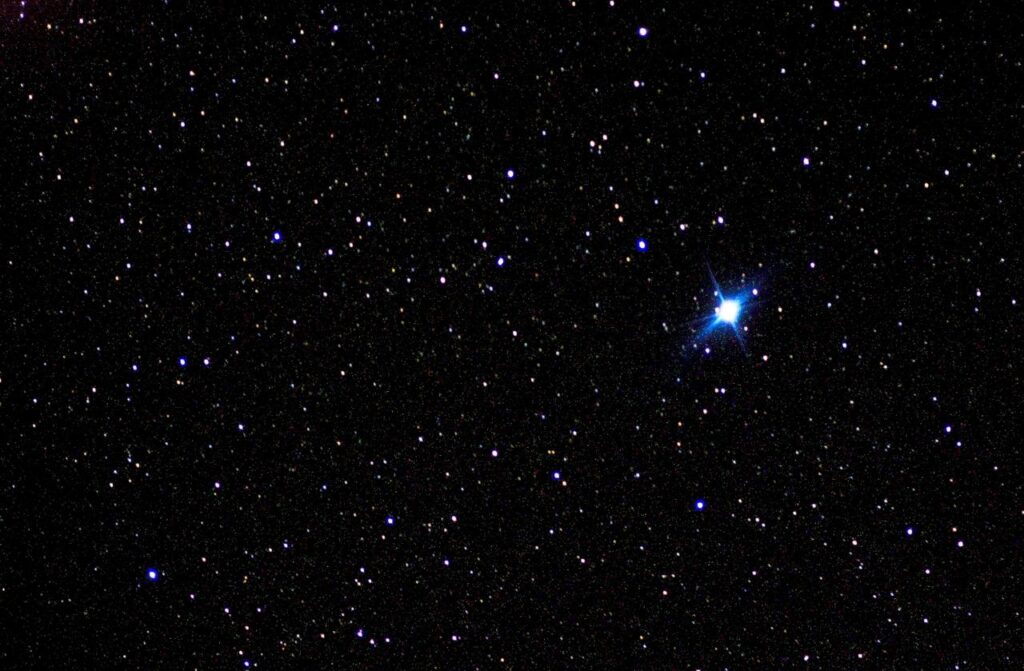
Of all stars, the one Europeans never get to see is one of the most important in the history of spaceflight: Canopus is bright and lies far from the plane of the solar system, which makes it the ideal reference point for space probes. Since the 1960s, missions from Mariner to Voyager have used so-called “Canopus trackers” – star sensors that keep the spacecraft oriented in space. The ISS crew has photographed it too (see featured image).
Canopus in numbers and stories
Its name probably comes from the helmsman of King Menelaus in Greek legend – fitting for a star that has guided navigation for thousands of years: Arab sailors and desert travellers already steered by it. By the way, in a few billion years our Sun will also become a giant star – Canopus already shows what such a stage of stellar evolution looks like.
Frequently asked questions about Canopus
Is Canopus brighter than Sirius?
Not in the sky – Sirius (−1.46 mag) remains the brightest star of the night. In reality, though, Canopus is by far the more luminous star: it shines several hundred times more strongly, but is almost 40 times farther away than Sirius.
Where can you see Canopus from?
Reliably south of about 37 degrees north – in the Mediterranean (southern Spain, Crete, Cyprus), on the Canary Islands and anywhere in the Southern Hemisphere. From the UK and Central Europe it always stays below the horizon.
Which bright star is the “substitute” from the UK and Central Europe?
The brightest star visible from here is Sirius in the winter constellation Canis Major (the Great Dog) – right after it comes Arcturus, which shines in spring and summer (across the whole sky it is only number four, because Canopus and Alpha Centauri never rise at our latitudes).
⭐ More star portraits: Sirius · Vega · Polaris · Betelgeuse — and what the sky is showing right now: The night sky in October 2026
Also never above our horizon: Alpha Centauri, the third-brightest star at −0.27 mag and our nearest neighbour.