
By Alexander Merz · Published on · Details checked on 14 September 2026
August 2026 is not a normal observing month – it is the astronomy month of the decade. On 12 August the Moon eats away up to 90 percent of the Sun in the evening sky over Central Europe, and in the very same night the Perseids reach their maximum – at new moon, so under a perfectly dark sky. Two weeks later, on 28 August, the full moon set while it was still eclipsed. In between lie four weeks with Saturn as the planet of the night, the Milky Way in its finest summer position and nights that grow longer and darker from day to day. All the dates, all the times – and its own set of figures for every larger city.
⚡ The quick answer: The three must-see dates in August 2026 are 12 August (partial solar eclipse in the early evening, 84 to 90 % obscuration over Germany), the night of 12/13 August (Perseid maximum at new moon, 50 to 70 meteors per hour under a dark rural sky) and 28 August (partial lunar eclipse, with the Moon setting 77 to 94 % eclipsed – that one is over, the recap is in the guide). The planetary highlight is Saturn, which by the end of the month already rises at 21:20 CEST. It only gets properly dark at around 23:50 in early August, and as early as 22:12 by the end of the month.
The key facts at a glance
- 12 August (past): The partial solar eclipse brought 84 to 90 % obscuration over Germany – the biggest solar event since 1999; all the coming dates are listed in the guide
- Night of 12/13 August (past): The maximum of the Perseids fell on a moonless new-moon night – stragglers from the stream are still visible until around 24 August, fewer with every evening
- 28 August (past): The partial lunar eclipse began at 04:33 – the Moon set in the morning twilight 77 to 94 % eclipsed; the recap with all the times is in the guide
- What comes next: The last nights of August belong to Saturn and the Milky Way – on 31 August the Moon passes about 6° from Saturn. After that: the occultation of Venus on 14 September, Neptune at opposition on 26 September and Saturn at opposition on 4 October 2026
- Planets: Saturn becomes the planet of the whole night, Mercury shows itself in the morning sky in early August, Venus stays a low evening greeting despite its greatest elongation
- Deep sky: The Milky Way, the Summer Triangle and the Andromeda Galaxy – August is the best month of the year for long looks into space
- Darkness: Astronomical night grows from 3.1 to 6.3 hours over the course of the month – by late August it is worth setting up noticeably earlier
- Outlook: After that the night sky in September takes over – with the occultation of Venus on 14 September, the opposition of Neptune and the Harvest Moon
Sky events in August 2026: the calendar
All dates with times in Central European Summer Time (CEST), calculated for the centre of Germany (51.2° N / 10.5° E). For places further west, rises and sets shift up to 20 minutes later, and correspondingly earlier in the east.
| Date | Event | What it means for you |
|---|---|---|
| 2 August | Mercury at greatest western elongation (19.5°) | Best morning visibility of the year: rises around 04:15, about 0.3 mag bright, low in the north-east |
| 4 August | Moon near Saturn (about 5°) | After midnight in the south-east, a pretty pair for binoculars |
| 6 August, 04:21 | Last quarter | From now on the nights get darker from one day to the next |
| 9 August | Crescent Moon near Mars (about 4°) | Very low in the north-east shortly before morning twilight – difficult, but a lovely photo subject |
| 11 August | Slim crescent Moon near Mercury (about 1°) | Around 04:30 above the north-eastern horizon, the last Mercury window of the month |
| 12 August, 19:36 | New moon | Exactly on the day of the solar eclipse and in the night of the Perseid maximum |
| 12 August, 19:11–21:00 | Partial solar eclipse | Maximum between 20:05 and 20:17 depending on location, 84 to 90 % obscuration – only with eclipse glasses! |
| Night of 12/13 August | Perseid maximum | No moonlight, plus a radiant that climbs to 67° by morning |
| 15 August | Venus at greatest eastern elongation (45.9°) | Geometrically the best evening date – yet still only a low greeting, because of the shallow summer ecliptic |
| 16 August | Crescent Moon near Venus (about 2°) | In the bright evening twilight, close above the western horizon |
| 20 August, 04:46 | First quarter | Half moon in the evening sky – the best time for craters in the telescope |
| 28 August, 06:18 | Full moon | The full moon coincides exactly with the lunar eclipse |
| 28 August, 04:33–06:56 | Partial lunar eclipse | Maximum at 06:13 with 93.8 % – from Central Europe the Moon sets in the middle of the eclipse |
| 31 August | Moon near Saturn (about 6°) | The ringed planet is now already in the evening sky |
When does it get really dark in August?
August is the month in which astronomy returns to Germany. In June there is no astronomical night at all in the northern half of the country, in early August it is barely three hours – and by the end of the month this window almost doubles. Astronomical darkness means that the Sun is more than 18° below the horizon and its residual light no longer plays a role. Only then do you see the Milky Way as it is meant to be seen.
| Date | Sunset | Astronomical darkness from | until | Sunrise | Hours of darkness |
|---|---|---|---|---|---|
| 1 August | 21:06 | 23:52 | 03:00 | 05:46 | 3.1 |
| 5 August | 21:00 | 23:36 | 03:14 | 05:52 | 3.6 |
| 10 August | 20:50 | 23:18 | 03:32 | 06:00 | 4.2 |
| 15 August | 20:40 | 23:02 | 03:46 | 06:08 | 4.7 |
| 20 August | 20:30 | 22:46 | 04:00 | 06:14 | 5.2 |
| 25 August | 20:20 | 22:30 | 04:14 | 06:22 | 5.7 |
| 31 August | 20:08 | 22:12 | 04:28 | 06:32 | 6.3 |
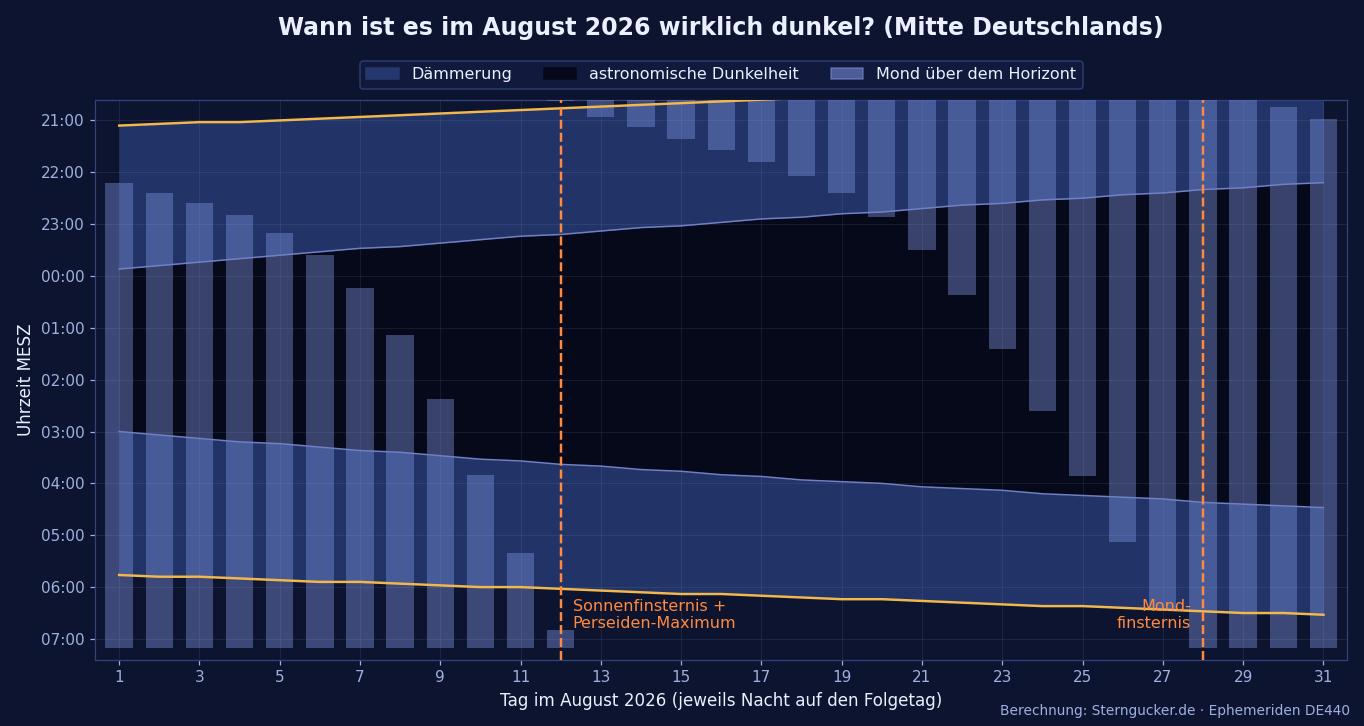
The graphic shows you the real observing plan for the month: in the first week the waning Moon only gets in the way during the second half of the night, around 12 August it is completely out of the picture, and from 20 August the waxing Moon eats further and further into the evening. So if you want to photograph the Milky Way, you have two windows: the nights from 8 to 17 August and the last two nights of the month.
How much of it you actually see depends on a second factor that no calculation can supply: the light pollution at your location. Under a brightened suburban sky, little of the Milky Way survives even in the darkest hour.
The solar eclipse on 12 August: looking back
On the evening of 12 August 2026 the new moon moved in front of the Sun. Over Iceland and northern Spain the eclipse was total; over Germany a deep partial phase remained: between 19:11 and 19:24 the Moon took its first bite out of the solar disc, and between 20:05 and 20:17 it was at its deepest. Depending on the location, 84 to 90 percent of the Sun’s surface was covered – low above the western horizon, shortly before sunset.
Nothing like it had been seen in Germany since the total eclipse of 1999; the next comparably deep solar eclipse over Germany will not follow until 2081. The next total eclipse within reach comes considerably sooner: on 2 August 2027 over southern Europe and North Africa.
How the eclipse unfolded, which times and degrees of obscuration applied to your city and when eclipse glasses will be worth having again – it is all in the big guide:
🌘 Everything about the solar eclipse of 12 August 2026
The complete review with all times and degrees of obscuration for your city – and the coming solar eclipse dates, first and foremost the total eclipse of 2 August 2027.
The Perseids 2026: the best meteor night in years
The Perseids are the most reliable meteor shower of the year – and in 2026 their maximum, in the night of 12 to 13 August, coincided with new moon: no sky glow, no glare, just the natural night sky. The maximum is now over, but the Perseids are not finished entirely: until around 24 August, individual shooting stars keep falling out of Perseus, fewer with every evening.
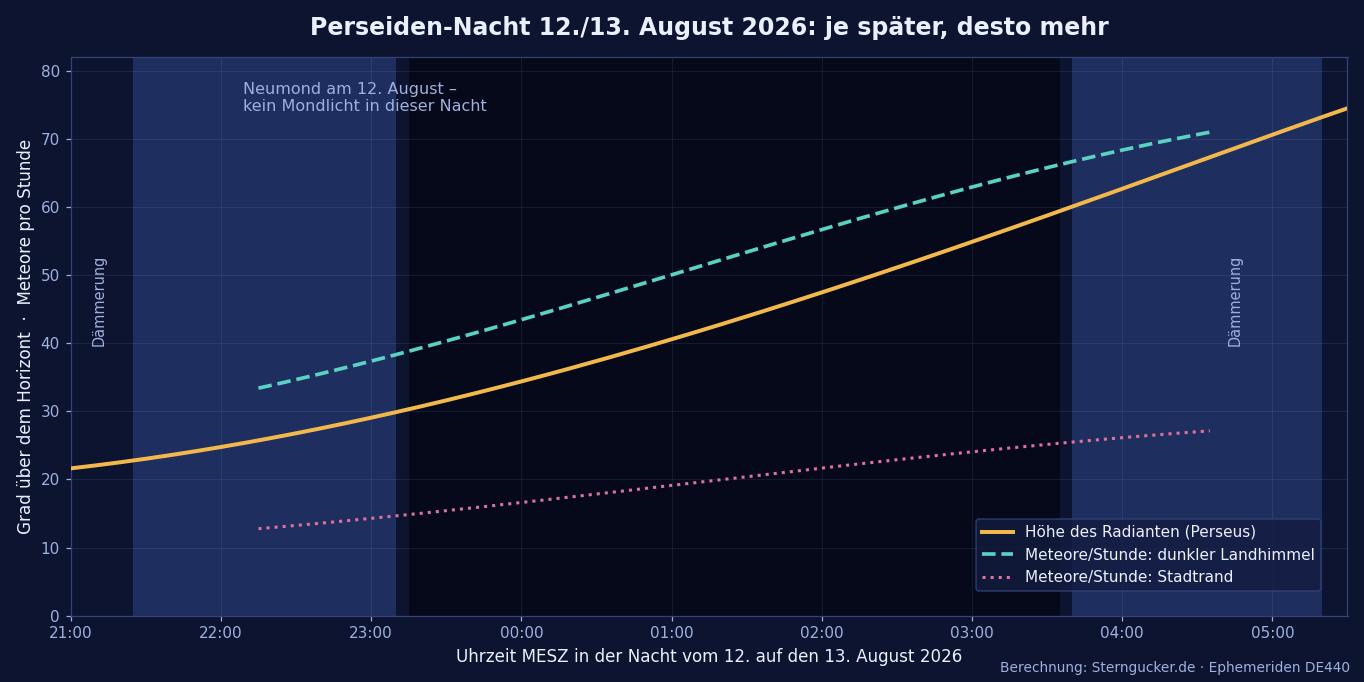
The decisive factor is the altitude of the radiant, the point in the constellation Perseus from which the meteors appear to come. The higher it stands, the more meteors fall into your field of view at all. At 22:00 it is 25° high, at midnight 34°, at 03:00 55° and shortly before dawn 67°. That is why the same advice always applies to the Perseids: the later, the better.
| Time (CEST) | Altitude of the radiant | Dark rural sky | Edge of a city |
|---|---|---|---|
| 23:00 | 29° | about 37 meteors/h | about 14 meteors/h |
| 00:00 | 34° | about 43 meteors/h | about 17 meteors/h |
| 01:00 | 41° | about 50 meteors/h | about 19 meteors/h |
| 02:00 | 47° | about 57 meteors/h | about 22 meteors/h |
| 03:00 | 55° | about 63 meteors/h | about 24 meteors/h |
| 04:00 | 63° | about 68 meteors/h | about 26 meteors/h |
These numbers are calculated honestly: they start from a ZHR of 100 – the value the Perseids reach under idealised conditions – and scale it down to the actual radiant altitude and the real sky quality. The often quoted “100 shooting stars per hour” is something a single observer practically never sees. By contrast, 50 to 70 meteors in the hour before dawn, far from the cities, is a realistically achievable target.
For the observation itself you need no equipment. Binoculars and telescopes even do harm here: they narrow your field of view and make you miss almost everything. What does help is a deckchair or a sleeping mat, warm clothing – in August the temperature drops below 10 °C at night – and 20 minutes of patience until your eyes are dark-adapted. A single glance at your phone resets that adaptation.
🌠 The complete Perseid plan
Best times, suitable observing sites, camera settings and the hour-by-hour schedule for the double evening of solar eclipse and shooting stars.
And if you want to know which showers come next: the meteor shower calendar lists all maxima up to the end of 2027.
Partial lunar eclipse on 28 August: the Moon set eclipsed
On the morning of 28 August the full moon dipped into the Earth’s umbra – and deeply so: at maximum, at 06:13 CEST, 93.8 percent of the Moon’s diameter was eclipsed. That is a narrow miss from a total eclipse; a thin bright strip remains on the southern edge.
The catch for Central Europe: at that moment the Moon is practically on the horizon already. The partial phase begins at 04:33, when the Moon is still 12 to 20° high in the west – that is the real show. After that it sinks lower and lower while growing darker and darker, until it sets between 06:10 and 06:56. Nobody in Germany experiences the maximum itself against a dark sky: by then the Sun is already rising on the opposite side.
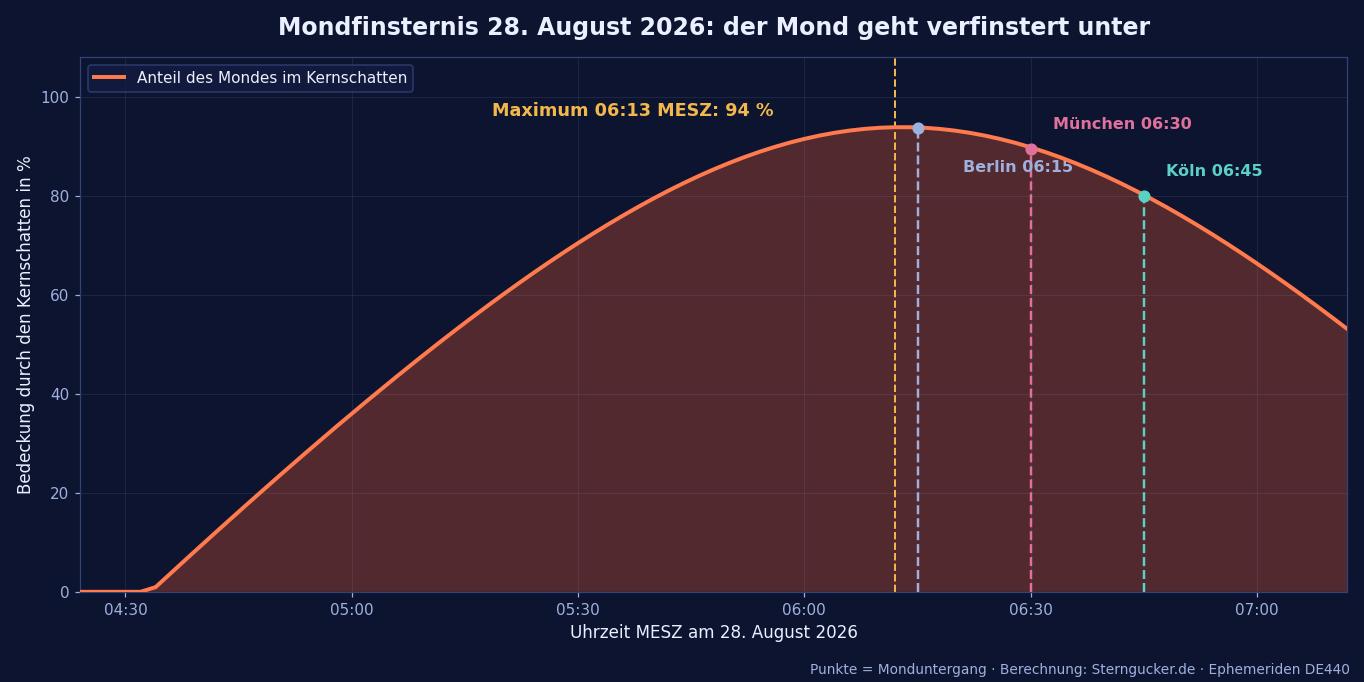
This leads to an unusual geography: the further east you are, the more of the eclipse you get to see – because the Moon sets later there relative to the course of the eclipse. In Dresden and Rostock it disappears behind the horizon more than 93 percent eclipsed, in Geneva only just under 70 percent. Conversely, in the west and south the Moon is higher at the start of the eclipse and therefore more comfortable to watch.
In practice this means: get up at 04:15 and look for a clear view towards the west. A hill, a field track, a lake – anything that keeps the view open all the way to the horizon. Binoculars make the colouring of the umbra visible; for photos a telephoto lens of 200 mm or more on a tripod is enough.
Moonset and obscuration for 44 German cities
All times in CEST, calculated for a level horizon. The column “Moon altitude at 04:33” tells you how high the Moon stands at the start of the partial phase – the larger the value, the more relaxed the observation.
| Location | Moonset | Obscuration at moonset | Moon altitude at 04:33 |
|---|---|---|---|
| Aachen | 06:49 | 76.6 % | 17.2° |
| Augsburg | 06:33 | 88.2 % | 16.4° |
| Berlin | 06:15 | 93.7 % | 12.6° |
| Bielefeld | 06:36 | 86.1 % | 15.2° |
| Bochum | 06:43 | 81.5 % | 16.2° |
| Bonn | 06:45 | 80.1 % | 16.8° |
| Braunschweig | 06:27 | 90.7 % | 14.1° |
| Bremen | 06:33 | 88.0 % | 14.4° |
| Chemnitz | 06:20 | 93.0 % | 13.8° |
| Dortmund | 06:42 | 82.4 % | 16.1° |
| Dresden | 06:16 | 93.6 % | 13.3° |
| Duisburg | 06:45 | 80.0 % | 16.4° |
| Düsseldorf | 06:45 | 79.7 % | 16.6° |
| Erfurt | 06:28 | 90.6 % | 14.7° |
| Essen | 06:44 | 80.8 % | 16.3° |
| Flensburg | 06:27 | 91.0 % | 13.0° |
| Frankfurt am Main | 06:39 | 84.2 % | 16.4° |
| Freiburg im Breisgau | 06:46 | 78.9 % | 18.2° |
| Garmisch-Partenkirchen | 06:33 | 87.8 % | 16.8° |
| Gelsenkirchen | 06:43 | 81.1 % | 16.2° |
| Halle (Saale) | 06:23 | 92.3 % | 13.9° |
| Hamburg | 06:27 | 90.8 % | 13.6° |
| Hannover | 06:30 | 89.3 % | 14.4° |
| Karlsruhe | 06:42 | 82.0 % | 17.3° |
| Kassel | 06:34 | 87.7 % | 15.2° |
| Kiel | 06:25 | 91.7 % | 13.0° |
| Konstanz | 06:41 | 82.8 % | 17.7° |
| Krefeld | 06:46 | 79.2 % | 16.6° |
| Cologne | 06:45 | 79.9 % | 16.7° |
| Leipzig | 06:21 | 92.7 % | 13.8° |
| Lübeck | 06:23 | 92.1 % | 13.0° |
| Magdeburg | 06:23 | 92.3 % | 13.7° |
| Mainz | 06:41 | 82.8 % | 16.7° |
| Mannheim | 06:41 | 82.8 % | 16.9° |
| Mönchengladbach | 06:47 | 78.5 % | 16.8° |
| Munich | 06:30 | 89.4 % | 16.2° |
| Münster | 06:40 | 83.5 % | 15.7° |
| Nuremberg | 06:30 | 89.5 % | 15.6° |
| Rostock | 06:17 | 93.5 % | 12.2° |
| Saarbrücken | 06:48 | 77.6 % | 17.8° |
| Stuttgart | 06:39 | 84.1 % | 17.0° |
| Sylt (Westerland) | 06:31 | 88.9 % | 13.4° |
| Wiesbaden | 06:41 | 82.9 % | 16.6° |
| Wuppertal | 06:43 | 81.0 % | 16.4° |
Austria and Switzerland
| Location | Moonset | Obscuration at moonset | Moon altitude at 04:33 |
|---|---|---|---|
| Basel | 06:48 | 77.4 % | 18.6° |
| Bern | 06:49 | 76.1 % | 19.1° |
| Geneva | 06:56 | 69.9 % | 20.3° |
| Graz | 06:16 | 93.7 % | 14.7° |
| Innsbruck | 06:32 | 88.4 % | 16.8° |
| Salzburg | 06:24 | 91.8 % | 15.6° |
| Vienna | 06:10 | 93.7 % | 13.5° |
| Zurich | 06:44 | 80.5 % | 18.2° |
You will find more on the mechanics of umbra and penumbra, on the colour of the eclipsed Moon and on the next dates on our page about the lunar eclipse.
The Moon phases in August 2026
| Date | Time (CEST) | Moon phase | What that means for you |
|---|---|---|---|
| 6 August | 04:21 | Last quarter | Waning Moon – the nights get darker from one day to the next |
| 12 August | 19:36 | New moon | A perfectly dark sky for the Perseid maximum – and the precondition for the solar eclipse on the same evening |
| 20 August | 04:46 | First quarter | Half moon in the evening sky – the best time for craters and mountain ranges in the telescope, because the shadows along the terminator are at their longest |
| 28 August | 06:18 | Full moon | Coincides with the partial lunar eclipse – the Moon sets eclipsed |
All the full moon dates of the year are listed in the full moon calendar, and all the phases day by day in the moon calendar 2026.
You now know what is in the sky this month. What will you look through?
Six short questions, an honest answer by email – with no pressure to buy.
The dates that are actually worth it are often months apart – and easily forgotten. So you do not miss one:
One short email, in good time – with the times and an honest take on whether it is worth getting up for.
You will get a confirmation email in a moment. Your address stays with us – no sharing, no third-party ads.
The planets in August 2026
August belongs to Saturn. The ringed planet stands in Pisces, rises around 23:00 at the start of the month and as early as 21:20 by the end – its opposition in early October is casting its shadow ahead. All times apply to the centre of Germany.
| Planet | Visibility | Rise or set on 15 August | Brightness | Constellation |
|---|---|---|---|---|
| Saturn | The whole second half of the night | Rises 22:22 | +0.7 mag | Pisces |
| Neptune | Second half of the night, telescope only | Rises 21:58 | +7.8 mag | Pisces |
| Uranus | Last third of the night, binoculars are enough | Rises 00:02 | +5.7 mag | Taurus |
| Mars | Morning sky, very low and difficult | Rises 01:42 | +1.3 mag | Gemini |
| Jupiter | Only from the end of the month, in the morning twilight | Rises 05:00 | −1.8 mag | Cancer |
| Venus | Evening twilight, very low in the west | Sets 21:48 | −4.3 mag | Virgo |
| Mercury | Only in the first half of the month, in the morning sky | Rises 04:54 | −1.2 mag | Cancer |
Saturn is the most rewarding telescope target of the month. Even 60x magnification visibly separates the rings from the globe; from about 100x the Cassini division becomes recognisable when the air is steady. The best time is the second half of the night, when Saturn is high enough that its light no longer has to pass through the turbulent air near the horizon.
Mercury is the surprise of the month. On 2 August it reaches its greatest western elongation at 19.5° and is therefore as easy to see in the morning sky as it rarely ever is. Look for it between 04:15 and 05:00 low in the north-east – an unobstructed horizon is essential. After 15 August it disappears into the sunlight again.
Venus is the classic case of “numbers do not lie, but they do deceive”. On 15 August it is 45.9° from the Sun, further than at any other time this year – and yet you can barely see it. The reason is the ecliptic, which lies very flat to the horizon in late summer: the large angular distance does not translate into altitude. Venus sets at 21:48, so a good hour after the Sun, and never stands more than a hand’s width above the horizon.
Mars is currently inconspicuous at +1.3 mag and sits low in the morning twilight – an object for collectors, not for connoisseurs. Jupiter returns from its close approach to the Sun at the end of August; on 15 August it is only 0.5° from Mercury, but by then both are too close to the Sun to be observed safely.
The constellations in August: Summer Triangle and Milky Way
Anyone who looks up in August first sees three very bright stars spanning a large triangle above the zenith: the Summer Triangle. It is not an official constellation but a memory aid made up of the brightest stars of three constellations – and the best way into finding your bearings in the summer sky.
- Vega in Lyra stands almost at the zenith (78° high) at 22:20 on 15 August and is the brightest of the three. The Ring Nebula M57 lies right next to it.
- Deneb in Cygnus culminates around 00:24 at an altitude of 84°. With its wings spread, the Swan lies in the middle of the band of the Milky Way.
- Altair in Aquila stays considerably lower at 48° at 23:34 on 15 August and marks the southern tip of the triangle.
Lower in the south, just above the horizon, stand Sagittarius and Scorpius – that is where the centre of our galaxy lies. To the east of them, from the middle of August, the flat triangle of Capricornus pushes above the horizon; its main star Algedi is a double star that practised eyes can separate without any aid. Meanwhile the autumn constellations climb in the north-east: Andromeda with the Andromeda Galaxy, Perseus and Cassiopeia.
If you want to find your way around the sky, a printed star chart will often get you there faster than your phone – if only because the display destroys your eyes’ dark adaptation every time.
Finding your way with no battery at all: Oculum Swivelling Sky Map 29 cm

Set date and time, hold it up, find the constellations: the swivelling star chart shows exactly the sky above you at that moment. No battery, no signal, no screen glare.
Price: € 19.90
Deep-sky objects in August: what is really worth it
The following table shows when the most important objects are at their highest on 15 August – the moment at which you see them most sharply, because their light has to cross the thinnest layer of air.
| Object | Constellation | Highest point on 15 August | Altitude | What you need to see it |
|---|---|---|---|---|
| Vega | Lyra | 22:20 | 78° | Naked eye |
| Deneb | Cygnus | 00:24 | 84° | Naked eye |
| Altair | Aquila | 23:34 | 48° | Naked eye |
| M13 – globular cluster in Hercules | Hercules | 20:24 | 75° | A misty patch in binoculars, resolved into individual stars from 15 cm aperture |
| M57 – Ring Nebula | Lyra | 22:36 | 72° | Telescope; a small smoke ring from 100x magnification |
| M27 – Dumbbell Nebula | Vulpecula | 23:42 | 62° | A patch in binoculars, a telescope shows the dumbbell shape |
| M31 – Andromeda Galaxy | Andromeda | 04:24 | 80° | Naked eye under a dark sky, impressively large in binoculars |
| h and χ – Double Cluster | Perseus | 06:02 | 84° | The finest binocular object of the northern sky |
| M8 – Lagoon Nebula | Sagittarius | 21:46 | 15° | Binoculars, but only with a genuinely clear southern horizon |
| Centre of the Milky Way | Sagittarius | 21:28 | 10° | Naked eye – the brightest part of the band, low in the south |
Two things stand out in this table. First: the summer objects near the zenith (M13, M57, M27) culminate at a time when it is not properly dark yet. Observe them later anyway – 60° altitude in real darkness beats 75° in twilight. Second: from Germany, the centre of our galaxy never reaches more than 10° in altitude. If you want to see the Milky Way in all its glory, you have to travel either to the Alps or considerably further south.
What you need for which target can be sorted out clearly. For the Milky Way, the Andromeda Galaxy as a whole, the Summer Triangle and the star clouds in Sagittarius, a bright pair of binoculars really is the better instrument than a telescope: it shows large fields at once and can be swung around in seconds.
For sweeping across the Milky Way: Celestron Cometron 7x50 Binoculars
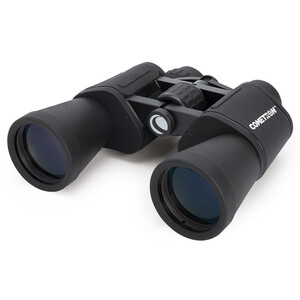
The astronomy classic among affordable binoculars: 7×50 with a large exit pupil for bright handheld views of the Moon and Milky Way – the ideal first step before a telescope.
Price: € 65
When a telescope is worth it anyway. As soon as you want to see Saturn’s rings, the craters on the half moon of 20 August, the Ring Nebula M57 or the individual stars in M13, binoculars run into a hard limit: they lack magnification and aperture. A 10×50 shows Saturn as a tiny oval; a 130 mm reflector at 100x magnification shows the rings separated from the globe. If you can only buy one instrument and really want to explore the sky, go for the telescope; binoculars are the addition, not the replacement.
The telescope for Saturn and deep sky: Skywatcher Dobson Telescope N 130/650 Heritage FlexTube
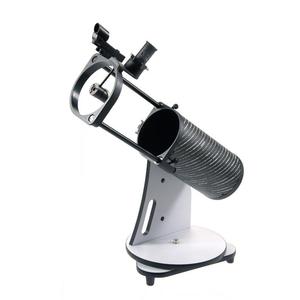
A compact tabletop Dobson with a true parabolic mirror. Folds down, fits in a bag: the Moon, planets and the bright deep-sky classics.
Price: € 265
Which design suits your budget and your balcony is worked out step by step in our guide to telescopes for beginners.
Photographing the Milky Way: settings and locations
August is the best month of the year for Milky Way photos: the bright centre stands in the south in the early evening, the nights are long enough again, and around 12 August no moon gets in the way. You do not need any special equipment for a usable image – a camera with an interchangeable lens and a stable tripod will do.
| Setting | Recommendation | Why |
|---|---|---|
| Lens | 14 to 24 mm focal length | Captures a large arc of the band and allows long exposures |
| Aperture | f/2.8 or wider | For night shots, light-gathering power matters more than sharpness in the corners |
| Exposure time | 10 to 20 seconds | Rule of thumb: 500 divided by the focal length – any longer and the stars turn into trails |
| ISO | 3200 to 6400 | Modern sensors can handle it; a little noise is better than an underexposed image |
| Focus | Manually on a bright star | Autofocus fails in the dark – focus on Vega using 10x live-view zoom |
| File format | RAW | It is the only way to bring out the Milky Way in post-processing |
| White balance | 3800 to 4200 Kelvin | Neutralises the orange light dome of the cities |
More important than any setting is the location. For a visible Milky Way you need a sky of at least Bortle class 4 – in Germany that means the Eifel, the Bavarian Forest, the Rhön, the Uckermark, the Swabian Alb and the Alps. What also matters is a clear view towards the south, because that is exactly where the brightest part of the band lies, just above the horizon. You will find more on technique and post-processing in our astrophotography section.
Equipment for the August sky
For once, August calls for three very different things – and the most expensive of them is not the most important:
- For 12 August during the day: a certified pair of solar eclipse glasses to ISO 12312-2. Without them the eclipse cannot be observed at all; with them it costs less than three euros.
- For the Perseid night: nothing at all. A deckchair, a blanket, a warm jacket. Every optical instrument makes the result worse.
- For the rest of the month: binoculars for the Milky Way and the large objects – or a telescope if you want to see Saturn, lunar craters and nebulae.
If you have to choose between binoculars and a telescope and you want to explore the sky seriously, the telescope is the right choice. The objects at which binoculars are superior can be counted on one hand; the objects for which magnification is essential fill entire catalogues.
* Affiliate link: if you buy through this link we may earn a small commission from Astroshop or High Point Scientific, at no extra cost to you.
Frequently asked questions about the night sky in August
What can you see in the sky in August 2026?
Three major events: the partial solar eclipse on 12 August with 84 to 90 % obscuration, the Perseid maximum in the night of 12 to 13 August at new moon, and the partial lunar eclipse on the morning of 28 August. On top of that Saturn as the planet of the second half of the night, the Summer Triangle at the zenith and the Milky Way right across the sky.
Which planets are visible in August 2026?
Saturn is the star: in the middle of August it rises at 22:22 and is in the sky for the whole second half of the night. Mercury shows itself in the morning sky in the first half of the month (greatest elongation on 2 August), Venus stands very low in the west in the evening, Mars is inconspicuous in the morning twilight. Jupiter only returns towards the end of the month. Uranus and Neptune are binocular and telescope objects respectively for the second half of the night.
When are the Perseids 2026 best seen?
In the night of 12 to 13 August, and as late as possible: between 03:00 and the start of twilight around 04:30 the radiant is at its highest. Under a dark rural sky, 63 to 70 meteors per hour are then realistic, and around 25 on the edge of a city. The nights from 8 to 15 August are worthwhile too.
How many shooting stars can you see per hour?
That depends on two things: the altitude of the radiant and the darkness of your sky. The frequently quoted figure of 100 meteors per hour is the so-called ZHR, a standardised comparison value for an ideal sky with the radiant at the zenith. In reality, a single observer in the Perseid night of 2026 sees 37 meteors per hour at 23:00 under a dark rural sky and about 68 at 04:00; on the edge of a city it is 14 and 26 respectively.
Which constellations are visible in August?
High at the zenith stand Lyra, Cygnus and Aquila with the Summer Triangle. In the south, low above the horizon, follow Sagittarius and Scorpius, and to the east of them Capricornus from the middle of the month. In the north-east the autumn constellations are already coming up: Andromeda, Perseus and Cassiopeia. The Big Dipper sinks in the north-west during the evening.
When can you see the Milky Way in August?
As soon as it is astronomically dark – from 23:52 in early August, and from as early as 22:12 at the end of the month. The brightest section in Sagittarius is at its highest shortly after nightfall and then sinks away. The precondition is a location far from the cities; under a brightened suburban sky nothing of the band is left. The best nights in 2026 are 8 to 17 August, because the Moon does not interfere then.
When is new moon in August 2026?
On 12 August 2026 at 19:36 CEST – exactly on the evening of the solar eclipse and in the night of the Perseid maximum. Neither is a coincidence: a solar eclipse can only take place at new moon, and the fact that the Perseid maximum falls on the same day is the stroke of luck of the year.
Where is the solar eclipse of 12 August 2026 visible?
Total over Greenland, Iceland and northern Spain. In Germany, Austria and Switzerland it is visible as a partial eclipse, with 84 to 90 % obscuration in Germany – the south-west gets more of it than the north-east. Important: observe it exclusively with certified eclipse glasses. All the times for 44 cities are listed in the solar eclipse guide.
Is the lunar eclipse of 28 August 2026 visible from Germany?
Yes, but only the first part. The partial phase begins at 04:33, when the Moon is still 12 to 20° high in the west. Nobody in Central Europe experienced the maximum at 06:13 against a dark sky: in Germany the Moon set between 06:15 and 06:49, eclipsed by 77 to 94 %, while the Sun was rising in the east. In Austria and Switzerland the range runs from 06:10 (Vienna) to 06:56 (Geneva). The further east you are, the further the eclipse has progressed at moonset.
➡️ What comes next: The night sky in September 2026 – with the opposition of Neptune and the Harvest Moon.
🛰️ Also on the move up there: The Starlink “string of lights” – what is behind it and when you can see it.
📅 Also interesting: Shooting stars 2026/2027: the complete meteor shower calendar
🗓️ Also interesting: Astronomical events 2026/2027: all sky events at a glance