By Alexander Merz · Published on · Details checked on 14 September 2026
Between two of the most striking constellations of the winter and spring sky lies a gap: on the right stand the Gemini twins, on the left Leo – and in between there seems to be almost nothing. That is exactly where the constellation Cancer lies. It is the faintest of all twelve zodiac constellations, its brightest star reaching only 3.53 mag. And yet, right in the middle of this gap sits one of the most beautiful star clusters in the entire sky.
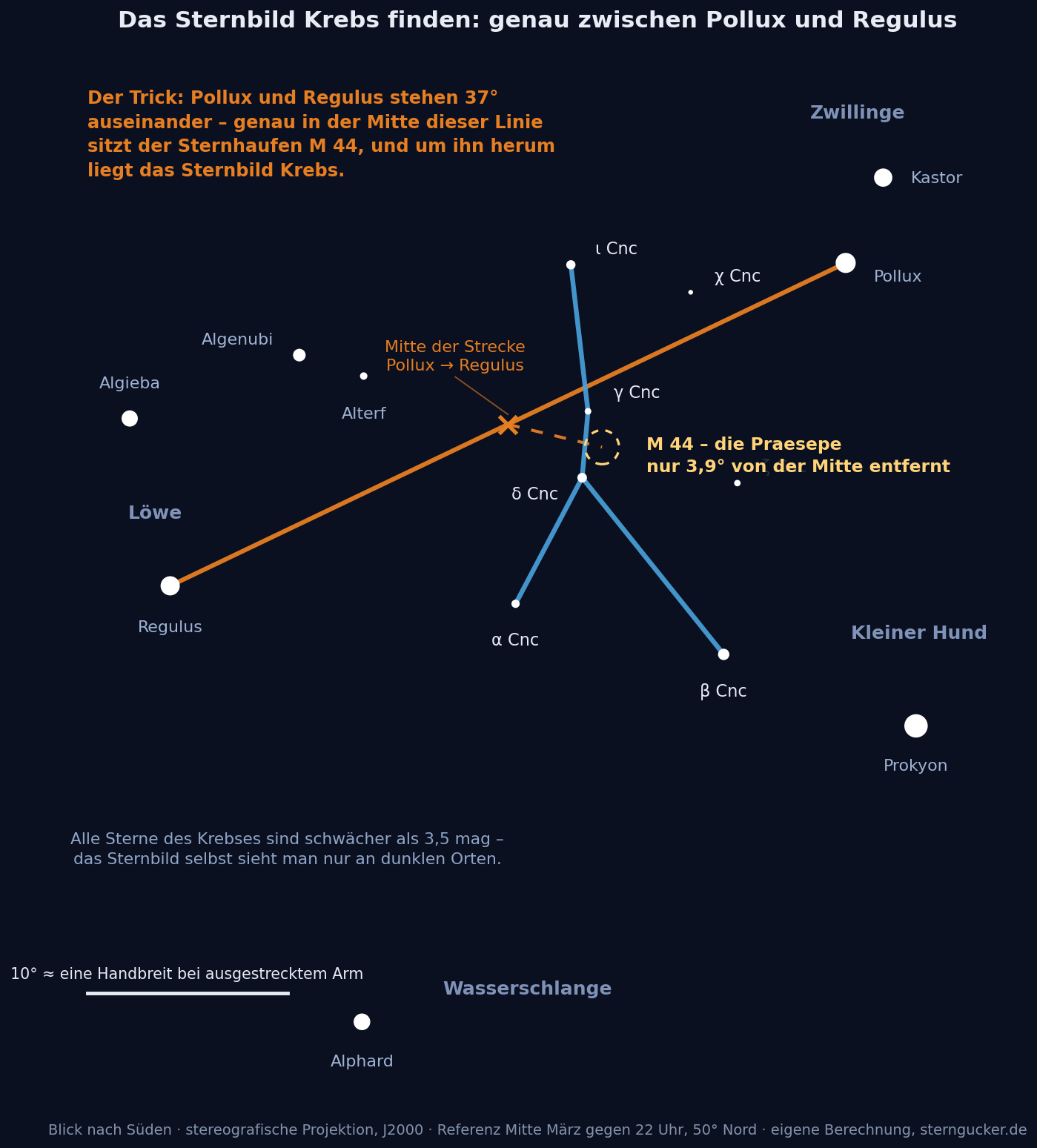
⚡ The quick answer: Cancer (Latin Cancer) sits exactly between Pollux and Regulus. Measure the stretch between these two bright stars – its midpoint lies only 3.9° from the star cluster M 44, the actual target within Cancer.
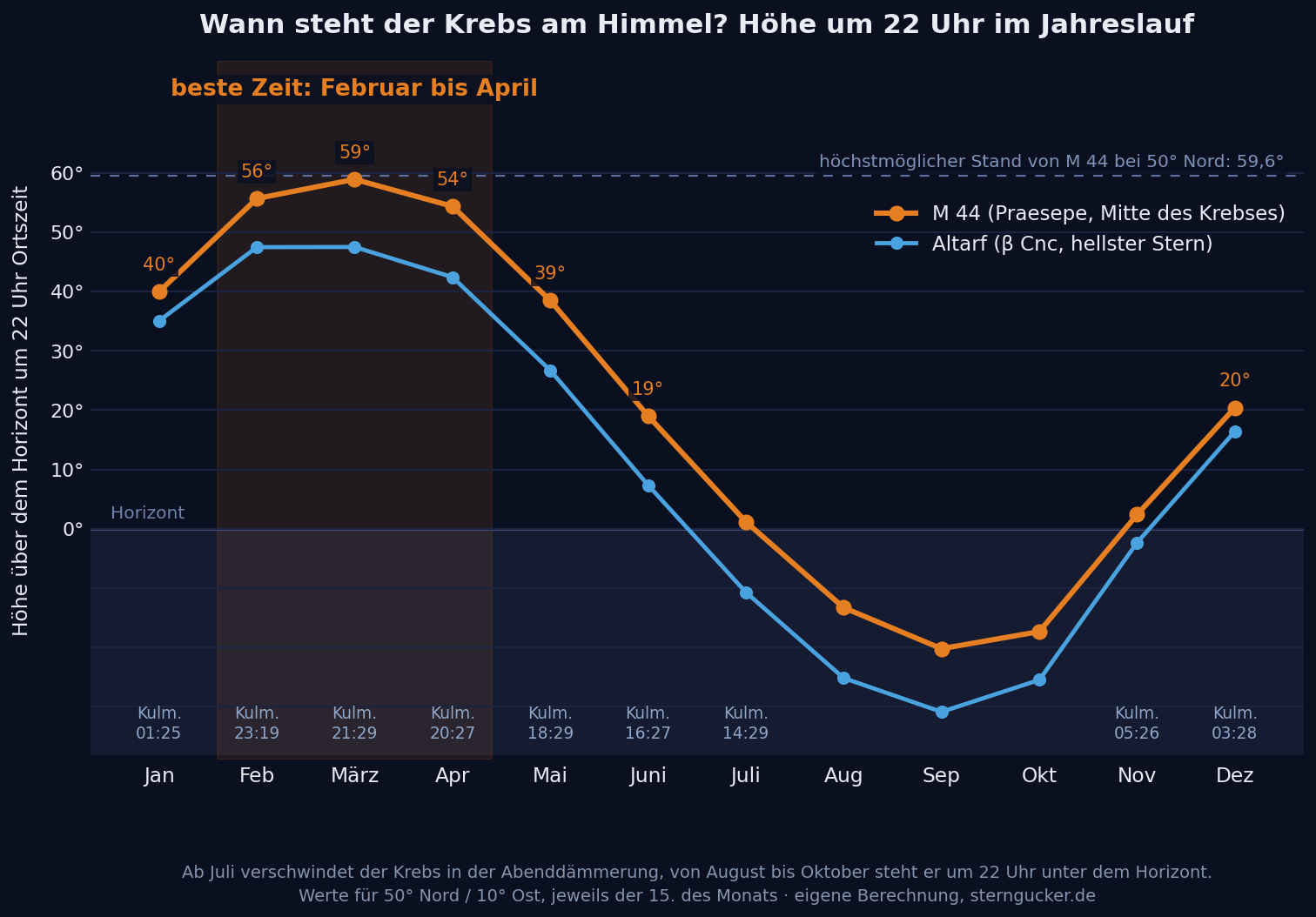
Best time: February through April, peaking in March. M 44 then stands highest around 21:30 – at 50° North, roughly 59° above the southern horizon. From August to October, Cancer isn’t visible in the evening at all.
The special thing: M 44, the Beehive Cluster (Praesepe), is a faint nebulous patch to the naked eye and, through binoculars, a field of over 300 stars. It’s one of the few deep-sky classics where a telescope actually performs worse than binoculars.
The constellation Cancer at a glance: data, size and boundaries
Cancer is one of the 48 classical constellations that Claudius Ptolemy listed in the 2nd century in his Almagest, making it one of the oldest patterns in the sky. Its official boundaries were fixed by the International Astronomical Union in 1928.
| Feature | Value |
|---|---|
| Latin name | Cancer (genitive: Cancri, abbreviation: Cnc) |
| Area | 506 square degrees – rank 31 of 88 |
| Right ascension | 07h 55m to 09h 23m |
| Declination | −6° 28′ to +33° 08′ |
| Brightest star | β Cancri (Altarf), 3.53 mag |
| Stars brighter than 3 mag | none |
| Best observing time | February to April, peaking in March |
| Visible between | 90° North and 60° South |
| Neighboring constellations | Gemini, Lynx, Leo Minor, Leo, Hydra, Canis Minor |
| Meteor shower | Delta Cancrids, maximum on 16/17 January |
| Sun in the constellation | 21 July to 10 August |
Two lines in this table explain why so many people have never consciously seen Cancer. The first is the “stars brighter than 3 mag” row – it reads none. No other zodiac constellation is this faint. For comparison: neighboring Leo has five stars above that threshold, Gemini four. The second is the area. At 506 square degrees, Cancer is only a bit more than half the size of Leo and sits in the bottom third of all 88 constellations.
Cancer is therefore a constellation you have to seek out deliberately – nobody notices it by chance. Under a brightened city sky you simply see nothing of the figure at all. How strongly light pollution hits here is more obvious than for any other zodiac constellation.
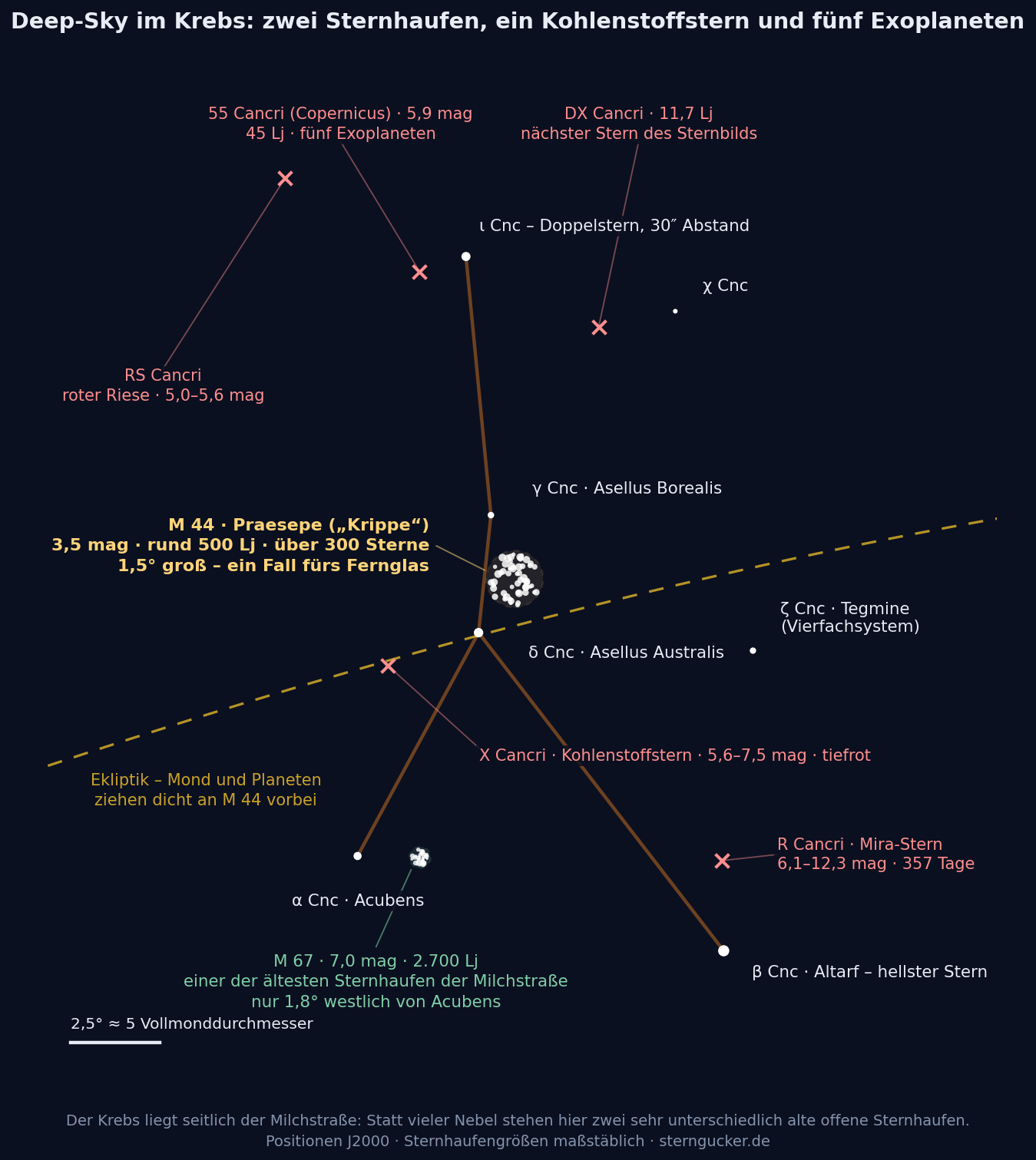
Conversely, the yield of worthwhile objects is surprisingly high: two star clusters from the Messier catalog, a deep-red carbon star, several fine double stars, a Mira star, and a solar system with five exoplanets. Cancer is far more than its faint star pattern promises.
Finding the constellation Cancer: the midpoint between Pollux and Regulus
With Cancer, the usual method doesn’t work. You can’t draw a line “toward the brightest star,” because there isn’t one. Instead, you’re not looking for the constellation but for the gap – and you find it via the two constellations to its right and left.
The main sighting line: from Pollux to Regulus
First find Pollux, the brighter of the two Gemini twin stars (1.14 mag), and then Regulus, the lead star in Leo (1.35 mag). Both are easy to find in the evening during spring: Pollux stands high toward the south to southwest, Regulus to its left, a bit lower. The stretch between the two measures 37.1° – nearly four outstretched hand spans.
The rule of thumb: Split the Pollux–Regulus stretch in half. Right there, with a deviation of only 3.9°, sits the star cluster M 44. That’s less than the width of two fingers at arm’s length – and less than the field of view of an ordinary pair of binoculars.
This is the most reliable sighting line in the entire spring sky, because it spans two very bright stars and it’s hard to misjudge the midpoint.
Under a truly dark sky you’ll see a faint, dim little cloud at that spot with the naked eye. That’s exactly M 44. If you see it, you’ve found Cancer – the stars of the figure stand all around it.
The cross-check via Procyon and Castor
If you’re unsure, check from below. Procyon in Canis Minor (0.34 mag) sits 20.7° southwest of M 44 – a line from Procyon diagonally up to the left hits the region. And Castor, the second Gemini twin star, is 19.2° away. Pollux itself lies only 15.1° from M 44 and is thus the nearest genuinely bright star.
A third check is provided by the Winter Hexagon: Cancer sits just outside it, northeast of the line connecting Procyon and Pollux. Anyone who knows Orion and Sirius has already walked most of the way there anyway.
What you actually see – and what you don’t
Some honesty is called for here, because many people search for Cancer too long and give up frustrated. Under a city sky the figure is invisible, full stop. Even at the edge of town you can at best make out δ and β Cancri as two lonely dots. Only at a limiting magnitude of about 5.5 mag does the upside-down Y come together.
M 44, on the other hand, is more forgiving: as a whole, the cluster is 3.5 mag bright and can already be sensed as a patch under moderately dark rural skies. Hence the practical advice: don’t look for the stars of Cancer, look for the patch. The figure then falls into place by itself. A star map helps enormously the first time.
The figure of Cancer: an upside-down Y in the sky
Anyone looking for a crab’s claw looks in vain. What the stars actually show is an upside-down Y – or, depending on your imagination, a lopsided cross. The figure consists of five stars between 3.5 and 4.7 mag.
| Star | Position in the figure | Brightness | Distance |
|---|---|---|---|
| ι Cnc | top (north tip) | 4.0 mag | start of the long arm |
| γ Cnc – Asellus Borealis | upper middle | 4.66 mag | 7.3° south of ι |
| δ Cnc – Asellus Australis | crossing point | 3.94 mag | only 3.3° below γ |
| α Cnc – Acubens | lower left (southeast) | 4.26 mag | 7.1° southeast of δ |
| β Cnc – Altarf | lower right (southwest) | 3.53 mag | 11.3° southwest of δ |
The layout is quickly explained. From ι Cancri a chain runs down through γ and δ to α – this arc measures 17.8° altogether. At δ, the second arm branches off and runs 11.3° to the southwest to Altarf, the brightest star in the constellation. δ Cancri is therefore the pivot point of the whole figure.
And the star cluster? M 44 sits exactly in the angle between the two upper stars: only 1.8° north-northwest of δ and 1.9° north-northeast of γ. The two stars aren’t called the “northern donkey” and “southern donkey” for nothing – they stand to the left and right of the “manger” the donkeys feed from. Anyone who has found γ and δ automatically has M 44 in the field of view.
There’s a sixth star that’s sometimes included in the drawing: ζ Cancri (Tegmine, 4.7 mag), 7.7° west of δ. It’s not part of the main figure in most depictions, but through a telescope it’s one of the most interesting objects in the constellation.
The stars of the constellation Cancer: from Altarf to DX Cancri
| Star | Proper name | mag | Distance (ly) | Type and specialty |
|---|---|---|---|---|
| β Cnc | Altarf / Tarf | 3.53 | 230 | K4 III – orange giant, brightest star |
| δ Cnc | Asellus Australis | 3.94 | 150 | K0 III – lies almost exactly on the ecliptic |
| ι Cnc | – | 4.0 | 300 | G6 + A3 – wide double star, 30.5″ |
| α Cnc | Acubens | 4.26 | 180 | A3 – “the claw” |
| γ Cnc | Asellus Borealis | 4.66 | 160 | A1 V – north of M 44 |
| ζ Cnc | Tegmine | 4.70 | 82 | quadruple system of F and G stars |
| RS Cnc | – | 5.0–5.6 | 2,000 | M6 II – semi-regular red giant |
| χ Cnc | – | 5.13 | 60 | F6 V |
| 55 Cnc | Copernicus | 5.9 | 45 | G8 + M3 – five known exoplanets |
| X Cnc | – | 5.6–7.5 | 2,000 | C6 II – carbon star, deep red |
| R Cnc | – | 6.1–12.3 | 830 | Mira star, period of 357 days |
| DX Cnc | – | 14.8 | 11.7 | red dwarf – nearest star in the constellation |
The distance column shows very nicely what a constellation actually is: not a group, but a line of sight. DX Cancri sits 11.7 light-years away, X Cancri roughly 2,000 – a factor of over 170. The stars in the figure have physically nothing to do with one another.
Altarf – the brightest star of Cancer
β Cancri carries the name Altarf (also Tarf), derived from the Arabic aṭ-ṭarf, “the end” or “the glance” – depending on the source, meaning either the tip of the crab’s claw or the lion’s eye. At 3.53 mag it’s the brightest star in the constellation, yet still just an inconspicuous dot.
Physically it’s an orange giant of spectral class K4 III at a distance of 230 light-years. It has used up its hydrogen supply in its core, swelled up, and today shines about 660 times as bright as the Sun. A planet of roughly eight Jupiter masses orbits it. A faint red dwarf accompanies it at a great distance.
Asellus Borealis and Asellus Australis – the two donkeys
γ and δ Cancri carry the finest names in the constellation: Asellus Borealis and Asellus Australis, the northern and southern donkey. They flank M 44, the “Manger” – an image that has persisted from antiquity, through the Middle Ages, all the way onto today’s star charts.
δ Cancri, at 3.94 mag, is the second-brightest star and, astronomically, the more interesting of the two: with an ecliptic latitude of only +0.08° it lies practically exactly on the ecliptic. Because of this it’s regularly occulted by the Moon – and occasionally even by planets. Such occultations are an impressive sight even through binoculars, since the star vanishes abruptly at the Moon’s dark limb.
γ Cancri is noticeably fainter at 4.66 mag, but it’s a white main-sequence star of class A1 at a distance of 160 light-years. In practice its position matters most: M 44 sits 1.9° south-southwest of it.
Tegmine, Acubens and Iota Cancri
ζ Cancri is called Tegmine, “in the shell” – and it’s a curiosity. What appears through binoculars as a single star of 4.7 mag turns out through a telescope to be a quadruple system: two suns orbit each other in 60 years, while a third pair circles around them in roughly 1,100 years. Even a small telescope separates the two bright components. At about 82 light-years, Tegmine is the closest of the bright stars in Cancer.
α Cancri is called Acubens, from the Arabic az-zubānā, “the claw.” At 4.26 mag it’s only the fourth-brightest star despite its alpha designation – a quirk that’s fairly common with Bayer designations. For observers it’s above all a signpost: M 67 sits only 1.8° west of Acubens.
ι Cancri, finally, is the double star for beginners. The components, at 4.0 and 6.6 mag, stand 30.5″ apart, which any tripod-mounted binoculars and any telescope split with ease. The real appeal is the contrast: a yellowish-orange giant next to a white companion – often called the “Albireo of spring.”
55 Cancri: five planets around a star of 6 mag
55 Cancri – officially named Copernicus since 2015 – is arguably the most remarkable star in the constellation. It sits 45 light-years away, is at 5.9 mag just barely reachable with the naked eye under a dark sky, and is orbited by five known exoplanets. That makes it one of the best-studied planetary systems there is.
Particularly well known is 55 Cancri e, a “super-Earth” of roughly eight Earth masses that orbits its star once every 18 hours. With surface temperatures well above 1,700 °C, an ocean of lava is likely bubbling there. Naturally none of that is visible – but it’s a nice thought to be looking at a solar system through the eyepiece. More on this in our Exoplanets section.
X Cancri, R Cancri and DX Cancri
X Cancri is the star you show to visitors. It’s a carbon star – a dying giant whose atmosphere contains so much carbon that it literally filters out short-wavelength light. The result is one of the deepest red hues in the entire sky, often described as “glowing coal.” Its brightness varies over roughly 180 days between 5.6 and 7.5 mag; it sits 2.7° east-southeast of δ Cancri and is thus easy to find. Even small binoculars show the color.
R Cancri is a classic Mira star: over 357 days – almost exactly a year – it varies between 6.1 and 12.3 mag. At maximum it’s a binocular object, at minimum you need a larger telescope. It sits 2.5° north of Altarf.
DX Cancri, finally, at 11.7 light-years, is the nearest star in the constellation – and one of the nearest stars overall. Yet you’ll barely see it: the red dwarf shines at only 14.8 mag, because it radiates only about one ten-thousandth of the Sun’s luminosity. There’s hardly a better example showing that closeness and brightness in the sky have nothing to do with each other.
Star in the constellation Cancer: crossword solutions
This question comes up regularly in crossword puzzles – usually with the letter count given. Here are the common solutions at a glance, sorted by length.
| Letters | Solution | Meaning |
|---|---|---|
| 4 | TARF | short form of the name of β Cancri, the brightest star |
| 5 | KREBS | the German word for the Latin Cancer |
| 6 | ALTARF | β Cancri, 3.53 mag – the brightest star in the constellation |
| 6 | CANCER | the Latin name of the constellation |
| 6 | KRIPPE | the German word for the star cluster M 44 |
| 7 | ACUBENS | α Cancri, “the claw” |
| 7 | ASELLUS | the two “donkeys” γ and δ Cancri |
| 7 | TEGMINE | ζ Cancri, the quadruple system |
| 8 | PRAESEPE | the Latin name of M 44 |
If asked for the Latin name of the zodiac sign Cancer, the answer is always Cancer (six letters) – whether the zodiac sign or the constellation is meant. The genitive form astronomers use for star designations is Cancri; the official three-letter abbreviation is Cnc. More star names can be found in our star overview.
When is Cancer visible: month by month in the evening sky
Cancer is a transitional constellation between winter and spring. In the evening sky it appears in the east in December, stands highest in March, and disappears into twilight in July. The following values are calculated for 50° North and 22:00 local time – roughly corresponding to Frankfurt, Prague, or Kraków.
| Month | M 44 at 22:00 | Altarf at 22:00 | Culmination of M 44 | Rating |
|---|---|---|---|---|
| January | 40° | 35° | 01:25 | good, but late |
| February | 56° | 47° | 23:19 | very good |
| March | 59° | 47° | 21:29 | best month |
| April | 54° | 42° | 20:27 | very good |
| May | 39° | 27° | 18:29 | already dropping noticeably |
| June | 19° | 7° | 16:27 | only low in the west |
| July | 1° | −11° | 14:29 | sets during twilight |
| August | −13° | −25° | – | not visible |
| September | −20° | −31° | – | not visible |
| October | −17° | −26° | – | not visible |
| November | 2° | −2° | 05:26 | in the morning sky |
| December | 20° | 16° | 03:28 | second half of the night |
The table explains a point that trips many people up: from August to October, Cancer isn’t visible in the evening at all, because it then sits together with the Sun in the daytime sky. The Sun crosses the constellation from 21 July to 10 August. Anyone searching for Cancer in late summer searches in vain – it only reappears starting in November, though then in the second half of the night.
Also notable is the difference between M 44 and Altarf. In January they’re only five degrees apart, in March already twelve. That’s due to declination: M 44 sits at +19.7°, noticeably further north than Altarf at +9.2°. For observers this means, in practical terms: the star cluster is always better placed than the brightest star. What else is up in the spring sky is covered in our overview of the night sky in spring.
How long does Cancer stay above the horizon per night?
This can be calculated exactly. At 50° North, M 44 stays 15 hours 22 minutes above the horizon, δ Cancri 15 hours 04 minutes, and ι Cancri as much as 17 hours 27 minutes. Altarf is visible for the shortest time, at 13 hours 29 minutes, closely followed by M 67 at 13 hours 55 minutes.
The spread of nearly four hours within a single constellation is remarkable – the reason being Cancer’s large north-south extent, from +33° to −6°. In practice this means: when M 44 is still comfortably in view, Altarf is often already uncomfortably low in the haze.
How high does Cancer rise: culmination heights for eleven cities
How high an object rises at most depends solely on geographic latitude – not on the date. The following values apply at the moment of upper culmination, i.e. the highest point in the south.
| City | M 44 | δ Cnc | α Cnc | M 67 | Altarf |
|---|---|---|---|---|---|
| Hamburg | 56.1° | 54.6° | 48.3° | 48.2° | 45.6° |
| Berlin | 57.1° | 55.6° | 49.3° | 49.3° | 46.7° |
| Dresden | 58.6° | 57.1° | 50.8° | 50.8° | 48.1° |
| Cologne | 58.7° | 57.2° | 50.9° | 50.9° | 48.2° |
| Frankfurt | 59.6° | 58.0° | 51.7° | 51.7° | 49.1° |
| Stuttgart | 60.9° | 59.4° | 53.1° | 53.0° | 50.4° |
| Vienna | 61.5° | 59.9° | 53.6° | 53.6° | 51.0° |
| Munich | 61.5° | 60.0° | 53.7° | 53.7° | 51.1° |
| Zurich | 62.3° | 60.8° | 54.5° | 54.4° | 51.8° |
| Graz | 62.6° | 61.1° | 54.8° | 54.7° | 52.1° |
| Bern | 62.7° | 61.2° | 54.9° | 54.9° | 52.2° |
The difference between Hamburg and Bern is about seven degrees. That sounds small, but it makes a noticeable difference for deep-sky objects: the higher an object stands, the less air is in the way. In Bern you view M 44 through roughly twelve percent less atmosphere than in Hamburg.
More important than the city, though, is the season for Cancer. The values above are maximum values, reached only at the moment of meridian transit – which in January doesn’t happen until 01:25. Anyone who wants to see Cancer comfortably high should head out in February or March.
Deep sky in the constellation Cancer: Praesepe, M 67 and more
This is the real reason to seek out this constellation at all. Cancer lies at the edge of the Milky Way – close enough that open clusters exist, far enough from the dense band that they don’t drown in foreground stars. The result is two Messier objects that could hardly be more different.
| Object | NGC | Type | mag | Distance (ly) | Size | Instrument |
|---|---|---|---|---|---|---|
| M 44 | NGC 2632 | open cluster | 3.5 | ~500 | 95′ (1.5°) | naked eye / binoculars |
| M 67 | NGC 2682 | open cluster | 7.0 | 2,700 | 30′ | binoculars / telescope |
| ι Cnc | – | double star | 4.0 / 6.6 | 300 | 30.5″ | binoculars / telescope |
| ζ Cnc | – | quadruple star | 5.1 / 6.2 | 82 | 1.1″ / 5.9″ | telescope from 10 cm up |
| X Cnc | – | carbon star | 5.6–7.5 | 2,000 | point-like | binoculars |
| R Cnc | – | Mira star | 6.1–12.3 | 830 | point-like | binoculars at maximum |
| 55 Cnc | – | star with 5 planets | 5.9 | 45 | point-like | naked eye under rural sky |
M 44 – the Praesepe or Beehive Cluster
M 44 is one of the closest open clusters there is: about 500 light-years away, with over 300 members between the 6th and 12th magnitude. Because it’s so close, it spans 1.5° – three times the diameter of the full Moon. It’s exactly this extent that determines what you should view it with.
Antiquity knew it long before the telescope. Aratus and Hipparchus described it as a misty cloud, and because it’s the first thing to vanish when haze rolls in, it was taken as a weather sign: “If the Manger cannot be seen, rain is coming.” It wasn’t until Galileo resolved it into individual stars in 1610 – counting forty of them right away.
The most important practical tip for M 44: grab binoculars, not a telescope. At 1.5° across, the cluster doesn’t fit into any normal telescope field of view – you’ll see a handful of bright stars and lose exactly the impression that makes M 44 special: a densely packed field standing out against a dark background.
A 10×50 pair, with a field of view of about 6°, shows the cluster in full with its surroundings. That’s the view worth going outside for.
Astrophysically, M 44 is about 600 to 700 million years old and shares its age, direction of motion, and chemical composition with the Hyades in Taurus. Both clusters likely formed from the same molecular cloud and have been drifting together through the galaxy ever since. Two stars with planets have meanwhile also been detected in M 44 – the first exoplanets ever found in an open cluster.
M 67 – one of the oldest star clusters in the Milky Way
M 67 is, in almost every respect, the opposite of M 44. It sits 2,700 light-years away, roughly five times farther, appears at 30′ only half the size of the full Moon, and at 7.0 mag is noticeably fainter. On the other hand, at three to five billion years, it’s one of the oldest known open clusters there is – most dissolve long before reaching that age.
That makes it scientifically valuable: M 67 contains stars very similar to the Sun in age and composition, and thus serves as a reference for models of stellar evolution. In the sky it sits 1.8° west of Acubens (α Cancri) and roughly 8.3° south-southeast of M 44.
Common mistake in observing guides: M 67 is sometimes placed “west of γ Cancri.” That’s not right – from γ it’s actually about 10° away. The correct signpost star is α Cancri (Acubens), only 1.8° east of it. With binoculars offering a 6° field of view, both fit comfortably together in the same view.
Through binoculars, M 67 is a distinct, grainy patch. A telescope from about 10 centimeters up resolves it into dozens of individual stars – and here the telescope actually has the advantage, because the cluster is small enough for the eyepiece. Something similar applies to NGC 752 in the constellation Andromeda.
Double stars in Cancer
For telescope owners, Cancer is above all a double-star constellation. Four pairs are worth the trip:
| Double star | Brightnesses | Separation | Note |
|---|---|---|---|
| ι Cnc | 4.0 / 6.6 | 30.5″ | very easy – even in tripod-mounted binoculars; lovely color contrast |
| ζ Cnc | 5.1 / 6.2 | 5.9″ and 1.1″ | the quadruple system; the close pair needs 10 cm and steady air |
| φ² Cnc | 6.3 / 6.3 | 5.2″ | two equally bright stars – a very clean pair |
| 57 Cnc | 6.0 / 6.4 | 1.4″ | demanding, only worthwhile from 15 cm aperture up |
ι Cancri is the entry point: 30 arcseconds, split by any instrument, and the color difference between the yellowish giant and the white companion is obvious immediately even at low magnification. ζ Cancri, by contrast, is a task for a calm evening and a short-focal-length eyepiece – more on that in our guide to the eyepiece.
Which instrument for Cancer: binoculars or telescope?
For many constellations the honest answer is: buy a telescope, otherwise you won’t see anything. With Cancer it’s the opposite – and we say that deliberately, even though a telescope would be the more expensive device. The reason lies in the size of the main object.
| Instrument | What you see | Assessment |
|---|---|---|
| Naked eye | M 44 as a nebulous patch, the Y figure only under rural skies | The entry point – but only far from the city. |
| 10×50 binoculars | M 44 in full with over 50 stars, M 67 as a patch, X Cnc deep red, ι Cnc resolved | The best choice for this constellation. |
| 13 cm telescope | M 67 resolved into individual stars, ζ Cnc resolved, M 44 only in sections | Worthwhile – but not for M 44. |
| 20 cm telescope | M 67 magnificent, the close ζ pair, 57 Cnc | Ideal for double stars and M 67. |
Here’s the honest verdict: M 44 is a binocular object, unambiguously so. At 1.5° across, the cluster blows past any telescope field of view. Anyone viewing it through a telescope sees a few bright stars and wonders what the fuss is about. Through binoculars, on the other hand, the whole cluster lies before a dark sky – and the difference is not subtle. We’ve laid out this trade-off in detail in Telescope or binoculars.
The clear recommendation: a bright 10×50
Cancer doesn’t need any special gear. A good pair of 10×50 binoculars has about a 6° field of view, gathers enough light for M 67, and shows M 44 the way it’s meant to be seen. What matters is clean optics and a steady grip – or better yet a tripod, since at tenfold magnification hand shake already becomes noticeable.
The right choice for M 44: Celestron Cometron 7x50 Binoculars
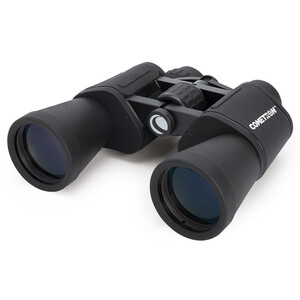
The astronomy classic among affordable binoculars: 7×50 with a large exit pupil for bright handheld views of the Moon and Milky Way – the ideal first step before a telescope.
Price: € 65
If it has to be a telescope after all
There are good reasons for a telescope in Cancer – they just aren’t called M 44. M 67 is small enough for the eyepiece and, from about 13 centimeters of aperture up, turns from a grainy patch into a field of dozens of individual stars. Then there are the double stars: ζ Cancri as a quadruple system and, for the patient, 57 Cancri. A compact Dobsonian is the simplest build for this.
For M 67 and the double stars: Skywatcher Dobson Telescope N 130/650 Heritage FlexTube
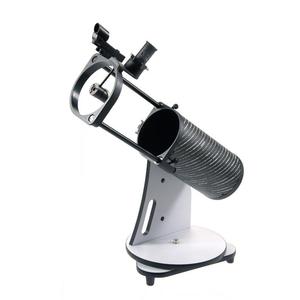
A compact tabletop Dobson with a true parabolic mirror. Folds down, fits in a bag: the Moon, planets and the bright deep-sky classics.
Price: € 265
More on build types and price ranges can be found in our overview of Dobsonian telescopes, in our beginner telescopes guide, and in the big guide to buying a telescope. If you’re unsure, our telescope advisor can help.
More important than any instrument: the sky. M 44 is an extended, surface-area object and therefore reacts especially sensitively to sky glow. Binoculars under a rural sky show more here than a telescope on the edge of town.
Filters don’t help: star clusters consist of stars radiating across the whole spectrum, whereas nebula filters work on isolated emission lines. Against light pollution, in Cancer only driving away from it helps.
Zodiac sign Cancer and constellation Cancer: the difference
Cancer is one of the twelve zodiac constellations – the ecliptic runs right through it, passing close by δ Cancri. That’s why the Sun, Moon, and all the planets regularly pass through this constellation, and why there’s a zodiac sign of the same name.
The date ranges, however, don’t match up – and quite noticeably so:
| Term | Period | Definition |
|---|---|---|
| Zodiac sign Cancer | 22 June to 22 July | fixed 30° segment of the ecliptic |
| Constellation Cancer | 21 July to 10 August | real patch of sky with IAU boundaries |
The roughly four-week shift arises from precession: Earth’s axis wobbles all the way around once every 25,800 years, and since the zodiac signs were fixed about 2,000 years ago, the sky has rotated accordingly. On top of that, the twelve zodiac signs divide the ecliptic into exactly equal 30° segments, while the constellations vary greatly in size – the Sun needs only about three weeks to cross the small constellation Cancer, but more than six for the large constellation Virgo. We explain this in detail in Zodiac signs and constellations.
The Tropic of Cancer – a name from antiquity
The Tropic of Cancer, at 23.5° north latitude, carries its name for a specific reason: in antiquity the Sun stood exactly in the constellation Cancer at the summer solstice. It reached its northernmost point there and “turned back” – hence the term.
Today that’s no longer true. Due to precession, the solstice point has kept moving on: since about 15 BC it has lain in Gemini, and since 1990 in Taurus. The name of the latitude line is thus a fossil from a time when it was still accurate. How M 44 itself shifts over the millennia is shown by this calculation:
| Epoch | Right ascension of M 44 | Declination |
|---|---|---|
| 2000 BC | 4h 41m | +23.5° |
| Year 0 | 6h 42m | +24.4° |
| Year 1000 | 7h 42m | +22.7° |
| Year 2000 | 8h 40m | +19.7° |
| Year 3000 | 9h 37m | +15.6° |
Over four thousand years, M 44 has thus moved almost eight degrees south and five hours further along in right ascension. Constellations aren’t eternal – the astronomical seasons shift along with them.
The Delta Cancrids: shooting stars in January
Cancer has its own meteor shower, even if it’s among the quieter ones. The Delta Cancrids are active from early to mid-January, with their maximum on the night of 16 to 17 January. The radiant – the point the meteors appear to come from – lies near δ Cancri, so right next to M 44.
Don’t expect a flood of shooting stars: the zenithal hourly rate is only about four meteors per hour. The shower does have a practical advantage, though – in January the radiant stands high in the sky during the second half of the night, and M 44 culminates that same night around 01:25. Anyone out observing can combine both. All the year’s dates can be found in our meteor shower calendar.
Mythology of the constellation Cancer: from tortoise to lobster
Cancer, Heracles and the Hydra
In the best-known Greek version, Cancer is tied to Heracles’s battle against the many-headed Hydra – the second of his twelve labors. As the hero was busy dealing with the water serpent, Hera, his sworn enemy, sent a giant crab to help. The creature pinched Heracles on the heel but was instantly crushed underfoot. Hera placed it among the stars as a reward – right next to the Hydra, which remains there to this day as the largest constellation by area.
There’s a second, older version: in it, the crab used its claws to prevent a nymph from escaping Zeus, and Zeus placed it among the stars as thanks. Both stories share the same core – a small creature intervenes in a great conflict and is rewarded for it. That it’s precisely the faintest zodiac constellation that got this role fits rather well.
The two donkeys and the battle against the Giants
The second story attached to this constellation hangs on γ and δ Cancri, the two “donkeys.” In the battle of the gods against the Giants, Dionysus and Hephaestus rode donkeys into the fray. The animals’ braying was so unbearable that the Giants fled in panic. In memory of this, the two donkeys were placed among the stars – and with them the Praesepe, the manger they feed from. The image is so old that it has survived to this day in the names of the objects.
From Egyptian tortoise to lobster
The figure is considerably older than the Greek myths. Around 3000 BC the Egyptians called this patch of sky Ab-Shetui – a tortoise. The Babylonians also saw a tortoise here. In the New Kingdom, the Egyptians additionally brought in the scarab, the sacred dung beetle, as a symbol of rebirth and immortality.
It was the Greeks who first turned it into a crab, and via Ptolemy this interpretation made its way into European tradition. After that things got restless: in the 12th century depictions as a water beetle appear, Albumasar showed the constellation in 1489 as a freshwater crayfish, and Jakob Bartsch drew it in the 17th century as a lobster. Hardly any other constellation has changed its animal species so often.
A nice footnote from the present: the Slovenian 50-cent coin depicts the constellation Cancer – along with a reference to the summer solstice point that once lay here.
Cancer’s neighbors: what surrounds it in the sky
Six constellations border Cancer. Because it’s itself so faint, they matter more for orientation than in any other zodiac constellation.
| Neighbor | Location | Note |
|---|---|---|
| Gemini | west | with Castor and Pollux – the most important sighting aid |
| Leo | east | with Regulus – the second reference point |
| Lynx | north | very star-poor and itself barely recognizable |
| Leo Minor | northeast | a small, inconspicuous group of stars |
| Canis Minor | southwest | with Procyon, one of the brightest stars in the sky |
| Hydra | south | the largest constellation by area there is |
In practice this means: Cancer sits wedged between two very conspicuous neighbors. To the west stand the Gemini twins with Castor and Pollux, to the east Leo with Regulus and its striking sickle. Anyone traveling east from Orion in spring inevitably passes through this region – and shouldn’t skip the detour to M 44 before moving on to the galaxies in Leo.
An overview of all 88 constellations can be found in our constellation catalog. What else is happening in the sky over the coming weeks is covered in our astro events and the highlights of the northern hemisphere.
Frequently asked questions about the constellation Cancer
When is the constellation Cancer best seen?
From February to April, peaking in March. M 44 then stands highest around 21:30 – at 50° North, roughly 59° above the southern horizon. From August to October, Cancer isn’t visible in the evening at all, because it sits together with the Sun in the daytime sky then.
How do I find the constellation Cancer in the sky?
Via the Pollux–Regulus stretch. Find Pollux in Gemini and Regulus in Leo; the connecting line is roughly 37° long. Its midpoint lies only 3.9° from the star cluster M 44. Under a dark sky you’ll see a dim little cloud there – that’s M 44, and Cancer’s stars stand all around it.
Which is the brightest star in the constellation Cancer?
Altarf (β Cancri) at 3.53 mag. It sits 230 light-years away and is an orange giant of spectral class K4 III. That makes it the faintest “brightest star” of all twelve zodiac constellations – no other star in Cancer even reaches 3 mag.
Why is the constellation Cancer so hard to see?
Because it simply contains no bright star. The five stars of the figure lie between 3.5 and 4.7 mag – invisible under a city sky and marginal even at the edge of town. You need a limiting magnitude of about 5.5 mag for the upside-down Y to come together. The star cluster M 44, at 3.5 mag, is noticeably easier and therefore the better entry point.
What is the Praesepe?
Praesepe (Latin for “manger”) is the proper name of the open cluster M 44 at the heart of Cancer. It sits about 500 light-years away, contains over 300 stars, and appears at 1.5° three times the size of the full Moon. To the naked eye it’s a faint nebulous patch, through binoculars a field of dozens of individual stars. The name comes from the two neighboring stars γ and δ Cancri, the “donkeys,” which feed from the manger.
Can you see M 44 with the naked eye?
Yes – under a dark sky. As a whole, the cluster is 3.5 mag bright and appears then as a faint, dim patch. A limiting magnitude of about 4.5 mag is already enough. In the city, on the other hand, it’s invisible, which since antiquity has made it a weather sign: when haze rolled in, the manger was the first thing to disappear.
Do you need a telescope or binoculars for M 44?
Binoculars, clearly. M 44 is, at 1.5°, so extended that it doesn’t fit into any normal telescope field of view – a telescope shows only a section and destroys the impression of the tight-knit star field. A pair of 10×50 binoculars with about a 6° field of view shows the cluster in full along with its surroundings. For M 67 and the double stars in Cancer, on the other hand, a telescope is the better choice.
How many stars does the constellation Cancer have?
The main figure consists of five stars – ι, γ, δ, α, and β Cancri – with ζ sometimes added as a sixth. Within the official constellation boundaries there are of course many more: under a very good sky, roughly fifty are visible to the naked eye. The star cluster M 44 alone contributes over 300, though most of these require binoculars.
Is Cancer a zodiac sign or a constellation?
Both – but they are two different things. The constellation is a real patch of sky with fixed boundaries, the zodiac sign a 30° segment of the ecliptic. The date ranges shift by about four weeks: zodiac sign 22 June to 22 July, constellation 21 July to 10 August.
What is the constellation Cancer called in Latin?
Cancer. The genitive form astronomers use for star designations is Cancri – hence names like α Cancri or 55 Cancri. The official abbreviation of the International Astronomical Union is Cnc.
Why is the Tropic of Cancer called that?
Because in antiquity the Sun stood, at the summer solstice, in the constellation Cancer. It reached its northernmost point there above the 23.5° North parallel and then turned back south. Due to precession, the solstice point has since shifted: since about 15 BC it has lain in Gemini, and since 1990 in Taurus. The name of the parallel, however, stuck.
How far is the constellation Cancer from Earth?
This question has no single answer, because a constellation isn’t an object but a line of sight. The stars of the figure lie one behind another between 82 light-years (ζ Cancri) and 300 light-years (ι Cancri). The nearest star in the constellation is the red dwarf DX Cancri at 11.7 light-years, and the most distant bright representative is the carbon star X Cancri at roughly 2,000.
Keep reading on Sterngucker
- Constellation Gemini – the western neighbor with Castor and Pollux
- Constellation Leo – the eastern neighbor with Regulus and nine galaxies
- Pollux – the starting point of the most important sighting line to Cancer
- Astronomy binoculars – why M 44 looks better here than through a telescope
- Night sky in spring – what else is up in the spring sky
- Zodiac signs and constellations – why the dates diverge
- Exoplanets – more on systems like 55 Cancri
- Deep-sky objects – worthwhile targets for binoculars and telescopes
- All constellations at a glance – the entry point to our catalog