By Alexander Merz · Published on · Details checked on 14 September 2026
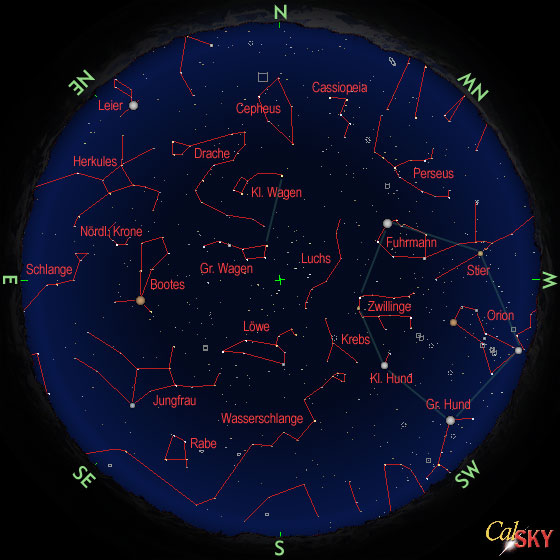
The starry sky has always had a pull on us that never really fades. From sparkling star clusters through brilliant planets to spectacular eclipses – the night sky in spring has plenty of highlights in store for every amateur astronomer and sky watcher. Look forward to incredible astronomical experiences between March and May!
⚡ A note on the dates: The individual dates described in detail on this page (lunar conjunctions, eclipses, oppositions) refer to spring 2025. They show by example what kinds of events the spring sky has to offer – the constellations, deep-sky objects and observing tips apply to every spring, unchanged. You will find current dates for the month you are in right here: September 2026 · October 2026 · November 2026 · all astro events · Highlights 2026/2027.
March: A Gorgeous Start to Astronomical Spring
March 1: The Moon Meets Venus and Mercury
Right at the start of the month a magical show awaits you: the crescent Moon, lit to just 4 %, joins brilliant Venus (-4.7 mag) and shy Mercury in the early twilight. Mercury stays low above the western horizon, so you need a view that is as unobstructed as possible and a bit of patience. Having the three objects this close together is not only pretty to look at, it also signals the start of an exciting season of astronomical highlights.
Tip: A pair of binoculars makes tracking down the fainter Mercury enormously easier.
March 9: The Moon Meets Mars & the Golden Handle
Two highlights on a single day:
- The Moon meets Mars
In the evening the red planet Mars and the Moon run into each other. Both sit in the constellation Gemini. Even with simple binoculars or a telescope you can pick up the glowing colour of Mars especially well. It is also worth keeping an eye out for Mercury, which recently reached its greatest eastern elongation and is therefore particularly easy to catch in the evening sky. - The Golden Handle on the Moon
The “Golden Handle” sounds poetic and is just as spectacular. It happens when the rising Sun lights up the crater rim of Sinus Iridum while the neighbouring regions are still in shadow. A glowing arc then appears on the terminator, the Moon’s day-night boundary – like a golden handle.
March 14: Partial Lunar Eclipse (Penumbral Phase)
In the early hours of the morning there is a partial lunar eclipse. For Central Europe, however, only the penumbral phase is visible, because the Moon sets before the umbra reaches it. Trying to catch the event anyway is worth it for die-hard enthusiasts.
Fun fact: Even when only part of the Moon is darkened, it is always a rare natural spectacle worth watching. For better viewing conditions, keep binoculars or a telescope handy.


March 20: Start of Spring and a Lunar Occultation
On March 20 the equinox marks the astronomical start of spring. The days are getting longer and the nights shorter – and yet those nights still hold a few surprises:
- The Moon occults π Sco: In the early morning the star π Sco disappears briefly behind the lit side of the Moon. At the same time the reddish Antares turns up right next door. If you follow this occultation, you get to watch a rare moment in the sky.
March 29: Partial Solar Eclipse
An absolute highlight is the partial solar eclipse that becomes visible over Central Europe – even if only a small fraction of the Sun is covered:
- London: ~24 % coverage
- Hamburg: ~20 % coverage
- Munich: ~10 % coverage
The eclipse starts at 11:20 CET, reaches its maximum around 12:10 CET and finally ends at 13:00 CET.
Careful: Only look at the Sun through proper eclipse glasses or suitable filters, so you protect your eyes!
April: Star Clusters, Planets and a Sparkling Meteor Shower
April 1: The Moon Meets the Pleiades
The Pleiades (also called the “Seven Sisters”) are an open star cluster in the constellation Taurus. On this evening they have a particularly photogenic encounter with the Moon, which stands only about one degree away. You can pick out the bright stars with the naked eye – through binoculars or a telescope they show their full splendour, often wrapped in a delicate haze.
Fun fact: The Pleiades are made up of young, hot stars that are only around 100 million years old – true “newcomers” compared with the age of our solar system (4.6 billion years).
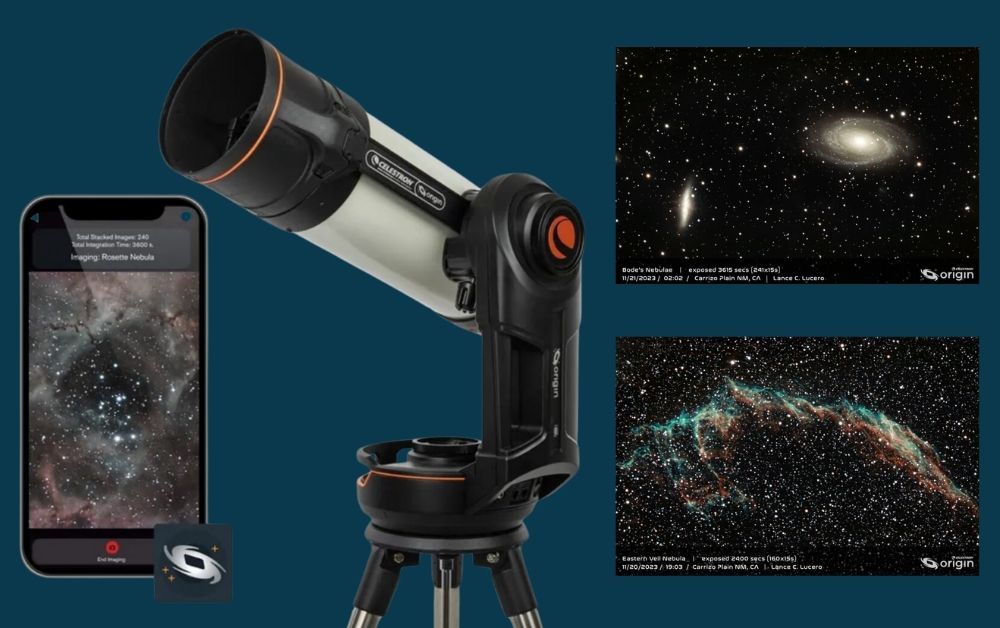
(Celestron Origin Intelligent Home Observatory, € 4,599)
April 2: The Moon Meets Jupiter
A day later the waxing Moon pairs up with the largest planet in our solar system: Jupiter. The imposing gas giant fascinates with its cloud bands, which show up once you look through a proper telescope. Even in good binoculars you can make out Jupiter’s four largest moons (Io, Europa, Ganymede, Callisto) as small points of light close by.
April 5: The Moon Meets Mars
On this day Mars and the Moon stand close together in the constellation Gemini. Mars shines at -1.5 mag and is easy to identify by its reddish colour. This pairing is perfect for your first observing attempts at dusk, because both objects are already visible to the naked eye.
April 22: The Lyrid Meteor Shower
The Lyrid meteor shower promises up to 20 meteors an hour, apparently streaming out of the constellation Lyra. Since the Moon barely gets in the way this year, conditions are ideal. Make yourself comfortable on a lounger, look towards the zenith and enjoy the show.
Extra knowledge: The Lyrids come from Comet Thatcher, discovered in 1861 by an American amateur astronomer. As the dust particles enter Earth’s atmosphere they burn up and produce the glowing shooting stars.
April 25: Venus at Maximum Brightness
At -4.7 mag Venus is like a floodlight in the morning sky. It rises at around 4:35 CET and stays visible for roughly 1.5 hours until sunlight drowns it out. On top of that, the thin crescent Moon joins Venus and the faintly glowing Saturn – a trio that sits low over the horizon and delivers breathtaking photo opportunities.
The dates that are actually worth it are often months apart – and easily forgotten. So you do not miss one:
One short email, in good time – with the times and an honest take on whether it is worth getting up for.
You will get a confirmation email in a moment. Your address stays with us – no sharing, no third-party ads.
May: A Minor Planet at Opposition and More Exciting Line-Ups
May 1: Vesta at Opposition
The minor planet Vesta, one of the brightest asteroids in the asteroid belt, is now at opposition to the Sun and reaches a brightness of around 5.4 mag. Under a really dark sky you can even spot Vesta with the naked eye. In a telescope Vesta still looks star-like – what makes it remarkable is simply the fact that you are watching an asteroid measuring about 525 kilometres across and sitting some 350 million kilometres away from us.
May 3: The Moon Meets M44 and Mars
The Moon travels along the ecliptic and runs into the open star cluster M44 (Praesepe, or the Beehive) in the constellation Cancer. The handy part: Mars joins in, so you can catch all three objects with a pair of binoculars.
Tip: M44 is a star cluster you can already make out with the naked eye as a hazy patch. Sweep your binoculars slowly around the Moon to make it easier to track down.
Reading tip: Stargazing for beginners and advanced observers
May 9: Venus Meets Saturn (+ Neptune Between the Two)
On the eastern horizon Venus and Saturn meet up at a separation of about 7°. What makes it special: Neptune sits between the two planets, which is a rare line-up. To spot Neptune, though, you need a telescope, because the ice giant is not visible to the naked eye.
May 24: The Moon Meets Venus
At dawn there is a picture-perfect moment: a crescent Moon lit to just 13 % moves in on brightly shining Venus. This pairing is a treat for amateur astrophotographers and everyone who is up early.
Note: Shortly before sunrise the atmosphere is often calmer, so with a bit of luck you get a really clear view.
May 28: The Moon Meets Jupiter
Towards the end of the month you come across another duo in the sky: the wafer-thin crescent Moon and the gas giant Jupiter. A clear view of the horizon matters here, because neither object climbs very high in the east. Early risers are rewarded with an impressive sight.
Conclusion: Now Is the Best Time for the Night Sky
With these astronomical highlights from March to May you are in for a feast for the senses. From occultations and eclipses through to brilliant planets and sparkling meteor showers: it pays to turn your eyes upward. Whether you are into lunar phenomena, planetary line-ups or shooting stars – the clear nights of spring and early summer offer no end of chances for observations you will not forget.
Remember the right kit (binoculars, telescope, a comfortable blanket or lounger), a warm jacket and – most important of all – a star chart or a decent app to find your way around. With a little preparation you can enjoy the show in the night sky to the full. We wish you plenty of clear nights and unforgettable moments under the stars!
More information: