By Alexander Merz · Published on · Details checked on 1 November 2026
The Moon is 3,474.8 kilometres (2,159 miles) across, making it the fifth-largest moon in the Solar System and just over a quarter as wide as Earth (12,742 km).
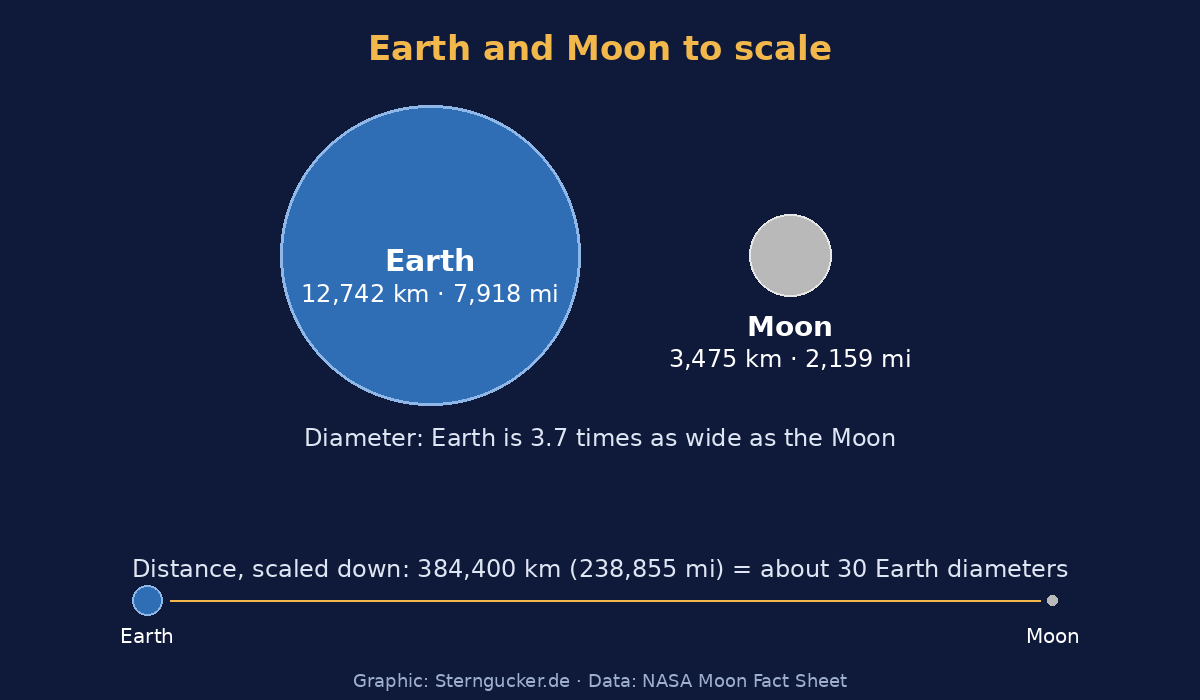
The Moon in numbers
All the key figures at a glance, each compared with Earth. The number most people are looking for is in the first row: a mean diameter of 3,474.8 km.
| Quantity | Moon | Compared with Earth |
|---|---|---|
| Diameter (mean) | 3,474.8 km (2,159 mi) | 27 % (Earth 12,742 km) |
| Diameter equator / poles | 3,476.2 / 3,472.0 km | almost a perfect sphere |
| Circumference at the equator | about 10,920 km (6,786 mi) | Earth about 40,075 km |
| Surface area | 37.9 million km² | 7.4 % (Earth 510 million km²) |
| Volume | 21.97 billion km³ | 2 %, fits inside Earth about 49 times |
| Mass | 7.35 × 10²² kg | 1.2 %, or 1/81 of Earth’s mass |
| Mean density | 3.34 g/cm³ | Earth 5.51 g/cm³ |
| Surface gravity | 1.62 m/s² | 16.5 %, about one sixth |
| Mean distance | 384,400 km (238,855 mi) | about 30 Earth diameters |
| Apparent size in the sky | 29.4 to 33.5 arcminutes | about half a degree |
Source: NASA Moon Fact Sheet. Circumference calculated from the equatorial diameter, ratios rounded to one decimal place.
How many Moons fit inside Earth?
About 49, measured by volume. Earth’s volume of 1.083 trillion km³ divided by the Moon’s 21.97 billion km³ gives 49.3.
Side by side, 3.7 Moons span Earth’s diameter. On a scale, though, it would take 81 Moons to balance Earth: the Moon is not only smaller but also less dense, because it lacks a large iron core.
The Moon compared with Europe
3,475 km is almost exactly the straight-line distance from Madrid to Moscow (about 3,440 km). Laid across Europe, the Moon would stretch from the Iberian Peninsula to Russia; across the United States it would fall a little short of New York to Los Angeles (about 3,940 km).
Its surface is nevertheless almost four times the size of Europe: 37.9 million km² against roughly 10 million km². That puts it between Africa (30.4 million km²) and Asia (44.6 million km²).
How much does the Moon weigh?
The Moon has a mass of 7.35 × 10²² kilograms, about 73.5 quintillion metric tons. That is only 1.2 percent of Earth’s mass.
Because it is so light, it also pulls more weakly: its surface gravity is 1.62 m/s², about one sixth of Earth’s. That is why the Apollo astronauts could hop across the surface despite their heavy spacesuits.
Unusually big for a moon
Measured against its planet, our Moon is an outlier: no other moon of a planet is this large in proportion. The big moons of Jupiter and Saturn are larger in absolute terms, but they are only a few percent of their planet’s size.
| Moon | Planet | Diameter | Share of planet |
|---|---|---|---|
| Ganymede | Jupiter | 5,268 km | 3.8 % |
| Titan | Saturn | 5,149 km | 4.4 % |
| Callisto | Jupiter | 4,821 km | 3.4 % |
| Io | Jupiter | 3,643 km | 2.6 % |
| Moon | Earth | 3,475 km | 27.3 % |
| Europa | Jupiter | 3,122 km | 2.2 % |
Some astronomers therefore almost speak of a double planet. Only the dwarf planet Pluto has a larger companion: Charon is half as wide as Pluto itself. More about the giant planet and its moons is on our Jupiter page.
This size matters for us: the Moon stabilises the tilt of Earth’s axis and drives the tides. Everything else is on our Moon overview page.
The Moon illusion on the horizon
The full explanation is in Why is the Moon so big?, here is the short version. Near the horizon the Moon looks enormous, but its angular diameter there is actually slightly smaller than high in the sky.
The effect is called the Moon illusion and happens in our brain. Try it: your little finger held at arm’s length always covers the Moon, wherever it is.
The Moon really does get bigger only because of its distance. Between its farthest and nearest points it grows by about 14 percent, from 29.4 to 33.5 arcminutes. An especially close full moon is called a supermoon.
See the Moon for yourself
The best way to grasp how big craters and mountains really are is to look for yourself. Even a small telescope shows craters down to about 4 km (2.5 mi) across, best along the light-shadow line of a waxing Moon. Which instruments are suitable is explained in Telescope for the Moon and planets.
For your desk, there is the Moon as a globe: a 30 cm Moon globe shows it at a scale of about 1 : 11.6 million, so one centimetre equals about 116 kilometres (one inch about 183 miles). You will find a selection on our Moon globe page.
Put the Moon on your desk: National Geographic “The Moon” globe, 30 cm
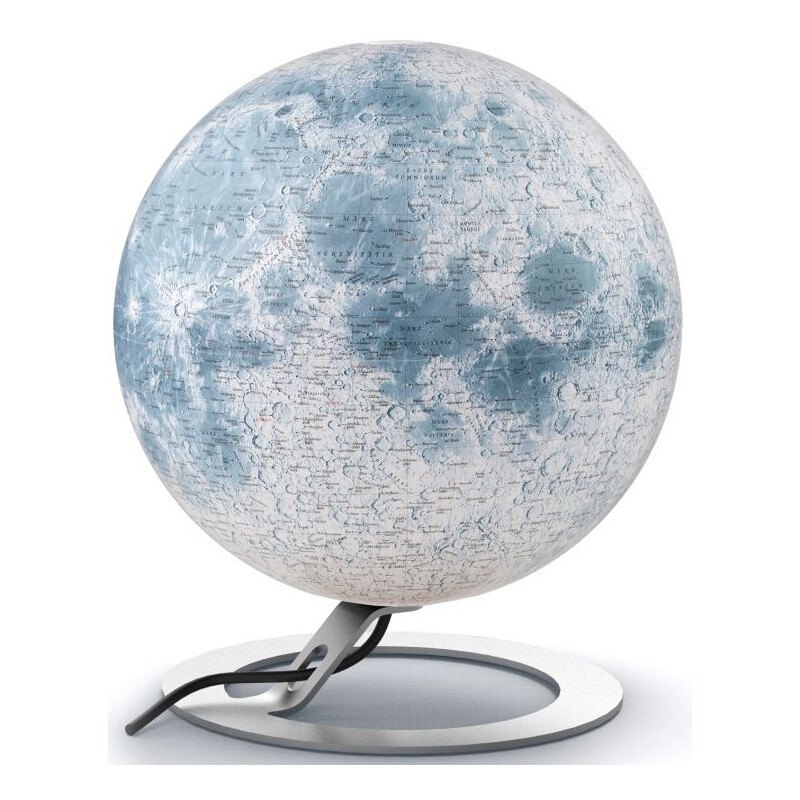
Moon globe with the Apollo landing sites and named lunar seas – the best balance of size, detail and price.
Price: € 149
FAQ about the Moon’s size
How big is the Moon compared to Earth?
Its diameter of 3,474.8 km is just over a quarter of Earth’s (12,742 km). Its surface area of 37.9 million km² is slightly larger than Africa.
How many Moons fit inside Earth?
About 49, by volume. Across the diameter, 3.7 Moons fit side by side, and it takes 81 Moons to match Earth’s mass.
Is the Moon bigger than Pluto?
Yes, clearly. Pluto is only 2,377 km across, our Moon 3,474.8 km.
How far away is the Moon?
On average 384,400 km (238,855 miles), about 30 Earth diameters. Light takes 1.3 seconds to cover it.
Is the Moon moving away from Earth?
Yes, by about 3.8 cm per year. This is measured by laser using reflectors left on the surface by the Apollo missions.
🌙 Related: all full moons, new moons and lunar eclipses are in our Moon calendar.