By Alexander Merz · Updated on
Ophiuchus (the Serpent Bearer) is a large summer constellation on the celestial equator: 948 square degrees, 11th largest of 88, with Rasalhague (2.1 mag) as its brightest star. Every year the Sun crosses it from 30 November to 18 December.
⭐ In short: Astronomically, the Sun spends about 18 days in Ophiuchus, almost three times as long as in Scorpius. It is still not an official 13th zodiac sign, because zodiac signs are equal 30-degree sections of the ecliptic, not constellations. In the sky you will find it from June to August in the evening to the south, between Vega, Altair and Antares – with seven globular clusters, of which M 10 and M 12 are easy targets even for a small telescope.
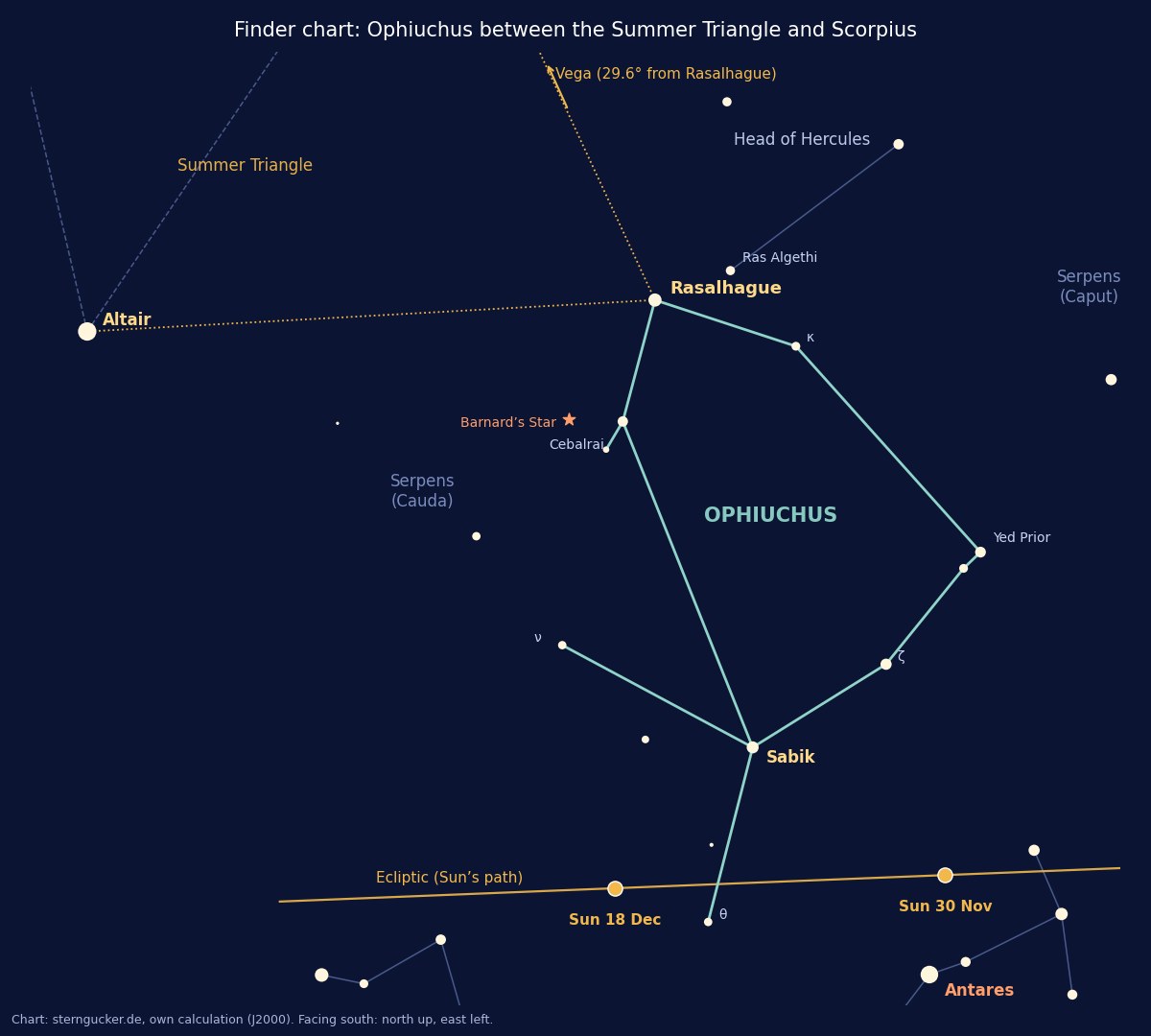
Ophiuchus fact file: area, rank and neighbours
Ophiuchus is one of the 48 classical constellations listed by Ptolemy. It shows a man holding a serpent – the serpent is a separate constellation, which Ophiuchus splits into a head and a tail.
| Feature | Value |
|---|---|
| Latin name | Ophiuchus (genitive: Ophiuchi) |
| Official abbreviation | Oph |
| Area | 948 square degrees |
| Size rank | 11th of 88 |
| Brightest star | Rasalhague (α Oph), 2.1 mag |
| Right ascension | approx. 15h 58m to 18h 42m |
| Declination | approx. +14° to −30° |
| Visible between | latitudes +80° and −80° |
| Best viewing | June to August, evenings to the south |
| Sun in the constellation | 30 November to 18 December |
| Neighbouring constellations | Hercules, Serpens (head and tail), Aquila, Sagittarius, Scorpius, Libra |
| Messier objects | M 9, M 10, M 12, M 14, M 19, M 62, M 107 (all globular clusters) |
Its size is the reason Ophiuchus is so often overlooked. Its stars are spread over a field larger than Leo, and none of them is brighter than 2nd magnitude. Under city skies you often see only Rasalhague and Sabik.
The Sun in Ophiuchus: from 30 November to 18 December
We recalculated the Sun’s path with NASA’s DE421 ephemeris and the official constellation boundaries of the International Astronomical Union (IAU). Result: every year the Sun enters Ophiuchus on 30 November and leaves it on 18 December. In leap years the entry can fall on the late evening of 29 November.
| Year | Sun enters Scorpius | … enters Ophiuchus | … enters Sagittarius |
|---|---|---|---|
| 2026 | 23 Nov 2026, 18:28 | 30 Nov 2026, 06:40 | 18 Dec 2026, 14:06 |
| 2027 | 24 Nov 2027, 00:40 | 30 Nov 2027, 12:46 | 18 Dec 2027, 20:21 |
| 2028 | 23 Nov 2028, 06:41 | 29 Nov 2028, 18:50 | 18 Dec 2028, 02:20 |
Over a whole year, the Sun spends 18.3 days in Ophiuchus but only 6.5 days in Scorpius. That makes Scorpius the constellation on the Sun’s path where it stays the shortest time.
| Constellation | Sun is inside | Duration |
|---|---|---|
| Libra | 31 October to 23 November | 23.1 days |
| Scorpius | 23 to 29 November | 6.5 days |
| Ophiuchus | 30 November to 18 December | 18.3 days |
| Sagittarius | 18 December to 20 January | 32.5 days |
⚠️ You cannot see this: while the Sun is in Ophiuchus, its stars are lost in daylight. Never point binoculars or a telescope anywhere near the Sun – without a certified front-mounted solar filter, permanent eye damage can occur in a fraction of a second.
The 13th zodiac sign: why Ophiuchus isn’t one
Every few years a news outlet announces that there is now a 13th zodiac sign. There is nothing new about it: the feet of Ophiuchus already stood on the Sun’s path in Ptolemy’s day. It was simply never added to the zodiac.
The reason lies in the system itself. Zodiac signs are twelve equal sections of the ecliptic, 30 degrees each, counted from the vernal equinox point. Constellations, by contrast, are irregular sky areas whose borders the IAU only fixed in 1930 – and the Sun’s path happens to cross 13 of them.
On top of that comes precession: Earth’s axis wobbles like a spinning top, so the vernal equinox point drifts backwards by about one degree every 72 years. Since the zodiac was defined, that adds up to almost 30 degrees – a whole sign. That is why, at the start of the sign Sagittarius, the Sun is still in the constellation Scorpius today.
How you judge this is not an astronomical question. Astrology deliberately works with its twelve-part calendar and not with the constellations, and Ophiuchus does not change that. You will find the full comparison of all signs in our table of zodiac signs and constellations.
Tip against fake news: in 2016 the story spread that NASA had changed the zodiac signs. NASA had only explained why constellation and sign no longer match – it changed nothing, and it would not be responsible for that anyway.
Finding Ophiuchus: via Vega, Altair and Antares
Ophiuchus has no striking figure, but it has helpful neighbours. The quickest route is via the Summer Triangle, which stands high in the south-east on July evenings.
- Step 1: Find Vega and Altair. Rasalhague forms an almost equilateral triangle with both, to the west: 29.6° to Vega, 33.6° to Altair.
- Step 2: Right next to Rasalhague, just 5.3° to the west, is Ras Algethi, the head of Hercules. These two “heads” are the tell-tale sign.
- Step 3: 29° south of Rasalhague lies Sabik (2.4 mag). A good 14° further south-west the red Antares sparkles in Scorpius.
- Step 4: Between Rasalhague and Sabik the remaining stars form a large, lopsided pentagon – the body of Ophiuchus.
The figure is about 40° tall, roughly four hand-widths at arm’s length. Once you have recognised it as a big pentagon, you will find it again every summer. A red light helps you keep your eyes dark-adapted while you search.
Visibility month by month: when you can see Ophiuchus
The table shows the altitude of Rasalhague and Sabik on the 15th of each month at 10 pm local time for central Germany (51° N). The best months are June to August, when Rasalhague crosses the south late in the evening.
| Month | Rasalhague 10 pm | Sabik 10 pm | Rasalhague highest | Rating |
|---|---|---|---|---|
| January | below horizon | below horizon | 10:13 | morning sky only |
| February | below horizon | below horizon | 08:11 | morning sky |
| March | below horizon | below horizon | 06:21 | morning sky |
| April | below horizon | below horizon | 05:19 | after midnight |
| May | 15.5° | below horizon | 03:22 | good after 11 pm |
| June | 34.2° | 12.9° | 01:20 | very good |
| July | 48.1° | 22.0° | 23:22 | best time |
| August | 50.7° | 21.8° | 21:20 | very good |
| September | 39.5° | 11.9° | 19:18 | early evening |
| October | 22.2° | below horizon | 17:20 | low in the west |
| November | below horizon | below horizon | 14:18 | at dusk only |
| December | below horizon | below horizon | 12:20 | not visible |
In October Ophiuchus is already low in the west after dark. In December it cannot be seen, because the Sun itself is in it; in January Rasalhague reappears in the east before dawn. The times repeat almost to the minute every year.
How high does Ophiuchus rise: altitude table for nine cities
The north of the constellation rises comfortably high, the south reaches down into the horizon haze. The maximum altitude follows from altitude = 90° − latitude + declination. This is how high the main targets climb at their highest point:
| Location | Rasalhague | Sabik | M 10 | M 19 | M 62 |
|---|---|---|---|---|---|
| Flensburg (54.8° N) | 47.8° | 19.5° | 31.1° | 9.0° | 5.1° |
| Hamburg (53.6° N) | 49.0° | 20.7° | 32.4° | 10.2° | 6.3° |
| Berlin (52.5° N) | 50.0° | 21.8° | 33.4° | 11.2° | 7.4° |
| Cologne (50.9° N) | 51.6° | 23.3° | 35.0° | 12.8° | 8.9° |
| Frankfurt (50.1° N) | 52.5° | 24.2° | 35.8° | 13.6° | 9.8° |
| Vienna (48.2° N) | 54.4° | 26.1° | 37.7° | 15.5° | 11.7° |
| Munich (48.1° N) | 54.4° | 26.1° | 37.8° | 15.6° | 11.7° |
| Zurich (47.4° N) | 55.2° | 26.9° | 38.5° | 16.4° | 12.5° |
| Innsbruck (47.3° N) | 55.3° | 27.0° | 38.6° | 16.5° | 12.6° |
What these numbers mean in practice:
- M 10 and M 12 are above 30° everywhere – easy to observe, even from northern Germany.
- M 62 is a horizon object in the north: 5.1° in Flensburg, 7.4° in Berlin. Only in the Alps, at more than 12°, does it become a worthwhile target.
- The Rho Ophiuchi cloud reaches 14° in Berlin and 18° in Munich – for photos you need a clear southern horizon.
The brightest stars in Ophiuchus: from Rasalhague to Barnard’s Star
Ophiuchus has five stars brighter than 3rd magnitude. None of them is spectacular, but three have a special story.
| Star | Magnitude | Distance | Type |
|---|---|---|---|
| Rasalhague (α) | 2.1 mag | 49 ly | white giant |
| Sabik (η) | 2.4 mag | 88 ly | double star, white |
| Zeta Ophiuchi | 2.5 mag | approx. 370 ly | hot blue runaway star |
| Yed Prior (δ) | 2.7 mag | 171 ly | red giant |
| Cebalrai (β) | 2.8 mag | 82 ly | orange giant |
| Kappa Ophiuchi | 3.2 mag | 88 ly | orange giant |
| Yed Posterior (ε) | 3.2 mag | 106 ly | yellow giant |
| Barnard’s Star | 9.5 mag | 6.0 ly | red dwarf |
Rasalhague: head of the serpent charmer
The name comes from Arabic and means “head of the serpent charmer”. Rasalhague is only 49 light-years away and has a close companion that orbits it in a little over eight years. From their orbit, the mass of the main star has been determined at about 2.4 solar masses.
Barnard’s Star: the fastest star in the sky
Just 3.6° east of Cebalrai sits an inconspicuous 9.5-magnitude star. At 6 light-years, Barnard’s Star is the second-nearest star system after Alpha Centauri, and it moves across the sky faster than any other star: 10.3 arcseconds per year.
In 80 years it travels almost half the diameter of the full Moon. With a 130 mm telescope and a finder chart you can check this yourself by photographing or sketching its position a few years apart.
RS Ophiuchi: the nova that keeps coming back
RS Ophiuchi is a binary system made up of a white dwarf and a red giant. About every 15 to 20 years it flares up as a nova, most recently in August 2021 to around 4.8 mag – visible to the naked eye. The next outburst cannot be predicted precisely.
Deep sky in Ophiuchus: seven globular clusters
No other constellation has as many Messier globular clusters as Ophiuchus. That is down to the viewing direction: here we are looking towards the centre of the Milky Way, around which the globular clusters swarm.
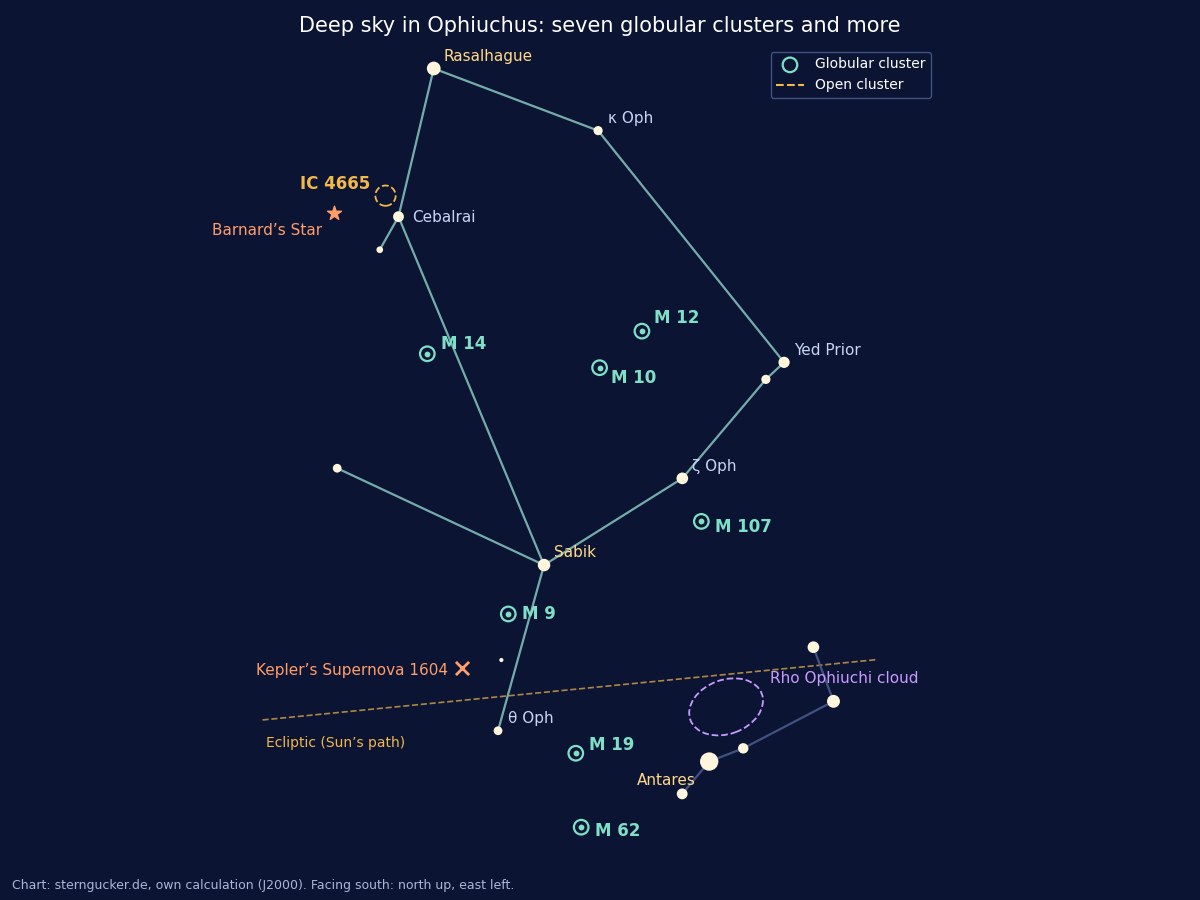
| Object | Magnitude | Size | Distance | Tip |
|---|---|---|---|---|
| M 10 (NGC 6254) | 6.6 mag | 20′ | 14,300 ly | dense, bright, first target |
| M 12 (NGC 6218) | 6.7 mag | 16′ | 15,700 ly | loose, resolves easily |
| M 62 (NGC 6266) | 6.5 mag | 15′ | 22,500 ly | asymmetric, very low |
| M 19 (NGC 6273) | 6.8 mag | 17′ | 28,700 ly | clearly oval |
| M 14 (NGC 6402) | 7.6 mag | 11′ | 30,300 ly | far away, hard to resolve |
| M 9 (NGC 6333) | 7.7 mag | 12′ | 25,800 ly | close to the galactic centre |
| M 107 (NGC 6171) | 7.9 mag | 13′ | 20,900 ly | faintest, 2.7° from ζ Oph |
M 10 and M 12: the pair to start with
M 10 and M 12 are only 3.3° apart, so both fit into one binocular field. In 7×50 binoculars they appear as two fuzzy “stars”, as observers on the astronomie.de forum confirm.
From 130 mm aperture the edges break up into individual stars. M 12 is looser and resolves more easily, M 10 looks brighter and more compact. Comparing them side by side on one night is one of the nicest exercises of the summer.
M 19 and M 62: low in the south
Both are just 7 to 8° from Antares and therefore low on the horizon. M 19 is one of the most flattened globular clusters, while M 62 looks lopsided because the Milky Way’s tidal forces are tugging at it. From the Alps both are worthwhile, from northern Germany they are more of a challenge.
IC 4665: the cluster for binoculars
Only 1.4° north-east of Cebalrai lies the open cluster IC 4665 (4.2 mag). It is larger than the full Moon and therefore looks better in binoculars than in a telescope. A second bright cluster, NGC 6633, sits on the eastern edge of the constellation.
The Rho Ophiuchi cloud: a stellar nursery
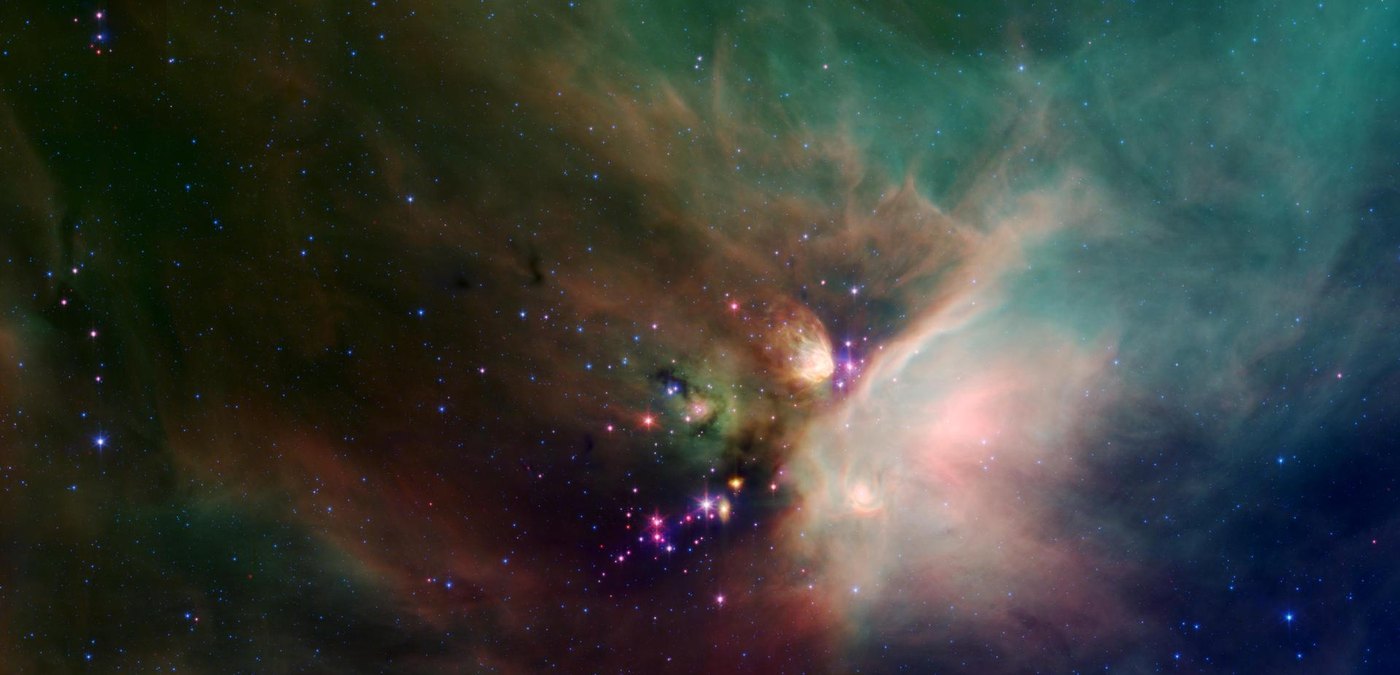
About 3° north of Antares lies one of the nearest star-forming regions, roughly 460 light-years away. Visually there is hardly anything to see, but on long exposures the region glows in blue, yellow and red.
From Central Europe the cloud stands only 14° high in Berlin. For a successful photo you need a dark site with a clear southern horizon and a tracking camera mount.
Kepler’s Supernova 1604: the last naked-eye stellar death
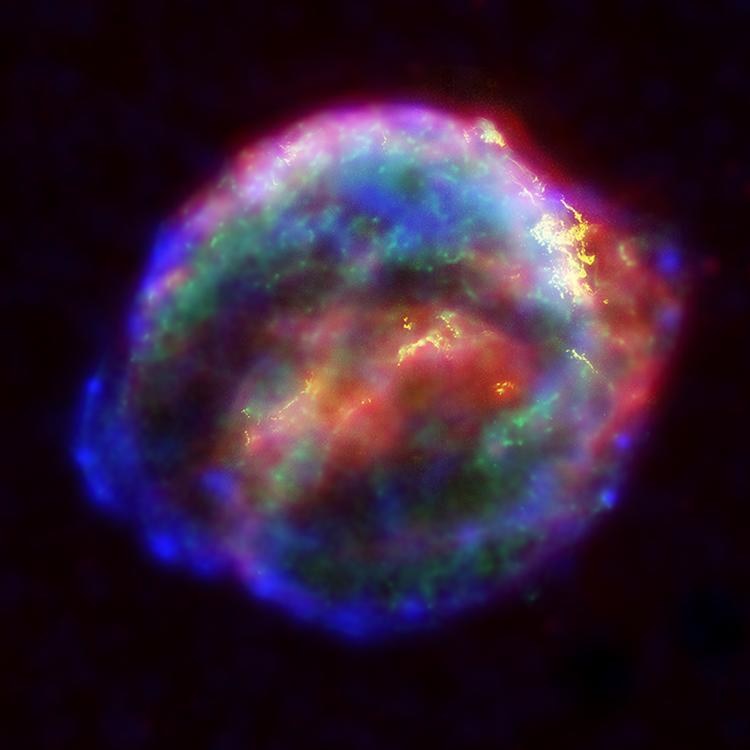
In October 1604 a new star appeared in the foot of Ophiuchus, brighter than Jupiter. Johannes Kepler observed it for more than a year and wrote the book De Stella Nova in pede Serpentarii about it.
It was the last supernova in our Milky Way that could be seen with the naked eye. The remnant is about 20,000 light-years away and accessible only to large telescopes and space observatories.
Which telescope for the globular clusters in Ophiuchus
For globular clusters there is a clear rule: aperture resolves stars. Binoculars show you where they are; only a telescope shows you what they are.
If you can only buy one instrument and really want to explore the sky, go for a telescope; binoculars are the complement, not the substitute. For M 10 and M 12, 130 mm is enough to see the first individual stars around the edges.
Recommended telescope: the entry point for globular clusters
Our beginner recommendation: Skywatcher Dobson Telescope N 130/650 Heritage FlexTube
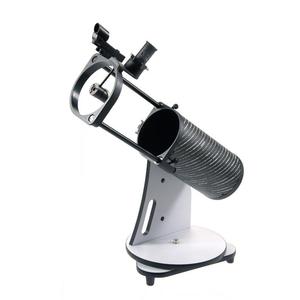
A compact tabletop Dobson with a true parabolic mirror. Folds down, fits in a bag: the Moon, planets and the bright deep-sky classics.
Price: € 265
130 mm of aperture on a simple tabletop mount – light, quick to set up and just right for the bright globular clusters. For M 62 and M 19 in the horizon haze it reaches its limits, but it is small enough to take to a spot with a clear view south. Our guide to beginner telescopes compares more models.
If you want more: the 200 mm Dobsonian for resolved clusters
For advanced observers: Skywatcher Dobson Telescope N 200/1200 Skyliner Classic
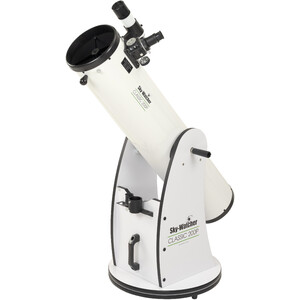
200 mm of aperture — the most sky for your money. Set it on the ground, point by hand: nebulae, clusters and galaxies for years to come.
Price: € 479
With 200 mm the Dobsonian gathers more than twice as much light as the 130. M 10 and M 12 then break up into individual stars right into the core, and even the fainter clusters M 9, M 14 and M 107 show first structure. The extra cost pays off if you want to observe deep-sky objects seriously and have room for a 1.2 m tube.
* Affiliate link: if you buy through this link we may earn a small commission from Astroshop or High Point Scientific, at no extra cost to you.
Ophiuchus mythology: Asclepius and the Rod of Asclepius
The Greeks saw in Ophiuchus Asclepius, the god of medicine. He was a son of Apollo and was raised by the wise centaur Chiron.
Legend has it that Asclepius watched a snake bring a dead companion back to life with a herb. With this knowledge he is said to have raised the dead – much to the anger of Hades, the god of the underworld.
Zeus then struck him down with a thunderbolt, but placed him among the stars as a constellation. The staff with a single snake, the Rod of Asclepius, is still the symbol of medicine today and of pharmacies.
Unique in the sky: the serpent (Serpens) that Asclepius holds is the only constellation split into two parts. Ophiuchus divides it into the head (Serpens Caput) in the west and the tail (Serpens Cauda) in the east.
Frequently asked questions about Ophiuchus
What does Ophiuchus mean?
Ophiuchus is a constellation that shows a man holding a serpent; the name is Greek for “serpent bearer”. In Greek legend he is Asclepius, the god of medicine. Astronomically it is one of the 88 official constellations and lies between Hercules and Scorpius.
Is the 13th zodiac sign official?
No. The astrological zodiac has twelve equal signs, and Ophiuchus is not one of them. It is only official as a constellation: the IAU lists it among the 88 constellations, and the Sun crosses it every year.
Am I Sagittarius or Ophiuchus?
If you were born between 23 November and 21 December, your zodiac sign is Sagittarius. Astronomically, for births from 30 November to 18 December the Sun was in the constellation Ophiuchus, and from 23 to 29 November in Scorpius. Your zodiac sign does not change because of this.
When would the Ophiuchus sign be?
If Ophiuchus were counted by the Sun’s actual position, it would run from 30 November to 18 December. In leap years the period sometimes starts on the evening of 29 November. The often-quoted dates 29 November to 17 December are one day off.
What is the symbol of Ophiuchus?
The sign used is ⛎, a symbol combining a serpent and a staff. It is now also available as a Unicode character, even though Ophiuchus plays no part in classical astrology.
Can you see Ophiuchus in winter?
Hardly. In December the Sun itself is in Ophiuchus, and in January and February only Rasalhague shows up shortly before dawn. The best time to observe it is June to August, late in the evening to the south.
Why does Ophiuchus have so many globular clusters?
It lies in the direction of the centre of the Milky Way. Globular clusters orbit the galactic centre, so they cluster in this part of the sky – seven of them are in the Messier catalogue.
Read more on Sterngucker
- All constellations at a glance – the entry point to our constellation guide
- Scorpius constellation – the southern neighbour with Antares
- Sagittarius constellation – the eastern neighbour in front of the galactic centre
- The Summer Triangle – the signposts to Ophiuchus
- Zodiac signs and constellations – the big table for all signs