By Alexander Merz · Updated on · Details checked on 12 October 2026
The Gemini constellation – Latin Gemini, “the Twins” – is a zodiac constellation of the winter sky: 514 square degrees in size, ranked 30th of the 88 constellations, with the bright stars Castor and Pollux as the heads of two brothers. Every year the Sun passes through it for about a month from the start of summer – later than the zodiac sign of the same name claims.
⭐ In short: You find Gemini via Orion – the line from Rigel through Betelgeuse points to Castor, and Pollux next to it is the brighter brother. They are best placed from January to March, high in the south in the evening. You see the figure with the naked eye, M 35 in binoculars, the double star Castor and the Eskimo Nebula in a telescope – and in December 2026 the Geminids bring almost moonless shooting-star nights.
Gemini constellation at a glance: facts, location and neighbours
Gemini is one of the 48 classical constellations that Ptolemy described as early as around AD 150. Its area is only medium-sized, but two first-magnitude stars make it far more conspicuous than larger neighbours such as Lynx.
| Property | Value |
|---|---|
| Latin name | Gemini (genitive Geminorum, abbreviation Gem) |
| Area | 514 square degrees – 30th of 88 |
| Brightest star | Pollux (β Gem), 1.2 mag |
| Second-brightest star | Castor (α Gem), 1.6 mag, sextuple system |
| Best time to observe | January to March, high in the south in the evening |
| Sun in the constellation | 21/22 June to 20/21 July |
| Gemini zodiac sign | 21 May to 21 June |
| Meteor shower | Geminids, peak 13/14 December |
| Messier object | M 35 (open star cluster) |
| Neighbours | Auriga, Lynx, Cancer, Canis Minor, Monoceros, Orion, Taurus |
The ecliptic, the Sun’s apparent path, runs right through the constellation. That is why the Moon and planets regularly pass through Gemini, and why, like Taurus and Cancer, it belongs to the zodiac. Of the twelve zodiac constellations it lies furthest north – from the UK and Ireland it climbs higher than any of the others.
How to find the Gemini constellation: via Orion, Procyon and Capella
The figure itself consists of two stick figures standing side by side. The heads, Castor and Pollux, are the only thing you recognise straight away – everything else follows once you have found them.
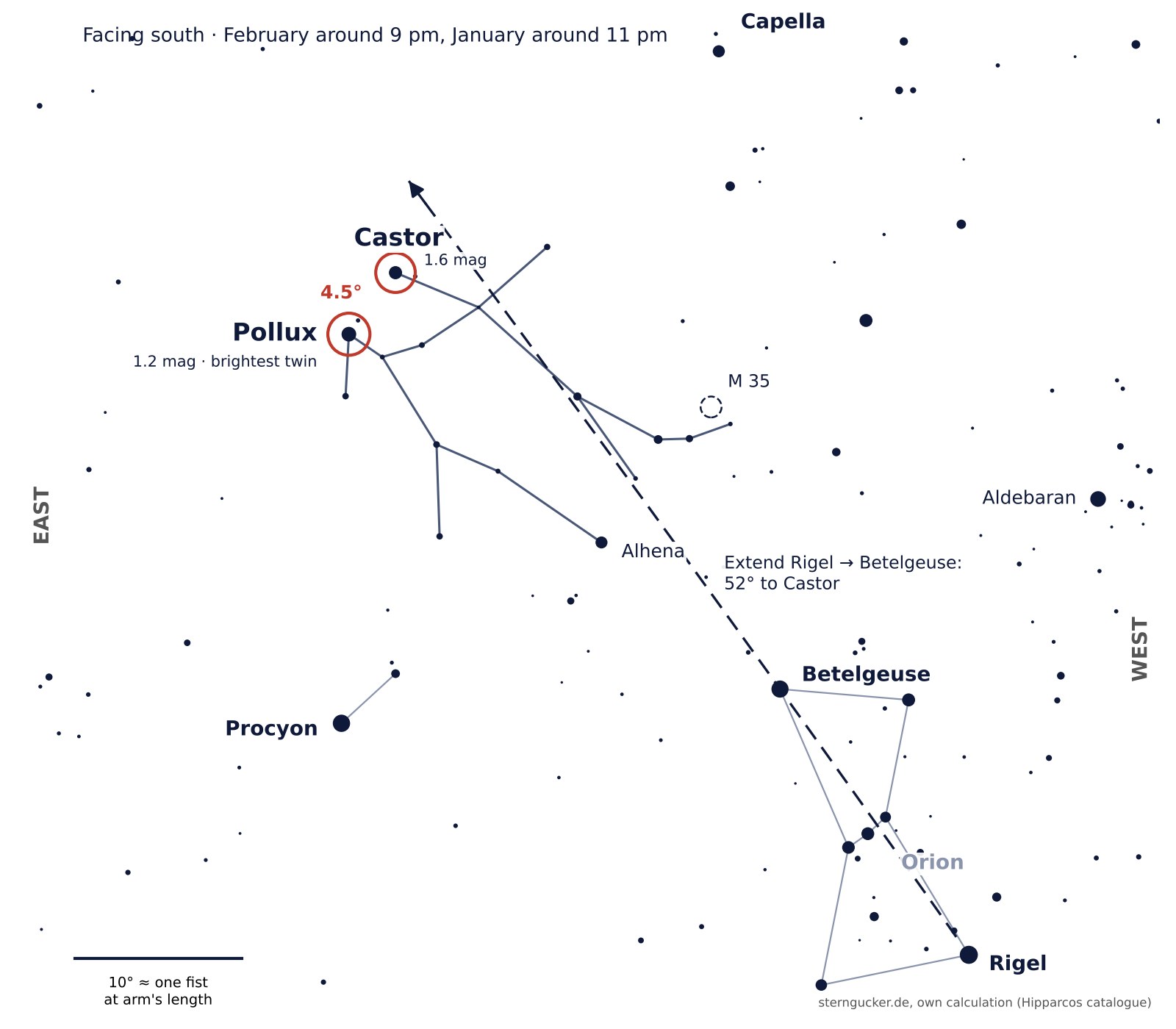
Route 1: extend Rigel through Betelgeuse
- Step 1: Look for Orion with its three belt stars in the south. At the bottom right is the blue-white Rigel, at the top left the orange Betelgeuse.
- Step 2: Connect the two (18.6°) and extend the line towards the upper left by almost three times that distance.
- Step 3: After 52° from Rigel you arrive at Castor, which is only 3.8° off the line. Pollux shines 4.5° further to the lower left – about three fingers’ width at arm’s length.
Route 2: the Winter Hexagon
Pollux is one corner of the Winter Hexagon formed by Capella, Aldebaran, Rigel, Sirius, Procyon and Pollux. If you know Procyon in Canis Minor, go straight up 23° from there and you will hit Pollux. Capella in Auriga is 30° to the upper right of Castor.
| Pointer | Distance | What you find there |
|---|---|---|
| Castor – Pollux | 4.5° | the two heads, three fingers wide |
| Rigel → Castor | 52° | via Betelgeuse, main pointer |
| Procyon → Pollux | 23° | straight up |
| Capella → Castor | 30° | towards the lower left |
| Aldebaran → Pollux | 45° | across Orion’s shoulder |
| Propus → M 35 | 2.3° | star cluster at the foot of the Castor twin |
| Wasat → NGC 2392 | 2.4° | Eskimo Nebula, east of Wasat |
Warning – reality check: You can see Castor and Pollux even from a city centre. The body stars of 3rd and 4th magnitude are lost in city light – the stick figures only become complete on the outskirts or in the countryside. How dark your sky is can be read off the Bortle scale.
In the evening in the east the Twins lie almost horizontal, with their heads pointing to the left. Only when they are in the south do the brothers stand upright, and before sunrise in the west they tilt with their heads to the upper right.
When you can see Gemini: month by month
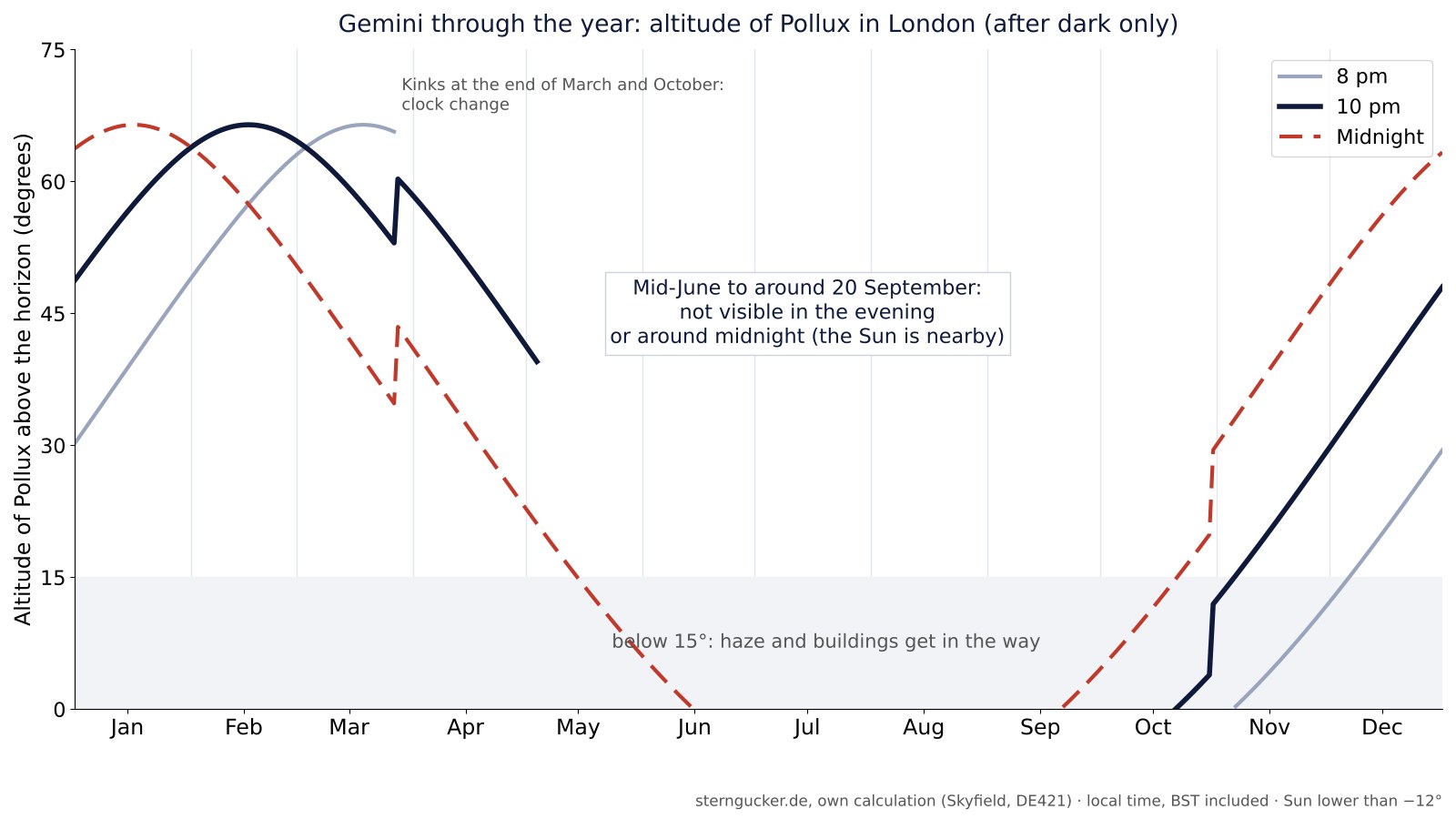
Gemini is a classic winter constellation. From December to April it is easy to see in the evening sky, and in February it already reaches its highest point around 10 pm. From June it disappears into the evening twilight because the Sun itself is moving through the constellation.
| Month | Pollux at 10 pm | Highest point | Rating |
|---|---|---|---|
| January | 57°, east-southeast | 00:06 | very good |
| February | 66°, south | 22:04 | best time |
| March | 59°, southwest | 20:14 | very good |
| April | 51°, west-southwest | 19:12 (still light) | good in the early evening |
| May | 33°, west | during the day | in twilight |
| June | 15°, west-northwest | during the day | hardly, sky too bright |
| July to September | below the horizon | during the day | not visible |
| October | below the horizon | 07:09 | rises only at 22:17 |
| November | 20°, east-northeast | 04:07 | from 10 pm |
| December | 38°, east | 02:09 | good from 9 pm |
How high Castor and Pollux climb in your city
Because Gemini lies so far north, it climbs to almost 70° here. At 52° N Castor stays above the horizon for about 19 hours a day, Pollux for almost 18. This is how high the main targets stand at the moment of their highest point:
| City | Castor | Pollux | M 35 | Eskimo Nebula |
|---|---|---|---|---|
| Edinburgh (56.0° N) | 65.9° | 62.0° | 58.4° | 54.9° |
| Glasgow (55.9° N) | 66.0° | 62.1° | 58.5° | 55.0° |
| Belfast (54.6° N) | 67.2° | 63.4° | 59.7° | 56.3° |
| Manchester (53.5° N) | 68.3° | 64.5° | 60.8° | 57.4° |
| Dublin (53.4° N) | 68.5° | 64.6° | 61.0° | 57.5° |
| Birmingham (52.5° N) | 69.3° | 65.5° | 61.8° | 58.4° |
| London (51.5° N) | 70.3° | 66.4° | 62.8° | 59.3° |
| Cardiff (51.5° N) | 70.3° | 66.5° | 62.8° | 59.4° |
In practice this means: all of Gemini’s targets reach about 55° or more everywhere in the UK and Ireland, well above the haze near the horizon. This is a particular advantage for the Eskimo Nebula, because the air high in the sky is usually steadier.
Castor and Pollux compared: two very different brothers
Castor and Pollux – the “heavenly twins” of the winter sky – look like a pair. In reality the two stars have nothing to do with each other: they are at different distances, of different ages and built completely differently.
| Property | Pollux (β Gem) | Castor (α Gem) |
|---|---|---|
| Brightness | 1.2 mag | 1.6 mag (all components) |
| Colour | orange | white |
| Distance | 34 light-years | 49–52 light-years |
| Star type | orange giant (K0 III) | six stars in three pairs |
| Diameter | almost 9 Suns | main stars about 2 Suns each |
| Special feature | planet Thestias (Pollux b) | double star you can split in a telescope |
Pollux: the brighter twin with a planet
Although Castor carries the letter alpha, Pollux is the brightest star in Gemini. At 34 light-years, the orange giant is the closest giant star of all and shines about 38 times as brightly as the Sun.
Since 2006 a gas giant with at least 2.3 Jupiter masses has been considered a companion, orbiting Pollux in about 590 days. This is not entirely certain: the measured signals could also come from magnetic activity on the star. More about this in our portrait of Pollux and in the overview of exoplanets.
Castor: six suns in one point of light
To the naked eye Castor is a single white star. In a telescope it splits into two stars of 1.9 and 3.0 mag, which orbit each other in about 460 years and are currently a good 5 arcseconds apart.
| Component | Brightness | Make-up | Orbit of the pair |
|---|---|---|---|
| Castor A | 1.9 mag | white star + red dwarf | 9.2 days |
| Castor B | 3.0 mag | white star + red dwarf | 92.9 days |
| Castor C (YY Gem) | 9.8 mag | two red dwarfs, eclipsing each other | 19.5 hours |
No amateur telescope can split the close pairs within A, B and C. What you see are three points of light: A, B and the faint Castor C, 73″ off to the side. That each of them is double is revealed only by spectra and by the dips in brightness of YY Geminorum.
Tip: For Castor A and B a telescope from about 70 mm aperture at 100 to 150 times magnification is enough. If the air is turbulent, the two merge into a figure of eight – then come back on a steadier evening.
More stars in Gemini: Alhena, Wasat, Mekbuda and co.
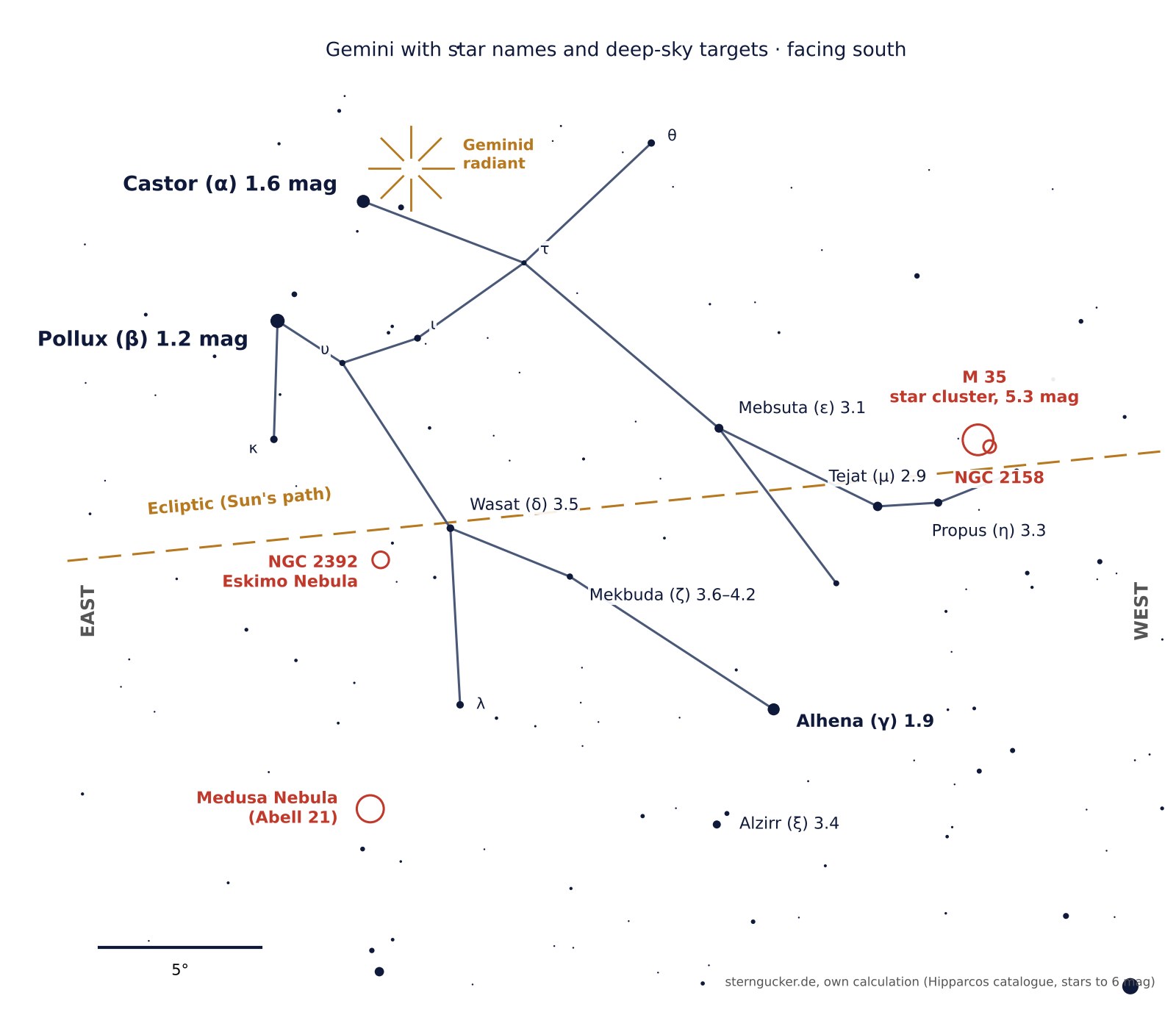
About a dozen stars trace the bodies of the brothers. Most of their proper names come from Arabic and are popular crossword answers – Gemini, Castor, Pollux, Alhena and Wasat turn up there most often.
| Star | Name | Brightness | Distance | Type |
|---|---|---|---|---|
| γ Gem | Alhena | 1.9 mag | 105 ly | white subgiant |
| μ Gem | Tejat | 2.9 mag | around 230 ly | red giant, slightly variable |
| ε Gem | Mebsuta | 3.1 mag | around 850–900 ly | yellow supergiant |
| η Gem | Propus | 3.2–3.9 mag | 350–700 ly (uncertain) | variable red giant |
| ξ Gem | Alzirr | 3.4 mag | 57 ly | yellowish-white subgiant |
| δ Gem | Wasat | 3.5 mag | 59 ly | double star on the ecliptic |
| ζ Gem | Mekbuda | 3.6–4.2 mag | around 1,200 ly | Cepheid, period 10.15 days |
Wasat lies only 0.2° from the ecliptic and is therefore occasionally occulted by the Moon; in 1857 even Saturn passed in front of it. Mekbuda is a Cepheid, a pulsating star: in a little over ten days it varies between 3.6 and 4.2 mag, which you can follow with the naked eye by comparing it with its neighbours.
Propus at the foot of the Castor twin changes its brightness semi-regularly over about 235 days. Together with Tejat it marks the way to the star cluster M 35, the finest deep-sky target in the constellation.
Deep-sky in Gemini: M 35, the Eskimo Nebula and the Medusa Nebula
The western edge of Gemini lies in the winter Milky Way. That is where M 35, the constellation’s only Messier object, sits, while further east two planetary nebulae – the cast-off gas shells of dying stars – await your telescope.
| Object | Type | Brightness | Size | Equipment |
|---|---|---|---|---|
| M 35 (NGC 2168) | open star cluster | 5.3 mag | 28′, almost the size of the full Moon | binoculars |
| NGC 2158 | open star cluster | 8.6 mag | 5′ | telescope from 100 mm |
| NGC 2392 (Eskimo Nebula) | planetary nebula | 9.1 mag | 48″ | telescope from 100 mm |
| Abell 21 (Medusa Nebula) | planetary nebula | very faint | about 10′ | from 200 mm with OIII filter |
| Castor A/B | double star | 1.9 / 3.0 mag | a good 5″ apart | telescope from 70 mm |
M 35 and NGC 2158: two clusters in one field
M 35 lies 2.3° to the upper right of Propus. Under a dark sky it is already a misty patch to the naked eye, and in binoculars a field of dozens of stars about 2,900 light-years away.
Only 25′ to the southwest lies NGC 2158, a small, grainy patch in the telescope. It is about four times as far away and around 20 times as old: about 2 billion years compared with around 100 million for M 35. Seeing this contrast in the same field of view is the real attraction.
NGC 2392: the Eskimo Nebula
The Eskimo Nebula lies 2.4° east of Wasat; William Herschel discovered it in 1787. At low magnification it looks like a slightly blurred, bluish star; only from about 100 times does it become a small disc with a bright central star.
Observers on the German astronomie.de forum recommend halving the distance between the faint stars 56 and 63 Geminorum and then searching about one degree to the south. Under a city sky a UHC or OIII filter helps, letting the nebula’s light through while darkening the background. Its distance is disputed: older values are 2,500 to 4,000 light-years, while the Gaia measurement gives around 6,500.
Warning – common mistake: The famous Hubble image with a face and fur hood is a long exposure. In the eyepiece the Eskimo Nebula remains a small, bright disc – only 48″ across, smaller than the Ring Nebula in Lyra. If you look for it with a wide-field eyepiece, you will often sweep right past it.
Medusa Nebula: the challenge for advanced observers
The Medusa Nebula (Abell 21) lies in the south of the constellation, a good 8° north of Procyon. It is about a third the size of the full Moon, but extremely low in surface brightness. Visually you need a truly dark sky, at least 200 mm aperture and an OIII filter – in photos it shows its tangled filaments, reminiscent of Medusa’s snake hair.
At around 1,500 light-years it is the nearer of the two nebulae. It is not a target for beginners, but a good reason to return to Gemini with larger equipment after a few years. Our overview nebulae in space explains the different types of nebula.
Binoculars or telescope for Gemini: honest equipment advice
For Castor, Pollux and the figure you need nothing but your eyes. For M 35 a pair of binoculars is enough – a 10×50 shows the whole cluster and its surroundings at once, plus sparkling chains of stars in the winter Milky Way.
For M 35 and the winter Milky Way: Omegon Brightsky 10x50 Binoculars

Bright, high-contrast binoculars: perfect for the Moon, star clusters and Milky Way fields, handheld.
Price: € 289
When a telescope is still worth it
The real highlights of Gemini are Castor as a double star, NGC 2158 and the Eskimo Nebula. All three are telescope-only targets, and an instrument with 130 mm aperture shows them reliably. How the decision generally works out is explained in telescope vs. binoculars.
For Castor, NGC 2158 and the Eskimo Nebula: Skywatcher Dobson Telescope N 130/650 Heritage FlexTube
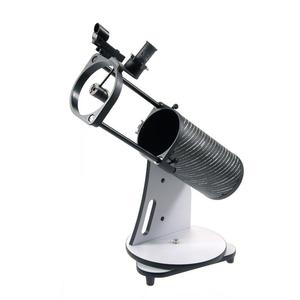
A compact tabletop Dobson with a true parabolic mirror. Folds down, fits in a bag: the Moon, planets and the bright deep-sky classics.
Price: € 265
If you want more: the 200 mm Dobsonian for nebula detail
For advanced observers: more light for nebulae: Skywatcher Dobson Telescope N 200/1200 Skyliner Classic
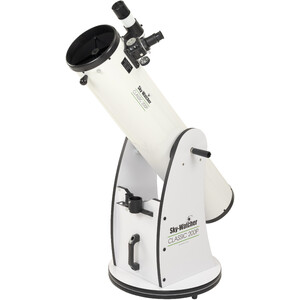
200 mm of aperture — the most sky for your money. Set it on the ground, point by hand: nebulae, clusters and galaxies for years to come.
Price: € 479
With 200 mm aperture you collect a good twice as much light as with 130 mm. The Eskimo Nebula then shows its ring structure, NGC 2158 resolves into individual stars at the edge, and with an OIII filter even the Medusa Nebula comes within reach. The extra cost is worth it if you want to hunt down deep-sky objects deliberately and have room to set it up – for Castor alone it is not necessary.
Geminids from Gemini: 2026 with an almost dark sky
The Geminids are the strongest meteor shower of the year, active from about 4 to 20 December. Their radiant – the point from which the shooting stars seem to come – lies just under 2° from Castor. Under ideal conditions up to 150 meteors per hour are possible, under a real country sky usually 60 to 100.
| Year | Peak (GMT) | Moon | Conditions |
|---|---|---|---|
| 2026 | 14 Dec, 13:41 | thin crescent, 25 %, sets at 20:00 | very good: nights of 13/14 and 14/15 |
| 2027 | 14 Dec, 19:54 | full Moon on 13 Dec | poor, Moon outshines |
| 2028 | 14 Dec, 01:57 | almost new Moon, 5 % | ideal: peak in the middle of a dark night |
In 2026 the peak falls on the afternoon of 14 December. Because the Moon sets early in the evening, both the night before and the night after are dark – on 14 December the crescent disappears at 21:13. The radiant is already 34° high at 9 pm and reaches 71° around 2 am, so the Geminids are worth it even if you go to bed early.
Their origin is unusual: the Geminids come from the asteroid 3200 Phaethon and not from a comet. You will find all the other winter showers in the meteor shower calendar.
Gemini constellation vs. Gemini zodiac sign: why the dates differ
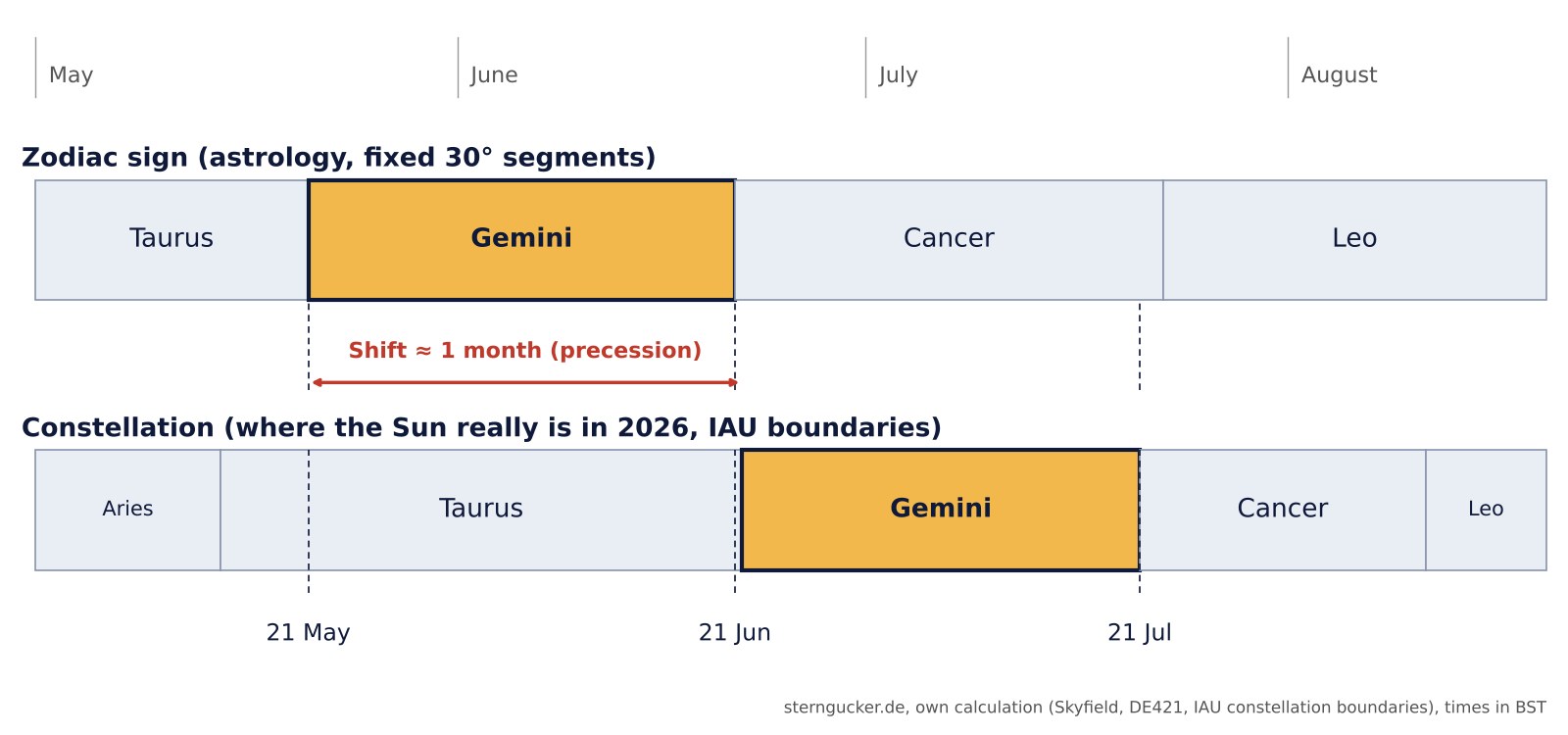
Anyone searching for “Gemini dates” or the Gemini star sign usually means astrology. The Gemini zodiac sign runs from 21 May to 21 June, whereas the constellation is a real area of sky with fixed boundaries. During that period, however, the Sun today is still in Taurus.
| Year | Sun enters Gemini | … enters Cancer | Duration |
|---|---|---|---|
| 2026 | 21 June 2026, 22:19 | 21 July 2026, 03:04 | 29.2 days |
| 2027 | 22 June 2027, 04:29 | 21 July 2027, 09:17 | 29.2 days |
| 2028 | 21 June 2028, 10:42 | 20 July 2028, 15:31 | 29.2 days |
The shift is caused by precession: the Earth’s axis wobbles like a spinning top, completing one circuit in about 25,800 years. The zodiac signs have not moved since antiquity, but the constellations in the sky have – by now almost a whole sign. You will find the complete comparison of all twelve signs in our overview zodiac signs and constellations.
Good to know: Until 1989 the Sun stood in Gemini at the June solstice. Since 1990 the solstice point has been in Taurus – another consequence of precession. Incidentally, the symbol ♊ is the astrological sign, a stylised Roman numeral two, not the star figure.
Moon and planets in Gemini: what happens from 2026 to 2028
Jupiter was in Gemini until June 2026, but it has now moved on. In winter 2026/27 no bright planet stays in the constellation, but the Moon visits the brothers every month – on Christmas Eve 2026 even as an almost full Christmas Moon.
| Who | Period in Gemini | Visibility |
|---|---|---|
| Moon | 26–28 Nov 2026 | 89 %, waning, from the evening |
| Moon | 23–25 Dec 2026 | 99 %, Christmas full Moon in Gemini |
| Moon | 20–22 Jan 2027 | 98 %, just before full Moon |
| Moon | 16–18 Feb 2027 | 86 %, high in the south in the evening |
| Moon | 16–18 Mar 2027 | 66 %, waxing |
| Venus | 4–26 Jul 2027 | only 8° from the Sun, not observable |
| Mars | 22 Jul – 1 Sep 2028 | in the morning sky |
| Venus | 14 Aug – 3 Sep 2028 | as a bright morning star |
| Saturn / Jupiter | from July 2032 / from May 2037 | next visits |
So a bright “star” in Gemini that isn’t on any chart is almost always the Moon or a planet. Which one it is right now, any planetarium app will tell you with the current positions for your location.
Uranus and Pluto: two discoveries in Gemini
On 13 March 1781 William Herschel found a small disc near Propus, which he first took for a comet. It was the planet Uranus, the first to be discovered with a telescope. In 1930 Clyde Tombaugh tracked down the dwarf planet Pluto on photographic plates of the area around Wasat.
Gemini mythology: Castor, Polydeuces and the Dioscuri
In Greek legend Castor and Polydeuces, Pollux in Latin, are the Dioscuri – the sons of the Spartan queen Leda. Polydeuces was fathered by Zeus and was immortal, Castor by King Tyndareus and mortal.
When Castor fell in battle, Polydeuces asked his father to let him share his immortality with his brother. Ever since, the two have spent alternate days on Olympus and in the underworld – and they stand together in the sky.
Patron saints of sailors: As Argonauts, the brothers sailed with Jason on the Argo. St Elmo’s fire on ships’ masts was considered their sign and a good omen. The Babylonians already saw “the great twins” here, and in Rome the Temple of Castor and Pollux in the Forum still commemorates the two today.
Frequently asked questions about the Gemini constellation
What does the Gemini constellation look like?
Like two stick figures standing side by side. The heads are the bright stars Castor and Pollux, and the bodies run as two almost parallel chains of stars towards Orion. In the evening in the east the figure lies horizontally, in the south it stands upright.
When can you see the Gemini constellation in the sky?
In the evening from December to April, best in February, when Pollux stands 66° high in the south at 10 pm. In November Gemini rises during the evening. From mid-June to around 20 September it cannot be seen in the evening or around midnight, because the Sun is close to it.
What is the Latin name of the Gemini constellation?
Gemini, genitive Geminorum, abbreviated Gem. That is why the stars are called α Geminorum (Castor), β Geminorum (Pollux) and so on. The Geminid meteor shower is also named after the Latin name.
Which star is brighter, Castor or Pollux?
Pollux, at 1.2 mag – it is orange and lies further to the southeast. Castor, at 1.6 mag, is somewhat fainter and white. Pollux is 34 light-years away, Castor about 50.
Why is Castor alpha even though Pollux is brighter?
In 1603 Johann Bayer did not assign the Greek letters strictly by brightness. The two were considered roughly equally bright, and Castor comes first in the legend. That is why he got the alpha.
When is the Sun in the Gemini constellation?
From 21 or 22 June to 20 or 21 July, so about 29 days. In 2026 it enters on 21 June at 22:19 BST and leaves the constellation on 21 July at 03:04 BST. The Gemini zodiac sign (21 May to 21 June) lies a month earlier.
Which planets are in Gemini in 2026/2027?
None in winter 2026/27. Jupiter left the constellation in June 2026, and Venus passes through in July 2027 only invisibly, close to the Sun. Only in summer 2028 do Mars and Venus stand in Gemini in the morning sky.
Can you see M 35 with the naked eye?
Yes, under a dark country sky as a small misty patch next to Propus. From the city you need binoculars. Only then does it become clear that the patch consists of dozens of stars.
Is Gemini part of the Winter Hexagon?
Yes, Pollux is one of the six corners, together with Capella, Aldebaran, Rigel, Sirius and Procyon. Some depictions use Castor instead of Pollux. Betelgeuse lies roughly in the middle of the hexagon.
Links marked with an asterisk (*) are affiliate links. If you buy through them we earn a small commission – the price stays the same for you.
Read more on Sterngucker
- Pollux – the brighter twin and its planet
- Geminids 2026 – the meteor shower from Gemini
- Cancer constellation – the eastern neighbour with the Beehive Cluster M 44
- Taurus constellation – the western zodiac neighbour
- Orion constellation – the signpost to Gemini
- Auriga constellation – Capella, the northern neighbour
- Zodiac sign vs. constellation – why the dates differ
- All constellations – the starting point of our catalogue