By Alexander Merz · Published on · Details checked on 3 October 2026
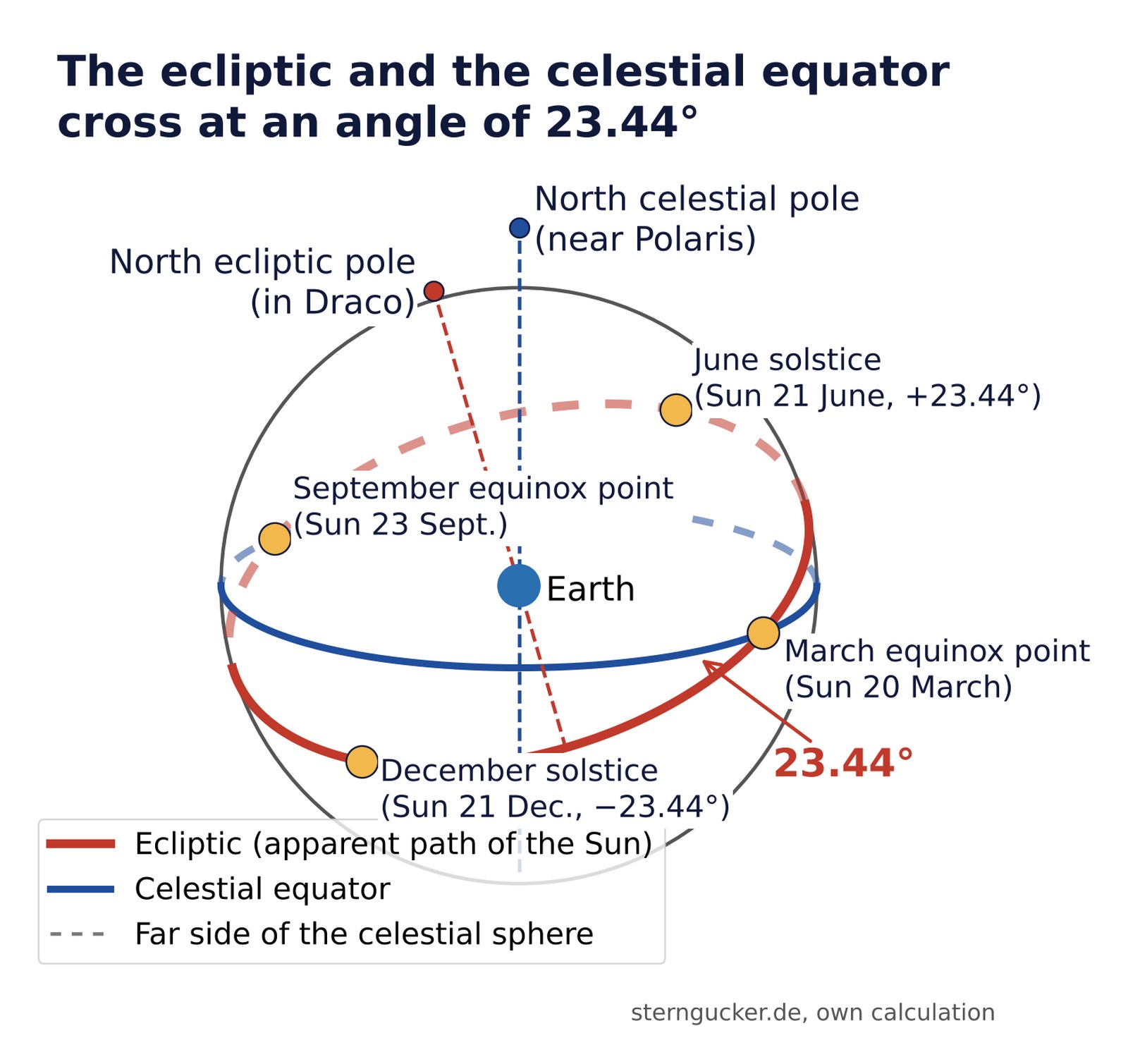
The ecliptic is the apparent path along which the Sun travels once around the whole sky against the background stars in the course of a year – just under 1° per day, through 13 constellations. It is the projection of Earth’s orbital plane onto the sky and is tilted by 23.44° to the celestial equator; you can explore all the constellations along it in our guide to the constellations and the zodiac.
⭐ In short: If you are looking for planets, the Moon or the zodiacal light, you are looking along the ecliptic. In practice, though, what matters most is how steeply it meets the horizon: on spring evenings and autumn mornings it rises steeply – that is when Mercury, a thin crescent Moon and the zodiacal light are easiest to see. On autumn evenings, by contrast, it lies so flat that even a Mercury far from the Sun disappears in the haze.
What is the ecliptic? The Sun’s path explained simply
Earth orbits the Sun once a year. Seen from Earth, it therefore looks as if the Sun were moving in front of changing constellations – in March in front of Pisces, in June in front of Taurus and Gemini. Join up these positions and you get a great circle around the whole sky: the ecliptic.
You cannot watch this motion directly, because the stars vanish in the daytime sky. You do notice it in the night sky, though: every evening a given star sets about four minutes earlier, and after half a year the winter sky stands where the Sun was in summer.
The name comes from the Greek ékleipsis, eclipse. Only when the Moon stands exactly on this line can there be a solar or lunar eclipse – something the astronomers of antiquity already knew.
| Feature | Value |
|---|---|
| What it is | Apparent yearly path of the Sun, projection of Earth’s orbital plane |
| Obliquity to the celestial equator (2026) | 23.436° = 23° 26′ 09″ |
| Change in obliquity | −0.47″ per year |
| Speed of the Sun | just under 1° per day (360° in 365.25 days) |
| Constellations on the ecliptic | 13 (IAU boundaries), including the 12 classical zodiac constellations |
| North ecliptic pole | Draco, 18h 00m / +66° 33′ |
| South ecliptic pole | Dorado, 6h 00m / −66° 33′ |
| Highest / lowest point at 52° North | 61.4° / 14.6° above the southern horizon |
| The March equinox point currently lies | in the constellation Pisces, in Aquarius from about 2597 |
Ecliptic and celestial equator: two circles, two crossing points
The celestial equator is Earth’s equator projected onto the sky. Because Earth’s axis is tilted relative to its orbital plane, the equator and the ecliptic lie at an angle to each other and cross at exactly two points. The Sun stands there at the start of spring and of autumn.
In between lie the two extremes: at the June solstice the Sun reaches the northernmost point of the ecliptic, at the December solstice the southernmost. These four moments define the astronomical seasons.
| Point on the ecliptic | Ecliptic longitude | Distance from the equator | Sun there in 2026 |
|---|---|---|---|
| March equinox point | 0° | 0° | 20 March, 14:45 GMT |
| June solstice | 90° | +23.44° | 21 June, 09:24 BST |
| September equinox point | 180° | 0° | 23 September, 01:05 BST |
| December solstice | 270° | −23.44° | 21 December, 20:50 GMT |
Exact times and day lengths around the shortest day are on our page about the winter solstice. The geometry is easy to remember: in summer the ecliptic runs high by day and low at night – in winter it is exactly the other way round.
Obliquity of the ecliptic: 23.44 degrees and slowly shrinking
Astronomers call the angle between the ecliptic and the celestial equator the obliquity of the ecliptic, symbol ε. For 2026 the official IAU formula gives 23.436°, or 23° 26′ 09″. It is the same angle by which Earth’s axis is tilted away from the perpendicular to its orbital plane.
| Year | Mean obliquity ε |
|---|---|
| 1900 | 23.452° |
| 2000 | 23.439° |
| 2026 | 23.436° |
| 2100 | 23.426° |
| 3000 | 23.310° |
The angle is currently shrinking by 0.47 arcseconds per year. As a result the Tropic of Cancer moves about 15 metres south every year, and the Arctic Circle moves north by the same amount. Over a human lifetime that adds up to a good kilometre.
In the long run the obliquity swings back and forth in a cycle of about 41,000 years. Depending on the model, the range is roughly 22.1° to 24.5°; Wikipedia gives 21° 55′ to 24° 18′. According to Laskar’s series, the last maximum of just over 24.2° was about 9,500 years ago, and in about 10,000 years the value will approach 22.6°.
The cause is the gravitational pull of the other planets, whose orbits are slightly tilted relative to Earth’s. The Moon acts as a stabiliser and stops Earth’s axis from tipping further. These variations are part of the Milanković cycles, which help drive the climate of the ice ages.
Tip: Why Earth’s axis is tilted at all has not been settled for good. The most likely explanation is giant collisions early on – such as the impact that formed the Moon – which knocked the young Earth over.
Angle of the ecliptic to the horizon: steep or flat
For observers, one question matters more than the obliquity: how steeply does the ecliptic climb out of the horizon in the evening or morning sky? Planets close to the Sun, the young crescent Moon and the zodiacal light all lie on this line. If it is steep, they rise high above the haze; if it is flat, they hug the horizon.
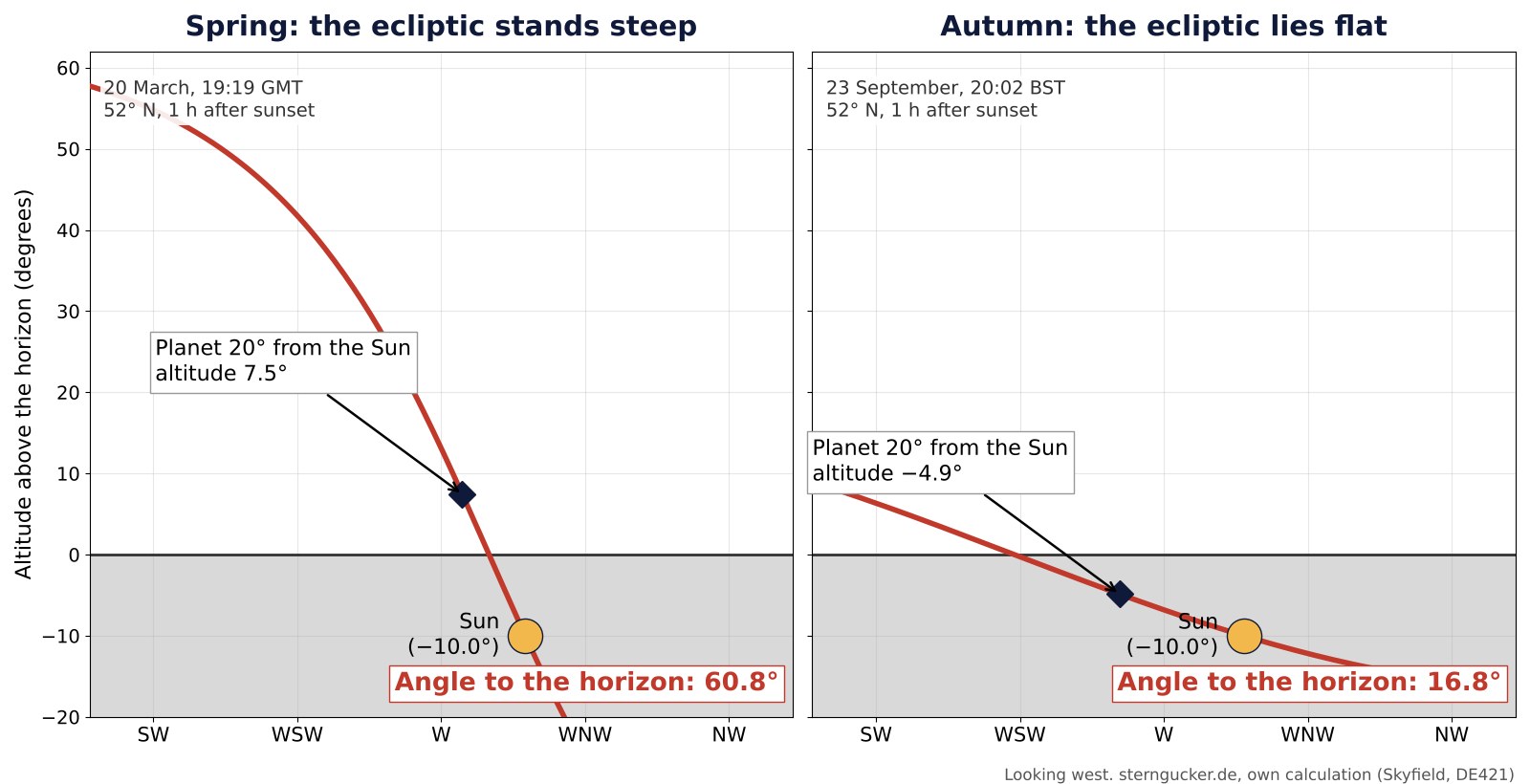
We calculated the angle for 52° North – the latitude of the English Midlands – one hour after sunset and one hour before sunrise. The table also shows how high a planet would stand if it were 20° from the Sun along the ecliptic – typical of Mercury at a good elongation.
| Date 2026 | Angle in the evening | Planet 20° east of the Sun | Angle in the morning | Planet 20° west of the Sun |
|---|---|---|---|---|
| 20 March | 60.8° | 7.5° high | 16.7° | −4.9° (below the horizon) |
| 21 June | 24.0° | 1.0° high | 24.1° | 1.1° high |
| 23 September | 16.8° | −4.9° (below the horizon) | 60.8° | 7.5° high |
| 21 December | 37.3° | 3.5° high | 37.6° | 3.6° high |
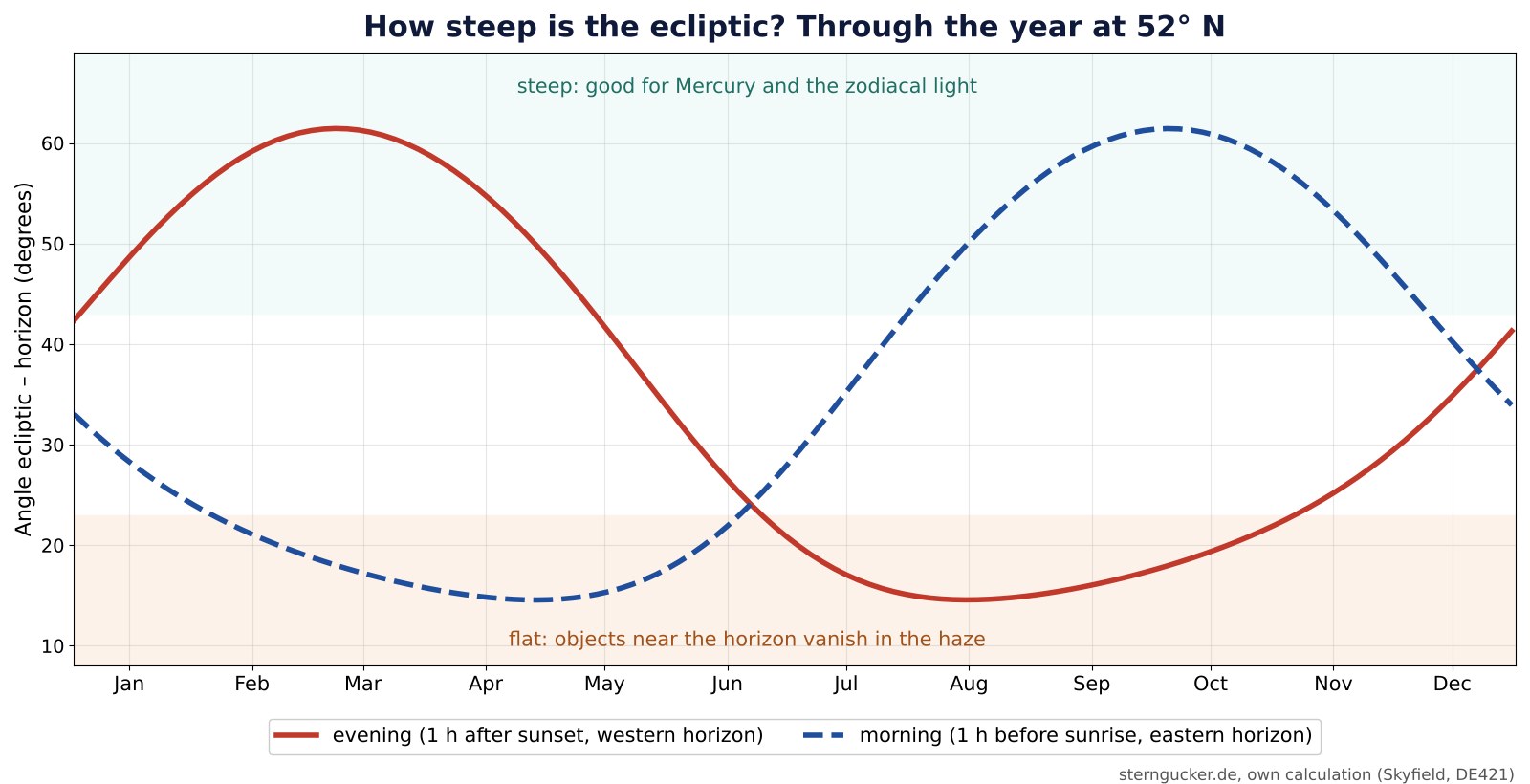
At 52° North the angle always swings between two fixed limits. Here the ecliptic is never steeper than 61.4° and never flatter than 14.6° – that is 90° minus your latitude, plus or minus the obliquity. In the evening the maximum is reached in early March, in the morning in early October.
Watching the tilt of the ecliptic: Mercury, zodiacal light, crescent Moon
Three sights show the effect so clearly that you can experience it yourself. All three follow the same rule: spring evenings, autumn mornings.
Mercury: why the distance from the Sun alone tells you nothing
Many calendars only list the greatest elongation, the largest angular distance of Mercury from the Sun. Our calculation shows that the largest separations can be precisely the worst apparitions. What counts is the altitude at the end of civil twilight, when the Sun is 6° below the horizon.
| Greatest elongation | Visible | Distance from the Sun | Best altitude with the Sun at −6° |
|---|---|---|---|
| 12 Oct 2026 | evening | 25.2° | invisible (−1.5°) |
| 20 Nov 2026 | morning | 19.6° | 10.6° |
| 3 Feb 2027 | evening | 18.3° | 9.2° |
| 17 Mar 2027 | morning | 27.6° | 1.9° |
| 28 May 2027 | evening | 22.9° | 9.6° |
| 15 Jul 2027 | morning | 20.7° | 5.6° |
| 24 Sep 2027 | evening | 26.3° | invisible (−1.3°) |
| 4 Nov 2027 | morning | 18.8° | 10.9° |
In October 2026 Mercury is 25° from the Sun and still stays invisible from the UK and Ireland, because the evening ecliptic lies flat. In November 2026 just under 20° of separation is enough for almost 11° of altitude in the morning sky – the best Mercury opportunity of the autumn. To check whether it is visible right now, see our overview Which planets are visible tonight?
Zodiacal light: a cone of light along the ecliptic
The zodiacal light is sunlight scattered by fine dust in the plane of the Solar System. It appears as a faint, slanting cone of light that follows the ecliptic exactly. That is why you only see it when the ecliptic stands steep: from February to April in the west after dusk, from August to October in the east before dawn.
Warning: The zodiacal light is so faint that a single town on the horizon wipes it out. You need a truly dark site with no Moon and full astronomical darkness, about 90 to 120 minutes after sunset or before sunrise. You can check how dark your sky is with the Bortle scale in our article on light pollution.
Experienced observers in the German astronomie.de forum advise comparing the glow with patches of sky at the same height to its left and right. Under a very dark sky the cone reaches like a leaning pyramid far beyond the middle of the sky.
The Moon boat: when the crescent lies on its back
The orientation of the crescent Moon also depends on the ecliptic. When the ecliptic is steep, the Sun lies almost straight below the Moon – the lit side faces down and the horns point up. This creates the “Moon boat”, also known as a “Cheshire Cat Moon”, which you can see on spring evenings with the waxing Moon.
| Crescent Moon (3 days old) | Time | Altitude of the Moon | Tilt of the line between the horns |
|---|---|---|---|
| evening, 11 Mar 2027 | 19:02 GMT | 27.0° | 25° – lies almost like a boat |
| evening, 3 Sep 2027 | 20:49 BST | −5.1° (already set) | 81° – would stand almost upright |
| morning, 5 Mar 2027 | 05:43 GMT | −1.3° (not yet risen) | 74° |
| morning, 28 Aug 2027 | 05:10 BST | 31.2° | 39° – easy to see, slightly tilted |
In autumn evenings it is the other way round: the flat ecliptic pushes the young crescent down towards the horizon, where it stands almost upright and sets soon after the Sun. In the tropics, by contrast, the crescent almost always lies on its back, because the ecliptic stands steep there all year round.
Highest and lowest points of the ecliptic: the Sun and the Full Moon
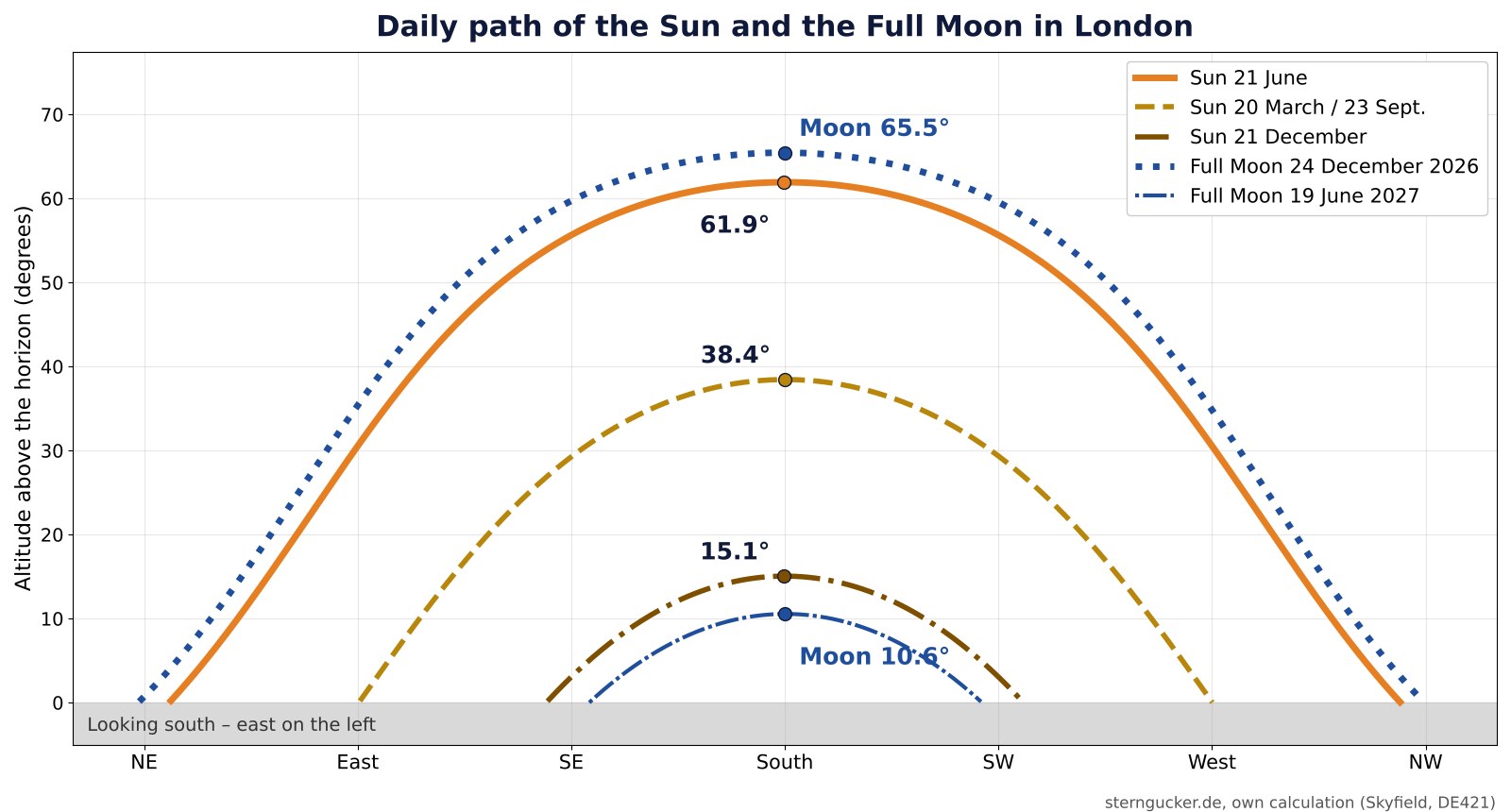
The height of the midday Sun follows directly from its position on the ecliptic. At the June solstice it stands 23.44° above the equator, at the December solstice 23.44° below it – so the noon altitude differs by just under 47° everywhere in the UK and Ireland.
| City | Latitude | 21 June | 20 March | 21 December |
|---|---|---|---|---|
| London | 51.5° N | 61.9° | 38.4° | 15.1° |
| Birmingham | 52.5° N | 61.0° | 37.5° | 14.1° |
| Manchester | 53.5° N | 60.0° | 36.5° | 13.1° |
| Dublin | 53.3° N | 60.1° | 36.6° | 13.2° |
| Edinburgh | 56.0° N | 57.5° | 34.0° | 10.6° |
With the Full Moon it is the other way round, because it stands exactly opposite the Sun. So the Full Moon runs where the Sun will be half a year later: high in winter like the June Sun, low in summer like the December Sun.
| Full Moon | Highest altitude in London |
|---|---|
| 24 Dec 2026 | 65.5° |
| 22 Mar 2027 | 36.9° |
| 19 Jun 2027 | 10.6° |
| 16 Sep 2027 | 38.3° |
The fact that the Christmas Full Moon, at 65.5°, even beats the June Sun (61.9° in London) is down to the Moon’s orbit being tilted by 5°. Around the major lunar standstill of 2025 the Moon swings up to just over 28° above and below the equator, further than the Sun. You can read more about this Full Moon on our supermoon page.
The constellations of the ecliptic: 13, not 12
According to the constellation boundaries set by the International Astronomical Union (IAU) in 1930, the ecliptic crosses not 12 but 13 constellations. The thirteenth is Ophiuchus, the Serpent Bearer, whose feet stand on the Sun’s path. The sections are very unequal in width, as our calculation for 2026 shows.
| Constellation | Sun inside it | Duration |
|---|---|---|
| Capricornus | 20 Jan to 16 Feb | 27.4 days |
| Aquarius | 16 Feb to 12 Mar | 24.1 days |
| Pisces | 12 Mar to 19 Apr | 37.5 days |
| Aries | 19 Apr to 14 May | 25.5 days |
| Taurus | 14 May to 21 Jun | 38.3 days |
| Gemini | 21 Jun to 21 Jul | 29.2 days |
| Cancer | 21 Jul to 11 Aug | 21.0 days |
| Leo | 11 Aug to 17 Sep | 37.1 days |
| Virgo | 17 Sep to 31 Oct | 44.5 days |
| Libra | 31 Oct to 23 Nov | 23.1 days |
| Scorpius | 23 Nov to 30 Nov | 6.5 days |
| Ophiuchus | 30 Nov to 18 Dec | 18.3 days |
| Sagittarius | 18 Dec to 20 Jan | 32.5 days |
The exact entry and exit times around Ophiuchus are on our page about Ophiuchus. The twelve zodiac signs of astrology, by contrast, are equal 30° sections, counted from the March equinox point – they have not matched the constellations for around 2,000 years. You will find all the signs side by side in our comparison Zodiac signs and constellations.
Planets and the Moon along the ecliptic: small deviations
All the major planets formed from the same flat disc around the young Sun. That is why their orbits deviate from Earth’s orbital plane by only a few degrees, and in the sky they move within a narrow band around the ecliptic. Seen from Earth, however, they can stray further from it than their orbital inclination suggests.
| Body | Orbital inclination to the ecliptic | Greatest distance from the ecliptic as seen from Earth |
|---|---|---|
| Mercury | 7.0° | 5.0° |
| Venus | 3.4° | 8.7° |
| Mars | 1.8° | 6.7° |
| Jupiter | 1.3° | 1.6° |
| Saturn | 2.5° | 2.8° |
| Uranus | 0.8° | 0.8° |
| Neptune | 1.8° | 1.8° |
| Moon | 5.1° | 5.3° |
| Pluto (dwarf planet) | 17.2° | 16.0° |
Venus is the odd one out: when it comes very close to Earth at inferior conjunction, its small orbital tilt is magnified as if under a lens. It can then stand almost 9° above or below the ecliptic. The same happens with Mars at oppositions when it is close to Earth.
Because all the planets move within this band, in the sky they appear to stand on a line. During a “planet parade” this line is especially easy to see, when several planets are above the horizon at the same time.
Observing planets along the ecliptic
Your eyes are enough to find them: a bright, steadily shining “star” close to the ecliptic is almost always a planet. For Saturn’s rings, Jupiter’s cloud belts and the phases of Venus you need a telescope with enough aperture, meaning the diameter of the main optic. To get started we recommend a compact Newtonian.
Our beginner’s pick: Skywatcher Dobson Telescope N 130/650 Heritage FlexTube
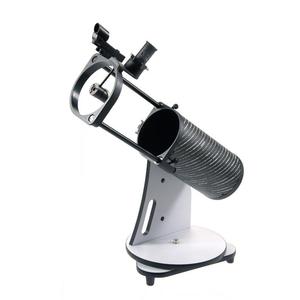
A compact tabletop Dobson with a true parabolic mirror. Folds down, fits in a bag: the Moon, planets and the bright deep-sky classics.
Price: € 265
The Heritage 130/650 reliably shows Saturn’s rings, the four large moons of Jupiter and the crescent of Venus. Its limit is fine detail on Mars and Jupiter, especially when the planets stand low on the flat summer ecliptic. Our guide Which telescope for planets? compares more instruments.
If you want more: the 200 mm Dobsonian
For advanced observers: Skywatcher Dobson Telescope N 200/1200 Skyliner Classic
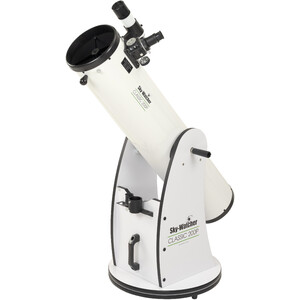
200 mm of aperture — the most sky for your money. Set it on the ground, point by hand: nebulae, clusters and galaxies for years to come.
Price: € 479
With 200 mm of aperture and a 1,200 mm focal length, the Skyliner gathers more than twice as much light as the 130 and gives sharper high-power views. Jupiter’s Great Red Spot, the Cassini Division in Saturn’s rings and details on Mars become realistic targets when the air is steady. The extra cost is worth it if you want to observe planets regularly and have room for a 1.2 m tube.
The ecliptic and eclipses: why they only happen at the nodes
At every New Moon the Moon stands between Earth and the Sun, yet there is not a solar eclipse every month. The reason is the Moon’s orbit, tilted by 5.1°: usually the Moon passes a few degrees above or below the Sun. Only when New or Full Moon falls close to one of the two points where the Moon’s orbit crosses the ecliptic, the lunar nodes, does it go dark.
| Date | Moon phase | Moon above (+) / below (−) the ecliptic | Result |
|---|---|---|---|
| 17 Feb 2026 | New Moon | −0.9° | annular solar eclipse |
| 3 Mar 2026 | Full Moon | −0.4° | total lunar eclipse |
| 16 May 2026 | New Moon | +4.9° | no eclipse |
| 12 Aug 2026 | New Moon | +0.9° | total solar eclipse |
| 28 Aug 2026 | Full Moon | +0.5° | partial lunar eclipse |
| 24 Nov 2026 | Full Moon | +5.0° | no eclipse |
| 2 Aug 2027 | New Moon | +0.2° | total solar eclipse |
The Sun passes each node once a year, so there are two eclipse seasons just under six months apart – in 2026 in February/March and in August. Because the nodes drift backwards once around the ecliptic in 18.6 years, the seasons move about 19 days earlier each year. All dates are on our pages about the lunar eclipse and the solar eclipse of 2027.
Warning: The Sun always lies on the ecliptic – if you follow the line with binoculars or a telescope, you can accidentally sweep it into view. Only ever observe the Sun with a certified objective solar filter or eclipse glasses meeting ISO 12312-2; sunglasses, CDs or emergency blankets do not protect your eyes.
Ecliptic coordinates and precession: the wandering March equinox point
For planetary orbits, astronomers use a coordinate system of their own with the ecliptic as its fundamental circle. Ecliptic longitude is counted from 0° to 360° along the ecliptic, starting at the March equinox point, while ecliptic latitude gives the distance north or south of it. By definition the Sun always has a latitude of almost exactly 0°.
Perpendicular to the ecliptic lie the two ecliptic poles. The northern one lies in the constellation Draco, only about ten arcminutes from the Cat’s Eye Nebula NGC 6543. The southern one lies in Dorado, about 5° from the Large Magellanic Cloud.
The north celestial pole circles the ecliptic pole once in about 25,800 years – this is precession, caused by the Moon and the Sun tugging on the flattened Earth. As a result the March equinox point moves backwards through the constellations by about 1° every 72 years. That is why Polaris will not be the Pole Star forever.
| Period | March equinox point in the constellation |
|---|---|
| until about 70 BC | Aries (hence “First Point of Aries”, symbol ♈) |
| about 70 BC to 2597 | Pisces |
| from about 2597 | Aquarius |
Astronomically, the much-quoted “Age of Aquarius” therefore only begins in around 570 years. Astrologers place its start at very different dates, because there is no binding boundary for it.
Frequently asked questions about the ecliptic
What is the ecliptic, in simple terms?
The ecliptic is the line along which the Sun moves against the stars in the course of a year. It arises because Earth orbits the Sun, so we see the Sun in front of changing constellations. The Moon and the planets also travel close to this line.
What is the obliquity of the ecliptic?
That is the name for the angle between the ecliptic and the celestial equator. In 2026 it is 23.436°, rounded to 23.44°, and it is decreasing by 0.47″ per year. Over about 41,000 years it varies between roughly 22.1° and 24.5°.
Why is the ecliptic tilted?
Because Earth’s axis is tilted relative to its orbit. The celestial equator follows Earth’s equator and the ecliptic follows the orbital plane – so the two are at an angle of 23.44° to each other. The tilt probably stems from violent collisions in the early days of the Solar System.
What is the difference between the ecliptic and the zodiac?
The ecliptic is a line, the zodiac a band about 20° wide around it. In astrology it is divided into twelve equal signs of 30° each. Astronomically, the ecliptic crosses 13 constellations of different widths.
Do all the planets lie on the ecliptic?
Almost. Their orbits are tilted to the ecliptic by between 0.8° (Uranus) and 7.0° (Mercury). Seen from Earth, Venus can stray up to 8.7° from it and Mars up to 6.7°.
Where is the ecliptic in the sky tonight?
The easiest way is to use the Moon and the planets: join them up in your mind and you have the ecliptic. It rises in the east, reaches its highest point in the south and sinks in the west. Which planets are up tonight is shown on our page Which planets are visible tonight?
What is the difference between the ecliptic and the celestial equator?
The celestial equator is the projection of Earth’s equator, the ecliptic the projection of Earth’s orbit. The two great circles cross at the March and September equinox points at an angle of 23.44°. When the Sun is on the equator, day and night are roughly equal in length everywhere.
Where does the word ecliptic come from?
From the Latin linea ecliptica, derived from the Greek ékleipsis, meaning eclipse. The name is a reminder that solar and lunar eclipses only happen when the Moon is on this line.
Why is the Full Moon so high in winter?
The Full Moon stands opposite the Sun and therefore on the part of the ecliptic that the Sun occupies in summer. On 24 December 2026 it reaches an altitude of 65.5° in London, on 19 June 2027 only 10.6°.
Links marked with an asterisk (*) are affiliate links. If you buy through them we earn a small commission – the price stays the same for you.
Read more on Sterngucker
- Zodiac sign vs. constellation – why your sign has “slipped”
- Ophiuchus constellation – the 13th constellation on the ecliptic
- Astronomical seasons – all dates and the explanation
- Winter solstice – times and day length
- Which planets are visible tonight? – find out for yourself