By Alexander Merz · Published on · Details checked on 3 October 2026
Aldebaran is the brightest star in the constellation Taurus and the reddish “Eye of the Bull”: a red giant of spectral type K5 III, around 67 light-years away and, at magnitude 0.75 to 0.95, the 14th brightest star in the night sky. You’ll find more bright stars in our overview Stars in the sky.
⭐ In short: Aldebaran is a winter star: from November to March it stands high in the south in the evening, and you can find it without any equipment by extending Orion’s Belt up to the right. It looks like part of the V-shaped Hyades star cluster, but it is actually less than half as far away, in the foreground. The Moon won’t cover it again until 2033 – we have calculated the first well-placed occultation for the UK and Ireland for 25 February 2034.
Aldebaran fact file: the red giant in numbers
Aldebaran carries the Bayer designation α Tauri, making it the lead star of Taurus. It is an old star that has used up the hydrogen in its core and has therefore swollen into a giant. The values come from the scientific literature as summarised by Wikipedia; we recalculated the positional data ourselves.
| Property | Value |
|---|---|
| Designation | α Tauri (Alpha Tauri), 87 Tauri |
| Constellation | Taurus (the Bull) |
| Star type | red giant, spectral type K5 III |
| Brightness | magnitude 0.75 to 0.95, slow irregular variable |
| Rank in the night sky | 14th brightest star |
| Distance | around 67 light-years (20.4 parsecs) |
| Radius | around 45 solar radii (diameter about 63 million km) |
| Mass | about 1.0 to 1.2 solar masses |
| Luminosity | about 400 to 500 times the Sun |
| Surface temperature | about 3,900 K |
| Age | about 6.4 billion years |
| Motion | moving away from us at 54 km/s |
| Position (J2000) | right ascension 4h 35m 55s, declination +16° 30′ |
| Distance from the ecliptic | 5.5° south (which is why lunar occultations are possible) |
| Best time to observe | November to March, evenings |
The age stands out: at a good 6 billion years, Aldebaran is older than the Sun. With a mass of about one Sun, it shows what our own star will look like in the distant future.
How to find Aldebaran: via Orion’s Belt and the Pleiades
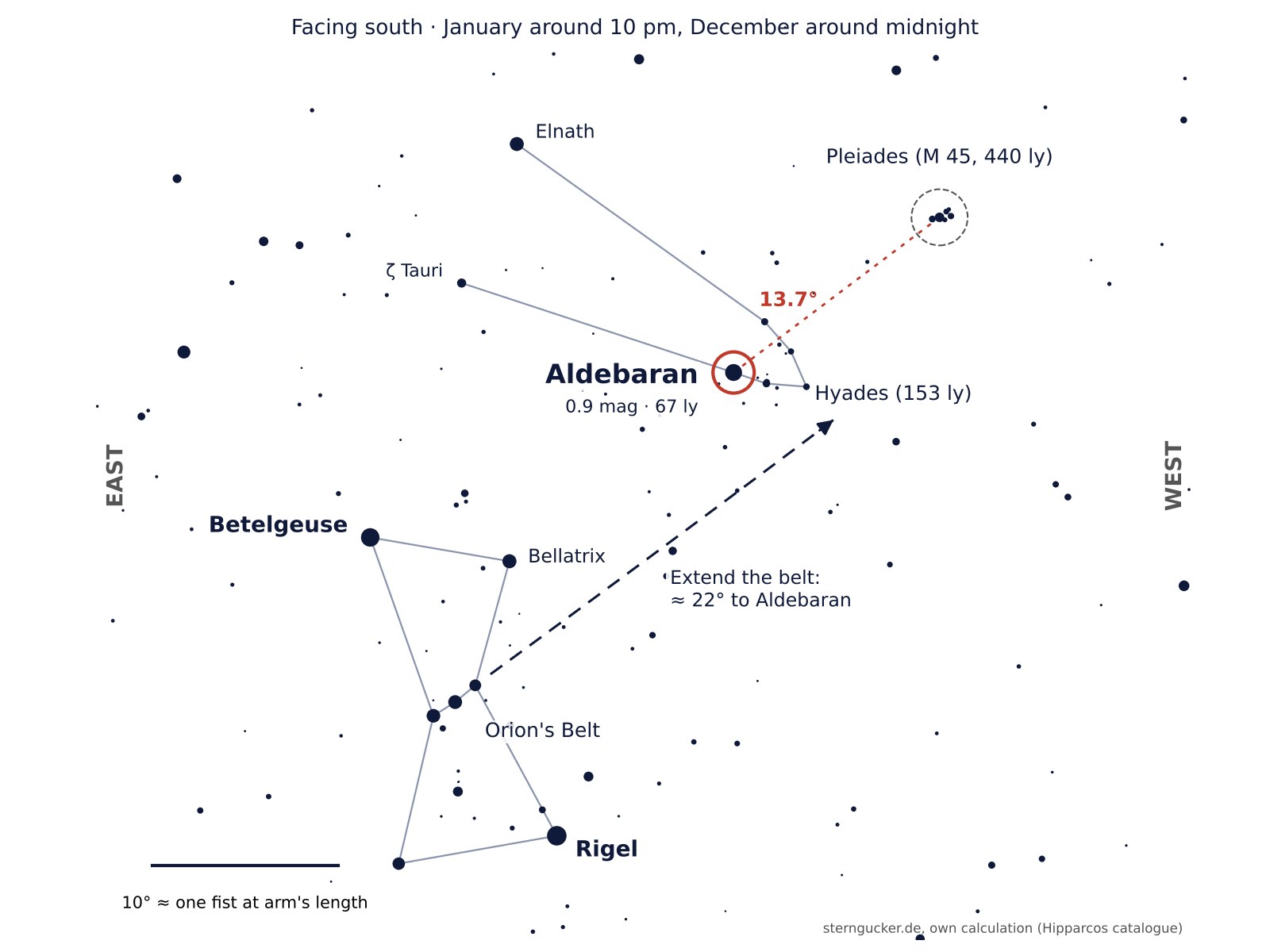
You don’t need to search for the star in Taurus if you know Orion. The three belt stars point up to the right towards it like an arrow. This works best on a winter evening, facing south.
- Step 1: Look for the three equally bright belt stars of Orion between reddish Betelgeuse at the top left and bluish Rigel at the bottom right.
- Step 2: Extend the line of the belt up to the right, about eight times the length of the belt. After roughly 22° (a good two fists at arm’s length) you reach a flat “V” of stars – the Hyades.
- Step 3: The brightest, orange star at the left-hand end of the V is Aldebaran. The belt line actually aims about 5° to the right of it, straight into the V.
- Step 4: Keep going in the same direction: 13.7° up to the right of Aldebaran glows the small, tight cluster of the Pleiades.
There’s a triangle to double-check: Aldebaran lies 21.4° from Betelgeuse and 26.5° from Rigel. The two tips of the Bull’s horns, Elnath and ζ Tauri, lie up to the left of it.
Tip: In autumn, Aldebaran rises in the east in the evening, long before Orion. Then the route works the other way round: first the Pleiades rise, a good hour and a half later Aldebaran, and after another two hours or so Orion’s Belt stands almost vertically above the eastern horizon. Look for the orange star low in the east-north-east and work your way up from there.
Aldebaran and the Hyades: foreground, not a member
Together with Aldebaran, the Hyades form the face of the Bull. But the V is a trick of perspective: the Hyades are a genuine open star cluster, while Aldebaran just happens to lie in the same line of sight. The distances from the Hipparcos catalogue make this clear.
| Object | Distance | Separation from Aldebaran in the sky | What it is |
|---|---|---|---|
| Aldebaran | 67 ly | – | red giant in the foreground |
| θ² Tauri (Hyades) | 149 ly | 1.9° | brightest Hyades star, magnitude 3.4 |
| Hyades (cluster centre) | 153 ly | about 4° | open star cluster, about 625 million years old |
| Elnath (β Tauri) | 131 ly | 16.8° | northern horn tip of the Bull |
| Pleiades (M 45) | around 440 ly | 13.7° | young open star cluster |
So Aldebaran is more than twice as close as the Hyades and does not belong to them. It is also much older: the Hyades stars formed together around 625 million years ago, Aldebaran ten times earlier.
Incidentally, Edmond Halley already noticed in 1718 that it moves. He compared ancient star positions with his own and found that Aldebaran had shifted a little – one of the first proofs that the “fixed stars” aren’t fixed at all. Today we know that Aldebaran drifts south by about a third of an arcminute per century.
Aldebaran month by month: when you can see it
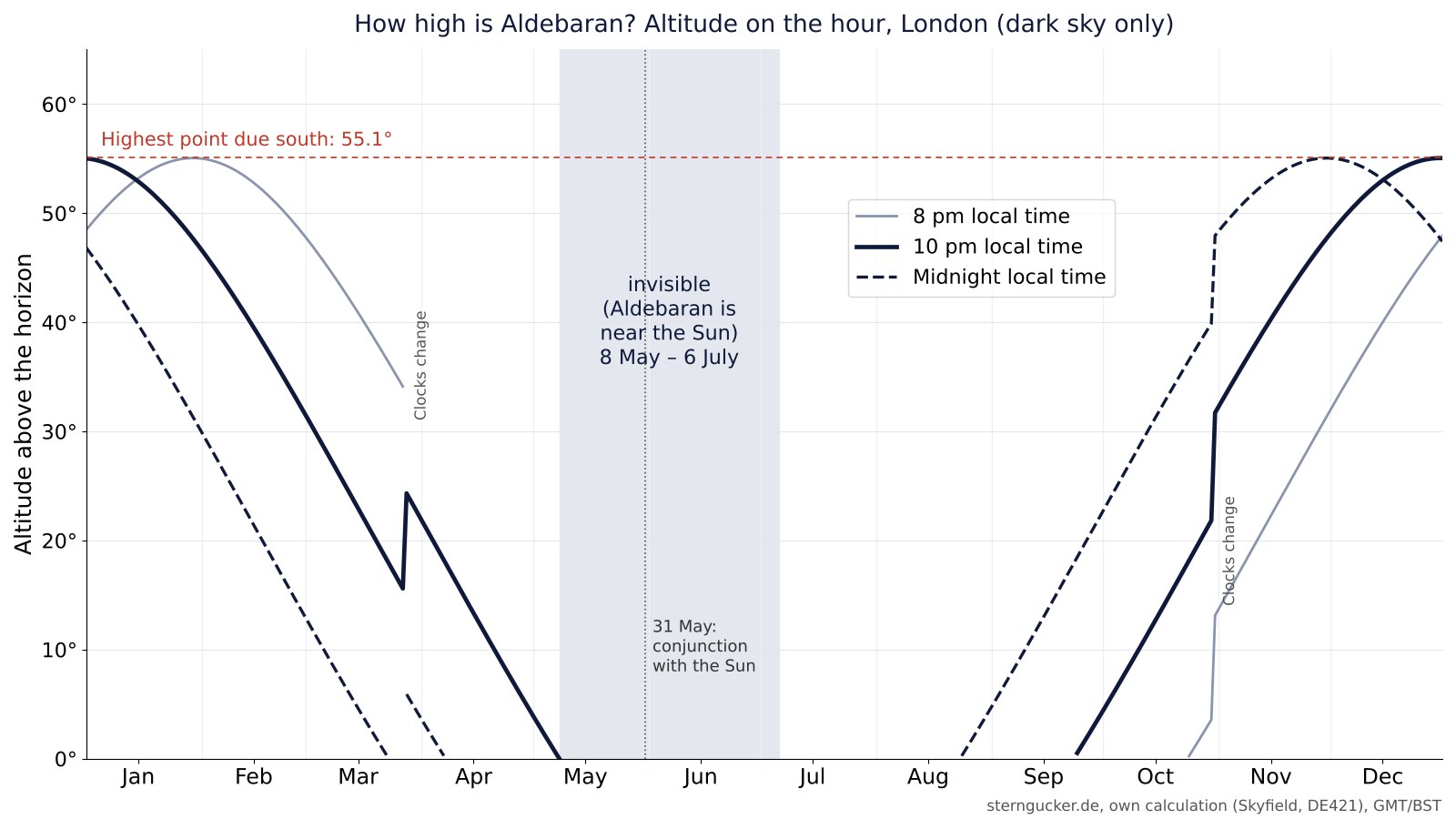
We calculated Aldebaran’s altitude for London on the 15th of each month at 10 pm local time, so in BST during the summer half of the year. The best months are December and January, when Aldebaran stands high in the south in the late evening.
| Month | Altitude at 10 pm | Direction | Highest point | Verdict |
|---|---|---|---|---|
| January | 52.9° | south-south-west | 8:57 pm | best time |
| February | 39.5° | west-south-west | 6:55 pm | very good in the evening |
| March | 22.9° | west | 5:05 pm | good after dark |
| April | 13.3° | west | 4:03 pm | low in the west |
| May | below the horizon | – | 2:05 pm | in evening twilight until about 8 May |
| June | below the horizon | – | 12:03 pm | invisible, close to the Sun |
| July | below the horizon | – | 10:02 am | from about 6 July in the morning in the east |
| August | below the horizon | – | 8:00 am | in the morning sky |
| September | below the horizon | – | 5:58 am | rises around 10:30 pm |
| October | 12.7° | east | 4:00 am | rises around 8:30 pm |
| November | 40.3° | east-south-east | 12:58 am | very good |
| December | 53.0° | south-south-east | 11:00 pm | best time |
In early summer, Aldebaran disappears for about two months. On 31 May every year the Sun stands almost exactly in front of it, and it rises and sets together with the Sun. Roughly speaking, from about 8 May you can no longer see it in the evening twilight, and it reappears in the morning before sunrise around 6 July.
How high does Aldebaran get? Table for eight cities
With a declination of +16.5°, Aldebaran lies well north of the celestial equator. That’s why it climbs more than 50° high everywhere in the UK and Ireland when it crosses the south. The maximum altitude is 90° minus your latitude plus the declination.
| Location | Latitude | Aldebaran | Pleiades |
|---|---|---|---|
| Edinburgh | 56.0° N | 50.6° | 58.2° |
| Glasgow | 55.9° N | 50.7° | 58.3° |
| Belfast | 54.6° N | 52.0° | 59.6° |
| Manchester | 53.5° N | 53.1° | 60.7° |
| Dublin | 53.3° N | 53.2° | 60.8° |
| Birmingham | 52.5° N | 54.1° | 61.7° |
| London | 51.5° N | 55.1° | 62.7° |
| Cardiff | 51.5° N | 55.1° | 62.7° |
Between Edinburgh and Cardiff there are only 4.5° of difference. So you don’t need a clear southern horizon for Aldebaran – a view over the rooftops is enough. Even under a light-polluted city sky it is one of the first stars to appear after sunset.
Why Aldebaran glows red: colour, temperature and size
To the naked eye, Aldebaran looks orange to reddish, much warmer than the cool white of Rigel or Sirius. The colour gives away the temperature: at around 3,900 kelvin its surface is about 1,900 degrees cooler than the Sun’s. Cool stars emit most of their light in the red and infrared.
| Star | Spectral type | Temperature | Radius | Distance |
|---|---|---|---|---|
| Aldebaran | K5 III | about 3,900 K | 45 R☉ | 67 ly |
| Betelgeuse (Orion) | M1–M2 Ia | about 3,600 K | 640–760 R☉ | about 550 ly |
| Pollux (Gemini) | K0 III | about 4,800 K | 9 R☉ | 34 ly |
| Antares (summer, for comparison) | M1.5 Iab | about 3,660 K | about 680 R☉ | about 550 ly |
| Sun (for comparison) | G2 V | about 5,800 K | 1 R☉ | – |
Aldebaran is a “normal” red giant, whereas Betelgeuse and Antares are supergiants. The difference lies in their mass: Aldebaran has about as much as the Sun, the other two 13 to 20 times that. That’s why only Betelgeuse and Antares will one day end as a supernova.
How big is Aldebaran compared with the Sun?
Aldebaran has about 45 times the radius of the Sun, and its diameter is around 63 million kilometres. Put in place of the Sun, it would reach a good half of the way to Mercury’s orbit. About 90,000 Suns would fit inside its volume.
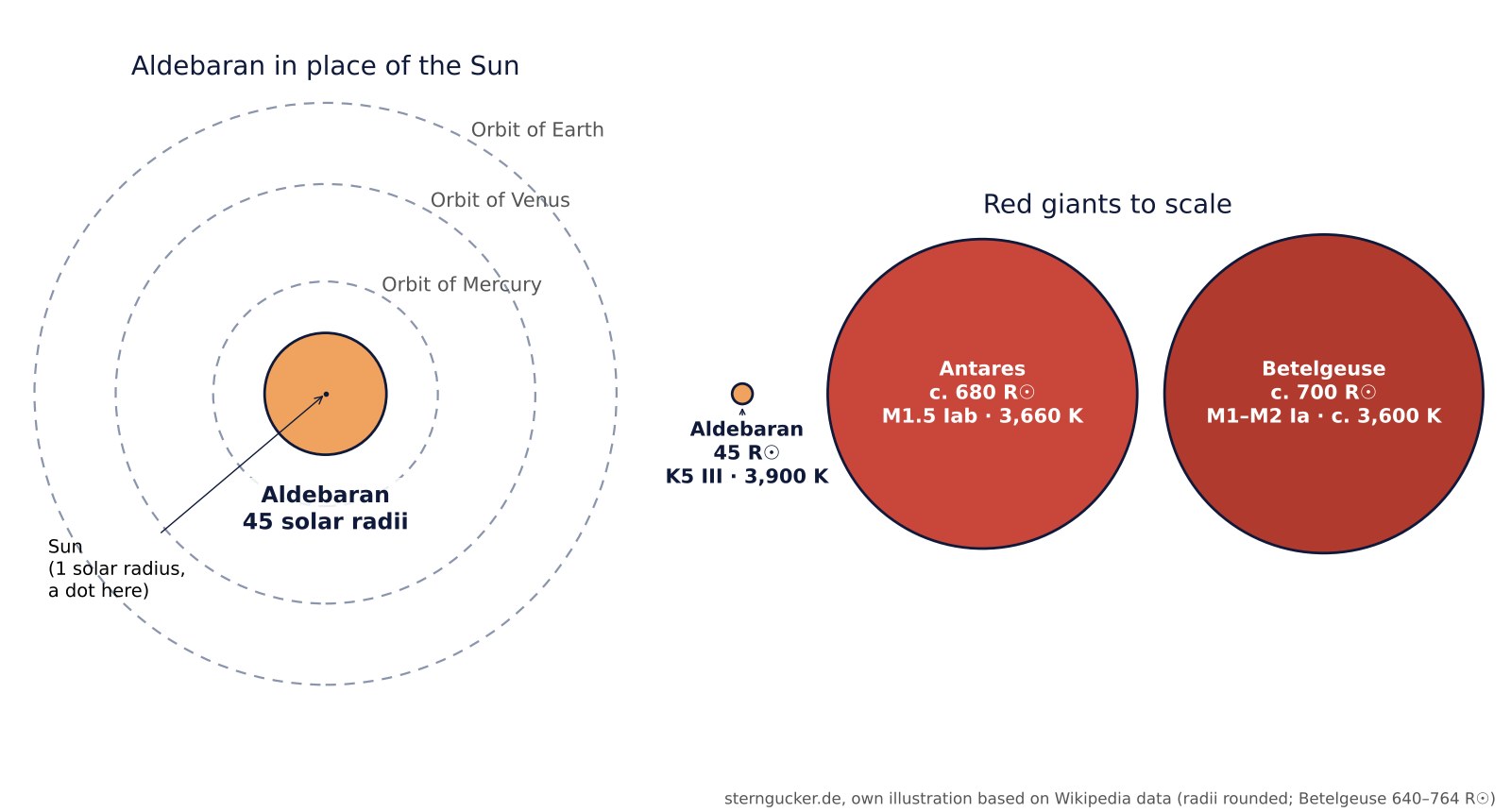
Next to the supergiants, Aldebaran looks tiny. Betelgeuse and Antares have roughly 15 times Aldebaran’s diameter – the fact that all three appear similarly bright in the sky comes down to their very different distances.
Lunar occultations of Aldebaran: the next series from 2033
Aldebaran lies only 5.5° south of the ecliptic, the Sun’s apparent path, close to which the Moon also travels. That’s why in some years the Moon slides in front of the star every month – an occultation. Because the Moon’s orbit swings round once every 18.6 years, these occultations come in series.
| Series | First occultation | Last occultation | Number |
|---|---|---|---|
| Last series | 29 January 2015 | 3 September 2018 | 49 |
| Next series | 18 August 2033 | 23 February 2037 | 48 |
| Series after that | March 2052 | – | – |
Until 2033 the Moon passes a few degrees from Aldebaran every month without covering it. If you want to see an occultation in Taurus now, watch the Pleiades: by our calculation their occultation series runs until mid-2029.
Aldebaran occultations in the UK: the dates for London
Each individual occultation is only visible from part of the world. We worked through all 48 dates of the new series for London: the Moon has to cover the star, both have to be above the horizon, and for a night-time observation the Sun has to be more than 6° below the horizon.
| Date | Disappearance | Reappearance | Moon | Conditions |
|---|---|---|---|---|
| Sun, 29 Jan 2034 | 3:21 pm | 4:17 pm | waxing, 75 % | in daylight, ends shortly before sunset |
| Sat, 25 Feb 2034 | 10:37 pm | 11:36 pm | first quarter, waxing | dark night, Moon 28° high – best date |
| Sat, 23 Dec 2034 | 7:13 pm | 8:00 pm | almost full, 96 % | evening, Moon 38° to 44° high |
| Fri, 14 Dec 2035 | 5:30 am | 6:10 am | full Moon | low in the west-north-west, Moon 9° to 4° high |
| Mon, 28 Apr 2036 | 9:04 pm | 9:56 pm | thin crescent, 8 % | in late twilight, low in the west-north-west, Moon 14° to 6° high |
| Thu, 9 Oct 2036 | below the horizon | 9:13 pm | waning, 80 % | reappearance only, 3° high in the east-north-east |
The highlight is the evening of 25 February 2034, a Saturday. The waxing half Moon then stands in the west, and Aldebaran vanishes abruptly at its dark, left-hand edge. In Edinburgh and Glasgow this happens at around 10:29 pm, in Dublin at around 10:30 pm and in Manchester at around 10:33 pm.
Other occultations fall in daytime in the UK, for example on 5 September 2034 and 16 August 2036. In a telescope the bright star can be seen even in daylight, as observers on the German forum astronomie.de describe for the occultations of 2015 and 2017. On 29 October 2034, the UK and Ireland miss out completely: that occultation can only be seen further south, from southern France, Switzerland and Italy.
Warning: During daytime occultations with a thin crescent Moon, for example on 21 April 2034 or 22 June 2036, the Sun is only 20 to 40 degrees from the Moon. Don’t point binoculars or a telescope at that part of the sky – an accidental glance at the Sun through optics destroys the retina in a split second. Find out more in our guide Observing the Sun safely.
Aldebaran in the Winter Hexagon: six bright winter stars
Aldebaran is one of the six corners of the Winter Hexagon, a huge figure made of the brightest stars of the winter sky. It stretches from Capella high in the south down to Sirius just above the horizon and encloses almost all of Orion. The corners belong to six different constellations.
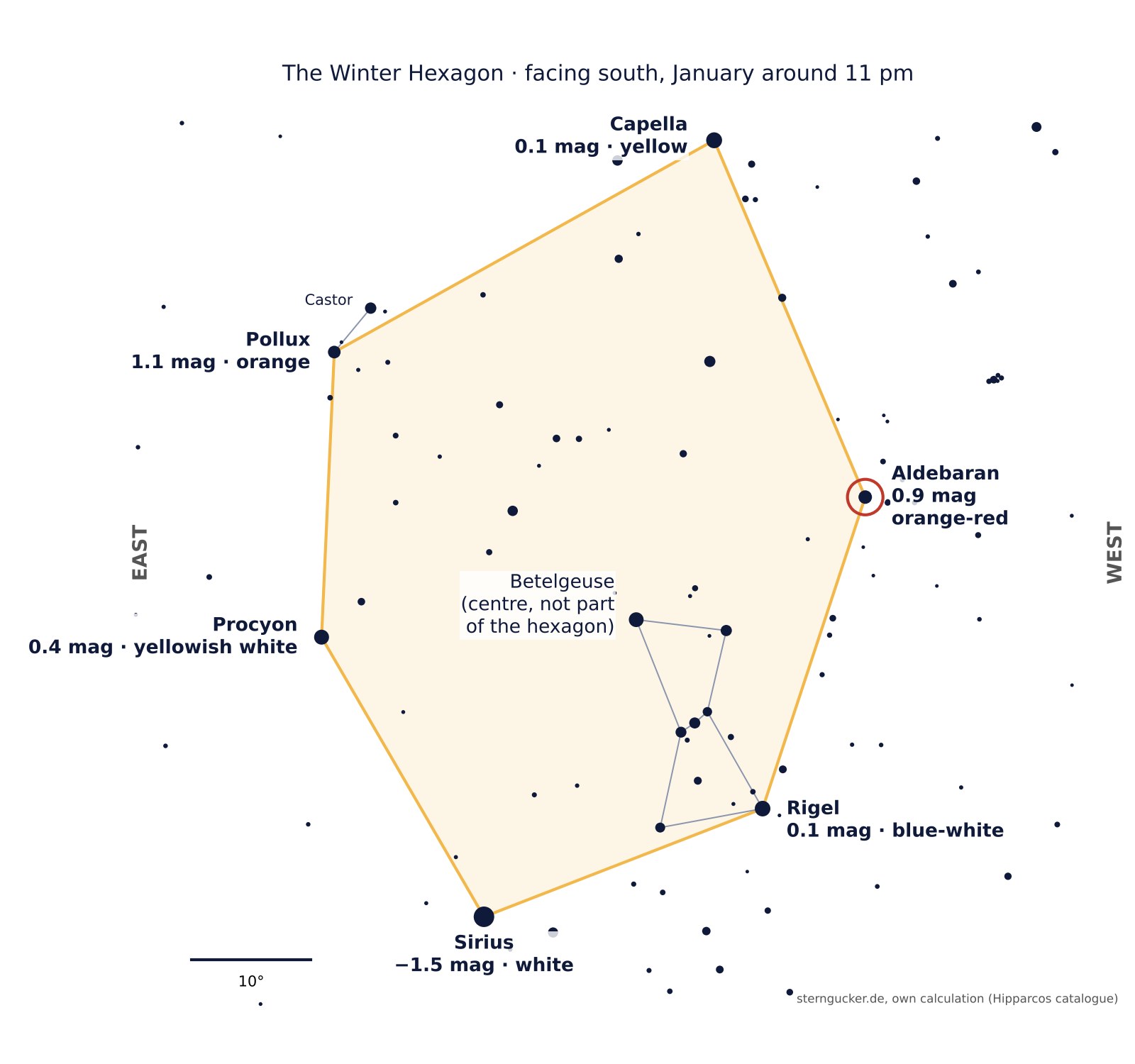
- Capella in Auriga – top corner, yellowish.
- Aldebaran in Taurus – right-hand corner, orange-red.
- Rigel in Orion – bottom right, blue-white.
- Sirius in Canis Major – bottom corner, the brightest star in the night sky.
- Procyon in Canis Minor – left-hand corner, yellowish white.
- Pollux in Gemini – top left, orange.
The hexagon is a great place to compare star colours. Aldebaran, Pollux and Betelgeuse are the three warm splashes of colour among lots of white and bluish stars. The difference shows best if you put the stars slightly out of focus in binoculars.
Aldebaran’s name and mythology: why it means “the follower”
The name comes from Arabic: ad-Dabarān means “the follower”. Aldebaran follows the Pleiades across the sky – it rises after them and reaches its highest point about 50 minutes later. For many cultures the Pleiades were an important calendar marker, and Aldebaran was their constant companion.
| Name | Origin | Meaning |
|---|---|---|
| ad-Dabarān | Arabic | the follower (of the Pleiades) |
| ʿAin al-Thaur, Oculus Tauri | Arabic, Latin | eye of the Bull |
| Cor Tauri | Latin | heart of the Bull |
| Palilicium | Latin | after the Roman shepherds’ festival of Parilia |
| Rohini | Indian | lunar mansion and favourite wife of the Moon god |
In the figure of the Bull, Aldebaran sits right in the eye, while the Hyades form the face. The Greeks saw Zeus in the animal, who turned himself into a bull to carry off the princess Europa – we tell the whole story in our article on the constellation Taurus. In Persia, Aldebaran was one of the four “Royal Stars”, together with Regulus, Antares and Fomalhaut.
The term “Aldebarans” has nothing to do with astronomy. It comes from esoteric and conspiracy circles, which invented supposed aliens from a planet near Aldebaran; there is no evidence whatsoever for them.
Aldebaran’s companion and planet: what is confirmed
A lot is claimed about Aldebaran, but little is confirmed. To this day the star has no confirmed planet. The overview shows the current state of research.
| Object | What it is | Status |
|---|---|---|
| Aldebaran B | red dwarf, magnitude 13.2, at least 680 AU away | probably bound, but not certain |
| Aldebaran C and D | faint stars nearby | belong to the Hyades in the background |
| Aldebaran b | planet candidate, at least 6 Jupiter masses, orbit about 629 days | reported in 2015, strongly doubted since 2019 |
| Pioneer 10 | NASA space probe, no radio contact since 2003 | heading roughly towards Aldebaran, arrival in about 2 million years |
With the planet candidate, the problem lies in the star itself. Red giants oscillate and pulsate, and that can mimic an orbit in the measurements. Newer studies therefore consider the signal a property of Aldebaran itself rather than an exoplanet.
Pioneer 10 was launched in 1972 and was the first probe to visit Jupiter. It will take around two million years to reach the neighbourhood of Aldebaran – carrying the famous Pioneer plaque, a greeting from humanity.
Observing Aldebaran: naked eye, binoculars or telescope
For Aldebaran itself you don’t need any equipment. The naked eye shows its colour at its best, especially in direct comparison with Rigel or Capella. A telescope just turns it into a brighter point.
Its surroundings, on the other hand, are a paradise for binoculars. The Hyades V is about 4° across and so just fits into the field of view of a pair of 10×50s, along with dozens of fainter cluster stars. The Pleiades next door are one of the finest binocular sights of the winter sky.
Our binocular pick: for the Hyades and Pleiades
For the Hyades and Pleiades: Celestron Cometron 7x50 Binoculars

The astronomy classic among affordable binoculars: 7×50 with a large exit pupil for bright handheld views of the Moon and Milky Way – the ideal first step before a telescope.
Price: € 65
A pair of 10×50 binoculars gathers enough light for the fainter Hyades stars and is light enough to hold freehand for a few minutes. The view gets steadier if you rest your elbows or screw the binoculars onto a tripod.
When a telescope is still worth it
For two things around Aldebaran a telescope is the better choice. During the lunar occultations from 2033, only at 50 to 100 times magnification do you see how abruptly the star vanishes at the Moon’s edge – and in daylight you can only find it with optics at all. On top of that there are double stars in the Hyades such as θ¹ and θ² Tauri, only 5.6 arcminutes apart, which nicely show their different colours in a telescope.
Our telescope pick: for occultations and double stars
Our beginner recommendation: Skywatcher Dobson Telescope N 130/650 Heritage FlexTube
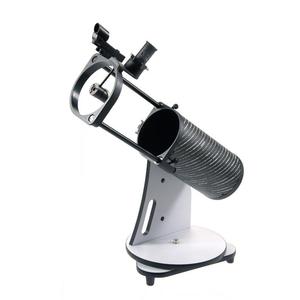
A compact tabletop Dobson with a true parabolic mirror. Folds down, fits in a bag: the Moon, planets and the bright deep-sky classics.
Price: € 265
With 130 mm of aperture, this small tabletop telescope shows the Moon’s edge pin-sharp, and the star stays a crisp point right up to the last second. For occultations low on the horizon you’ll need a raised spot, such as a sturdy table. Our guide Best beginner telescopes compares more models.
If you want more: the 200 mm Dobsonian
For advanced observers: Skywatcher Dobson Telescope N 200/1200 Skyliner Classic
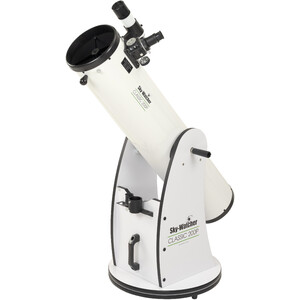
200 mm of aperture — the most sky for your money. Set it on the ground, point by hand: nebulae, clusters and galaxies for years to come.
Price: € 479
With 200 mm of aperture, the Dobsonian gathers more than twice as much light as the 130, and winter nebulae such as the Orion Nebula show much more structure. Aldebaran’s faint magnitude 13 companion also comes within reach, although it remains a real challenge in the glare of the main star. The extra cost is worth it if you want to observe seriously beyond the bright stars and have room for a 1.2 m long tube.
Frequently asked questions about Aldebaran
Which star is the Eye of the Bull?
The Eye of the Bull is Aldebaran, the brightest star in the constellation Taurus. The Hyades around it form the animal’s face. The Arab astronomers already called it ʿAin al-Thaur, “eye of the Bull”.
What is the brightest star in Taurus?
The brightest star in Taurus is Aldebaran (α Tauri) at magnitude 0.75 to 0.95. The second brightest is Elnath (β Tauri), at the tip of the northern horn, at magnitude 1.65.
How far away is Aldebaran?
Aldebaran is around 67 light-years away, which is about 630 trillion kilometres. So the light you see today set off around 1959. We explain exactly what a light-year is in a separate article.
How big is Aldebaran?
Aldebaran measures around 45 solar radii, which means a diameter of about 63 million kilometres. Its mass, by contrast, is only about 1.0 to 1.2 solar masses – the gas in its outer layers is extremely thin.
Is Aldebaran red?
Aldebaran shines orange-red because its surface, at around 3,900 kelvin, is comparatively cool. Astronomers classify it as spectral type K5, on the border between orange and red stars. Low on the horizon, the air makes it look even redder.
When will the Moon next cover Aldebaran?
The next occultation series begins on 18 August 2033 and runs until February 2037. By our calculation, the first occultation in a dark sky visible from the UK and Ireland is on the evening of 25 February 2034, at around 10:35 pm.
Does Aldebaran have a planet?
No planet has been confirmed. The candidate Aldebaran b, reported in 2015, has been considered doubtful since 2019 because the signal probably comes from oscillations of the star.
What are the “Aldebarans”?
The “Aldebarans” are an invention of esoteric and conspiracy myths, not a scientific discovery. Not even a planet has been proven at Aldebaran, let alone life.
Will Aldebaran become a supernova?
No, Aldebaran is too light for that. It will shed its outer layers and end up as a white dwarf, much like the fate awaiting the Sun. A supernova, on the other hand, is expected from the supergiants Betelgeuse and Antares.
Links marked with an asterisk (*) are affiliate links. If you buy through them we earn a small commission – the price stays the same for you.
Read more on Sterngucker
- Taurus constellation – Hyades, Pleiades and the myth of Europa
- Orion constellation – the signpost to Aldebaran
- Betelgeuse – the red supergiant in Orion
- Antares – the red counterpart in the summer sky
- All constellations at a glance