By Alexander Merz · Published on · Details checked on 3 October 2026
A solar eclipse is a sky event in which the New Moon passes exactly between the Sun and the Earth and casts its shadow onto our planet. Worldwide this happens two to five times a year, but it only becomes total within a strip no more than about 270 km wide.
⭐ In short: The last solar eclipse in the UK and Ireland was on 12 August 2026 – partial, in the early evening with the Sun low in the west. The next one comes on 2 August 2027 around 10 am, when roughly a sixth to almost half of the Sun disappears depending on where you are. For a total eclipse in the UK you have to wait until 23 September 2090. And: you may only look without eclipse glasses during the few minutes of totality, never during a partial phase.
What is a solar eclipse? The Moon covers the Sun
During a solar eclipse the Sun doesn’t get dimmer, it is simply covered up. The Moon sits in front of the Sun as a dark disc, because we are looking at its unlit far side – after all, it is New Moon.
The spectacle is made possible by a cosmic coincidence. The Sun is about 400 times larger than the Moon, but also about 400 times farther away. That is why both appear almost exactly the same size in the sky, roughly as big as a pea held at arm’s length.
| Feature | Value |
|---|---|
| Requirement | New Moon close to a lunar node |
| Frequency worldwide | 2 to 5 per year |
| Width of the path of totality | at most about 270 km |
| Longest possible totality | about 7½ minutes |
| Duration of the whole eclipse at one place | usually 1 to 3 hours |
| Total eclipse at the same place | on average about every 375 years |
| Repeat cycle | Saros: 18 years, 11 days, 8 hours |
| Last total eclipse in the UK | 11 August 1999 |
| Next total eclipse in the UK | 23 September 2090 |
Because the Moon’s shadow is small, the whole Earth never sees the same eclipse. Where you stand decides whether it is total, partial or nothing at all – just 100 km outside the path of totality a sliver of Sun remains that barely darkens the day.
How does a solar eclipse happen? Umbra and penumbra
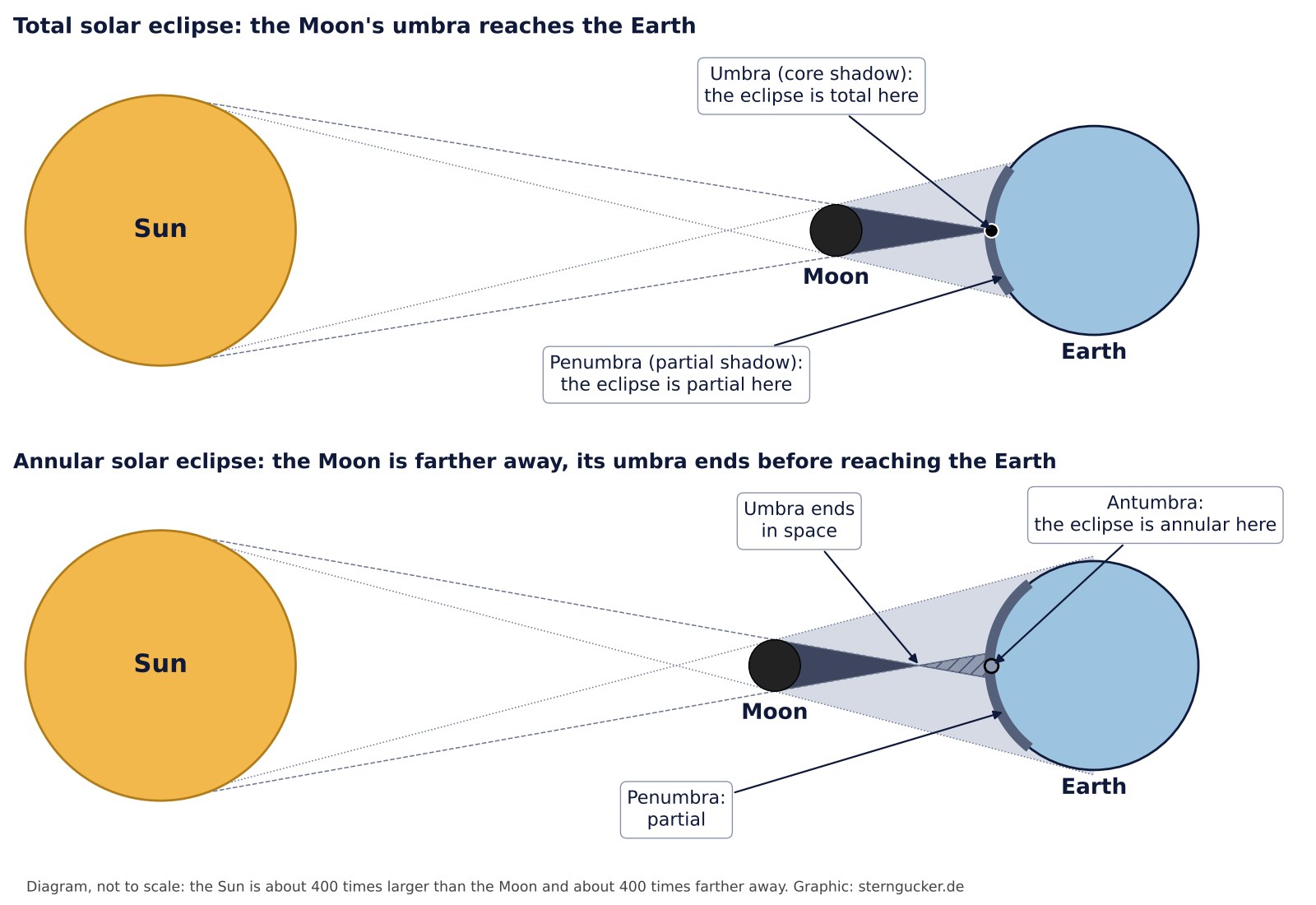
Like every lit object, the Moon casts two shadows. The umbra is the region that no direct sunlight reaches; it narrows behind the Moon into a long, pointed cone. Around it lies the penumbra, where only part of the solar disc is covered.
On average the umbral cone is about as long as the distance between the Moon and the Earth. Sometimes its tip just reaches the Earth’s surface, sometimes it ends a few thousand kilometres short of it. That is exactly what decides whether an eclipse is total or annular.
During the eclipse the shadow sweeps across the Earth from west to east. Even at its slowest point it races over the ground at about 1,700 km/h, because the Moon moves along its orbit faster than the Earth rotates. That is why totality lasts only a few minutes at any one place.
Tip: The Sun has a diameter of about 1.39 million km, the Moon just 3,475 km. The 400-to-400 ratio is pure coincidence – a few hundred million years ago the Moon was closer, and in the distant future there will be no more total eclipses.
Types of solar eclipse: total, annular, partial, hybrid
Which type you see depends on two things: how precisely the Moon lines up with the Sun and how far it currently is from the Earth. The Moon’s distance varies between about 356,500 and 406,700 km, and with it its apparent size in the sky changes noticeably.
| Type | What you see | Cause | Share of all eclipses |
|---|---|---|---|
| Total | Sun completely covered, corona visible, day turns into twilight | Moon close to Earth, appears larger than the Sun; you are in the umbra | 26.7 % |
| Annular | Bright “ring of fire” around the Moon | Moon far from Earth, appears smaller; you are in the antumbra | 33.2 % |
| Partial | Sun as a crescent | Only the penumbra hits the Earth, or you are next to the central path | 35.3 % |
| Hybrid | Total or annular depending on location | The tip of the umbra lies almost exactly on the Earth’s surface | 4.8 % |
Total solar eclipse
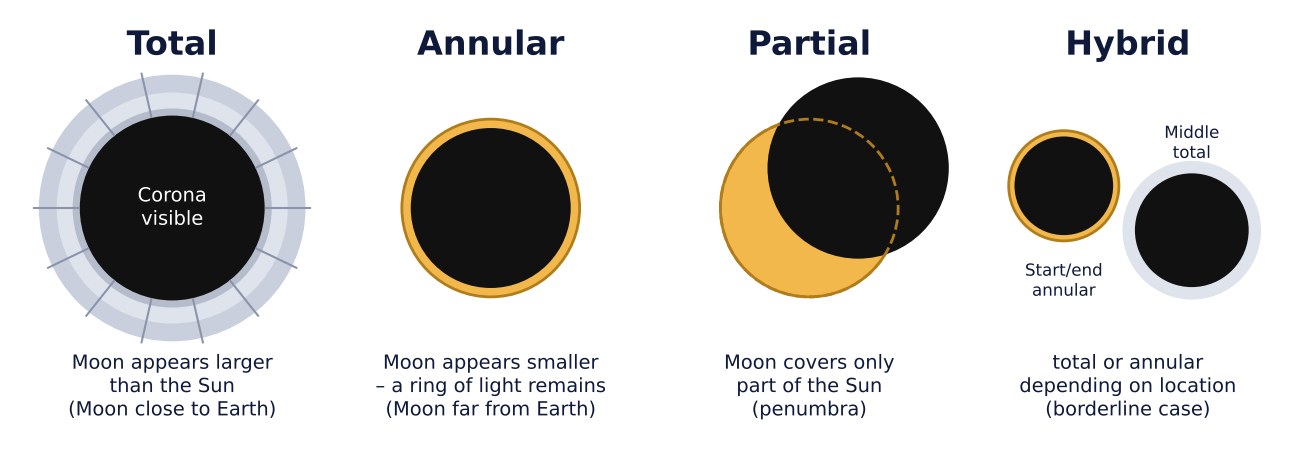
In a total eclipse the Moon, at up to 33.5 arcminutes, appears larger than the Sun with its 31.5 to 32.5 arcminutes. Only then can you see the corona, the pearly white halo of the Sun’s atmosphere. Around the narrow path of totality the same eclipse is only partial.
Annular solar eclipse
When the Moon is near the farthest point of its orbit, it shrinks to just over 29 arcminutes. It then no longer quite fits over the Sun, and a dazzling ring remains. It hardly gets darker, and you need eclipse glasses the whole time.
Partial solar eclipse
The partial eclipse is the type we almost always get in the UK and Ireland. The Moon just takes a bite out of the Sun, and only from about 80 per cent coverage do you notice the light turning pale.
Hybrid solar eclipse
The rare hybrid eclipse begins and ends as an annular eclipse, while in the middle of its path it is total. The reason is the curvature of the Earth: in the middle of the track the Earth’s surface is a few thousand kilometres closer to the Moon, so the tip of the umbra just reaches it. The last hybrid eclipse was on 20 April 2023 over Australia, the next follows on 14 November 2031 over the Pacific.
Why not at every New Moon? Orbital tilt and eclipse seasons
There is a New Moon every month, but not a solar eclipse. The Moon’s orbit is tilted by 5.1° to the Earth’s orbit, so at most New Moons the Moon passes just above or below the Sun.
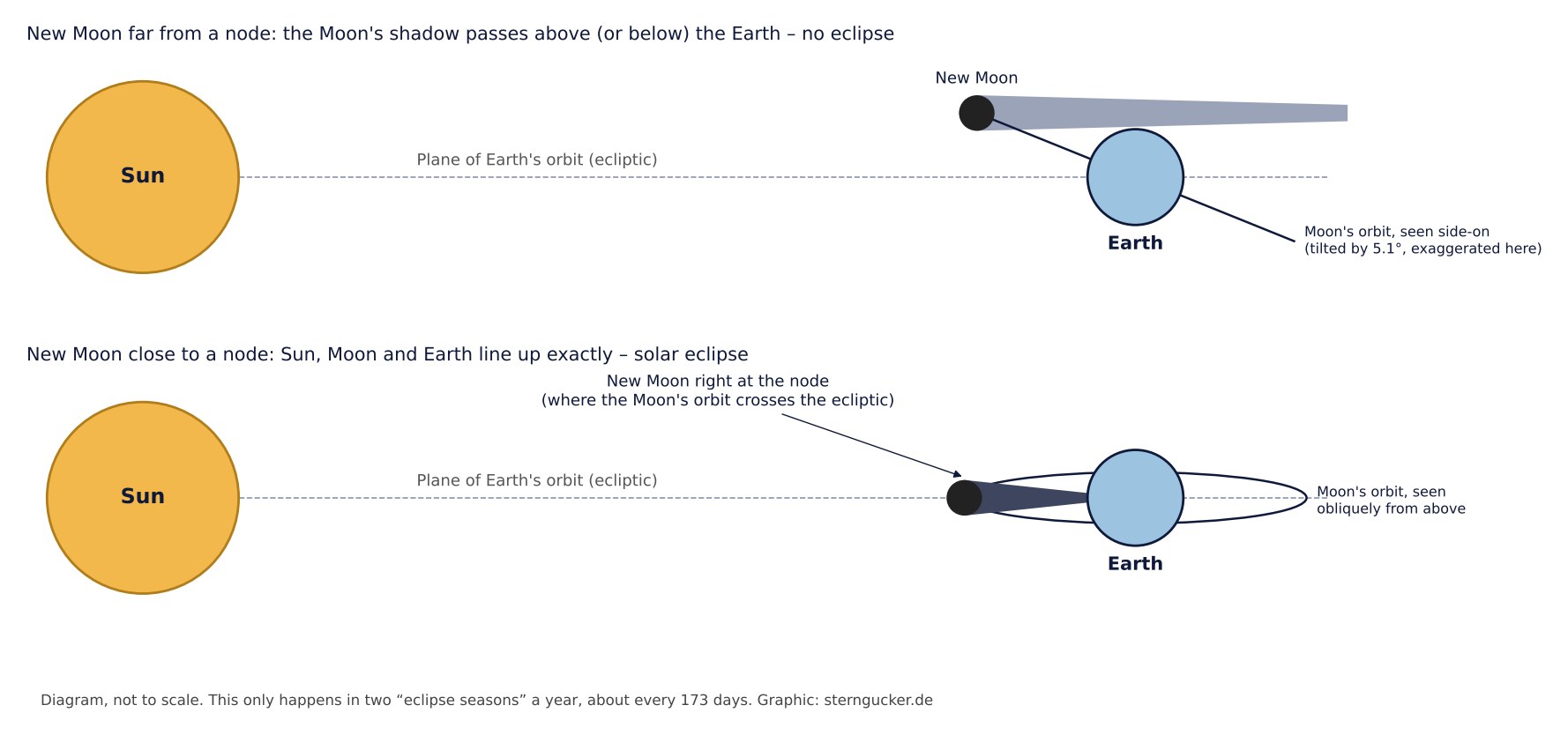
The two points where the Moon’s orbit crosses the plane of the Earth’s orbit are called nodes. Only when the New Moon is close to a node do the Sun, Moon and Earth line up exactly. Seen from the Earth, the Sun points towards a node about every 173 days – these are the eclipse seasons.
Each season lasts a little over a month, slightly longer than the Moon takes from one New Moon to the next. That is why every season has at least one solar eclipse, sometimes two partial ones in quick succession. Usually a lunar eclipse follows two weeks before or after, as in August 2026.
Tip: The nodes move backwards once around the Earth’s orbit in 18.6 years. That is why the eclipse seasons slip about 19 days earlier every year: in 2026 they fell in February and August, in 2028 in January and July.
Saros cycle and frequency: how often solar eclipses happen
The Babylonians already discovered that eclipses repeat. After one saros of 18 years, 11 days and 8 hours, the Sun, Moon and nodes are back in almost the same position, and a very similar eclipse follows. If there are five leap years in between instead of four, it is 10 days instead of 11.
The eight hours have a visible consequence. In that time the Earth turns a third further, so the next eclipse in the series falls about 120° farther west. The total eclipse over Cornwall and northern France on 11 August 1999 returned in this way on 21 August 2017 over the USA and follows on 2 September 2035 over Japan.
| Eclipses per calendar year | Share of years |
|---|---|
| 2 | 72.5 % |
| 3 | 17.5 % |
| 4 | 9.5 % |
| 5 | 0.5 % (last in 1935, next in 2206) |
Worldwide, solar eclipses are therefore not rare, but at a fixed place they are. On average a total eclipse crosses the same spot only about every 375 years, and some places wait much longer. London last saw totality in 1715 and, according to our calculation, won’t see it again before 2150.
Last and next solar eclipse: the overview for the UK and Ireland
The last solar eclipse in the UK and Ireland was on 12 August 2026. Shortly after 7 pm, depending on location, about 88 to 98 per cent of the Sun disappeared; it was total only in Greenland, Iceland and Spain. All times and photos are in our review of the 2026 solar eclipse.
The next one is coming soon: on 2 August 2027 we will see a partial eclipse around 10 am with the Sun high in the sky. It is total in southern Spain and North Africa, with more than six minutes of totality in Egypt. Times and coverage for your town are on our page about the solar eclipse of 2 August 2027.
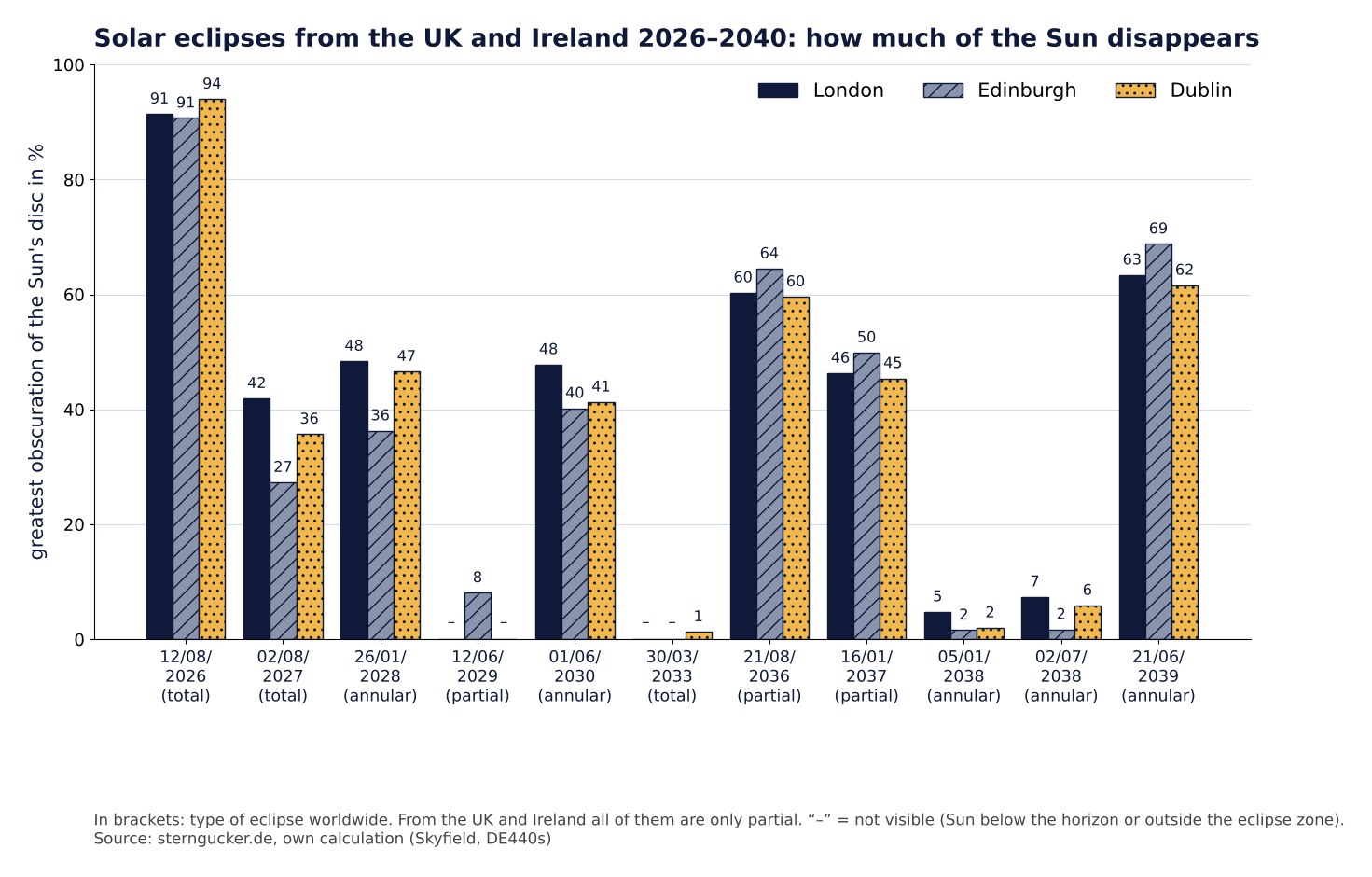
We calculated every solar eclipse up to 2040 ourselves for three cities. Up to 2040 there are eleven eclipses visible from the UK or Ireland, all of them only partial. Obscuration is the share of the Sun’s disc that is covered; the figure in brackets is the Sun’s altitude at maximum.
| Date | Type worldwide | London | Edinburgh | Dublin |
|---|---|---|---|---|
| 12/08/2026 (review) | total | 91.4 % (10°) | 90.7 % (14°) | 94.0 % (15°) |
| 02/08/2027 | total | 41.9 % (40°) | 27.3 % (37°) | 35.7 % (36°) |
| 26/01/2028 | annular | 48.4 % at sunset | 36.3 % at sunset | 46.6 % at sunset |
| 12/06/2029 | partial | not visible | 8.1 % at sunrise | not visible |
| 01/06/2030 | annular | 47.8 % (12°) | 40.2 % (13°) | 41.3 % (10°) |
| 30/03/2033 | total | not visible | not visible | 1.3 % at sunset |
| 21/08/2036 | partial | 60.3 % (9°) | 64.5 % (12°) | 59.6 % (13°) |
| 16/01/2037 | partial | 46.3 % (7°) | 49.9 % (3°) | 45.4 % (3°) |
| 05/01/2038 | annular | 4.8 % (9°) | 1.6 % (7°) | 2.0 % (10°) |
| 02/07/2038 | annular | 7.4 % (53°) | 1.7 % (52°) | 5.9 % (56°) |
| 21/06/2039 | annular | 63.4 % (13°) | 68.8 % (17°) | 61.6 % (18°) |
The list shows why the percentage alone isn’t enough. In each of the three cities the Sun is lower than 10° at maximum on at least four of the dates, often just above the horizon at sunrise or sunset. Then you need a spot with a clear view to the east or west and a bit of luck with the weather.
Two dates come with a neat coincidence built in. The eclipse on 20 March 2034 falls on the spring equinox, the one on 21 June 2039 on the summer solstice. The 2034 eclipse can’t be seen from the UK, but 21 June 2039 is the most impressive after 2027: in the evening more than two thirds of the Sun disappears in Scotland.
Tip for travellers: If you don’t want to wait until 2090, you have to travel to totality. Spain was the nearest destination on 12 August 2026, and the next easy-to-reach targets are southern Spain, Gibraltar and North Africa on 2 August 2027 – in Gibraltar totality lasts about 4½ minutes. An annular eclipse follows on 1 June 2030 in Greece and Turkey; what to pack is in our astronomical highlights 2026/2027.
Total solar eclipse in the UK and Ireland: 1999, 2090 and beyond
The last total solar eclipse in the UK was on 11 August 1999. Shortly after 11 am the umbra crossed the Isles of Scilly, Cornwall and south Devon, with totality lasting about two minutes in Penzance and well over a minute and a half in Plymouth. Unfortunately clouds covered much of Cornwall, and many people only experienced the sudden darkness.
The next total solar eclipse in the UK follows on 23 September 2090 at about 6:30 pm, low in the western sky. The path runs over Cornwall, Devon and the south coast of England, with about 2½ minutes of darkness in Penzance, but the Sun is only 3 to 7° high. The south-western tip of Ireland gets totality too; Cork and London stay just outside according to our calculation.
| Date | Type in the UK/Ireland | Where central | Example |
|---|---|---|---|
| 30/06/1954 | total | far north of Shetland (Unst) | Lerwick just outside, 98.9 % |
| 11/08/1999 | total | Isles of Scilly, Cornwall, south Devon | Penzance 2 min 4 s |
| 31/05/2003 | annular | north of Scotland, at sunrise | Sun only 1–4° high |
| 23/09/2090 | total | Cornwall, Devon, English south coast, south-west Ireland, before sunset | Penzance 2 min 34 s |
| 23/07/2093 | annular | Northern Ireland, northern England, southern Scotland | Belfast, Newcastle, Edinburgh, Glasgow |
| 03/06/2133 | total | Outer Hebrides | Stornoway 1 min 54 s |
| 07/10/2135 | total | southern Scotland and northern England | Sun only about 7–9° high |
The last annular solar eclipse in the UK was on 31 May 2003 over the north of Scotland. It was a borderline case: the ring stood just a few degrees above the horizon at sunrise. Much better is the annular eclipse on 23 July 2093, which passes high over Belfast, Newcastle, Edinburgh and Glasgow around midday.
What you see during totality: corona, diamond ring and a chill
People who have experienced a total eclipse rarely describe it calmly. Whether 99 or 100 per cent of the Sun is covered makes a difference like night and day – only at full coverage does the sky tip into deep twilight within a few seconds.
- Shadow bands: Shortly before and after totality, shimmering light and dark stripes sometimes flicker across pale surfaces on the ground.
- String of pearls: Individual points of light, called Baily’s beads, shine through the valleys on the Moon’s edge.
- Diamond ring: The last point of light sparkles like a gem on a ring of corona – the signal to take your glasses off or put them back on.
- Corona: The Sun’s halo spreads out over several Moon diameters, often with reddish prominences glowing at the edge.
- Sky and horizon: Bright planets and stars appear, and all around the horizon glows a band like at sunset.
- Temperature and nature: It gets noticeably cooler, often by a few degrees, the wind may drop and birds fall silent.
During a partial eclipse you see none of this. Even 1 per cent of remaining Sun is so bright that the corona stays invisible, and it gets at most as dim as on a dull day. A lovely side effect, though, are the many small solar crescents in the shade of leafy trees.
Tip from experience: Seasoned observers advise against experiencing your first totality through a camera viewfinder. Automate the photos or leave the camera out altogether and simply look. If you still want to take pictures, you’ll find everything you need under how to photograph a solar eclipse.
Watching a solar eclipse safely: glasses, filters, pinhole projector
A solar eclipse is no more dangerous than the Sun on any other day. The danger is that during an eclipse people look for a long time and on purpose, and the retina doesn’t hurt while it happens. Damage often only shows hours later and can be permanent.
Warning: Sunglasses, foil emergency blankets, CDs, X-ray films, smoked glass and welding glass below shade 14 are no protection – not even stacked. Never point binoculars, a telescope or a camera at the Sun without a certified filter in front of the lens; the concentrated light destroys the eye in a fraction of a second.
For the naked eye you need eclipse glasses to ISO 12312-2 with a CE or UKCA mark. According to the German Federal Office for Radiation Protection (BfS) they let through at most about 0.001 per cent of sunlight, and the Royal Observatory Greenwich also advises buying only glasses with ISO 12312-2 printed on them. Before every use, check that the film has no scratches or holes.
ISO 12312-2: Omegon Solar Eclipse Glasses Solar Safe
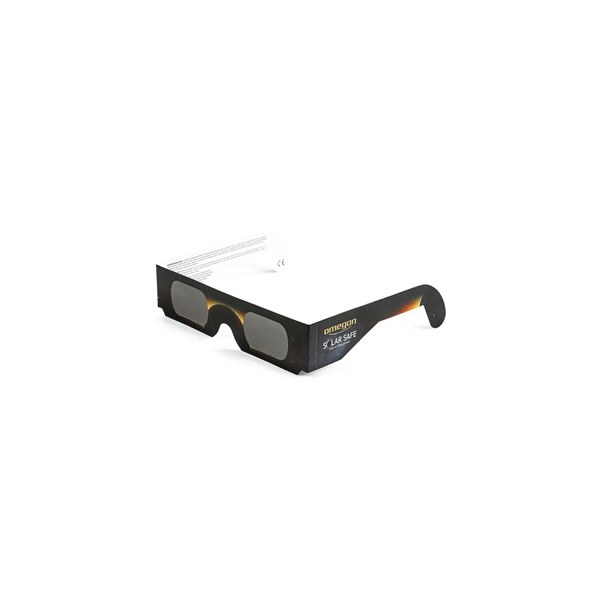
Certified to ISO 12312-2 – the only safe way to look at an eclipsed Sun with the naked eye. A few euros only, so there is no reason to improvise: buy several for the whole family.
Price: € 5
With binoculars or a telescope the filter always goes in front of the objective, never in front of the eyepiece. An affordable solution is Baader AstroSolar film*Baader AstroSolar film*, from which you can make filters that fit exactly. Which filters and instruments are suitable is explained in our guide observing the Sun safely.
Indirect observation works without any equipment at all. A pinhole projector casts the solar crescent safely onto a sheet of paper, and so does a colander or the gaps in a canopy of leaves. Instructions with measurements are under build a pinhole projector for the solar eclipse.
Looking without glasses: only during totality
The honest answer to whether you may look without glasses: only during totality, and only inside the path of totality. As soon as the diamond ring flashes, the glasses have to go straight back on.
| Situation | Look without a filter? |
|---|---|
| Partial eclipse, even at 99 % coverage | No |
| Annular eclipse, even at its peak | No |
| Total eclipse before second contact | No |
| Totality (Sun completely covered, corona visible) | Yes, with the naked eye and binoculars |
| From the diamond ring (third contact) | No – glasses straight back on |
Solar eclipse and lunar eclipse: the differences
Both eclipses are shadow plays, just with the roles reversed. In a solar eclipse the Moon’s shadow falls on the Earth, in a lunar eclipse the Earth’s shadow falls on the Moon. Almost all the practical differences follow from this.
| Feature | Solar eclipse | Lunar eclipse |
|---|---|---|
| Moon phase | New Moon | Full Moon |
| Shadow of … on … | Moon on Earth | Earth on Moon |
| Visible | total only in a narrow strip | from the whole night side of the Earth |
| Longest totality | about 7½ minutes | about 1¾ hours |
| Appearance | black lunar disc, corona | Moon copper red as a blood moon |
| Protection needed | yes, except during totality | no, perfectly safe |
Worldwide there are roughly as many solar as lunar eclipses. Even so, you see a lunar eclipse from your home far more often, because it is visible from a whole hemisphere of the Earth.
Solar eclipse explained for kids: the torch experiment
For children, a solar eclipse can be explained in one sentence. The Moon slides in front of the Sun like a hand in front of a lamp, and where its shadow falls it gets dark in the middle of the day. But they understand it best when they act it out themselves.
- Materials: a torch as the Sun, a large ball or globe as the Earth, a small ball (such as a table tennis ball) as the Moon and a darkened room.
- Set-up: One child shines the torch at the Earth from two or three metres away. Stick a small figure or a dot on the Earth – that’s where you live.
- First try: A second child moves the Moon between lamp and Earth, slightly higher. The shadow misses the Earth – that’s what happens at almost every New Moon.
- Second try: Now exactly on the line from lamp to Earth. A small dark shadow spot moves across the Earth: anyone standing in it sees a total solar eclipse.
- Third try: Hold the Moon closer to the lamp. The umbra gets smaller and no longer reaches the Earth – almost like an annular eclipse.
Along the way the experiment shows why only a few people ever see a total eclipse. The shadow spot is tiny compared with the whole Earth. For an eclipse you can watch with the whole family, the lunar eclipse is ideal, because it needs no protection at all.
Warning: Never leave children alone with eclipse glasses or binoculars during a real eclipse. The pinhole projector is the safest method for children, because nobody looks at the Sun. Explain beforehand that even an almost completely covered Sun harms the eyes.
Frequently asked questions about solar eclipses
What is a solar eclipse?
In a solar eclipse the New Moon stands exactly between the Sun and the Earth and covers the Sun completely or partly. Its shadow falls on part of the Earth. Worldwide this happens two to five times a year.
When was the last solar eclipse in the UK?
On 12 August 2026. It was partial in the UK and Ireland: in the early evening 91.4 per cent of the Sun’s disc disappeared in London and 94.0 per cent in Dublin. Before that there were partial eclipses on 29 March 2025 and 25 October 2022.
When is the next solar eclipse in the UK?
On 2 August 2027 at around 10 am. Then roughly a quarter of the Sun is covered in Scotland and well over a third in southern England: London 41.9 per cent, Edinburgh 27.3 per cent, Dublin 35.7 per cent. After that come 26 January 2028 and 1 June 2030.
When is the next total solar eclipse in the UK?
On 23 September 2090. It will be total over Cornwall, Devon and the south coast of England for up to about 2½ minutes, but with the Sun low before sunset. The last total solar eclipse in the UK was on 11 August 1999.
Can you look at a solar eclipse without glasses?
Only during totality, when the Sun is completely covered. For every partial or annular phase you need glasses to ISO 12312-2 or a projection with a pinhole projector. Sunglasses do not protect you.
How long does a solar eclipse last?
At one place usually one to three hours from first to last contact. Totality itself lasts only seconds up to at most about 7½ minutes, while an annular phase can exceed 12 minutes.
How often is there a total solar eclipse?
Worldwide about every year and a half. At the same place, though, only about every 375 years on average. That’s why many observers travel to totality.
Why does a solar eclipse only happen at New Moon?
Only at New Moon is the Moon in the direction of the Sun as seen from the Earth. Because its orbit is tilted by 5.1°, its shadow only hits the Earth when it is also close to an orbital node.
What is a hybrid solar eclipse?
An eclipse that is annular or total depending on location. This happens when the tip of the umbra lies almost exactly on the Earth’s surface. Only 4.8 per cent of all solar eclipses are hybrid, and the next one is on 14 November 2031.
Links marked with an asterisk (*) are affiliate links. If you buy through them we earn a small commission – the price stays the same for you.
Read more on Sterngucker
- Solar eclipse of 2 August 2027 – time and coverage for your town
- Solar eclipse 2026 – review and times for UK and Irish cities
- Observing the Sun safely – filters, film and suitable instruments
- Build a pinhole projector – instructions with measurements and formula
- Photographing a solar eclipse – with a phone and a camera
- Lunar eclipse – all upcoming dates
- All about the Sun – back to the overview