By Alexander Merz · Updated on · Details checked on 7 October 2026
A nebula in space is a huge cloud of gas and dust between the stars that either glows on its own, reflects starlight or blocks light. Most well-known nebulae lie within our own galaxy, often hundreds to thousands of light-years away.
⭐ In short: There are five kinds: emission nebulae, reflection nebulae, planetary nebulae, supernova remnants and dark nebulae.
From Germany and similar latitudes, the Orion Nebula is the main one you can see with the naked eye. Through a telescope, nebulae look grey rather than colourful – the colours in famous photos only appear when a camera collects light over long exposures.
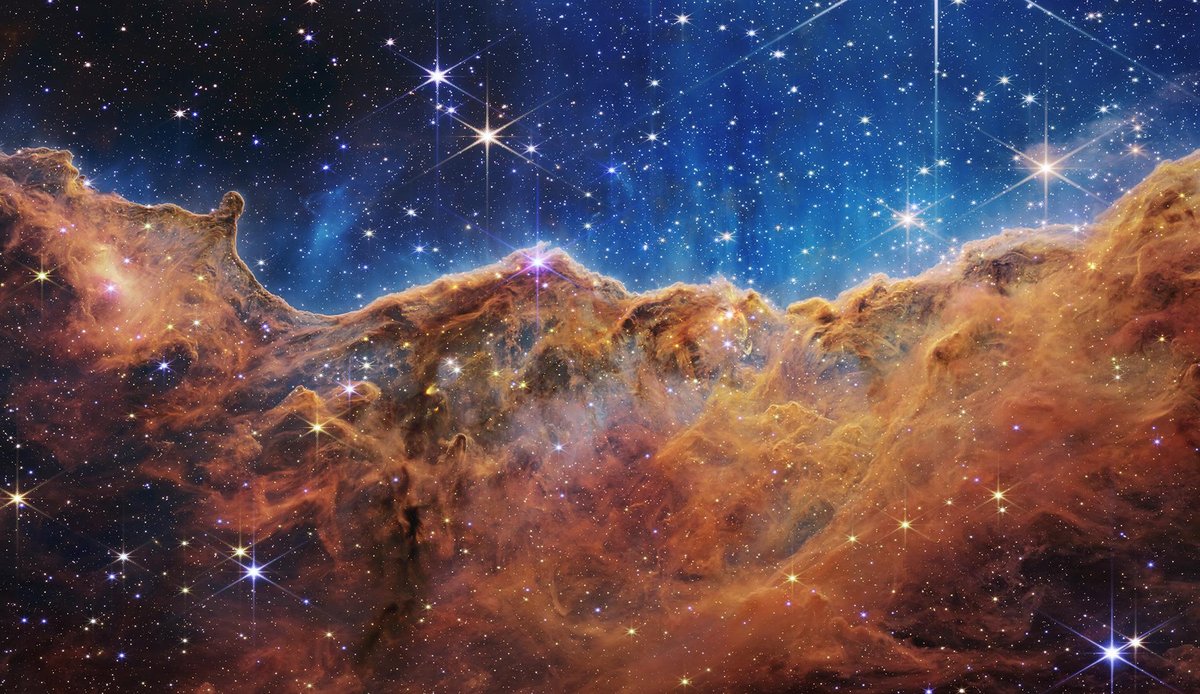
Nebulae in space: definition and origin of the term
Early astronomers called every fuzzy patch in the sky a “nebula”. That included star clusters and galaxies, which looked like mere veils of light in the telescopes of the time.
Charles Messier compiled a catalogue of such objects in 1774 so that comet hunters would not mistake them for comets. That is why many nebulae still carry a Messier number, such as M 42 for the Orion Nebula or M 57 for the Ring Nebula.
Only larger telescopes revealed that some “nebulae” were in fact distant galaxies. By today’s definition, true nebulae are interstellar clouds of gas and dust, made mostly of hydrogen.
Types of nebulae at a glance
The types of nebulae differ mainly in where their light comes from. That also decides how they look in photos and whether a filter helps when observing.
| Type of nebula | Source of the light | Colour in photos | Example |
|---|---|---|---|
| Emission nebula | gas excited to glow by hot young stars | red to pink | Orion Nebula (M 42) |
| Reflection nebula | dust scatters the light of nearby stars | blue | Pleiades (M 45) |
| Planetary nebula | shell of gas cast off by a dying star | blue-green, red | Ring Nebula (M 57) |
| Supernova remnant | shock wave from an exploded star | red, blue, filamentary | Crab Nebula (M 1) |
| Dark nebula | cold dust blocks the light behind it | dark silhouette | Horsehead Nebula (B 33) |
Emission nebulae: stellar nurseries
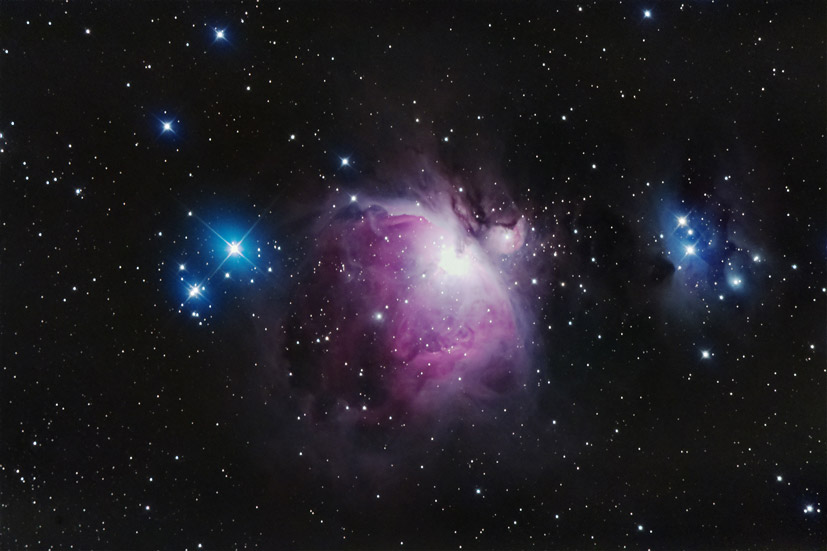
In an emission nebula, young and very hot stars emit so much UV light that the surrounding hydrogen starts to glow. The typical red in photos comes from the hydrogen-alpha line.
Emission nebulae are star-forming regions: new stars are being born here right now. The best-known example is the Orion Nebula, about 1,350 light-years away and visible to the naked eye from Germany.
The Eagle Nebula (M 16) is another one. It contains the famous “Pillars of Creation”, photographed by the Hubble and later the Webb telescope.
Reflection nebulae: why they glow blue
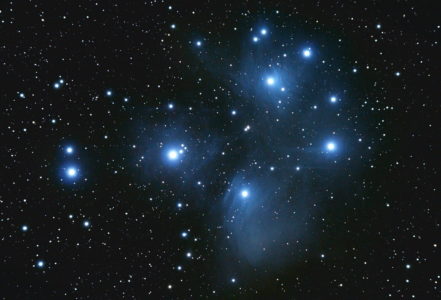
A reflection nebula does not shine on its own. Fine dust scatters the light of neighbouring stars, much like fog on a road scatters the light of headlights.
Blue light is scattered more strongly than red. That is why reflection nebulae almost always look blue in photos – for the same reason our daytime sky is blue.
The textbook example is the veil around the Pleiades. Through a telescope your eye sees hardly any of it, while a long exposure shows it clearly.
Planetary nebulae: how Sun-like stars end
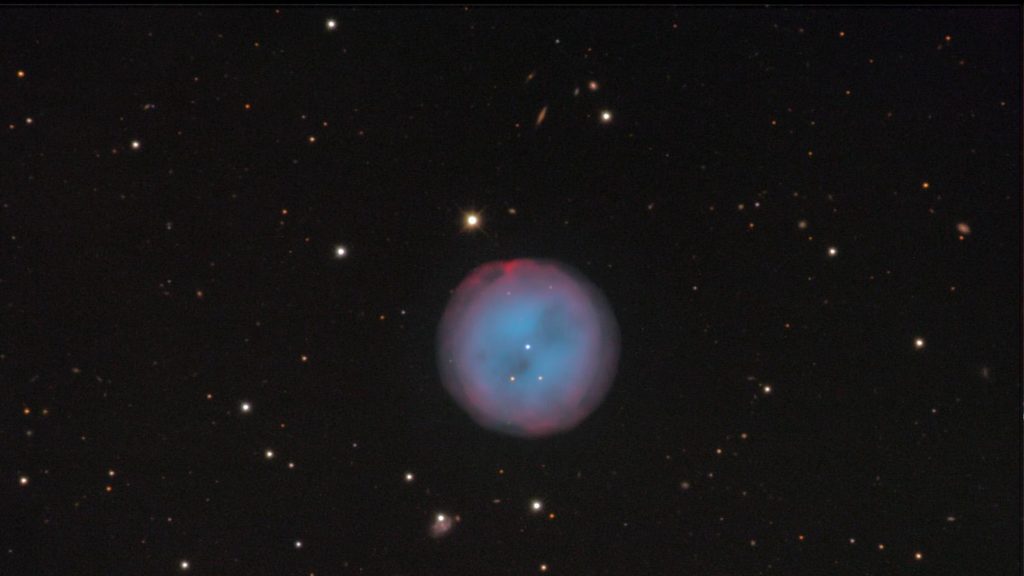
Planetary nebulae have nothing to do with planets. The name goes back to William Herschel, to whom they looked like small, round discs in the telescope, much like a planet.
In reality a dying star sheds its outer layers of gas, and the hot core makes them glow. Our Sun will end this way too, in about five billion years.
Well-known examples are the Ring Nebula M 57 in the constellation Lyra and the Dumbbell Nebula M 27 in Vulpecula. Planetary nebulae are small but bright, so they take higher magnifications well.
Supernova remnants: debris of an exploded star
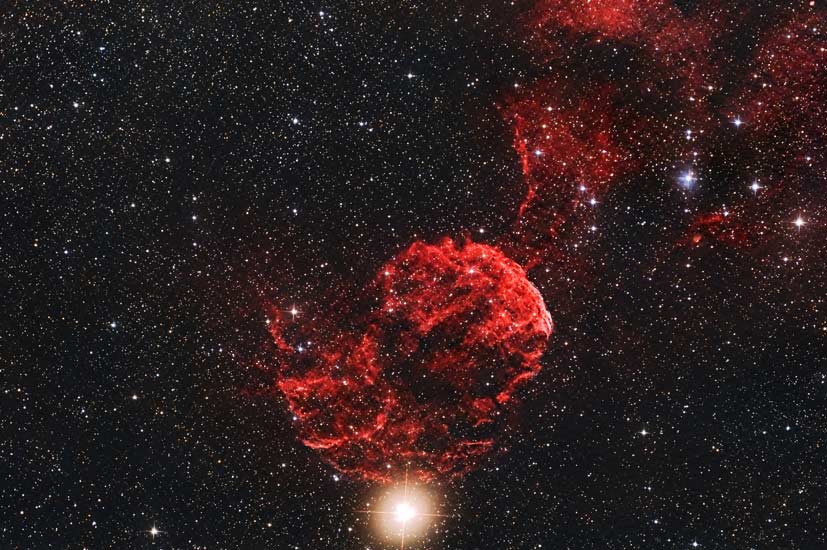
When a massive star explodes as a supernova, its shell races into space at thousands of kilometres per second. The shock wave heats the surrounding gas and makes it glow.
The Crab Nebula M 1 in Taurus is the remnant of a supernova that Chinese astronomers saw in the year 1054. The Veil Nebula in Cygnus is a much older remnant, whose delicate filaments stretch across about three degrees, or six full-Moon widths.
Dark nebulae: clouds that swallow light
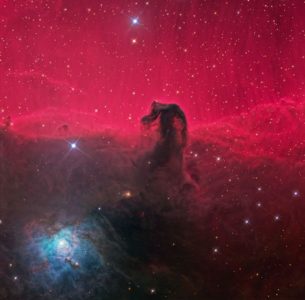
A dark nebula is a cold, dense cloud of dust and molecular gas. It only becomes visible as a silhouette when stars or a glowing nebula lie behind it.
The Horsehead Nebula in the constellation Orion stands out against the red-glowing gas behind it. The stars of tomorrow form in clouds like this, because the cold gas can contract there.
In summer you can even see a large dark nebula without any optical aid. The dark rift in the band of the Milky Way between Cygnus and Sagittarius is dust that blocks the light of the stars behind it.
Famous nebulae: names, constellation and best time to observe
The table lists the best-known nebulae you can find from Germany and similar northern latitudes, plus two famous nebulae of the southern sky. “Best time” means the months when the nebula stands high in the evening sky.
| Nebula | Type | Constellation | Magnitude | Instrument | Best time |
|---|---|---|---|---|---|
| Orion Nebula (M 42) | Emission | Orion | 3.7 mag | naked eye, binoculars | Dec–Mar |
| Lagoon Nebula (M 8) | Emission | Sagittarius | 6.0 mag | binoculars, telescope | Jul–Aug |
| Eagle Nebula (M 16) | Emission | Serpens | 6.0 mag | telescope, filter helps | Jul–Aug |
| North America Nebula (NGC 7000) | Emission | Cygnus | 4.0 mag | binoculars, dark sky | Jul–Oct |
| Ring Nebula (M 57) | Planetary | Lyra | 8.8 mag | telescope from 70 mm | Jun–Sep |
| Dumbbell Nebula (M 27) | Planetary | Vulpecula | 7.4 mag | binoculars, telescope | Jul–Oct |
| Cat’s Eye Nebula (NGC 6543) | Planetary | Draco | 8.1 mag | telescope | May–Oct |
| Helix Nebula (NGC 7293) | Planetary | Aquarius | 7.6 mag | telescope + OIII filter | Sep–Oct |
| Crab Nebula (M 1) | Supernova remnant | Taurus | 8.4 mag | telescope | Dec–Feb |
| Veil Nebula (NGC 6960/6992) | Supernova remnant | Cygnus | 7.0 mag | telescope + OIII filter | Jul–Oct |
| Horsehead Nebula (B 33) | Dark nebula | Orion | – | photo, large telescope | Dec–Feb |
| Pleiades nebula (M 45) | Reflection | Taurus | – | photos only | Oct–Feb |
| Carina Nebula (NGC 3372) | Emission | Carina | 1.0 mag | southern sky only | – |
| Tarantula Nebula (30 Dor) | Emission | Dorado | 8.0 mag | southern sky only | – |
The magnitude (mag) applies to the whole nebula. The larger the area, the thinner that light is spread: on paper the Helix Nebula at 7.6 mag is brighter than the Ring Nebula, yet in the eyepiece it is much harder to see.
You will find more objects beyond nebulae in our catalogue of deep-sky objects. The Andromeda Galaxy does not belong on this list: it used to be called the “Andromeda Nebula”, but it is a galaxy in its own right.
The largest nebula in the universe: the Tarantula Nebula and the question of definition
There is no single answer, because “largest nebula” means different things depending on the yardstick: real size in light-years or apparent size in the sky. On top of that, no nebula has a sharp edge.
In the Milky Way’s neighbourhood, the Tarantula Nebula (30 Doradus) is considered the largest and most active star-forming region. It lies in the Large Magellanic Cloud, about 160,000 light-years away, and spans several hundred light-years depending on where you draw the boundary.
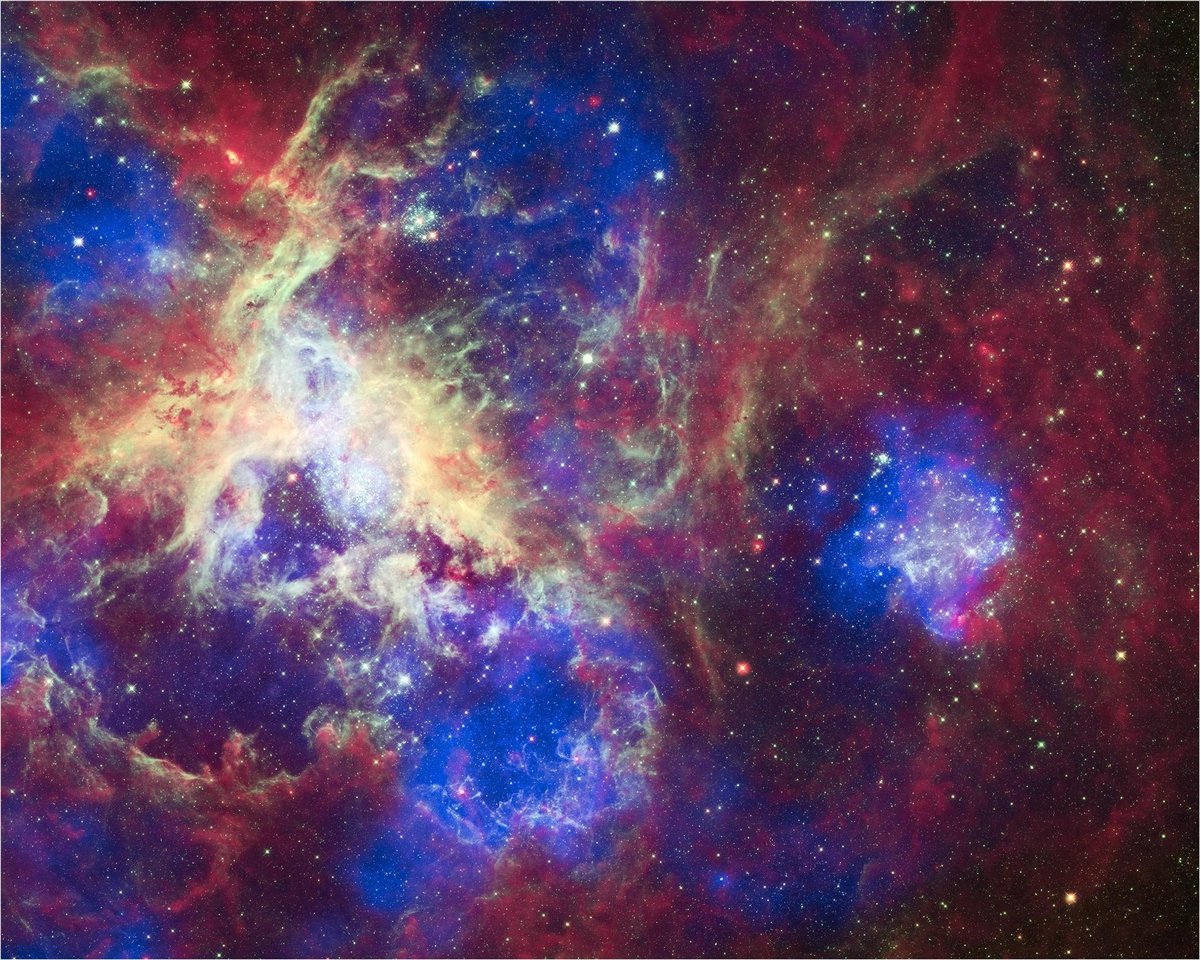
If the Tarantula Nebula were as close as the Orion Nebula, it would cast shadows at night. Even larger is NGC 604 in the Triangulum Galaxy, more than 1,300 light-years across.
The largest area of sky, on the other hand, is covered by the Gum Nebula, an old supernova remnant about 36 degrees across. It lies in the southern sky and is so faint that it only shows up in photos.
| Yardstick | Largest nebula | Size |
|---|---|---|
| Nearby universe (star formation) | Tarantula Nebula (30 Dor) | several hundred light-years |
| Known giants in neighbouring galaxies | NGC 604 (Triangulum Galaxy) | over 1,300 light-years |
| Apparent size in the sky | Gum Nebula (southern sky) | about 36 degrees |
| Brightest large nebula in the northern sky | Orion Nebula (M 42) | about 1 degree, around 24 light-years |
Why nebulae look grey through a telescope
The colourful images online are taken with cameras that collect light for minutes or hours. Your eye cannot add up light; it only ever sees the moment.
In low light the rods in your eye take over, and they are colour-blind. That is why almost all nebulae appear as a grey to slightly greenish glow in the eyepiece. Only very bright nebulae such as the Orion Nebula show a hint of colour in large telescopes.
That is only disappointing if you expect Hubble images. Seeing the Orion Nebula in the eyepiece for the first time means seeing real, ancient light – with fine structures that no photo shows so vividly.
Nebula filters: UHC and OIII
A nebula filter only lets through the wavelengths in which emission and planetary nebulae shine. The sky background gets darker and the nebula stands out better – it does not get brighter.
The UHC filter is the all-rounder for beginners; the OIII filter is narrower and strong on planetary nebulae and the Veil Nebula. Both work best at low magnification, that is, with a large exit pupil.
They will not turn a city sky into a country sky. How dark your site is matters more than any accessory – more in our guide to light pollution and our overview of telescope filters.
Filter for gas nebulae: Omegon Pro 1.25" UHC Filter
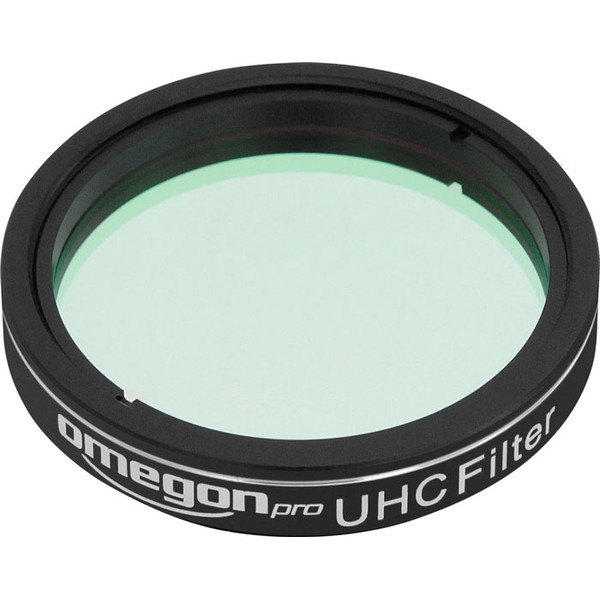
Affordable 1.25-inch UHC filter: makes the Orion, Lagoon and Ring Nebulae stand out visibly from the sky background. Not intended for galaxies.
Price: € 59
Which instrument for nebulae?
For nebulae, what matters most is aperture, the diameter of the lens or mirror. More aperture gathers more light and shows faint outskirts that a small instrument swallows.
10×50 binoculars show the Orion, Lagoon and North America Nebulae as bright patches. For the Ring, Cat’s Eye and Crab Nebulae you need a telescope, and a Dobsonian with 200 mm aperture gives you the most light for your money.
Lots of aperture for the money: Skywatcher Dobson Telescope N 200/1200 Skyliner Classic
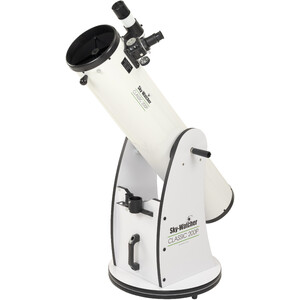
200 mm mirror on a simple rocker-box mount: shows the Ring and Dumbbell Nebulae and the filaments of the Veil Nebula (with an OIII filter). Large and heavy – check your storage space first.
Price: € 479
Photographing nebulae: from phone to smart telescope
If you want to see the colours, you need a camera. Even a mirrorless camera on a tripod captures the Orion Nebula with 10 to 20 seconds of exposure; for more detail you need a tracking mount.
A smart telescope makes it easier. It takes the pictures, stacks them automatically and shows the nebula in colour on your phone after a few minutes; the Seestar models also have a built-in light-pollution filter.
Know the limits: 50 mm of aperture delivers lovely overview images, but no Hubble-level detail. If you want to go deeper, the next step is deep-sky astrophotography.
Colour nebulae without prior knowledge: ZWO Seestar S50 Pro Smart Telescope
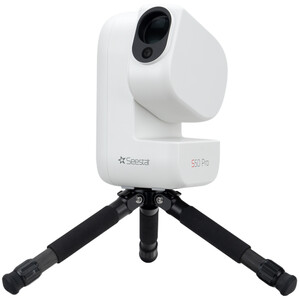
Smart telescope with 50 mm aperture and a built-in nebula filter: shows the Orion, Lagoon or North America Nebula in colour on your phone after a few minutes. No eyepiece viewing possible.
Price: € 999
Nebulae are faint, so aperture matters more than magnification here.
Six short questions, an honest answer by email – even when binoculars are the better choice.
Frequently asked questions about nebulae in space
What is the name of the nebula in space?
There is not one nebula but thousands. The best-known names are the Orion Nebula, the Eagle Nebula with the “Pillars of Creation”, the Ring Nebula, the Crab Nebula, the Horsehead Nebula and the Carina Nebula. Astronomers usually refer to them by catalogue numbers such as M 42 or NGC 7000.
What is a nebula in space made of?
About 99 percent gas, mainly hydrogen and helium, and about one percent dust. The dust consists of tiny grains of carbon and silicates.
Which famous nebulae are there in space?
In the northern sky the best known are the Orion, Lagoon, North America, Ring, Dumbbell, Crab and Veil Nebulae. The southern sky adds the Carina and Tarantula Nebulae. The table above lists their constellation and the best time to observe them.
Which is the largest nebula in the universe?
Among known star-forming regions, the Tarantula Nebula in the Large Magellanic Cloud and NGC 604 in the Triangulum Galaxy are among the largest. They span several hundred to over a thousand light-years. There is no clear number one, because nebulae have no sharp edge.
Can you see a nebula with the naked eye?
Yes. In winter the Orion Nebula is visible below Orion’s Belt as a small, fuzzy patch. Under a very dark sky you can also make out the Lagoon Nebula in Sagittarius and the North America Nebula in Cygnus.
Why are reflection nebulae blue?
The dust in the nebula scatters blue light more strongly than red light. That is why the reflected starlight appears blue – just like Earth’s daytime sky.
Does a planetary nebula contain planets?
No. The name comes from the fact that such nebulae looked like small planetary discs in old telescopes. In reality it is the cast-off shell of a dying star.
Is the Andromeda Galaxy a nebula?
No. It used to be called the “Andromeda Nebula”, but it is a galaxy in its own right with hundreds of billions of stars, about 2.5 million light-years away. Read more on our page about the Andromeda Galaxy.
* Affiliate link: if you buy through this link we may earn a small commission from Astroshop or High Point Scientific, at no extra cost to you.