By Alexander Merz · Updated on · Details checked on 14 October 2026
The North Star (Polaris, α Ursae Minoris) is the brightest star in the Little Dipper and in 2026 sits just 0.62 degrees from the north celestial pole – which is why it points north on every clear night. It shines at magnitude 1.98 from roughly 430 to 450 light-years away and is part of our portraits of bright stars. Below we show you how to find the North Star in three steps.
⭐ In short: The quickest way to find Polaris is via the Plough (Big Dipper): extend the back edge of the “pan” a good five times. It always sits in the north, exactly as high above the horizon as your latitude. It isn’t bright, but it is the only star that barely moves all night – and your naked eye is all you need.
By the way: this page is about the star. The Polaris missile of the Royal Navy’s former nuclear deterrent and SpaceX’s Polaris Dawn mission only share its name.
How to find the North Star: three steps from the Plough
Polaris is not a conspicuous star, and that is exactly what makes the search tricky at first. The reliable route leads via the Plough (Big Dipper), which almost everyone knows. Both star patterns never set anywhere in the UK and Ireland, so the method works on every clear night of the year.
Via the Plough: extend the edge of the pan five times
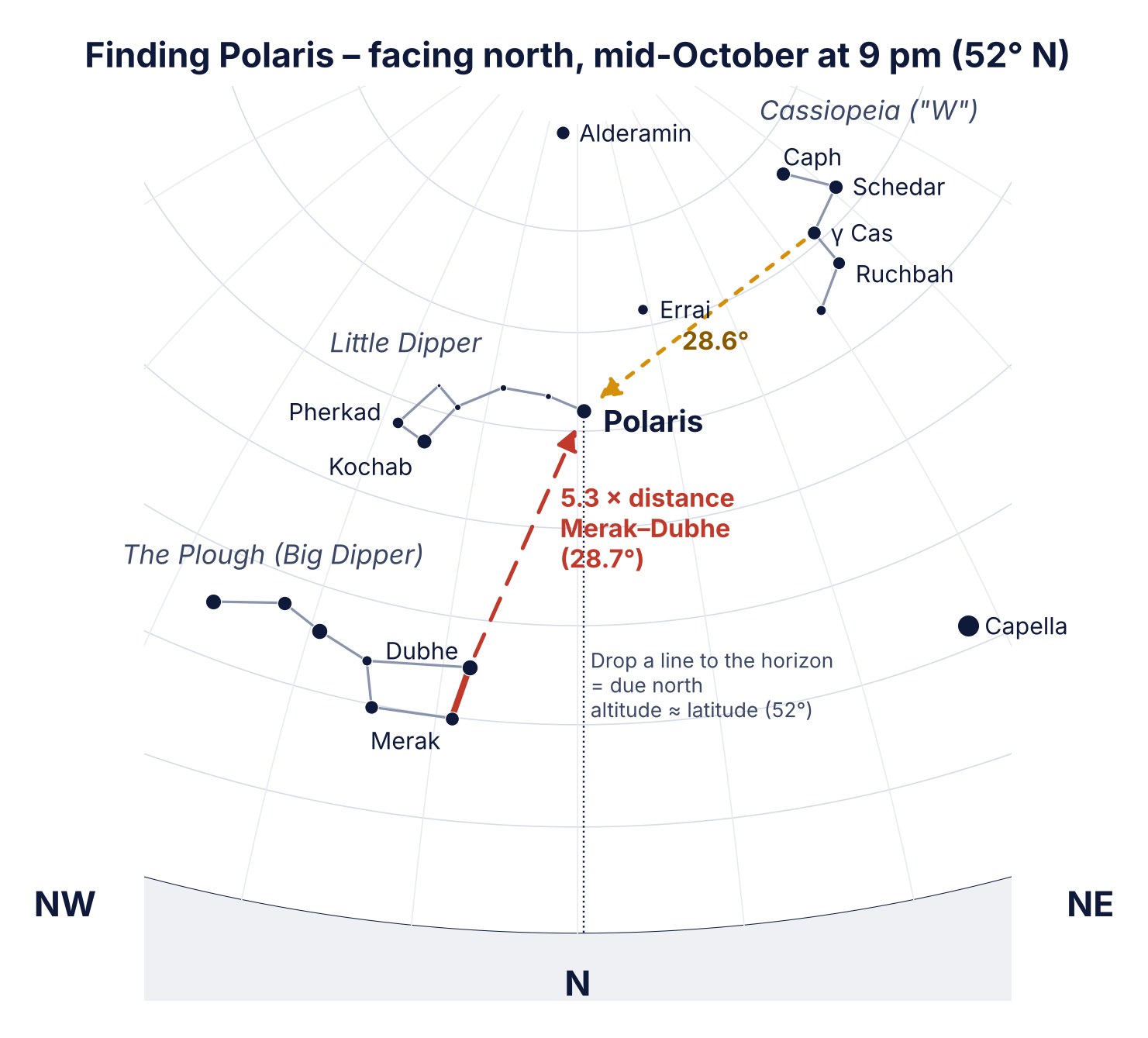
- Step 1: Find the Plough, seven bright stars forming a pan with a handle. In autumn it hangs low in the north in the evening, in spring almost overhead.
- Step 2: Take the two back stars of the pan, the side opposite the handle: Merak at the bottom, Dubhe at the top. They are 5.4° apart, about three fingers at arm’s length.
- Step 3: Extend the line from Merak through Dubhe a good five times further. After 28.7° – roughly three fists – you reach a lone, moderately bright star: Polaris.
We checked the geometry: the distance Dubhe–Polaris is 5.3 times Merak–Dubhe, not exactly five. The line also misses Polaris by just under 2°. To the eye that doesn’t matter, because no other star of similar brightness lies in that area.
Via Cassiopeia: when the Plough is low
In autumn and winter the Plough is low in the evening and disappears behind trees or houses. That’s when Cassiopeia, the “W” in the sky, helps – it stands high up on the opposite side. Polaris lies almost exactly halfway between the two constellations.
From the middle star of the W (Gamma Cassiopeiae) it is 28.6° to Polaris, from Dubhe 28.7°. Remember: the Plough and the W turn around Polaris like two clock hands, and it always sits on the axis between them. When the W is high in the north-east, you’ll find Polaris about three fists further towards the horizon.
Double-check: is that really Polaris?
The most common beginner’s mistake is confusing it with Kochab, the second-brightest star of the Little Dipper. Kochab is almost as bright, but clearly orange, and sits at the other end of the Dipper, just under 17° from Polaris. With these three features you can be sure:
| Feature | Polaris | Kochab |
|---|---|---|
| Brightness | 1.98 mag | 2.08 mag |
| Colour | whitish yellow | clearly orange |
| Position in the Little Dipper | end of the handle | corner of the bowl |
| Distance from the north celestial pole | 0.62° | 15.8° |
| Movement within one hour | practically none | visibly circles the pole |
The quickest check is the altitude: in the UK and Ireland Polaris stands about five fists above the northern horizon, in Scotland five and a half. If you’re unsure, note its position against a roof ridge and look again after half an hour – all the other stars will have moved a bit.
Tip: A night sky app shows you Polaris in seconds. Still, learn the route via the Plough – it works without a battery, and you’ll recognise three constellations along the way. How to find star patterns systematically is explained in our guide How to identify constellations.
Where is Polaris: due north, as high as your latitude
Polaris always stands above the geographic north point of the horizon. According to our calculation, its direction from the UK and Ireland deviates from true north by at most about 1°, depending on where it currently is on its small circle around the pole. That’s more precise than most people can read a compass.
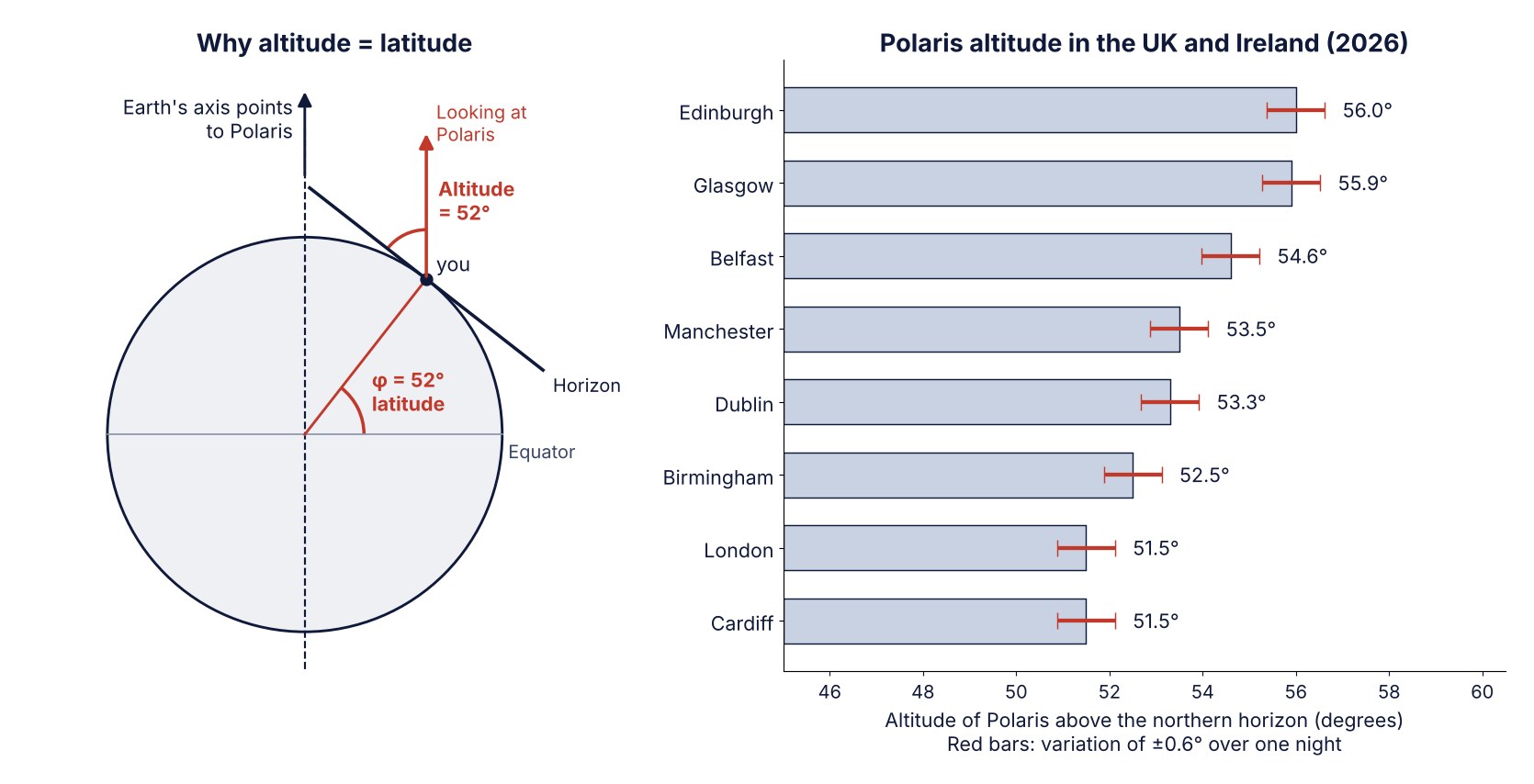
Its altitude above the horizon depends only on where you are. The altitude of Polaris equals your geographic latitude: at the North Pole it would be straight overhead, at the equator it would sit on the horizon. The chart shows why.
Altitude of Polaris: table for eight cities
We calculated the altitude for 2026 with NASA’s DE421 ephemeris for every minute of a day. Between London and Edinburgh there is a difference of about 4.5° – in Scotland Polaris stands noticeably higher than in the south of England.
| City | Latitude | Altitude of Polaris | Range in one night | In fists |
|---|---|---|---|---|
| Edinburgh | 56.0° N | 56.0° | 55.3° to 56.6° | 5½ |
| Glasgow | 55.9° N | 55.9° | 55.2° to 56.5° | 5½ |
| Belfast | 54.6° N | 54.6° | 54.0° to 55.2° | 5½ |
| Manchester | 53.5° N | 53.5° | 52.9° to 54.1° | a good 5 |
| Dublin | 53.3° N | 53.3° | 52.7° to 54.0° | a good 5 |
| Birmingham | 52.5° N | 52.5° | 51.9° to 53.1° | a good 5 |
| London | 51.5° N | 51.5° | 50.9° to 52.1° | 5 |
| Cardiff | 51.5° N | 51.5° | 50.9° to 52.1° | 5 |
It follows that you can measure your latitude with Polaris, to within about a degree using a simple protractor. Sailors determined their position exactly this way for centuries, and the principle still works today.
Why Polaris doesn’t move: Earth’s axis points at it
Earth turns once on its axis in 23 hours and 56 minutes, and in the north that axis points almost exactly at Polaris. To us it therefore looks as if the whole sky turns around it while it stays put. More on Earth’s rotation in our article How fast does the Earth spin?
The axis also answers the question of why Polaris is always in the north. The north celestial pole is the extension of Earth’s axis into space, and seen from the northern hemisphere this point always lies above the northern horizon. The constellations near it never set – they are circumpolar.
Not quite still: the small circle around the pole
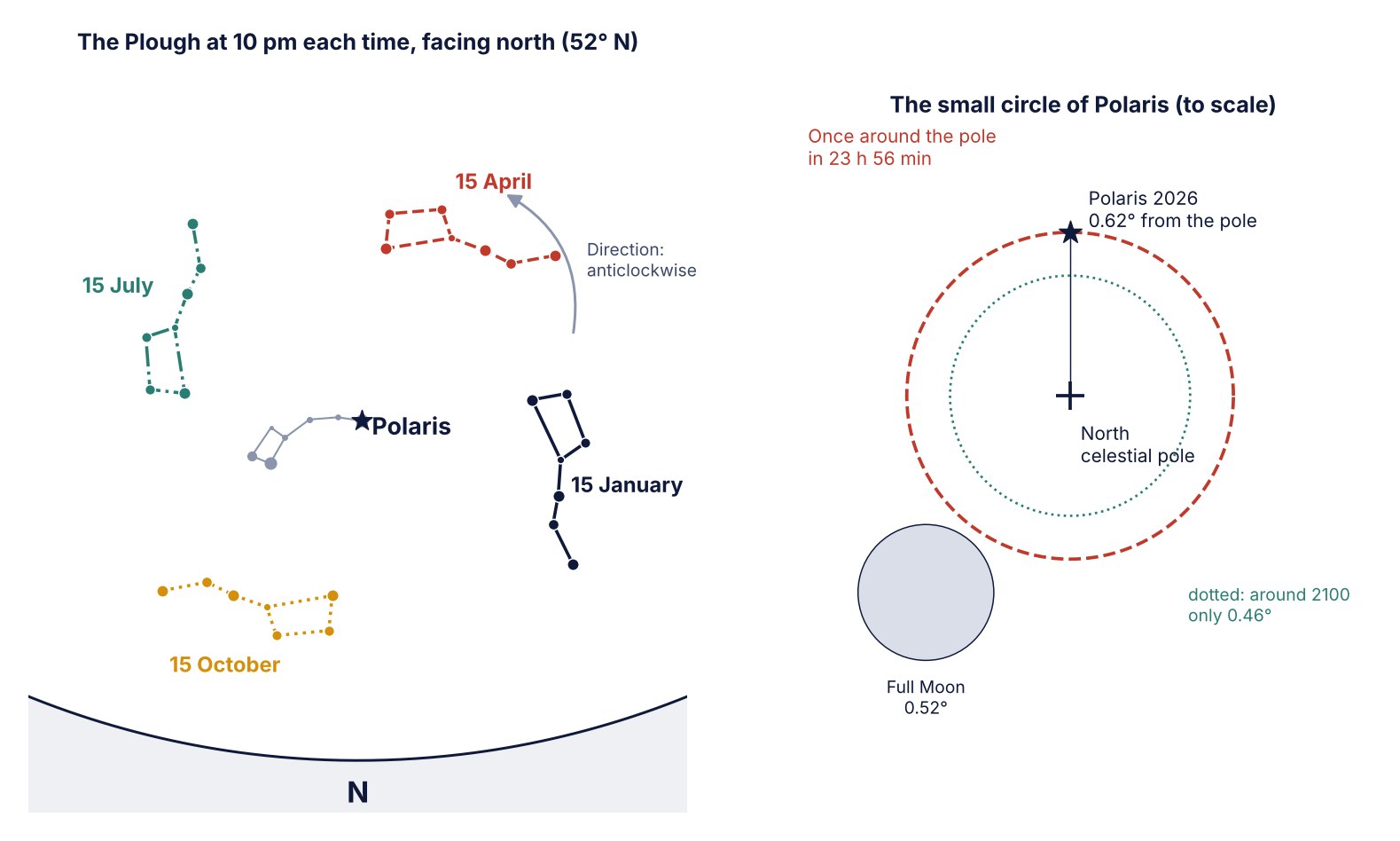
Strictly speaking, Polaris moves too. In 2026 it stands 0.62° from the north celestial pole, that’s 1.2 full-Moon diameters. At this distance it circles the pole once in 23 hours and 56 minutes.
So the circle has a diameter of 1.25°, or just under two and a half full Moons. With the naked eye you won’t notice any of it, because the altitude varies by only ±0.6° over a night. On long-exposure photos, though, the motion becomes visible – more on that below.
Closest approach around 2100
The distance has been shrinking for centuries because Earth’s axis slowly wobbles. Around the year 2100 Polaris reaches its closest approach at 0.46°, after which it moves away again. Depending on the model, the minimum falls between 2100 and 2102, at 27 to 28 arcminutes.
| Year | Distance from the north celestial pole | In full-Moon diameters |
|---|---|---|
| 1900 | 1.23° | 2.4 |
| 1950 | 0.97° | 1.9 |
| 2000 | 0.74° | 1.4 |
| 2026 | 0.62° | 1.2 |
| 2050 | 0.55° | 1.1 |
| 2100 | 0.46° (minimum) | 0.9 |
| 2150 | 0.53° | 1.0 |
| 2200 | 0.72° | 1.4 |
| 2300 | 1.20° | 2.3 |
Polaris fact file: supergiant, Cepheid, triple star
Behind the unremarkable point of light hides one of the most interesting stars in the northern sky. Polaris is a yellow supergiant, about 46 times the size of the Sun, and has two companions. The key data at a glance:
| Feature | Value |
|---|---|
| Names | Polaris, North Star, Pole Star, Stella Polaris, Lodestar; Bayer designation α Ursae Minoris (α UMi) |
| Constellation | Ursa Minor (Little Dipper), end of the handle |
| Apparent magnitude | 1.98 mag, varies by a few hundredths |
| Brightness rank | around 48th in the whole sky |
| Distance | roughly 430 to 450 light-years (studies: approx. 320 to 520) |
| Spectral type | F7 Ib, yellow supergiant |
| Radius / mass | approx. 46 solar radii / approx. 5 solar masses |
| Luminosity | roughly 1,300 to 2,300 times the Sun |
| Pulsation period | 3.97 days (Cepheid) |
| Companions | Polaris Ab (orbit 29.4 years), Polaris B (8.7 mag, 18″ separation) |
| Distance from the north celestial pole | 0.62° (2026), minimum 0.46° around 2100 |
| Coordinates (J2000) | right ascension 2h 31m 49s, declination +89° 15′ 51″ |
Is Polaris the brightest star? No
That’s the most widespread misconception about it. At magnitude 1.98, Polaris only ranks around 48th among the brightest stars; the brightest star of the night is Sirius at −1.46 mag. Polaris is famous solely for its position at the pole.
Even so, it is easy to see under a city sky, unlike the other stars of the Little Dipper. How many Dipper stars you can make out tells you the quality of your sky – more on this in the article on light pollution and the Bortle scale.
A pulsating star: Polaris as a Cepheid
Polaris swells slightly and contracts again every 3.97 days. Stars of this kind are called Cepheids, and they are the measuring tapes of astronomy: their period reveals their true luminosity and, from that, the distance to faraway galaxies.
In Polaris the pulsation behaves unusually. The variation in brightness shrank to a few hundredths of a magnitude in the 20th century and apparently has been increasing slightly again since. You won’t see any of this with the naked eye.
How far away is Polaris?
Of all stars, the most famous one in the north is the subject of disputed measurements. The Hipparcos satellite gave about 433 light-years, Gaia – via the companion Polaris B – about 447 light-years (we explain what a light-year is separately). Individual studies came to just over 320 or just over 520 light-years – so the light you see today set off around the year 1600, in the time of Johannes Kepler.
Three stars in one: Polaris Aa, Ab and B
The bright main star Polaris Aa has a very close companion, Polaris Ab, which orbits it every 29.4 years. Ab is so close to the supergiant that only the Hubble Space Telescope could image it directly, in 2006. The third star, Polaris B, on the other hand, is far enough away for a small telescope.
Precession of the pole: who was North Star before and after Polaris
Earth’s axis wobbles like a spinning top, tracing a large cone over roughly 25,800 years. The north celestial pole therefore wanders across the sky on a circle with a radius of just over 23°, and the title of “North Star” is passed around. The same motion is why zodiac signs and constellations no longer match today.
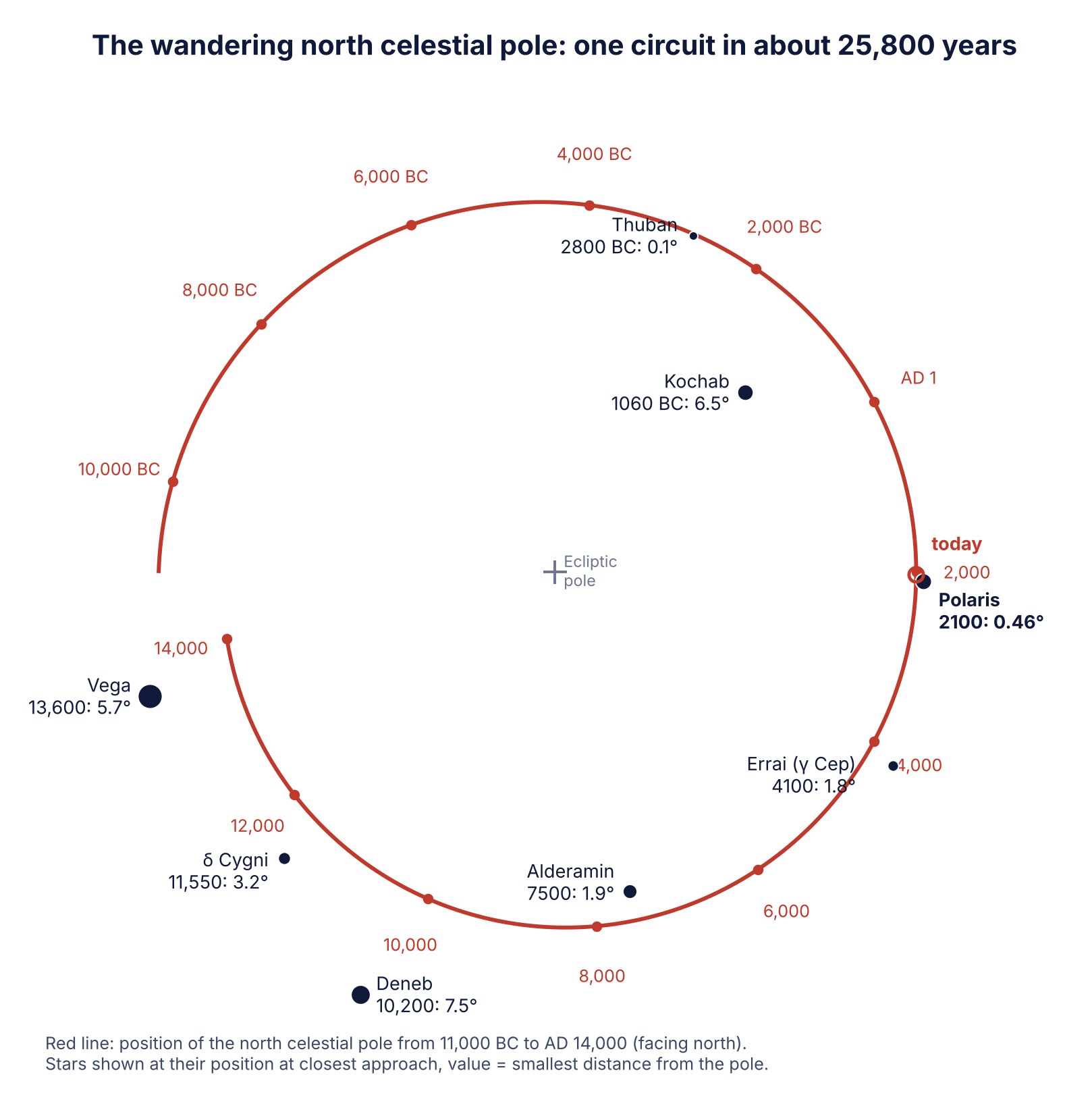
We recalculated the path of the pole with Vondrák’s long-term precession model (2011) and the space motion of each star. Result: a really good pole star is the exception; most of the time no bright star sits close to the pole.
| Star | Brightness | Closest approach | Smallest pole distance |
|---|---|---|---|
| Thuban (α Draconis) | 3.7 mag | c. 2800 BC | 0.1° |
| Kochab (β Ursae Minoris) | 2.1 mag | c. 1060 BC | 6.5° |
| Polaris (α Ursae Minoris) | 2.0 mag | c. 2100 | 0.46° |
| Errai (γ Cephei) | 3.2 mag | c. 4100 | 1.8° |
| Alderamin (α Cephei) | 2.5 mag | c. 7500 | 1.9° |
| Deneb (α Cygni) | 1.3 mag | c. 10,200 | 7.5° |
| δ Cygni | 2.9 mag | c. 11,550 | 3.2° |
| Vega (α Lyrae) | 0.0 mag | c. 13,600 | 5.7° |
Thuban in the constellation Draco was an almost perfect pole star around 2800 BC, only a tenth of a degree from the pole. In antiquity, by contrast, no star really stood at the pole; Kochab, 6.5° away, was the best candidate. Polaris has only been closer to the pole than Kochab since the 5th century, and around 1500 it was still 3.4° away.
Among the successors, it pays to look closely. Deneb never comes closer than 7.5° to the pole and is hardly fit to be a pole star; in Cygnus, δ Cygni around 11,550 is the better candidate. For Vega many sources say “around 14,000”; including its proper motion, our calculation gives the closest approach around 13,600, but only to 5.7°.
Tip: Vega has been near the pole before – according to our calculation around 12,050 BC, at 3.4°. So the brightest pole star of the last 15,000 years was Vega, the most precise one Thuban. Polaris is the second most precise, but only moderately bright.
No pole star in the south: Sigma Octantis and the Southern Cross
In the southern hemisphere the south celestial pole is not marked. The “South Star” Sigma Octantis shines at only magnitude 5.4 and in 2026 stands about 1.2° from the pole. Under city lights it is invisible, and even in the countryside it takes some practice to spot.
| Feature | Polaris (north) | Sigma Octantis (south) |
|---|---|---|
| Brightness | 1.98 mag | 5.4 mag |
| Pole distance 2026 | 0.62° | 1.2° |
| Visible in the city | yes | no |
| Practical signpost | Plough, Cassiopeia | Southern Cross |
South of the equator, people therefore orient themselves by the Southern Cross. The long axis of the Cross, extended about 4.5 times, leads close to the south celestial pole. From the UK and Ireland, by the way, you can see neither the south pole of the sky nor the Cross.
Navigating by Polaris: north, latitude, mount
Finding north without a compass
Once you’ve found Polaris, imagine dropping a vertical line from it straight down to the horizon. That point is true north, to within about a degree. With your back to Polaris you are facing south, east is to your left, west to your right.
A magnetic compass, on the other hand, points not to the geographic but to the magnetic north pole. In the UK and Ireland the difference is currently small, between about 1° west and 1° east, but near steel and power lines it can be much more. For rough orientation, Polaris is at least as reliable.
Polar alignment of a mount
An equatorial mount follows the stars with just one axis – provided that axis points at the celestial pole. For visual observing it’s enough to tilt the polar axis to your latitude and aim it roughly at Polaris. The remaining 0.62° hardly matter at the eyepiece.
Long exposures need more precision. In the polar scope, Polaris is therefore not placed in the centre but on a small circle, at the spot an app shows for the date and time. Small travel mounts (star trackers) are aligned in exactly the same way.
Warning: The brightest star in the polar scope isn’t automatically Polaris – beginners often catch Kochab or a bright star at the edge of the field. Check first with the naked eye via the Plough, and only then at the mount. By the way, you set the tilt with the adjustment screws on the mount head, not by tilting the tripod.
Photographing Polaris: star trails around the pole
If you point a camera on a tripod north and expose for a long time, the stars draw concentric arcs. The sky turns by 15° per hour, no matter how far a star is from the pole. The arcs close to the pole stay short, though, because their circle is small.
| Total exposure | Rotation of the sky | Arc of Polaris | Arc of Kochab |
|---|---|---|---|
| 15 minutes | 3.75° | 0.04° | 1.0° |
| 30 minutes | 7.5° | 0.08° | 2.0° |
| 1 hour | 15° | 0.16° | 4.1° |
| 2 hours | 30° | 0.33° | 8.2° |
| 4 hours | 60° | 0.65° | 16.4° |
So on your photo Polaris also draws a short line. The true centre of all the arcs lies a good full-Moon diameter away from it – nice proof that it doesn’t sit exactly at the pole. Rather than one exposure of an hour, it’s better to take many single frames of 20 to 30 seconds and combine them on the computer.
That keeps the sky background dark, and aircraft can be removed from individual frames. The right basic settings for aperture, ISO and focus matter more than the camera model, so test them on a bright star before the long sequence.
Polaris B in a telescope: seeing the North Star’s companion
To find and use Polaris you don’t need any equipment. The naked eye is the right instrument here; binoculars at least show the “Engagement Ring”, a small circle of faint stars in which Polaris sits like the diamond. 10×50 binoculars are enough for that.
A rewarding telescope target is the companion Polaris B. It shines at magnitude 8.7 and sits 18″ from the main star, which is about 500 times brighter – in binoculars it is lost in the glare. From about 60 to 80 mm aperture and 50 to 100× magnification you can split the two cleanly, a fine test of optics and seeing.
Telescope recommendation: the entry point for double stars like Polaris
Shows Polaris B reliably: Skywatcher Dobson Telescope N 130/650 Heritage FlexTube
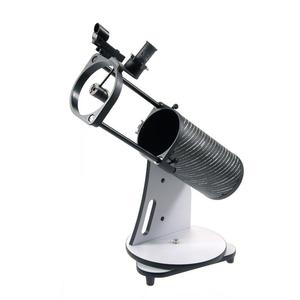
A compact tabletop Dobson with a true parabolic mirror. Folds down, fits in a bag: the Moon, planets and the bright deep-sky classics.
Price: € 265
130 mm of aperture on a small tabletop mount splits Polaris B with the supplied 10 mm eyepiece. Polaris is an ideal first target because it barely moves in the eyepiece – you hardly need to nudge the telescope. That’s why the Heritage 130P is our standard entry-level recommendation.
If you want more: the 200 mm Dobsonian for tight double stars
For advanced observers: Skywatcher Dobson Telescope N 200/1200 Skyliner Classic
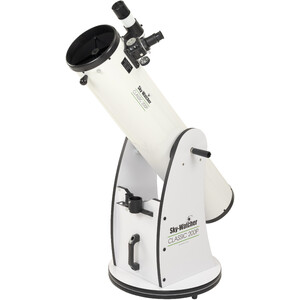
200 mm of aperture — the most sky for your money. Set it on the ground, point by hand: nebulae, clusters and galaxies for years to come.
Price: € 479
With 200 mm the Dobsonian gathers about 2.4 times as much light as the 130. That lets you split much tighter and fainter double stars than Polaris, and galaxies and nebulae show structure for the first time. The extra cost is worth it if you want to observe regularly and have room for a 1.2 m tube – for Polaris B alone you don’t need it.
Frequently asked questions about the North Star
Is the North Star the brightest star in the sky?
No. At magnitude 1.98 it only ranks around 48th among the brightest stars. The brightest star in the night sky is Sirius, and in the north Capella and Vega are much brighter. The North Star is famous for its position at the north celestial pole, not for its brightness.
Is the North Star always in the north?
Yes, from the northern hemisphere it stands in the north every night and at every hour. From the UK and Ireland its direction deviates from true north by at most about 1°. It is there during the day too – sunlight just outshines it.
Is the North Star the same as Polaris?
Yes. North Star, Pole Star, Lodestar and Polaris all refer to the same star. The Latin name is Stella Polaris, the scientific designation α Ursae Minoris. Since 2016 “Polaris” has been the official proper name of the International Astronomical Union.
Which constellation is the North Star in?
In Ursa Minor, also known as the Little Dipper. It marks the end of the handle there, the outermost star of the Dipper’s “handle”. The Little Dipper is much fainter than the Plough and under a city sky often only half of it can be seen.
How far is the North Star from Earth?
Roughly 430 to 450 light-years. Hipparcos measured about 433, Gaia about 447 light-years; individual studies range between just over 320 and just over 520 light-years. That is unusually uncertain for such a well-known star.
Is the North Star a planet or Venus?
No, the North Star is a star, a distant sun – a supergiant, in fact. Venus is a planet and, as the “evening star” or “morning star”, can only be seen low in the west or east, never high in the north. A very bright point of light in the north is therefore never the North Star.
What is the brightest star in the north?
Usually Capella in Auriga (0.1 mag), which never sets from the UK and Ireland and stands low in the north at night in summer. North of about the latitude of London, Vega never sets either and skims just above the northern horizon on winter nights. Which bright point is where depends on the time of night and the season.
Does everything revolve around the North Star?
Seemingly, yes: because of Earth’s rotation all stars circle the north celestial pole, and the North Star sits only 0.62° from it. Strictly speaking, the sky turns around the pole and the North Star circles along with it. The effect is a reflection of Earth’s rotation, not a movement of the stars.
What does the North Star mean?
The name Polaris comes from the celestial pole where it sits. Because it doesn’t move, it was the fixed point for sailors and travellers for centuries; that’s why in English it has also long been called the “lodestar”, the leading star. To this day it is a symbol of guidance and constancy.
Links marked with an asterisk (*) are affiliate links. If you buy through them we earn a small commission – the price stays the same for you.
Read more on Sterngucker
- Little Dipper – the constellation of Polaris with all its stars
- The Plough (Big Dipper) – the signpost to Polaris
- Cassiopeia constellation – the “W” on the opposite side
- Circumpolar constellations – everything around the pole that never sets
- Draco constellation – home of Thuban, the pole star of the pyramid age
- Vega – the brightest future pole star
- All stars at a glance